A Visual Guide to Tajweed Symbols in Quran and What They Mean
Tajweed symbols in Quran script are the small marks, colored letters, and stop signs woven through every printed Mushaf, telling you exactly how to pause, stretch, and pronounce each word the way the Prophet ﷺ recited it. Whether you’re staring at a page full of quran tajweed symbols for the first time or trying to explain a stop sign to your child, this guide breaks down every category — and shows you exactly how to master them with a certified tutor, starting from just $9/hr.
📑 Table of Contents
- What Are Tajweed Symbols in Quran?
- Why Tajweed Symbols Matter for Correct Recitation
- All Quran Symbols Meaning: A Category-by-Category Breakdown
- How to Choose the Best Place to Learn Quran Tajweed Symbols Online
- Tajweed Symbols in Quran Course Pricing
- Online vs In-Person: Where Should You Learn Tajweed Symbols?
- Real Results: How Daan Students Master Tajweed Symbols
- All Symbols in Quran: How Many Are There?
- Frequently Asked Questions
What Are Tajweed Symbols in Quran? A Simple Definition
Tajweed symbols in Quran text are the small diacritical marks, colored letters, and marginal signs added to the Uthmani script to guide correct recitation — showing readers when to stop, when to continue, how long to stretch a sound, and which letters shift in pronunciation next to certain others. The Quran as revealed to the Prophet Muhammad ﷺ carried no such marks; early reciters relied entirely on oral transmission from teacher to student.
As Islam spread beyond Arabia, scholars introduced these notations so that non-native Arabic speakers — much like many students at Daan Quranic Academy today — could recite accurately without a live teacher standing over every word. That’s still the safest way to learn them: a real, qualified tutor correcting you in real time, which you can explore through our Tajweed Rules Mastery course.
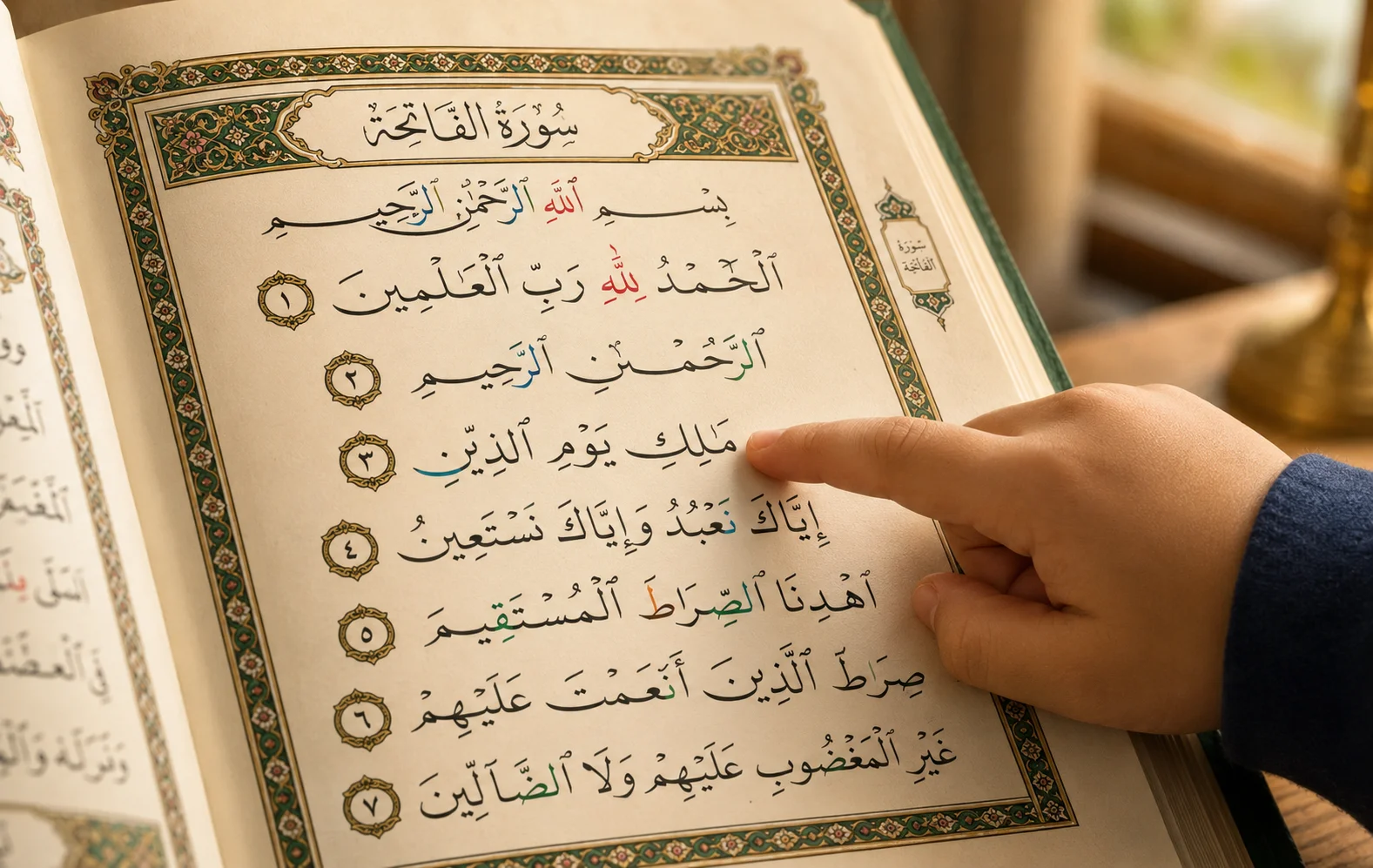
Broadly, all quran tajweed symbols fall into five families: stop signs (waqf), pronunciation and stretching marks (madd, sukoon, shaddah), silent letters, sajdah (prostration) markers, and section dividers like juz and hizb. We’ll walk through each one below, with real examples from the Mushaf.
Why Tajweed Symbols Matter for Correct Quran Recitation
Tajweed symbols matter because a single misplaced stop or shortened stretch can change the grammatical — and sometimes theological — meaning of a verse, which is exactly why measured, deliberate recitation is commanded in the Quran itself. This isn’t a modern academic preference; it’s a divine instruction.
Real session recording: An adult student practising Madd elongation while a certified tutor corrects the exact stretch count in real time. All videos are real, unedited screen-recordings from actual student sessions at Daan Academy, posted with student consent.
أَوْ زِدْ عَلَيْهِ وَرَتِّلِ الْقُرْآنَ تَرْتِيلًا
“…or add to it, and recite the Qur’an with measured, deliberate recitation.”
This is the very verse scholars point to as the foundation of Tajweed as a science. “Tartil” — measured recitation — cannot happen without knowing where to pause, where to stretch, and where to keep going, which is precisely the job of every tajweed symbol on the page.
“The one who is skilled in reciting the Qur’an is with the noble, righteous recording angels, and the one who reads it with difficulty, stumbling through it, will have a double reward.”
Narrated by Aisha (RA) — Sahih al-Bukhari 4937, also Sahih Muslim 798
Notice the hadith honors both the fluent reciter and the struggling learner — there’s no shame in needing help decoding a Mushaf full of unfamiliar marks. What matters is that the correction comes from someone properly trained, which is why every tutor on our Why Choose Us page is vetted for formal Tajweed and Qira’at training before ever teaching a live class.
All Quran Symbols Meaning: A Complete Category-by-Category Breakdown
All Quran symbols meaning falls into five main categories: stop signs (waqf), elongation and pronunciation marks (madd, sukoon, shaddah), silent letters, sajdah markers, and section dividers (juz, hizb, ruku) — each with its own distinct shape and rule. Here is what each one looks like and does.
Waqf (Stop) Signs — the Most Common Tajweed Symbols
Waqf signs are the marks you’ll encounter most often. They tell you whether stopping at that exact point changes the meaning of the sentence, or whether it’s safe to pause for breath.
| Symbol | Name | What It Means |
|---|---|---|
| مـ | Waqf Lazim | Mandatory stop — continuing without pausing can alter the verse’s meaning. |
| ط | Waqf Mutlaq | Absolute stop — stopping is strongly preferred here. |
| ج | Waqf Ja’iz | Permissible stop — you may pause or continue; the choice is flexible. |
| قلى | Qila (Qala) | Stopping is preferred, though continuing is still valid. |
| صلى | Sila | Continuing is preferred, though a pause is still valid. |
| ص | Waqf Murakhkhas | A short pause is allowed only if you need a breath; continuing is better. |
| لا | La (No Stop) | Do not stop here — the meaning of the sentence continues directly. |
| ∴ ⋯ ∴ | Mu’anaqah | Stop at one of the two dotted points, never at both, in the same recitation. |
| س | Saktah | A brief pause without taking a new breath, similar to a comma. |
For a deeper look at how misreading these signs trips up new reciters, read our guide on 5 Common Tajweed Mistakes Non-Arabic Speakers Make and How to Fix Them.
Madd (Elongation) Signs
Madd symbols — usually a small wavy line (~) above a letter, or a tiny alif, waw, or yaa placed above the script — instruct you to stretch a vowel sound. Depending on the type (Madd Asli, Muttasil, Munfasil, or Lazim), the stretch can last 2, 4–5, or a full 6 counts, and getting the count wrong is one of the most common errors non-Arabic speakers make.
Silent Letters, Shaddah, and Sukoon
A small circle (sukoon) above a letter means it carries no vowel sound at all, while a small “w”-shaped mark (shaddah) means the letter is doubled and held for a beat longer. Some letters in the Uthmani script are written but never pronounced — these are marked with a small circle above them to show they’re silent, purely to preserve the historical spelling.
Sajdah and Section Markers
A special sajdah symbol (۩) marks the fifteen verses in the Quran where reciters and listeners are encouraged to perform a prostration. Elsewhere in the margins, the letter ع (Ain) marks a Ruku division, while small circular markers indicate the start of a new Juz or Hizb — useful for anyone following a memorization schedule through our Hifz program.
How to Choose the Best Place to Learn Quran Tajweed Symbols Online in 2026
The best place to learn Quran tajweed symbols online is a platform that pairs you with a certified, native Arabic-speaking tutor for private 1-on-1 sessions — not pre-recorded videos or crowded group classes where individual mistakes go uncorrected. Here’s exactly what to check before you sign up with anyone.

Check Tutor Credentials and Ijazah Certification
Look for academies whose tutors hold verified Ijazah certifications in Qira’at, ideally with a documented chain of transmission back to the Prophet ﷺ. Many tutors at Daan Academy hold Ijazah in multiple Qira’at, which you can review on our Our Tutors page.
Confirm 1-on-1, Not Group, Sessions
Unlike group classes that dilute attention across ten students, private sessions let a tutor catch the exact moment you skip a Waqf Lazim or shorten a Madd. Every class at Daan Academy is one-on-one by default.
Test Communication in Fluent English
While many platforms rely on non-native speakers who struggle to explain the “why” behind a rule, Daan’s tutors are all native Egyptian Arabs who also communicate fluently in English — no language barrier standing between you and the lesson.
Look for Transparent, Flexible Pricing
Some platforms bury their pricing behind a sales call. Daan Academy publishes three clear tiers starting from $9/hr, so you know exactly what you’re paying before you commit.
Start With a Free Trial Session
Never commit to a paid plan before watching a tutor teach. Book a free trial session first and see how they explain a single tajweed symbol before deciding anything further.
Tajweed Symbols in Quran Course Pricing: What Should You Budget?
Learning to correctly read tajweed symbols in Quran typically costs between $9 and $13 per hour for private online tutoring — considerably less than most parents and reverts expect once they compare it against group academies or in-person tuition.
Plans start from just $9/hr with native Egyptian tutors. Compare our three flexible pricing tiers — Essential ($9/hr), Pro ($10.99/hr), and Elite ($12.99/hr) — each designed for different learning goals and budgets, with a family discount available on Elite.
If cost is your main hesitation, remember that a single in-person tutor visit in many cities can cost more than an entire week of private online lessons. A referral program also lets existing families invite a friend for a discount on both accounts — a small but real way the price drops further over time.
Online vs In-Person: Where Should You Learn Tajweed Symbols?
Online Tajweed learning generally beats in-person classes on flexibility, tutor selection, and cost, while in-person classes only hold an edge if you already live near a highly qualified reciter — which most English-speaking Muslims outside major Islamic centers do not.
| Criteria | Online (Daan Academy) | Typical In-Person Class |
|---|---|---|
| Tutor availability | Native Egyptian, Al-Azhar-trained tutors, any time zone | Limited to who is local |
| Scheduling | Flexible, any time, from anywhere | Fixed weekly slot, travel required |
| Class size | 1-on-1 private sessions | Often group-based |
| Progress tracking | Smart Student Dashboard with session reports | Usually informal or none |
| Starting cost | From $9/hr | Varies widely, often higher |
Where most academies offer a generic curriculum regardless of age or ability, Daan Academy builds a personalized learning plan around your current grasp of tajweed symbols, tracked transparently through session reports and monthly progress updates.
Real Results: How Daan Academy Students Master Tajweed Symbols
Daan Academy students learn to read tajweed symbols confidently through consistent 1-on-1 correction, structured progress tracking, and a 600+ game educational library that keeps younger learners engaged between formal lessons.
As of 2026, families across 15+ countries — including the UK, USA, and much of Europe — have used our platform to move from struggling with basic stop signs to confidently reading Madd rules unassisted. Our tutors are trained in the Quranic sciences in the tradition associated with institutions like Al-Azhar, and every completed course milestone comes with a verified certificate students can keep.
For a broader look at what a complete online program covers beyond just symbols, see our Best Online Tajweed Course in 2026 guide.
All Symbols in Quran: How Many Are There, and What Do They Mean?
There is no single fixed number for all symbols in Quran recitation — different Mushaf printings, such as the Madani and Indo-Pak editions, use anywhere from around 12 to 18 distinct tajweed marks, though every edition covers the same core categories of stopping, stretching, silence, and prostration.
Color-coded “Tajweed Mushafs” add another layer on top of these symbols: red typically marks Madd rules, green marks Ghunnah (nasalization) and Idgham, and other colors flag Qalqalah or Ikhfa — a visual system some students find easier to absorb before moving to a plain black-and-white Mushaf. You can read more about the history of this notation on Wikipedia’s overview of Tajwid.
If you’re just starting from the very basics — the Arabic letters themselves, before tackling tajweed symbols — our Comprehensive Guide to Learning Noorani Qaida is the right place to begin.

Frequently Asked Questions
How much do online Tajweed classes cost?
Private online Tajweed classes with a native Egyptian tutor start from $9/hr on our Essential plan, rising to $10.99/hr (Pro) and $12.99/hr (Elite) depending on the features included. See the full breakdown on our Pricing Plans page.
Can I learn Quran tajweed symbols without knowing Arabic first?
Yes. Most students start with Noorani Qaida to learn the Arabic letters and basic vowel sounds, then move into tajweed symbols once they can read connected words comfortably. A tutor will assess your level in the free trial and place you accordingly.
Is it safe for my child to learn Tajweed symbols online?
Every session is private, one-on-one, and recorded for quality on our end, with parents able to monitor progress through the Daan LMS dashboard at any time. All tutors are vetted before teaching children.
Can I try a Tajweed class before committing to a plan?
Yes — book a completely free trial session first. There’s no obligation to continue afterward, and it’s the best way to see how a tutor explains tajweed symbols in real time.
How do I know if a Tajweed tutor is properly qualified?
Ask about their Ijazah certification and chain of Qira’at, and how long they’ve taught. You can review our tutors’ backgrounds directly on the Our Tutors page before booking.
How long does it take to learn all the tajweed symbols in Quran?
Most students recognize the core waqf and madd symbols within 4–8 weeks of consistent weekly sessions, though mastering fluent application while reciting typically takes several months of guided practice.
What’s included in the free trial session?
A full live session with a real tutor who assesses your current level, introduces a few relevant tajweed symbols, and outlines a learning plan — with zero commitment to continue afterward.
Stop Guessing at Tajweed Symbols — Learn Them From a Real Tutor
Reading about waqf signs and Madd rules only goes so far. A certified native Egyptian tutor can correct your recitation live, in a single free session.
No commitment required. One free session to experience the Daan Academy difference.
Final Thoughts
Every tajweed symbol in Quran text — from the smallest sukoon circle to a full Waqf Lazim — exists to protect a single goal: preserving the Quran exactly as it was revealed. Reading about them here is a solid start, but nothing replaces a qualified tutor watching you recite and correcting you in the moment.
We’ll close with the dua the Prophet ﷺ was taught to ask for more understanding:
May Allah make it easy for you to learn and apply every tajweed symbol you encounter. If you’d like more free guides like this one, explore our blog for further reading.