
Rules of Ikhfa in Tajweed: Letters & 10 Examples from Quran
The rules of Ikhfa in Tajweed govern what happens when Noon Sakinah or Tanween is followed by one of 15 specific Arabic letters — the sound is neither pronounced clearly nor fully merged, but concealed with a two-count nasal ghunnah. Get this rule wrong and your recitation sounds rushed or robotic; get it right and every ayah flows the way the Prophet ﷺ and his Companions recited it. Below you’ll find the 15 Ikhfa letters, 10 verified Quranic examples with references, and how to actually train your tongue and ear to apply them — with a certified native Arabic tutor listening in real time.
📑 Table of Contents
- What Is Ikhfa in Tajweed?
- The 15 Letters: Rules of Ikhfa in Tajweed Explained
- Ikhfa Letters Examples: How Each Letter Changes the Sound
- 10 Examples of Ikhfa in the Quran You Can Practice Today
- What to Look For When Learning the Rules of Ikhfa in Tajweed Online
- Ikhfa vs Idgham vs Izhar: What’s the Difference?
- Online vs In-Person Tajweed Classes: Which Helps You Master Ikhfa Faster?
- How Much Do Tajweed and Ikhfa Classes Cost?
- Common Ikhfa Pronunciation Mistakes to Avoid
- Frequently Asked Questions
What Is Ikhfa in Tajweed?
Ikhfa (الإخفاء) is the Tajweed rule that “conceals” the sound of Noon Sakinah (نْ) or Tanween when either is followed by one of 15 specific Arabic letters, producing a nasal ghunnah held for roughly two counts instead of a clear Noon sound or a full merger into the next letter. The word Ikhfa literally means “to hide” — and that’s exactly the sensation: the Noon disappears just enough that you never fully pronounce it, yet it never vanishes completely either.
Classical Tajweed scholars describe Ikhfa as sitting in the middle of a spectrum. On one end is Izhar (clear pronunciation, used before throat letters). On the other is Idgham (full merging, used before letters like ي ن م و ل ر). Ikhfa — sometimes called Ikhfa Haqiqi to distinguish it from the separate rule of Ikhfa Shafawi governing Meem Sakinah — is the careful middle ground. Understanding this one rule correctly is often the single biggest jump in recitation quality for students working through our Quran and Tajweed courses.
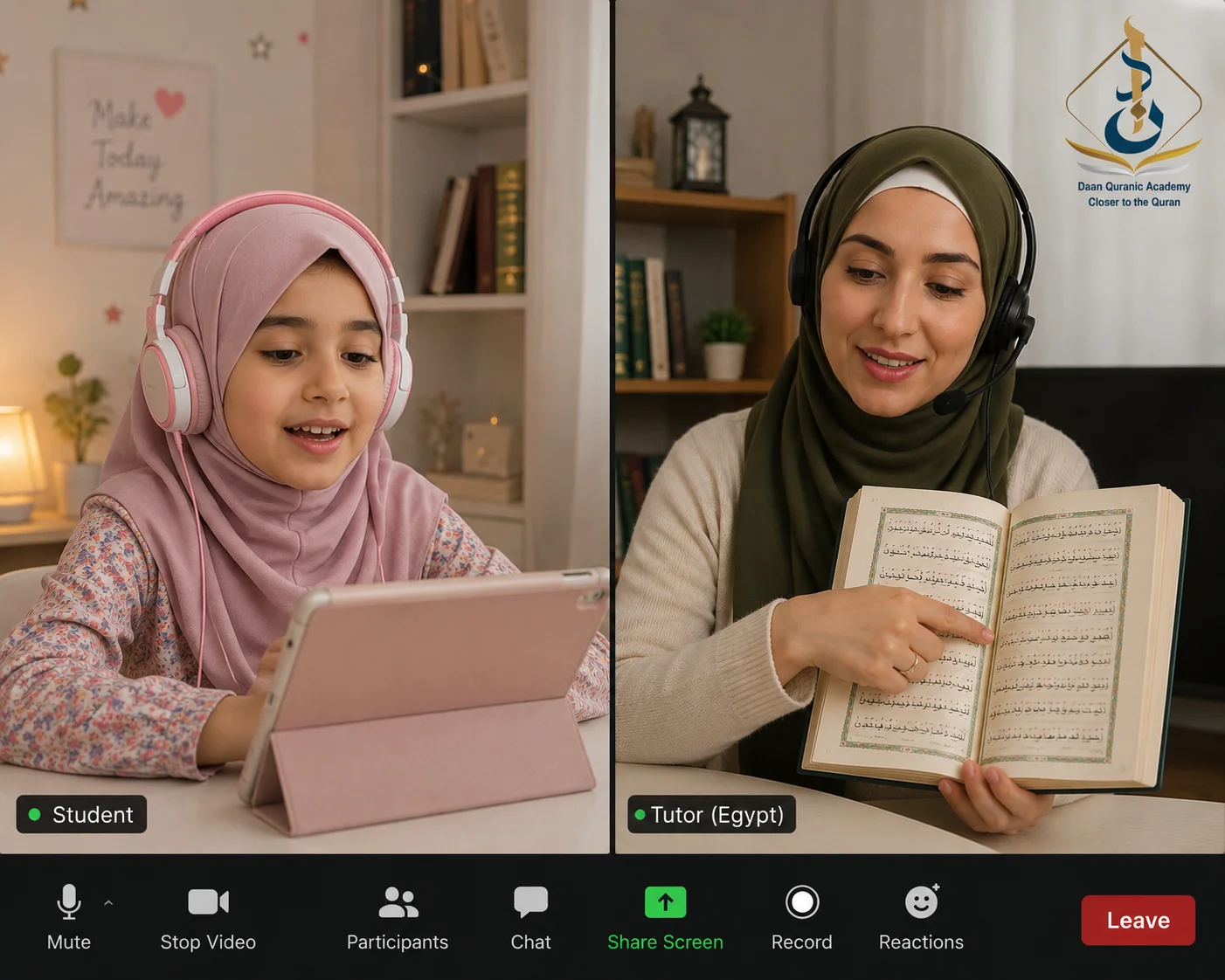
Three conditions must all be true at once for a sound to count as correct Ikhfa: the Noon is not pronounced with full clarity, the following letter carries no shaddah, and a ghunnah of roughly two counts flows into that letter. Miss any one of these three and you’ve slipped into either Izhar or Idgham by accident — which is precisely the kind of narrow error boundary that a live tutor catches instantly and a phone app cannot.
وَلَقَدْ خَلَقْنَا الْإِنسَانَ مِن صَلْصَالٍ مِّنْ حَمَإٍ مَّسْنُونٍ
“And indeed, We created man from sounding clay, from altered black mud.”
Notice the phrase مِن صَلْصَالٍ (“min ṣalṣālin”). The Noon Sakinah at the end of “min” is followed by the letter Sad (ص) — one of the 15 Ikhfa letters — so it is concealed with a nasal ghunnah rather than pronounced clearly. That single word is a textbook illustration of the rules of Ikhfa in Tajweed in action.
The 15 Letters: Rules of Ikhfa in Tajweed Explained
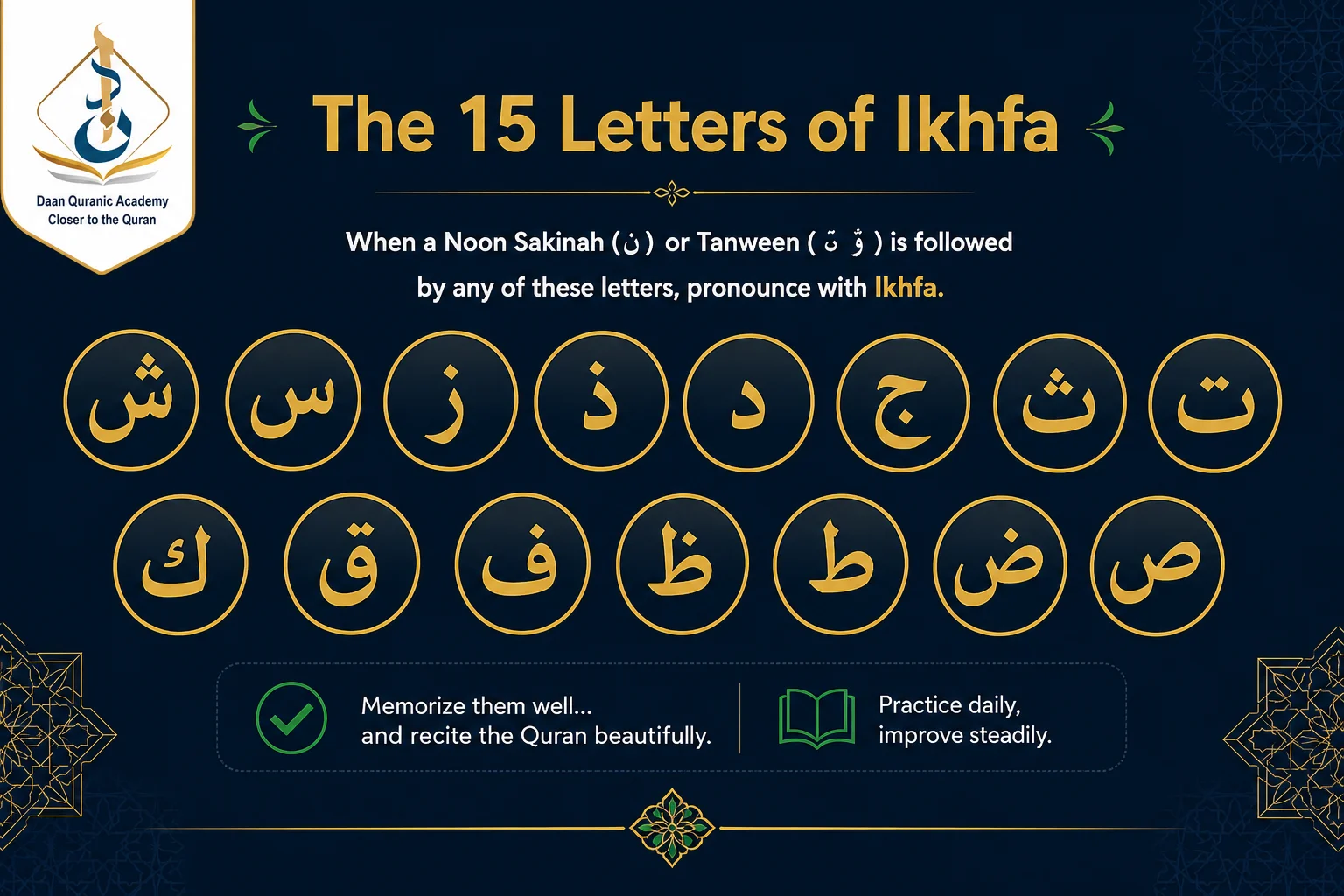
The 15 letters that trigger Ikhfa are ص ذ ث ك ج ش ق س د ط ز ف ت ض ظ — every Arabic letter not already assigned to Izhar, Idgham, or Iqlab. Classical scholars encoded them into a two-line mnemonic poem from the famous Tajweed primer Tuhfat al-Atfal, still taught in Quran schools worldwide today:
صِفْ ذَا ثَنَا كَمْ جَادَ شَخْصٌ قَدْ سَمَا، دُمْ طَيِّبًا زِدْ فِي تُقًى ضَعْ ظَالِمًا
The first letter of every word in these two lines gives you all 15 Ikhfa letters in order. Most students who drill this daily with a tutor memorize it within two or three sessions.
Real session recording: A student practicing the Noon Sakinah rules — including Ikhfa — with live correction from a certified tutor at Daan Quranic Academy. All videos are real, unedited screen-recordings from actual student sessions at Daan Academy, posted with student consent.
Ikhfa also isn’t uniform in strength across all 15 letters. It is strongest before ط، د، ت — letters phonetically closest to the Noon’s own articulation point, so the concealment feels almost embedded. It is weakest before ق، ك, where the ghunnah is present but the Noon’s disappearance feels less total. The remaining 11 letters sit in a moderate middle zone. This is one of the finer points our certified native Egyptian tutors drill early, because self-taught learners often apply the same weight to every letter and lose the nuance entirely.
Ikhfa also occurs in three written positions — Noon Sakinah inside a single word (مِنكُمْ), Noon Sakinah at the boundary of two words (مِنْ قَبْلِ), and Tanween before the next word (رِزْقٌ كَرِيمٌ). All three carry the identical two-count ghunnah ruling; only the location on the page changes.
Ikhfa Letters Examples: How Each Letter Changes the Sound
Ikhfa letters examples show that the same rule sounds slightly different depending on which of the 15 letters follows the Noon — a “full mouth” letter like Sad or Qaf produces a thicker, heavier ghunnah, while an “empty mouth” letter like Tha or Fa produces a lighter one. The table below groups the 15 letters by strength so you can see the pattern at a glance.
| Ikhfa Strength | Letters | Why |
|---|---|---|
| Strongest | ط، د، ت | Closest to the Noon’s own articulation point |
| Moderate | ص، ذ، ث، ج، ش، س، ز، ض، ظ، ف | Neither close nor distant — the “default” Ikhfa sound |
| Weakest | ق، ك | Furthest from the Noon’s articulation point, closer to Izhar |
This gradation is exactly why native-speaker modeling matters so much when learning Tajweed rules. A non-native reader can memorize the 15 letters from a chart in an afternoon, but hearing — and reproducing — the subtle weight difference between Ikhfa before ط and Ikhfa before ك takes guided, repeated listening. It’s a core reason families exploring our specialized Tajweed Rules Mastery course choose sessions with tutors who grew up reciting these sounds natively rather than learning them as adults themselves.
For readers who want to go deeper on how these sounds interact with pronunciation more broadly, our guide to 5 Common Tajweed Mistakes Non-Arabic Speakers Make covers several errors that overlap directly with Ikhfa, including releasing the ghunnah too early.
10 Examples of Ikhfa in the Quran You Can Practice Today
These 10 examples of Ikhfa in the Quran were checked individually against the Quranic text so every reference below is accurate — each shows a different one of the 15 letters in real Quranic context, so you can hear the rule rather than just read about it.
Sad (ص) — مِن صَلْصَالٍ
“min ṣalṣālin” — “from sounding clay.” Noon Sakinah before Sad. Surah Al-Hijr, 15:26.
Fa (ف) — عَنِ الْأَنفَالِ
“‘anil-anfāli” — “about the spoils of war.” Noon Sakinah before Fa within the same word. Surah Al-Anfal, 8:1.
Dhal (ذ) — مَّن ذَا الَّذِي
“man dhā-lladhī” — “who is it that.” From Ayat al-Kursi. Surah Al-Baqarah, 2:255.
Ta (ت) — مِنْ تَحْتِهَا
“min taḥtihā” — “beneath which (rivers flow).” Noon Sakinah before Ta. Surah Al-Baqarah, 2:25.
Tha (ث) — مِنْ ثَمَرَةٍ
“min thamaratin” — “any fruit.” Same ayah, a second Ikhfa letter appears a few words later. Surah Al-Baqarah, 2:25.
Qaf (ق) — مِنْ قَبْلُ
“min qablu” — “before.” Also in the same ayah, showing three Ikhfa letters in one verse. Surah Al-Baqarah, 2:25.
Dal (د) — أَندَادًا
“andādan” — “rivals” (i.e. false equals to Allah). Noon Sakinah before Dal inside one word. Surah Al-Baqarah, 2:22.
Jeem (ج) — مَن جَاءَ
“man jā’a” — “whoever comes (with a good deed).” Surah Al-An’am, 6:160.
Zha (ظ) — يَنظُرُونَ
“yanẓurūna” — “they wait/look.” Noon Sakinah before Zha inside one word. Surah Al-Baqarah, 2:210.
Kaf (ك) — مِنكُمْ
“minkum” — “from among you.” One of the weakest-Ikhfa letters, so the ghunnah is lighter here. Surah Aal-e-Imran, 3:140.
Reading these 10 examples of Ikhfa in the Quran on a page is useful, but hearing them recited correctly — then repeating them with someone actively listening for your ghunnah length — is what actually builds the reflex. That real-time feedback loop is the difference between recognizing Ikhfa and reciting it without thinking.
What to Look For When Learning the Rules of Ikhfa in Tajweed Online
The right place to learn the rules of Ikhfa in Tajweed online should offer live 1-on-1 correction, native-level Arabic pronunciation modeling, and a structured path from the basics through full application in recitation — not a pre-recorded video course you watch passively. Here’s what to actually check before you commit.
Live, 1-on-1 Correction — Not Group Classes
Ikhfa errors are subtle — a ghunnah cut half a beat short is easy to miss in a recording and nearly impossible for a tutor to catch in a group of six students reciting together. Unlike group classes that dilute attention, every session at Daan Quranic Academy is private and personalized, so a tutor can stop you mid-word the moment a ghunnah runs short.
Native Arabic Speakers With Formal Ijazah Training
While many platforms rely on non-native instructors, at Daan Academy every tutor is a native Egyptian Arabic speaker formally trained in Quranic sciences, and many hold certified Ijazah in multiple Qira’at with a verified chain of transmission. That matters specifically for Ikhfa, because the weight difference between letters is something native speakers absorbed as children, not something learned purely from a rulebook.
Fluent English Communication
A tutor who understands Tajweed deeply but can’t explain the “why” behind a rule in your language slows your progress. Every tutor at Daan Academy speaks fluent English, so the mechanics of ghunnah length, makhraj, and letter strength are explained clearly, not just modeled and repeated.
Progress You Can Actually See
Where most academies offer a generic curriculum with no visible tracking, Daan Academy’s Smart Student Dashboard gives you session history, a running progress report, and milestone certificates — so you know exactly how your Ikhfa, and every other rule, is improving over time.
If you want to see the full picture of what a structured program covers beyond just Ikhfa, our guide to the best online Tajweed course in 2026 walks through curriculum design in more depth.
Ikhfa vs Idgham vs Izhar: What’s the Difference?
Ikhfa, Idgham, and Izhar are three different responses to Noon Sakinah or Tanween depending on which letter comes next — and confusing them is one of the most common recitation errors non-Arabic speakers make. The table below makes the distinction concrete.
| Rule | Sound of Noon | Ghunnah | Shaddah on Next Letter |
|---|---|---|---|
| Izhar | Fully clear | None | No |
| Ikhfa | Concealed — between clear and merged | Two counts | No |
| Idgham (with ghunnah) | Fully merged | Two counts | Yes |
The critical distinction between Ikhfa and Idgham is the shaddah: in Idgham, the Noon disappears completely and the following letter is doubled and stressed. In Ikhfa, the following letter is never doubled — the Noon dissolves into a ghunnah, not into the letter itself. This is precisely the kind of ear-training distinction that’s hard to self-correct from a book, which is why students in our Tajweed Rules Mastery course practice minimal-pair drills — reciting an Ikhfa word and an Idgham word back to back until the difference becomes automatic.
“The one who is proficient with the Qur’an will be with the noble and righteous scribes (the angels), and the one who reads it and stumbles over it, finding it difficult, will have two rewards.”
Narrated by Aisha (رضي الله عنها) — Sahih al-Bukhari 4937
This Hadith is often cited by Tajweed teachers precisely because it rewards effort at every stage — the student still working through rules like Ikhfa letter by letter is promised a reward just as real as the fluent reciter’s, which is worth remembering on the days the ghunnah still feels unnatural.
Online vs In-Person Tajweed Classes: Which Helps You Master Ikhfa Faster?
For mastering a precise, ear-driven rule like Ikhfa, online 1-on-1 Tajweed classes with a native tutor generally outperform in-person group classes, simply because online sessions guarantee individual correction every single class, while in-person group settings often mean a student recites for only a few minutes per hour.
Online learning also removes two of the biggest practical obstacles families report: commute time and calendar conflicts with a fixed local class schedule. With flexible scheduling available at any time from anywhere in the world, a working adult in the UK or a homeschooling parent in the US can book sessions around their own week rather than around a mosque’s fixed timetable. Automated smart notifications before each session also help students who are new to structured learning stay consistent — consistency being, by far, the biggest predictor of how quickly Ikhfa becomes automatic rather than a rule you have to consciously recall mid-recitation.
Students across more than 15 countries have gone through Daan Academy’s structured Tajweed pathway, and the pattern our tutors report is consistent: learners who complete weekly 1-on-1 sessions internalize Noon Sakinah rules — Ikhfa included — within a few months of consistent practice, while those reciting alone from books often carry the same small ghunnah errors for years without realizing it.

How Much Do Tajweed and Ikhfa Classes Cost?
Online Tajweed classes that include Ikhfa and the other Noon Sakinah rules typically range from roughly $9 to $13 per hour depending on the tutor tier and plan — meaningfully more affordable than most in-person private tutoring, without sacrificing the 1-on-1 correction that a rule like Ikhfa actually requires.
Plans at Daan Academy start from just $9/hr with certified native Egyptian tutors. Compare our three flexible pricing tiers — Essential, Pro, and Elite — each built for a different pace of learning, with a family discount available on the Elite plan for households enrolling more than one learner.
Some platforms lack transparency on pricing, leaving cost as a surprise after the first session. Daan Academy’s three plans are clearly listed from $9/hr, and every new student can try a full class before paying anything through our free trial session — no card required, no obligation to continue.
Common Ikhfa Pronunciation Mistakes to Avoid
The most common Ikhfa mistake is releasing the ghunnah too early — students correctly begin concealing the Noon, then cut the nasal sound short instead of holding it for the full two counts. This “half-finish” pattern is the single most frequent error we hear from beginners learning the rules of Ikhfa in Tajweed for the first time.
- Cutting the ghunnah short: Practice holding a sustained nasal “ng” sound for a slow count of two before releasing into the next letter.
- Reverting to full Izhar: Some students, especially those coming from English pronunciation habits, unconsciously pronounce the Noon clearly out of instinct — undoing the concealment entirely.
- Over-merging into Idgham: The opposite error — letting the Noon disappear so completely that the next letter gets a stress it shouldn’t have.
- Treating every letter the same: Applying identical weight to Ikhfa before ط and Ikhfa before ك, missing the strength gradation covered above.
Every one of these errors is easy to develop unnoticed when practicing alone, and hard to unlearn once it becomes a habit. It’s exactly why real-time correction — not just theory — is the fastest route to fixing them. Our related guide on top Arabic pronunciation challenges for English speakers covers several of the underlying makhraj issues that often sit behind these same Ikhfa mistakes.

Frequently Asked Questions
What is Ikhfa in Tajweed in simple terms?
Ikhfa is the rule where Noon Sakinah or Tanween is “hidden” before 15 specific letters — pronounced with a nasal ghunnah for about two counts rather than spoken clearly or merged into the next letter.
How much do online Ikhfa and Tajweed classes cost?
At Daan Academy, plans start from $9/hr and go up to $12.99/hr depending on the tier. You can compare all three plans in detail on our pricing page.
Can I try a class before committing to Tajweed lessons?
Yes. Every new student can book a free trial session with no commitment required, to experience live correction before enrolling in a paid plan.
Is online Quran and Tajweed learning safe for children?
Every class is a private, 1-on-1 session, and parents can sit in or monitor sessions at any time. Tutors are vetted native Arabic speakers with formal training — you can read more about our screening process on the Why Choose Us page.
How do I know if a Tajweed tutor is actually qualified?
Look for native Arabic fluency, formal training in Quranic sciences, and ideally a certified Ijazah with a verifiable chain of transmission. You can view individual tutor backgrounds on our tutors page.
How long does it take to master the rules of Ikhfa in Tajweed?
Most students recognize and apply the 15 Ikhfa letters correctly within a few weeks of consistent 1-on-1 practice, though smoothing the ghunnah into natural, unconscious recitation typically takes a few months of regular sessions.
Ready to Master the Rules of Ikhfa in Tajweed?
Reading about Ikhfa only goes so far — real progress comes from reciting it out loud while someone qualified listens for every ghunnah. Book a free session and hear the difference in your very first class.
No commitment required. One free session to experience the Daan Academy difference.
Final Thoughts
The rules of Ikhfa in Tajweed reward patience more than any other single rule in Quranic recitation — it’s a sound you build gradually, one corrected ghunnah at a time, until it stops requiring conscious thought. Whether you’re a revert learning Tajweed from scratch, a parent guiding a child through Noorani Qaida toward full recitation, or an adult refining years of self-taught habits, the 15 letters and the 10 examples above are a solid foundation to build on.
We ask Allah to make the recitation of His Book easy upon every learner’s tongue, and to grant reward for every letter recited with care and correction sought sincerely. Ameen.
Explore more guides like this one on our blog.