Quran Stop Signs Explained: Meanings, Rules & Examples of Stopping Signs in Quran
The stopping signs in Quran recitation — known in Arabic as ‘alamat al-waqf — are the small red letters printed above certain words in the Mushaf that tell a reciter exactly where to pause, where to continue, and where stopping is absolutely forbidden. In the Mushaf Al-Madinah, the print used by the vast majority of English-speaking Muslims and reverts today, there are six main stopping signs, each with its own rule. Get them wrong and you can accidentally change the meaning of a verse. Get them right — with a qualified, native Egyptian tutor guiding you — and your recitation becomes clearer, more confident, and closer to how the Prophet ﷺ himself recited.
📑 Table of Contents
- What Are the Stopping Signs in Quran?
- The 6 Waqf Signs in Mushaf Al-Madinah: Quran Stop Signs With Examples
- How to Choose an Academy to Master Stopping Signs in Tajweed
- Online vs In-Person: Learning the Stop Signs in Quran Meaning
- Affordable Tajweed Classes: The Cost of Learning Quran Signs of Stopping
- Why Families Trust Daan Academy With Quran Stop Signs
- What Is Sakta? Waqf vs Sakta Explained
- Common Mistakes With Stopping Signs in Quran
- Frequently Asked Questions
What Are the Stopping Signs in Quran?
Stopping signs in Quran are small Arabic letters — such as مـ, لا, ج, صلى, and قلى — printed above the text of the Mushaf to mark where a reciter should stop, continue, or never pause. They belong to a branch of Quranic sciences called al-waqf wal-ibtida’ (stopping and starting), and they exist for one reason: to protect the meaning of the ayah from being distorted by a poorly placed breath.
Early Qur’anic manuscripts had no dots, vowel marks, or stopping signs at all — native Arabic speakers simply didn’t need them. As Islam spread and non-Arabic speakers began learning to recite, scholars gradually added these tools, and the system of waqf signs we use today was refined over centuries by scholars of Tajweed. Understanding the stopping signs in Quran is now considered an essential part of learning correct Tajweed, alongside Noorani Qaida and the rules of Madd.

Before learning the signs themselves, it helps to hear how the Prophet ﷺ himself recited. His wife, Umm Salamah (may Allah be pleased with her), described his recitation as broken into clear, separate verses rather than rushed together — the very foundation of what the waqf system was later built to preserve.
“The Messenger of Allah ﷺ would recite verse by verse, pausing after each one — reciting ‘Bismillahi-r-Rahmani-r-Raheem,’ then stopping, then ‘Al-hamdu lillahi Rabbil-‘alameen,’ then stopping again, before continuing.”
Narrated by Umm Salamah — Sunan Abi Dawud, Hadith 4001
This is precisely why the Qur’an itself commands measured, unhurried recitation rather than a rushed, run-on delivery:
وَرَتِّلِ الْقُرْآنَ تَرْتِيلًا
“And recite the Qur’an with slow, measured recitation.”
Learning to recite this way — with correct stopping signs in Quran passages — is exactly what a structured Tajweed Rules Mastery course is built to teach, starting from the very first lesson.
The 6 Waqf Signs in Mushaf Al-Madinah: Quran Stop Signs With Examples
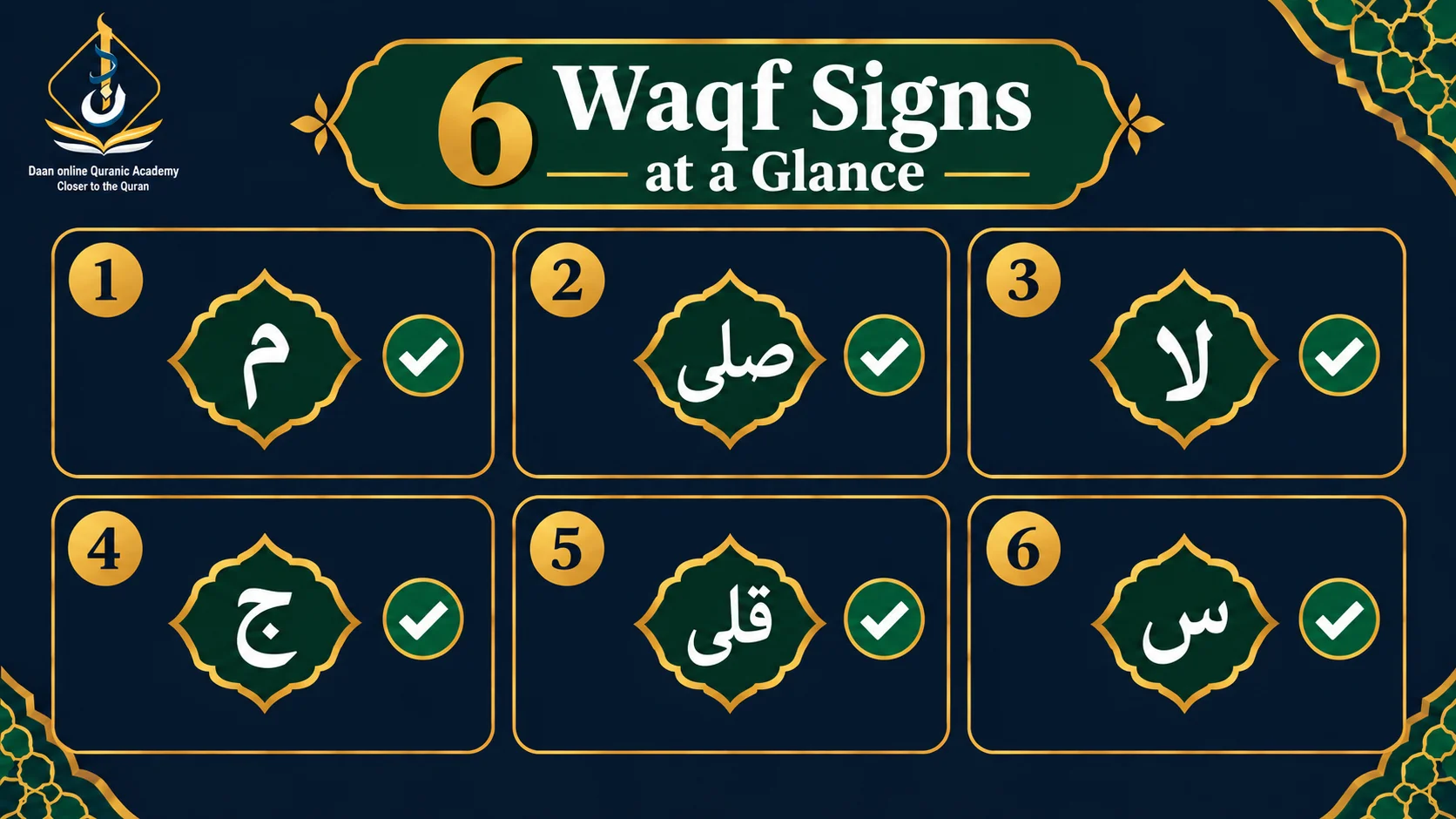
The Mushaf Al-Madinah — the print used across the UK, USA, and Europe — contains six main stopping signs: waqf lazim, la, jeem, sla, qla, and the paired mu’anaqah dots. Each one carries a different instruction, and none of them are decorative — every mark exists because scholars identified a real risk of the meaning being misunderstood without it.
| Symbol | English Name | Meaning | What to Do |
|---|---|---|---|
| مـ | Waqf Lazim (Necessary Stop) | Continuing risks a mistaken meaning | Always stop here |
| لا | La (Prohibited Stop) | Stopping here breaks the sentence’s meaning | Never stop; continue reciting |
| ج | Waqf Ja’iz (Permissible Stop) | No preference either way | Stop or continue — both are fine |
| صلى | Al-Wasl Awla | Stopping is allowed, but continuing is better | Prefer to continue |
| قلى | Al-Waqf Awla | Continuing is allowed, but stopping is better | Prefer to stop |
| ∴ ∴ | Mu’anaqah (Paired Stop) | Two nearby spots, linked together | Stop at one only, never both |
Seeing these Quran stop signs with examples makes the rules far easier to remember than reading definitions alone. Here are three genuine cases straight from the Mushaf:
Real session recording: A native Egyptian tutor giving live, real-time correction as a student applies stopping signs in Quran recitation. All videos are real, unedited screen-recordings from actual student sessions at Daan Academy, posted with student consent.
Waqf Lazim — Surah Al-Ma’idah 5:51
“…لَا تَتَّخِذُوا الْيَهُودَ وَالنَّصَارَىٰ أَوْلِيَاءَ ۘ بَعْضُهُمْ أَوْلِيَاءُ بَعْضٍ…” The lazim mark falls directly after “awliya'” — stopping here is necessary, because reading straight through would wrongly suggest the second clause is joined to the command rather than standing as its own statement.
Qla (Waqf Awla) — Surah Al-Kahf 18:22
“…مَّا يَعْلَمُهُمْ إِلَّا قَلِيلٌ ۗ فَلَا تُمَارِ فِيهِمْ…” The قلى mark sits after “illa qalil.” Both stopping and continuing are permitted, but pausing here is the preferred, more cautious choice.
Mu’anaqah — Surah Al-Baqarah 2:2
“ذَٰلِكَ الْكِتَابُ لَا رَيْبَ ۛ فِيهِ ۛ هُدًى لِّلْمُتَّقِينَ” Two dots appear after “rayb” and again after “fih.” A reciter may pause at either point — but never both in the same recitation, since the two form a single linked choice.
Mastering this table takes guided repetition, not memorisation alone — it’s one of the core skills built into every Quran Reading & Recitation course at Daan Academy.
How to Choose an Academy to Master Stopping Signs in Tajweed
The right academy for learning stopping signs in Tajweed combines certified native tutors, 1-on-1 live sessions, and a structured curriculum — not a generic recorded course. Waqf rules are applied live, in real recitation, so a tutor needs to hear you and correct you in the moment. Here’s what actually separates a solid choice from a disappointing one.
Native, Formally Trained Tutors
Look for tutors who are native Arabic speakers, not just fluent second-language speakers — waqf placement depends on subtle grammatical cues that native training makes second nature. At Daan Academy, every tutor is a native Egyptian, formally trained in the Quranic sciences, and many are certified Ijazah holders in multiple Qira’at with chains of transmission back to the Prophet ﷺ.
1-on-1 Sessions, Not Group Classes
Unlike group classes that dilute a tutor’s attention across many students, waqf correction needs to happen the moment a mistake is made. Every class at Daan Academy is private and personalised, so a tutor can stop you at the exact symbol and explain why.
Fluent English Communication
Where many platforms rely on tutors who can recite beautifully but struggle to explain a rule in plain English, every Daan Academy tutor speaks fluent English — so the logic behind each stopping sign actually makes sense, not just the sound of it.
You can browse full tutor profiles, qualifications, and specialisms on the Our Tutors page before you ever book a session.
Online vs In-Person: Learning the Stop Signs in Quran Meaning
Online Tajweed classes now match — and often exceed — in-person madrasah lessons for teaching the stop signs in Quran meaning, thanks to screen-sharing, recorded progress, and direct access to specialist tutors. A generation ago, mastering waqf rules meant finding a qualified teacher nearby. Today, distance is no longer the limiting factor — tutor quality is.
In a live online session, both tutor and student can view the exact same page of the Mushaf on screen, with the symbol circled or highlighted in real time — something that’s often harder to coordinate in a crowded in-person class. Explore how this works on the Why Choose Us page.
Where many in-person options are limited to whoever happens to teach at the local mosque, learning online opens access to native Egyptian tutors specifically trained in the Quranic sciences — regardless of what city or country a family lives in. Flexible scheduling means lessons fit around school, work, and prayer times rather than the other way around, and every session includes smart notifications so nothing is missed.
Families juggling several children’s schedules also benefit from the Smart Student Dashboard (Daan LMS), where session history, balance, and progress reports for the whole family sit in one place — something a paper attendance register simply can’t offer.
Affordable Tajweed Classes: The Cost of Learning Quran Signs of Stopping
Learning the Quran signs of stopping through private, 1-on-1 online Tajweed classes starts from just $9/hr — far more affordable than many families expect for individually tailored instruction. Where some platforms keep pricing vague until checkout, Daan Academy publishes three clear plans from the outset.
Plans start from just $9/hr with native Egyptian tutors. Compare our three flexible pricing tiers — Essential, Pro, and Elite — each designed for different learning goals and budgets, with a family discount available on the Elite plan.
Every plan includes the same core essentials: certified native tutors, a structured curriculum covering Noorani Qaida through advanced Tajweed rules like waqf and madd, verified completion certificates, and 24/7 dedicated support for anything technical or academic. Higher tiers add extras like more weekly sessions and access to the 600+ educational games library that keeps younger learners engaged between lessons.
Rather than committing upfront, every family can start with a completely free trial session — no card details, no pressure, just a genuine chance to see how a tutor teaches stopping signs before paying anything.
Why Families Trust Daan Academy With Quran Stop Signs
Families across the UK, USA, and Europe choose Daan Academy to teach the stopping signs in Quran because of verified tutor credentials, transparent progress tracking, and a track record of students completing full Tajweed and Hifz programmes. Trust isn’t claimed — it’s demonstrated through what a family can actually see and check.
Every tutor’s qualifications are listed openly, including Al-Azhar training and Ijazah certification where held, so parents aren’t taking a stranger’s word for it. Detailed session reports and monthly progress updates mean a parent always knows exactly which stopping signs, surahs, or Tajweed rules their child has covered — not a vague “doing well” at the end of term.
For families across 15+ countries, the referral programme has also become a quiet form of word-of-mouth trust: existing families inviting friends, with both sides receiving a discount, is usually a stronger signal of satisfaction than any testimonial page could be.
What Is Sakta? Waqf vs Sakta Explained
Sakta is a brief pause without taking a breath, marked with a small س, and it is different from waqf, which is a full stop where breathing is allowed. The two are easy to confuse for beginners, but the distinction matters for correct Tajweed.
A waqf — whether lazim, ja’iz, or otherwise — is a genuine stopping point where the reciter may pause, breathe, and then resume, either from the same word or the next appropriate starting point. A sakta, by contrast, is a light, momentary suspension of sound with no breath taken at all, before the voice continues immediately into the next word. It exists in only a handful of fixed locations across the Qur’an, most notably in Surah Al-Kahf, Ya-Sin, Al-Qiyamah, and Al-Mutaffifin, where scholars determined that a tiny separation prevents two words from blending into a different meaning entirely.
Because sakta positions are few and specific, they’re usually one of the last refinements a student learns — typically after the six main waqf signs are already second nature, as part of a more advanced Islamic Studies or Tajweed Rules Mastery course.
Common Mistakes With Stopping Signs in Quran
The most common mistake with stopping signs in Quran recitation is treating every red mark as identical — stopping at a لا, or rushing through a مـ, simply because the reciter never learned what each symbol individually means. Self-taught reciters, in particular, tend to repeat the same handful of errors.
Learn the Six Symbols by Sight First
Before applying any waqf rule in live recitation, be able to instantly recognise مـ, لا, ج, صلى, قلى, and the paired dots on sight — hesitating mid-ayah to work out a symbol breaks the flow that Tajweed is meant to protect.
Never Skip a لا Sign
The single most repeated beginner mistake is pausing for breath exactly where a لا sign forbids it, often because it falls at a natural-sounding breath point. Practising these specific spots with a tutor until they feel automatic prevents the habit from forming.
Don’t Treat Ja’iz as “Optional to Learn”
Because ج allows either choice, some students assume it needs no attention at all — but recognising it still matters, since it tells you stopping there won’t distort meaning, which is valuable information mid-recitation, especially in prayer.
Get Live Correction, Not Just Reading Practice
Reading waqf rules from a book explains the theory, but only a tutor listening in real time can catch the moment a stop is misapplied and correct it before it becomes a habit — which is exactly what 1-on-1 sessions are designed for.
Revisit the Table Regularly
Even confident reciters benefit from periodically reviewing the full set of stopping signs, since infrequently-seen marks like the mu’anaqah dots are the easiest to forget between sessions.

Frequently Asked Questions
What are the stopping signs in Quran and why do they matter?
They are small Arabic letters printed above certain words in the Mushaf — such as مـ, لا, ج, صلى, and قلى — that tell a reciter where to stop, where to continue, and where stopping is forbidden, so that pausing for breath never accidentally changes a verse’s meaning.
How many waqf signs are in the Mushaf Al-Madinah?
Six main signs appear in the Mushaf Al-Madinah: waqf lazim (مـ), la (لا), waqf ja’iz (ج), sla (صلى), qla (قلى), and the paired mu’anaqah dots (∴ ∴), alongside the separate sakta (س) mark for brief, breathless pauses.
Is it obligatory to stop at every waqf sign?
Only at waqf lazim (مـ) is stopping necessary. Ja’iz (ج) allows either choice, sla and qla each carry a preference, and la (لا) actually forbids stopping — so no, the rules differ sign by sign rather than applying uniformly.
Can I try a Quran class before committing?
Yes. Daan Academy offers a completely free trial session with a real tutor, so you can see how waqf and Tajweed rules are taught before choosing a plan.
How much do online Tajweed classes cost?
Plans start from $9/hr on the Essential tier, with Pro at $10.99/hr and Elite at $12.99/hr. Full details are on the Pricing Plans page.
Is it safe for my child to learn Quran stop signs online?
Yes — every class is 1-on-1 with a formally trained, verified tutor, sessions are structured and monitored through the Daan LMS dashboard, and parents receive transparent progress reports after every lesson.
How do I know if a tutor is actually qualified to teach Tajweed?
Check for native Arabic fluency, formal training in the Quranic sciences, and Ijazah certification. Full tutor credentials are listed on the Our Tutors page before you book.
Ready to Master the Stopping Signs in Quran?
Every stopping sign in the Mushaf carries a rule worth getting right — and a native Egyptian tutor can help you apply every one of them correctly, live, from your very first session.
No commitment required. One free session to experience the Daan Academy difference.
Final Thoughts
The stopping signs in Quran are not small technicalities — they are a safeguard, passed down through generations of scholars, to make sure the words of Allah are recited exactly as intended, pause by pause. Learning them takes patience, repetition, and — most of all — a tutor who can correct you the moment a stop is missed or misapplied. With the right guidance, what once felt like a page of unfamiliar red symbols becomes second nature.
We ask Allah to make the Qur’an a light in every reciter’s heart, and to make the learning of its rules — including every stopping sign in Quran recitation — a means of drawing closer to Him. Ameen.