The True Importance of Tajweed in Preserving the Quran’s Divine Message | Daan Quranic Academy
The importance of Tajweed lies in one simple truth: mispronouncing a single letter of the Quran can change its meaning entirely, which is why every reciter — beginner or advanced — needs to learn the correct rules of articulation. Tajweed is not decoration added on top of recitation; it is the discipline that protects the Quran’s wording exactly as it was revealed to Prophet Muhammad ﷺ. For English-speaking Muslims, reverts, and parents raising children in the West, understanding why Tajweed matters — and finding a tutor who can actually teach it correctly — is one of the most consequential decisions in a family’s Islamic education. This guide explains the religious, linguistic, and practical importance of Tajweed, what the Quran and authentic Hadith say about it, and how to choose a program that gets it right from the very first lesson.
📑 Table of Contents
- The Importance of Tajweed in Quran Recitation: A Clear Definition
- What Is Tajweed and Its Importance? Understanding the Rules Behind the Rhythm
- The Importance of Tajweed in Quran: Preserving a Divine Message Word for Word
- Importance of Tajweed Hadith: What the Prophet ﷺ Taught About Recitation
- How to Choose the Best Online Tajweed Course: 7 Criteria That Matter
- Tajweed Course Pricing: Is Learning Tajweed Online Affordable in 2026?
- Learning Tajweed Online vs. Self-Study Apps: A Fair Comparison
- Real Results: What Families Say About the Importance of Tajweed Training
- Common Tajweed Mistakes Non-Arabic Speakers Make (And How to Fix Them)
- Frequently Asked Questions
The Importance of Tajweed in Quran Recitation: A Clear Definition
The importance of Tajweed in Quran recitation comes down to accuracy: Tajweed is the set of pronunciation rules that governs how each Arabic letter is articulated, so that the Quran is recited exactly as it was revealed — not approximately, but precisely. The word Tajweed comes from the Arabic root meaning “to improve” or “to make excellent,” and in practice it covers everything from the correct exit point (makhraj) of each letter to elongation rules, nasalization, and the pauses that shape meaning.
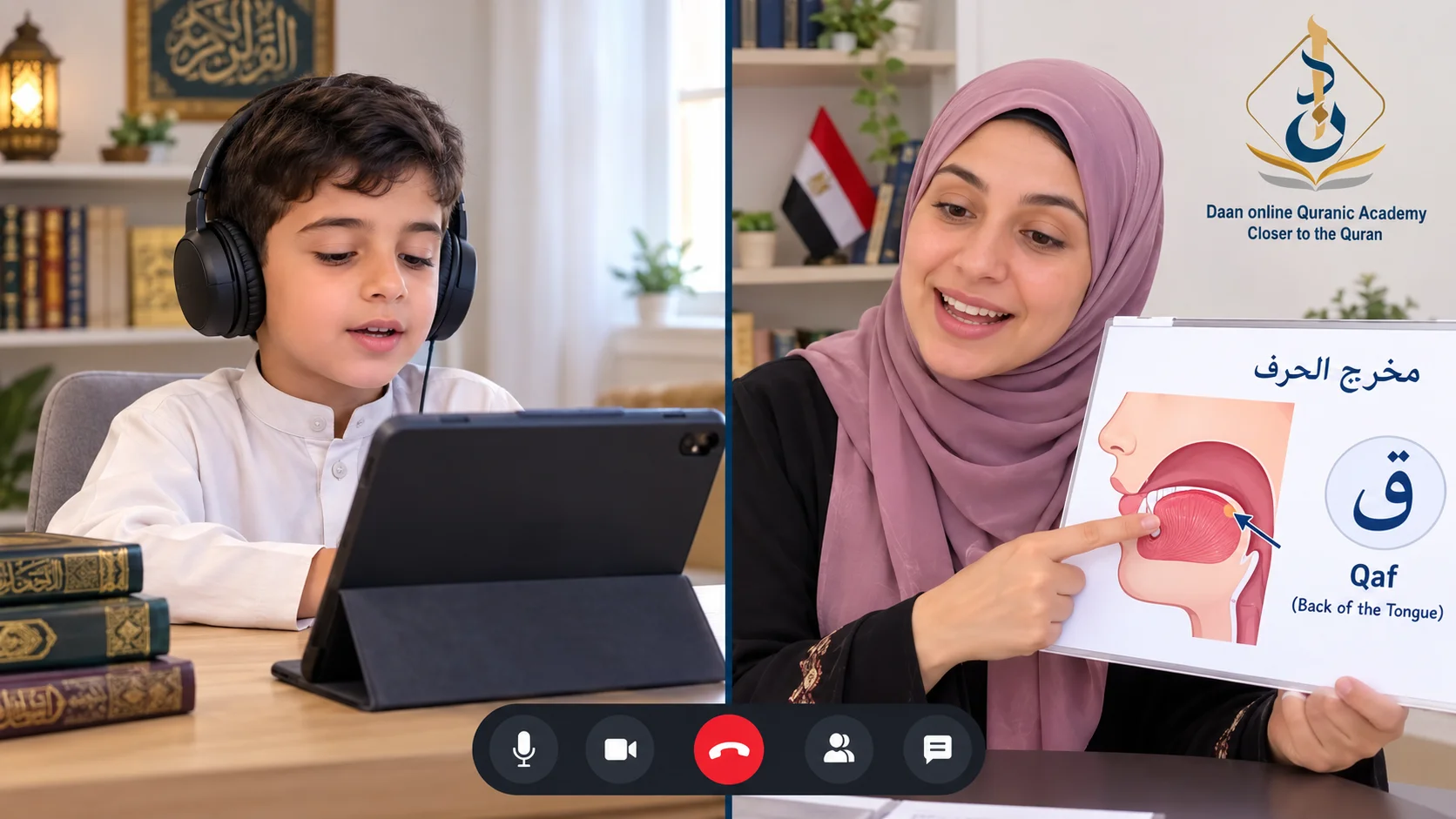
For English-speaking Muslims and reverts, this matters more than it might first appear. Arabic contains sounds that do not exist in English — the throaty ع (Ain), the heavy ط (Taa), the emphatic ص (Saad) — and without a tutor who can hear the difference, these letters often get swapped for their nearest English equivalent. That is not a small stylistic issue; in Arabic, swapping one letter for another can turn one word into a completely different word. This is precisely why the importance of Tajweed is treated as a matter of religious obligation by scholars, not simply good practice.
At Daan Quranic Academy, every class is a private, 1-on-1 live session with a native Egyptian tutor — never a group lesson where individual pronunciation slips go uncorrected. You can browse the full range of structured learning paths, including Tajweed Rules Mastery, on our Quran and Tajweed courses page, where each course maps out exactly what a student will master at every stage.
What Is Tajweed and Its Importance? Understanding the Rules Behind the Rhythm
What is Tajweed and its importance can be summed up in one line: Tajweed is the science of giving every Arabic letter its correct sound, length, and characteristics, and its importance is that it protects the Quran from being altered through mispronunciation — generation after generation, exactly as it has been for over 1,400 years. Scholars often describe this using the concept of tarteel — reciting slowly, distinctly, and with reflection.
Real session recording: Watch a student receive live, real-time pronunciation correction from a certified tutor as a Tajweed rule is applied mid-recitation — this is the moment the importance of Tajweed becomes tangible rather than theoretical. All videos are real, unedited screen-recordings from actual student sessions at Daan Academy, posted with student consent.
The term Tajweed is documented extensively as a formal branch of Quranic sciences, taught traditionally through a chain of certified teachers rather than from a book alone — which is exactly why an Ijazah (a certified license to teach) matters so much when choosing a tutor. Many of Daan Academy’s tutors hold certified Ijazah in multiple Qira’at, meaning their own recitation has been verified letter-by-letter through a documented chain of transmission tracing back to the Prophet ﷺ.
Every tutor at Daan Academy also communicates in fluent English, which removes the single biggest barrier reverts and non-Arabic-speaking parents face when trying to learn technical pronunciation rules from a teacher who cannot explain them clearly in their language. You can review individual tutor backgrounds, Ijazah chains, and teaching specialties on our tutors page.
The Importance of Tajweed in Quran: Preserving a Divine Message Word for Word
Muslims believe the Quran is the literal, unaltered word of Allah, and the importance of Tajweed in Quran preservation is that it is the mechanism by which that exact wording — sound by sound — has survived intact since the 7th century. This is not a modern academic theory; it is directly rooted in the Quran’s own instruction to reciters.
أَوْ زِدْ عَلَيْهِ وَرَتِّلِ الْقُرْآنَ تَرْتِيلًا
“…or add to it (a little), and recite the Qur’an with measured, rhythmic recitation.”
The command to recite with tarteel — a slow, distinct, measured cadence — is the Quranic foundation from which the entire discipline of Tajweed developed. Classical commentators explain that reciting slowly with clear letters is not just easier to understand; it is an act of respect for the words being spoken, since the reciter is quite literally repeating the speech of Allah. This is one reason Daan Academy structures every lesson around correct articulation from day one, rather than rushing students toward speed.
For families who want a full roadmap from the very first Arabic letter through to confident, rule-based recitation, our guide on how to learn Quran for non-Arabic speakers walks through the entire learning path stage by stage.
Importance of Tajweed Hadith: What the Prophet ﷺ Taught About Recitation
The importance of Tajweed Hadith evidence is that the Prophet ﷺ personally praised skilled recitation while also reassuring struggling learners that their effort is doubly rewarded — meaning Tajweed is both a standard to strive for and a journey every beginner is honored for attempting. This balance is captured in one of the most frequently cited hadith on Quran recitation.
“The one who recites the Qur’an proficiently is with the noble, righteous, recording angels, and the one who recites it with difficulty, stumbling through it, will have two rewards.”
Narrated by Aisha (RA) — Sahih al-Bukhari 4937 & Sahih Muslim 798
This hadith is often the first thing tutors at Daan Academy share with anxious adult beginners: proficiency is the goal, but the struggle of learning is never wasted. It also explains why the Prophet ﷺ encouraged reciters to keep refining their pronunciation rather than settling for “close enough” — proficiency (being “mahir” with the Quran) is explicitly the higher of the two ranks described in the narration, which is the entire justification for structured Tajweed instruction rather than casual self-teaching.
To understand what Daan Academy stands for as an institution and why its tutor-vetting process is built around this exact hadith, visit our Why Choose Us page.
How to Choose the Best Online Tajweed Course: 7 Criteria That Matter
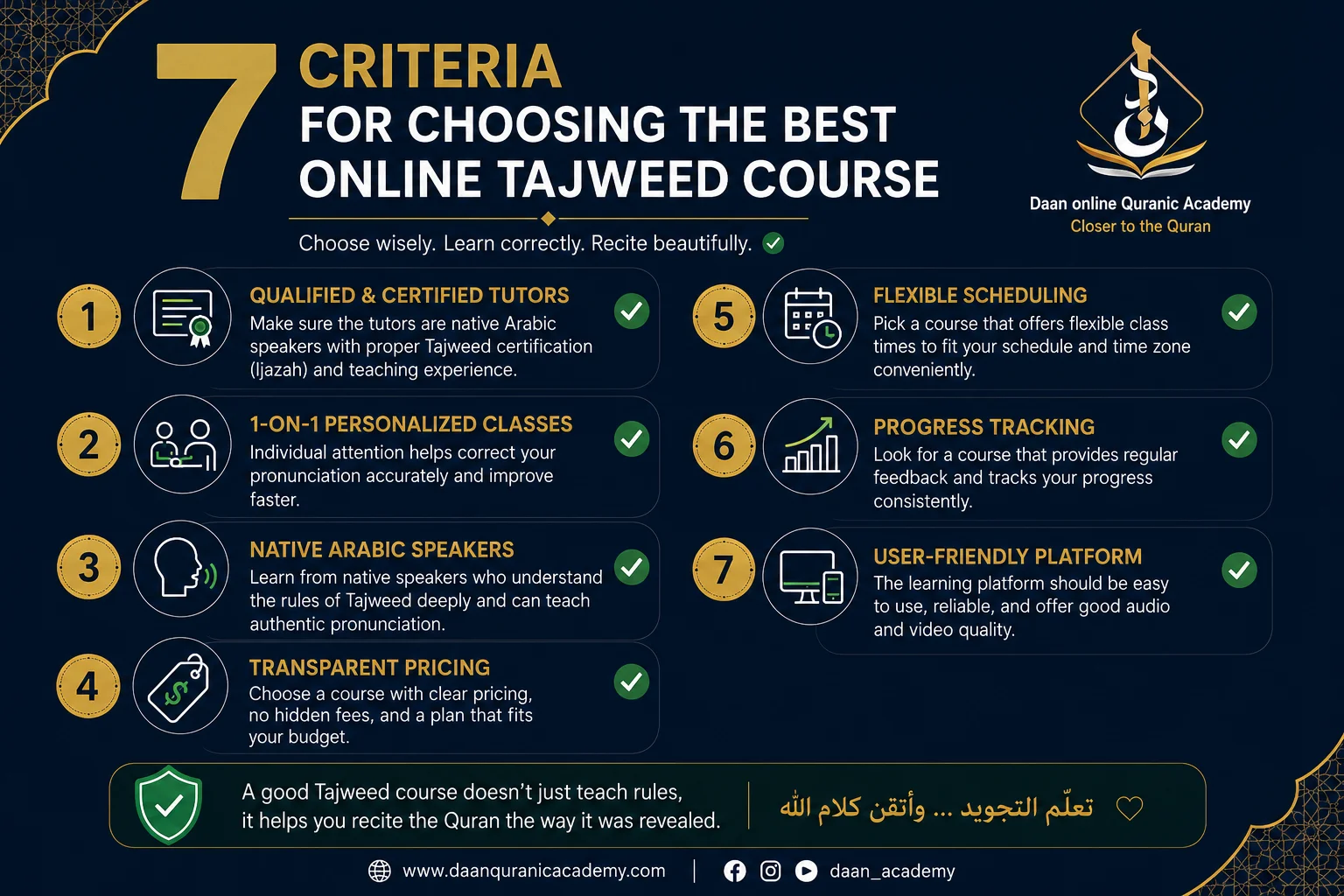
The best online Tajweed course is one built around live, 1-on-1 correction from a certified native Arabic-speaking tutor — because Tajweed is a spoken skill that cannot be learned from video lessons or an app alone. Before enrolling anywhere, it’s worth checking a program against these seven criteria.
- Live, 1-on-1 instruction — group classes dilute individual correction time
- Native Arabic-speaking tutors — non-native speakers often miss subtle makhraj errors
- Verified Ijazah certification — proof the tutor’s own recitation was formally certified
- Fluent English communication — rules must be explained clearly, not just demonstrated
- Transparent, published pricing — no hidden fees or vague “contact us” quotes
- A free trial session — the ability to test tutor fit before paying
- Progress tracking tools — a way to see measurable improvement over time
What to Look For: Certified, Native Tutors
Look for academies that publish real tutor credentials rather than vague claims of “qualified teachers.” At Daan Academy, every tutor is a native Egyptian Arab, formally trained in Quranic sciences, and many hold Ijazah certifications in multiple Qira’at with documented chains of transmission — details you can verify directly on our tutors page before booking a single class.
What to Look For: Real Progress Tracking
A serious program should show you, not just tell you, how a student is improving. Daan Academy’s Smart Student Dashboard gives parents and adult learners session-by-session progress reports, attendance history, and a running balance — all in one place, alongside a 600+ educational games library that keeps younger children engaged between formal lessons.
Tajweed Course Pricing: Is Learning Tajweed Online Affordable in 2026?
Learning Tajweed online is generally more affordable than in-person tutoring, with quality 1-on-1 programs available from roughly $9 to $13 per hour once you account for the elimination of travel time and venue costs. Some platforms are vague about pricing until after a sign-up form is submitted — that lack of transparency is itself worth treating as a warning sign.
Plans start from just $9/hr with native Egyptian tutors. Compare our three flexible pricing tiers — Essential, Pro, and Elite — each designed for different learning goals and budgets, with a family discount available on the Elite plan for households enrolling more than one child.
Because every session at Daan Academy is 1-on-1, families are not paying for a seat in a crowded virtual classroom where a tutor’s attention is split six or eight ways. A free trial session is included before any commitment, so you can evaluate tutor fit against the criteria above with zero financial risk — book yours through our free trial page.
Learning Tajweed Online vs. Self-Study Apps: A Fair Comparison
Self-study apps can teach the theory of Tajweed rules, but they cannot correct a student’s live pronunciation the way a human tutor can — and pronunciation, not memorization of rule names, is the entire point of Tajweed. Here is how the main options compare.
| Learning Method | Live Pronunciation Correction | Certified Native Tutor | Typical Cost | Flexibility |
|---|---|---|---|---|
| Self-study apps | No | No | Free–$15/mo | High, but unguided |
| Group online classes | Limited (shared time) | Varies | $5–$8/hr | Moderate |
| Daan Academy 1-on-1 sessions | Yes, every session | Yes, native Egyptian tutors | From $9/hr | Any time, anywhere |
Where many platforms lean on pre-recorded content or large group calls, Daan Academy builds a personalized learning plan around each student’s current pronunciation level, tracked through smart notifications that remind students before every session so consistency — the real driver of Tajweed improvement — is never left to memory alone.
Real Results: What Families Say About the Importance of Tajweed Training
The clearest evidence for the importance of Tajweed shows up in outcomes: students who complete structured Tajweed training read with noticeably fewer pronunciation errors in Salah and Quran recitation than those who learned informally. Daan Academy currently serves students and families across 15+ countries, spanning the UK, USA, Europe, and Australia.
Every course milestone is marked with a verified certificate, giving students and parents a tangible record of progress — from completing Noorani Qaida through to advanced Tajweed Rules Mastery. Combined with 24/7 dedicated support for technical or academic questions and a referral program that rewards existing families for introducing others, the goal is a learning relationship that lasts years, not a single course purchase.

Common Tajweed Mistakes Non-Arabic Speakers Make (And How to Fix Them)
The most common Tajweed mistakes among non-Arabic speakers involve confusing similar-sounding letters, skipping elongation (madd) rules, and reciting too quickly to apply any rule at all. None of these are signs of a poor reciter — they’re simply the predictable result of learning a sound system that doesn’t exist in English without a tutor trained to catch them.
For a full breakdown of the five most frequent errors and step-by-step corrections, see our dedicated guide on common Tajweed mistakes and how to fix them. The pattern across nearly all of them is the same: a mistake becomes a habit only when nobody corrects it in real time, which is exactly the gap live 1-on-1 tutoring is designed to close.
Book a Free Trial Session
Meet a native Egyptian tutor, get an honest assessment of your current pronunciation, and ask any questions — with no commitment required.
Get Matched to the Right Course
Whether you’re starting from Noorani Qaida or refining advanced Tajweed rules, your learning plan is built around where you actually are, not a fixed curriculum.
Track Real Progress Every Week
Session reports, a completion certificate at each milestone, and smart reminders keep momentum going long after the first lesson.

Frequently Asked Questions
What is Tajweed and why is it important?
Tajweed is the set of rules governing correct pronunciation of Quranic Arabic — where each letter is articulated, how long vowels are held, and how letters interact. It’s important because incorrect pronunciation can change the meaning of a word, so Tajweed protects the Quran’s message exactly as it was revealed.
How much do online Tajweed classes cost?
At Daan Academy, 1-on-1 Tajweed classes start from $9/hr on the Essential plan, with Pro and Elite tiers at $10.99/hr and $12.99/hr for added features. Full details are available on our pricing plans page.
Can I try a Tajweed class before I commit to a plan?
Yes. Daan Academy offers a completely free trial session with no obligation to continue, so you can meet your tutor and assess fit before choosing a plan. You can book one directly on our free trial page.
Is it safe for my child to learn Tajweed online?
Every class is a private, 1-on-1 video session, never an open group call, and tutors are formally vetted before teaching. Parents also get visibility into every session through progress reports on the student dashboard.
How long does it take to learn Tajweed properly?