How Many Sajdah in the Quran? (Complete List of Sajdah Tilawat)
How many sajdah in the quran? There are 14 verses of prostration agreed upon by all four Sunni schools, with a possible 15th depending on which madhhab you follow — Hanafi scholars count Surah Sad (38:24) as a sajdah tilawat, while Shafi’i, Maliki, and Hanbali scholars replace it with the second sajdah in Surah Al-Hajj (22:77). Below you will find the complete list of all 15 possible sajdah locations, the scholarly reasoning behind the difference, and exactly how to perform Sajda-e-Tilawat correctly — plus where to learn proper Tajweed and recitation from certified native Egyptian tutors at Daan Quranic Academy.
📑 Table of Contents
- How Many Sajdah in the Quran? The Quick Answer
- What Is Sajdah Tilawat? Understanding the Prostration of Recitation
- How Many Sajdahs in the Quran? The Complete List of 15 Verses
- How Many Sajdah Tilawat in Quran: 14 or 15 by Madhhab
- Why Do Muslims Prostrate When Reciting These Verses?
- How to Perform Sajdah Tilawat: Step-by-Step
- What to Look For in a Quran Academy That Teaches Tajweed and Sajdah Rules
- Learning the Sajdah Verses Online: Cost, Value, and What’s Included
- How Many Sajdah in Quran: Online vs. at a Local Mosque
- Frequently Asked Questions
How Many Sajdah in the Quran? The Quick Answer
How many sajdah in the quran? The Quran contains 14 sajdah tilawat verses agreed upon by every major school of Islamic jurisprudence, with a total of 15 possible locations once the difference between the Hanafi and Shafi’i schools is accounted for. These verses — known as Ayat al-Sajdah — instruct the reader or listener to pause and perform a single prostration as an act of humility before Allah.
The disagreement is not a contradiction; it comes down to a single verse. Thirteen locations are accepted by every school without dispute. The fourteenth spot is either Surah Sad (38:24), which Hanafi scholars count as a sajdah tilawat, or the second sajdah in Surah Al-Hajj (22:77), which Shafi’i, Maliki, and Hanbali scholars include instead. Combine both positions and you get the full list of 15 verses marked with the ۩ symbol across different printed copies of the Quran.
Knowing how many sajdah in the quran there are is one thing — reciting these verses correctly, recognizing the ۩ symbol mid-recitation, and applying the right Tajweed rules around them is another. That is the kind of detail a live, native-speaking tutor catches that a self-study app usually misses. You can see how this is taught inside our Quran recitation and Tajweed courses.
What Is Sajdah Tilawat? Understanding the Prostration of Recitation
Sajdah Tilawat, or the Prostration of Recitation, is a single prostration performed when a Muslim recites or hears one of the specific Quranic verses that command or describe prostration. It is distinct from the two daily prostrations in Salah — Sajda-e-Tilawat can happen at any moment the verse is encountered, whether during prayer, personal recitation, or while listening to someone else read.
The practice is rooted directly in the Sunnah. Abu Huraira reported that the Prophet ﷺ explained that whenever a person recites a verse of prostration and prostrates, Shaytan withdraws in despair, lamenting that he was commanded to prostrate to Adam and refused, while the believer who obeys earns Paradise (Sahih Muslim 81a). This is part of why the sajdah verses carry such weight for reverts and lifelong Muslims alike — each one is a small, physical act of submission woven directly into the text of the Quran itself.
Real session recording: A live 1-on-1 Quran recitation class with a native Egyptian tutor at Daan Academy, showing how a student is guided through proper pausing, pacing, and Tajweed rules in real time. All videos are real, unedited screen-recordings from actual student sessions at Daan Academy, posted with student consent.
How Many Sujood in Quran? Sujood vs. Sajdah Explained
“Sujood” is simply the Arabic plural of sajdah (prostration). When people ask how many sujood in quran, they usually mean the 14–15 tilawat verses covered in this guide — not the prostrations performed within Salah itself. Sujood in the Quran and Sunnah covers several categories: the two prostrations in every rak’ah of Salah, Sajda-e-Shukr (gratitude for good news), Sajda-e-Sahw (to correct a forgotten step in prayer), and Sajda-e-Tilawat. For how many sujood in quran in the tilawat sense specifically, the answer is the same 14–15 locations covered throughout this guide.
How Many Sajdahs in the Quran? The Complete List of 15 Verses
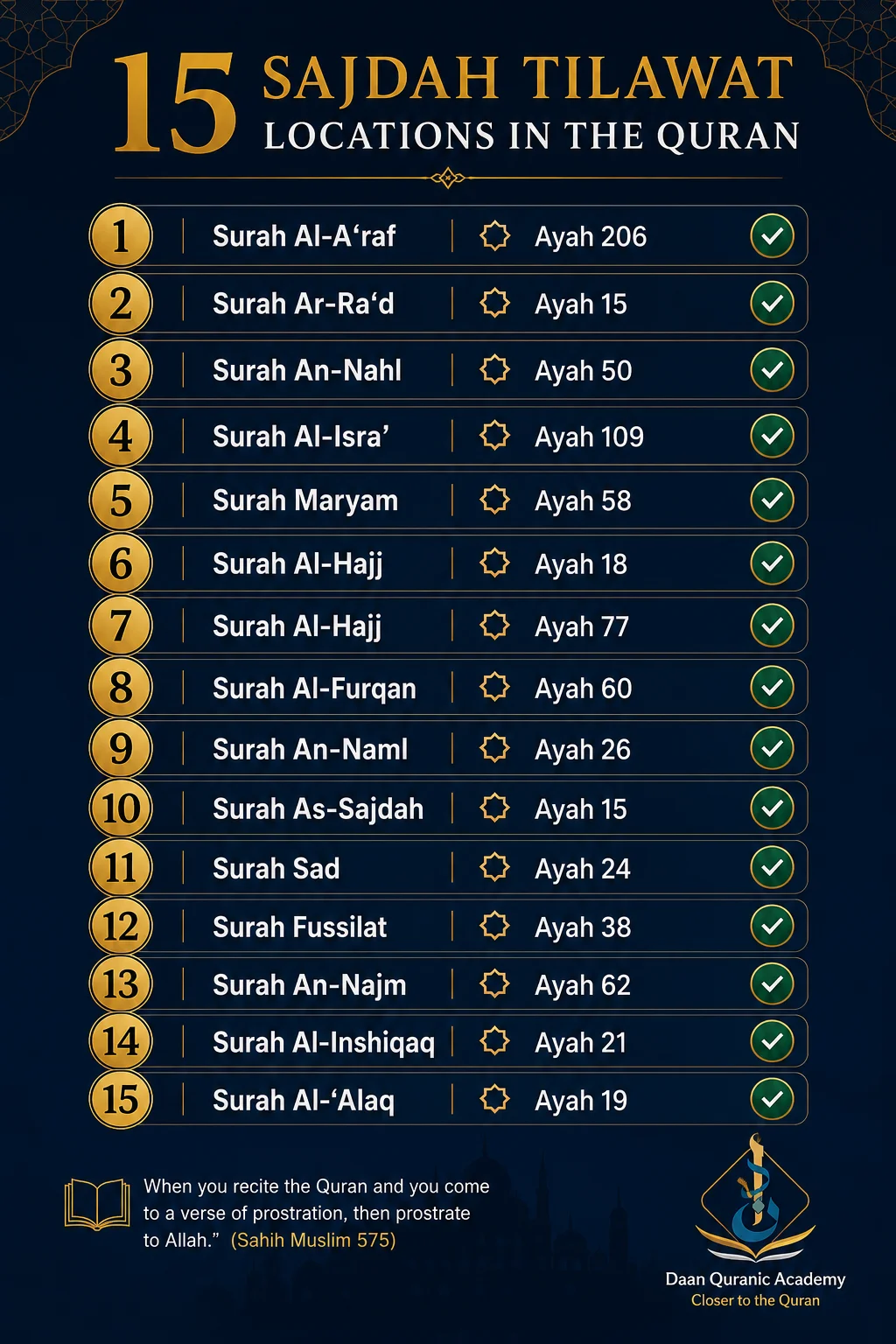
How many sajdahs in the quran across all schools combined? 15 possible locations. Here is the complete, para-wise list of every verse associated with sajdah tilawat, including the one location where scholars differ. Use this as a reference while reciting — many printed Mushafs mark these verses with a small ۩ symbol in the margin.
| # | Surah | Ayah | Included By |
|---|---|---|---|
| 1 | Al-A’raf | 7:206 | All schools |
| 2 | Ar-Ra’d | 13:15 | All schools |
| 3 | An-Nahl | 16:50 | All schools |
| 4 | Al-Isra | 17:109 | All schools |
| 5 | Maryam | 19:58 | All schools |
| 6 | Al-Hajj (1st) | 22:18 | All schools |
| 7 | Al-Hajj (2nd) | 22:77 | Shafi’i, Maliki, Hanbali |
| 8 | Al-Furqan | 25:60 | All schools |
| 9 | An-Naml | 27:26 | All schools |
| 10 | As-Sajdah | 32:15 | All schools |
| 11 | Sad | 38:24 | Hanafi (others: sajda shukr) |
| 12 | Fussilat | 41:38 | All schools |
| 13 | An-Najm | 53:62 | All schools |
| 14 | Al-Inshiqaq | 84:21 | All schools |
| 15 | Al-Alaq | 96:19 | All schools |
Two of these locations from the full list of how many sajdahs in the quran are especially popular for practicing recitation, since they close two of the shortest and most memorized surahs:
كَلَّا لَا تُطِعْهُ وَاسْجُدْ وَاقْتَرِبْ ۩
“No — do not obey him. Instead, prostrate and draw near to Allah.”
Getting comfortable spotting these verses mid-Surah — and pronouncing the surrounding words with correct Tajweed — develops fastest with a live tutor correcting you in real time. Read our related guide on 5 Common Tajweed Mistakes Non-Arabic Speakers Make for more on this.
How Many Sajdah Tilawat in Quran: 14 or 15 by Madhhab
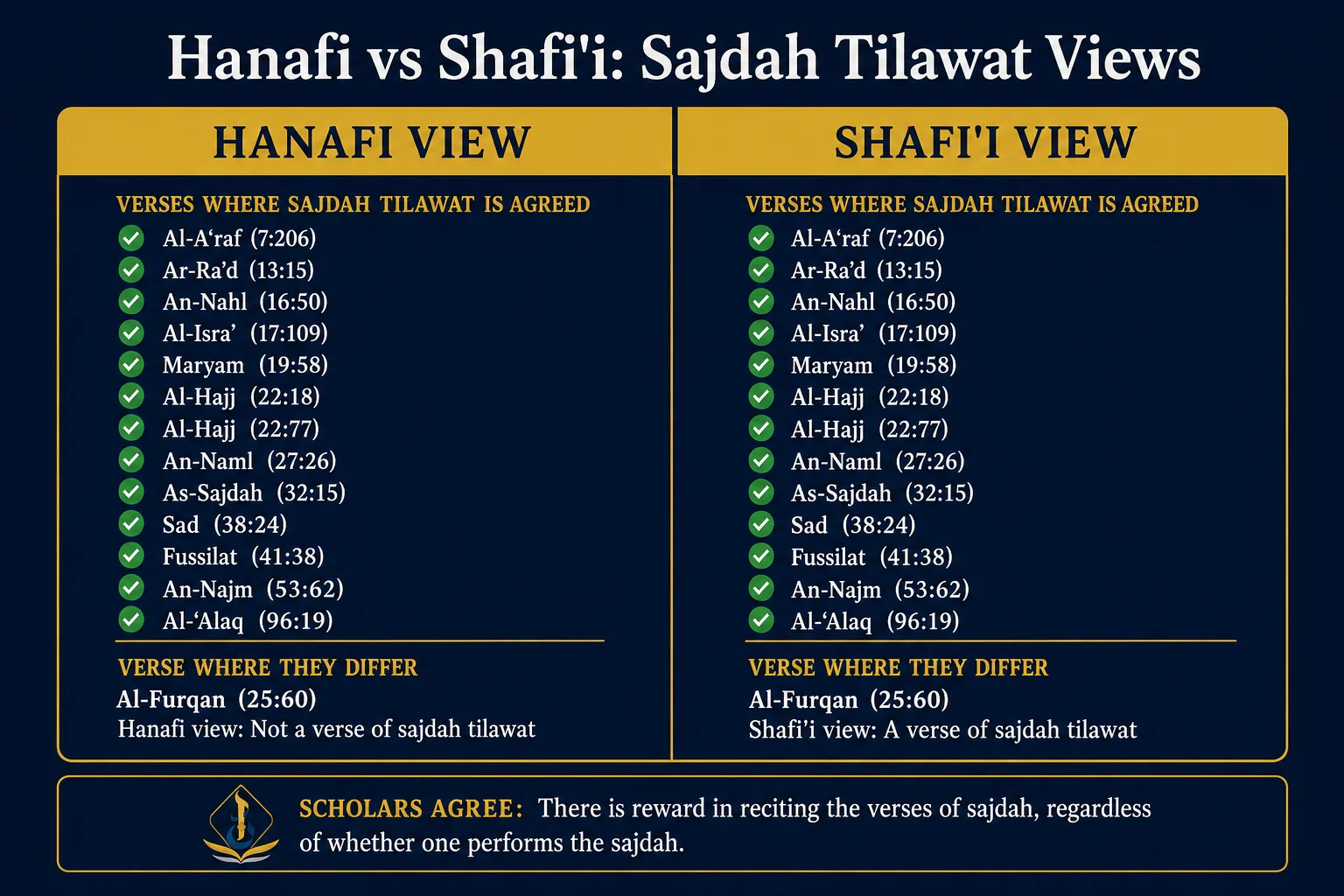
The honest answer to how many sajdah tilawat in quran scholars universally agree on is 14 — the disagreement over the 15th is a matter of legal reasoning (fiqh), not a difference in the Quranic text itself. Every single Arabic word of the sajdah verses is identical across all schools; what differs is whether a given verse is classified as a command to prostrate immediately, or as a description of prostration that does not carry that ruling.
| Point of Comparison | Hanafi View | Shafi’i / Maliki / Hanbali View |
|---|---|---|
| Total sajdah count | 14 | 14 (different 14th verse) |
| Surah Sad (38:24) | Counted as sajdah tilawat | Counted as sajda shukr, not tilawat |
| Al-Hajj second sajdah (22:77) | Not counted | Counted as the second sajdah in Al-Hajj |
| Ruling on performing it | Wajib (obligatory) | Sunnah / mustahab (highly recommended) |
The Shafi’i position draws on a hadith in which Umar ibn al-Khattab (RA) recited a sajdah verse during a Friday sermon and prostrated, then on a later Friday recited the same verse but chose not to, explaining that Allah had not made the prostration obligatory unless the reader wished (Sahih al-Bukhari 1077). When deciding how many sajdah tilawat in quran applies to your practice, the safest approach recommended by many scholars is simply to prostrate at all 15 possible locations. A qualified Tajweed tutor can walk you through which convention your household or region typically follows.
Why Do Muslims Prostrate When Reciting These Verses?
Sajdah tilawat is a direct, physical response to hearing the Quran describe prostration — a moment where the listener joins the angels, the earth, and creation itself in acknowledging Allah. For many reverts especially, that first sajdah tilawat — pausing mid-recitation to physically bow — is a memorable, grounding moment in their journey with the Quran.
“Whenever a son of Adam prostrates upon reciting a sajdah verse, Shaytan withdraws in despair, lamenting that he was commanded to prostrate and refused — while the believer who obeys earns nearness to Paradise.”
Narrated by Abu Huraira (ra) — Sahih Muslim, Hadith 81a
Understanding how many sajdah in the quran there are and where they fall is part of building genuine confidence in live recitation — the kind of confidence that only comes from regularly encountering these verses with a qualified teacher who can guide your response in real time.
Recognizing a sajdah verse takes more than memorizing a list — you need to be able to read and follow along in the Mushaf confidently. That is why sajdah rules are introduced early inside a structured Noorani Qaida or Quran reading course, once a student can recognize Arabic script and basic Tajweed marks.
How to Perform Sajdah Tilawat: Step-by-Step
Performing sajdah tilawat outside of Salah takes less than a minute and follows a simple, well-documented sequence. Here is the standard method taught by the majority of scholars:
Face the Qibla
Face the Qibla if you are able to, though it is not a strict requirement outside of Salah.
Say “Allahu Akbar”
Begin with “Allahu Akbar” without raising the hands as you would in Salah.
Prostrate Once
Place your forehead on the ground exactly as you would during Salah — one single, full prostration.
Recite the Dua of Sajdah Tilawat
“Sajada wajhiya lilladhi khalaqahu wa shaqqa sam’ahu wa basarahu bihawlihi wa quwwatihi, fatabarakallahu ahsanul khaliqin” — “My face has prostrated to the One who created it and fashioned its hearing and sight by His power and might; blessed is Allah, the best of creators.”
Rise Without a Second Sajdah
A single prostration is sufficient. No taslim (salam) is required outside of Salah.
If you are reciting the Quran and cannot stop immediately — for example while driving, or listening to a recitation on your phone — the majority view is that it remains recommended (or obligatory, for Hanafis) to perform the missed sajdah as soon as reasonably possible afterward.
What to Look For in a Quran Academy That Teaches Tajweed and Sajdah Rules
The best online Quran academy for learning recitation, Tajweed, and sajdah rules combines certified native Arabic tutors, genuinely private lessons, and transparent, affordable pricing. If you are comparing options for yourself or your child, these are the criteria worth checking before you commit.
Native, Formally Trained Tutors
Look for tutors who are native Arabic speakers with formal training in Quranic sciences — not just fluent readers. At Daan Quranic Academy, every tutor is a native Egyptian Arab, and many are certified Ijazah holders in multiple Qira’at with a verified chain of transmission back to the Prophet ﷺ.
Genuinely 1-on-1 Lessons
Group classes dilute how much individual correction a student receives, especially for something as precise as Tajweed pronunciation or recognizing a sajdah verse mid-recitation. Every class at Daan Academy is a private, 1-on-1 session, so the tutor’s full attention is on your progress alone.
Clear Progress Tracking
Where many platforms leave parents guessing about what’s actually being covered, Daan Academy uses a Smart Student Dashboard where you can track sessions, review detailed progress reports, and see exactly which surahs, rules, and milestones your child has completed.
Fluent English Communication
A tutor’s Quranic knowledge only helps if they can actually explain it in a language you understand. Every tutor at Daan Academy speaks fluent English, removing the language barrier that many English-speaking Muslims and reverts run into with other academies.
You can browse the full breakdown of what is covered — from Noorani Qaida through Tajweed Rules Mastery and Ijazah — on our courses page, or read more about our teaching approach on the Why Choose Us page.
Learning the Sajdah Verses Online: Cost, Value, and What’s Included
Online Quran and Tajweed classes that include sajdah tilawat and recitation rules typically start from as little as $9/hr when taught 1-on-1 by a qualified native tutor. Cost is often the biggest hesitation for families comparing academies, so it is worth knowing exactly what you are paying for before choosing a plan.
Daan Academy’s plans start from just $9/hr with native Egyptian tutors. Compare our three flexible pricing tiers — Essential ($9/hr), Pro ($10.99/hr), and Elite ($12.99/hr, with a family discount available) — each designed for different learning goals and budgets.
- Flexible scheduling — book sessions at any time, from anywhere in the world, around school or work
- 600+ educational games — for children learning Noorani Qaida and early recitation, to keep sessions engaging
- Verified completion certificates — issued at each course milestone
- Smart session reminders — automated notifications so no class is missed
- 24/7 dedicated support — for technical or academic questions, any time
Rather than committing upfront, it is worth trying a session first. Every new student can book a free trial class to experience a 1-on-1 lesson with a native tutor before choosing a plan — no obligation attached.
How Many Sajdah in Quran: Online vs. at a Local Mosque
Understanding how many sajdah in quran there are is the same whether you learn online or at a mosque — the real difference is how consistently and accurately that knowledge is transmitted. Local mosque classes are often free or low-cost and offer valuable in-person community, but they are frequently taught in groups on a fixed weekly schedule that is hard to reschedule around family or work commitments.
Online academies with native tutors solve the scheduling problem directly. For families across the UK, USA, and Europe, learning how many sajdah in quran there are and how to perform each one correctly is more effective in a private online session than in a crowded local class — especially when the tutor can pause, demonstrate, and correct pronunciation mid-recitation without interrupting an entire group.
For non-Arabic speakers specifically, this consistency matters even more. Our guide on How to Learn Quran for Non-Arabic Speakers covers this in more depth if you are just getting started.

Frequently Asked Questions
How many sajdah in the quran are there exactly?
How many sajdah in the quran? There are 14 verses of prostration agreed upon by all four major Sunni schools, with a possible 15th depending on your madhhab — Hanafi scholars count Surah Sad (38:24), while Shafi’i, Maliki, and Hanbali scholars count the second sajdah in Surah Al-Hajj (22:77) instead.
How many sajdahs in the quran if I follow the Shafi’i school?
How many sajdahs in the quran for Shafi’i followers? 14 — the same number as Hanafi, but with a different 14th verse. Shafi’i scholars count the second sajdah in Surah Al-Hajj (22:77) rather than Surah Sad (38:24). The total across both positions is 15 possible locations.
How many sajdah tilawat in quran does a student need to recognize?
A student should recognize all 15 possible locations for how many sajdah tilawat in quran there are, even if they only follow 14 based on their madhhab — because many Mushafs mark all 15 with the ۩ symbol. Most Tajweed tutors cover all locations and explain the madhhab distinction clearly during lessons.
How much do online Quran classes that teach Tajweed and sajdah rules cost?
At Daan Quranic Academy, 1-on-1 classes start from $9/hr on the Essential plan, with Pro and Elite tiers offering additional features. You can compare all three plans in detail on our pricing page.
Can I try a class before committing to a plan?
Yes. Daan Academy offers a free trial session with no commitment required, so you can meet your tutor and experience a 1-on-1 class before choosing a plan.
What if I forget to perform sajdah tilawat while reciting?
The majority view is that you should perform the missed sajdah as soon as you reasonably remember, even after finishing your recitation. It does not invalidate your reading of the Quran.
How do I know whether to follow the 14 or 15 sajdah tilawat count?
This depends on which madhhab you or your community follow — Hanafi scholars count Surah Sad (38:24), while Shafi’i, Maliki, and Hanbali scholars count the second sajdah in Surah Al-Hajj (22:77) instead. If you are unsure, many scholars suggest prostrating at all 15 possible locations to be safe.
Learn to Recognize Every Sajdah Verse With Confidence
Now that you know how many sajdah in the quran — 14 agreed upon, 15 locations in total — the next step is reading them fluently with correct Tajweed. A free trial with a native Egyptian tutor is the easiest way to see where you or your child currently stand.
No commitment required. One free session to experience the Daan Academy difference.
Final Thoughts
Whether you count 14 or 15, every sajdah verse in the Quran carries the same message — that all of creation bows to Allah, and the reader is invited to join in that submission physically, not just in words. How many sajdah in the quran you encounter in your recitation depends on how much of the Quran you cover — and learning to recognize all of them, pause correctly, and recite with proper Tajweed is a skill that grows with consistent, guided practice. Explore more on our blog or book a free trial with Daan Quranic Academy today.
We ask Allah to make the Quran a source of light and guidance in your recitation, and to make every sajdah a means of nearness to Him. Ameen.