
Idgham in Tajweed: Letters & Idgham Mutajanisain Explained (2026 Guide)
Idgham in Tajweed is the rule that merges one Arabic letter into the letter after it, so the two are pronounced as a single, doubled sound instead of two separate ones. Get it wrong and a recitation sounds choppy and hesitant; get it right and it flows the way a trained reciter’s recitation should. This guide walks through every idgham letter, breaks down idgham mutajanisain step by step with real Quranic examples, and shows you exactly what to look for in a tutor who can correct these rules live — whether you’re a parent choosing lessons for your child or an adult revert building your recitation from the ground up.
📑 Table of Contents
- What Is Idgham in Tajweed? A Clear Definition
- Idgham Letters: The Complete Breakdown by Category
- Idgham Mutajanisain Explained: When Two Letters Share a Makhraj
- Idgham Tajweed Rules: How to Apply Idgham Correctly
- Idgham Examples from Quran You Can Practice Today
- What to Look For in a Course That Teaches Idgham in Tajweed
- Idgham vs Ikhfa vs Izhar: Where Idgham Fits Among the Noon Sakinah Rules
- Common Mistakes Learners Make With Idgham in Tajweed
- How to Practice Idgham in Tajweed at Home Between Lessons
- Frequently Asked Questions
What Is Idgham in Tajweed? A Clear Definition
Idgham in Tajweed (إدغام) is the rule of merging two neighbouring letters so that the first letter disappears and the second is pronounced with a shaddah, or doubling. Rather than voicing two distinct sounds, the reciter blends them into one stronger sound — a technique that separates fluent, correctly-trained recitation from a hesitant, letter-by-letter read.
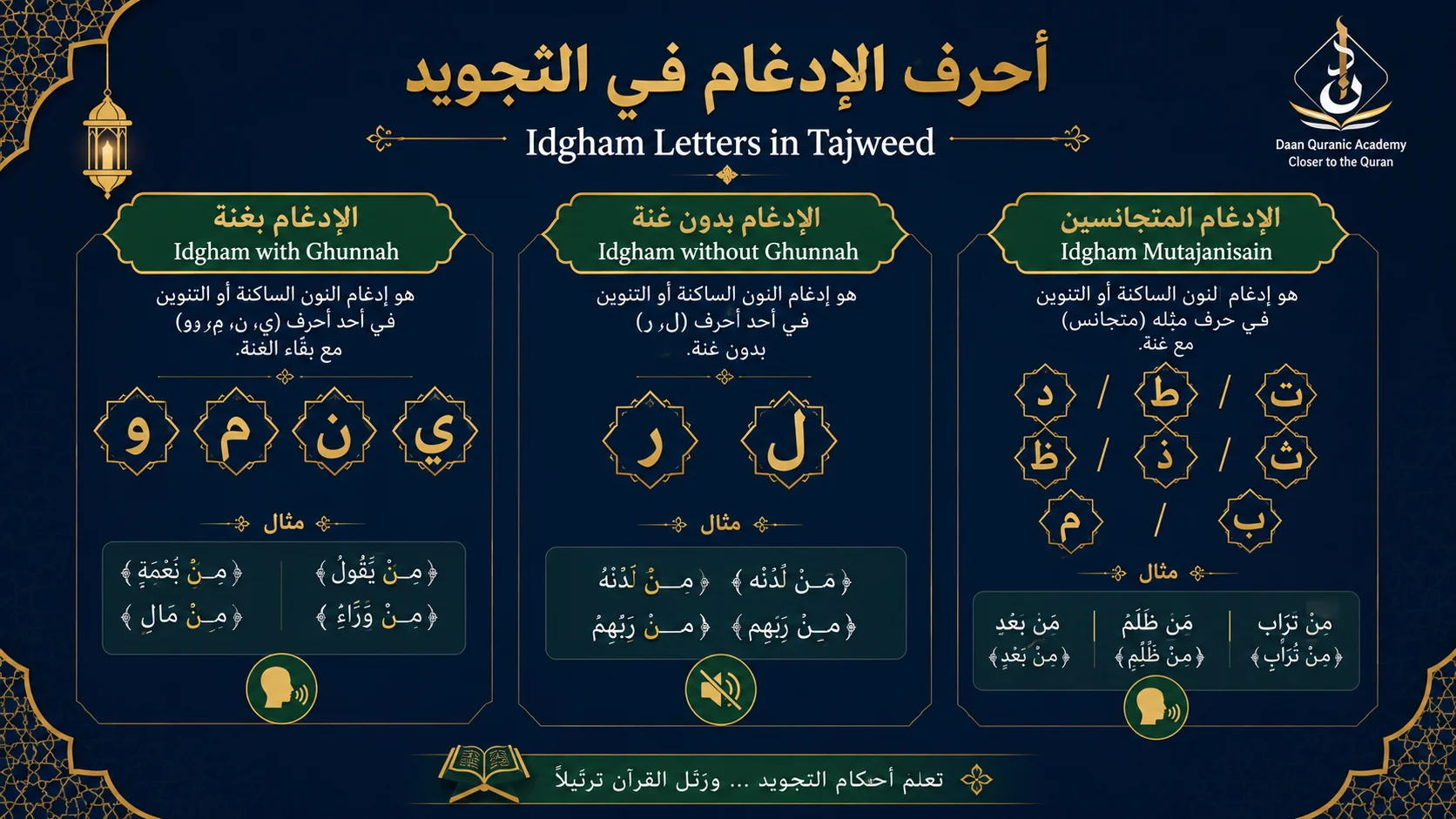
Idgham isn’t one single rule — it’s a family of related rules that scholars of Tajweed (the science of correct Quranic pronunciation, formalised in classical texts such as Al-Jazariyyah) grouped by what causes the merge. Some idgham rules apply specifically when a Noon Sakinah or Tanween meets certain letters. Others — including idgham mutajanisain, the focus of much of this guide — apply whenever two letters with a shared or close articulation point (makhraj) meet, regardless of Noon Sakinah.
This matters because idgham isn’t cosmetic. In several of the examples below, skipping the merge or forcing one where it doesn’t belong changes how a verse sounds when read aloud — and a tutor who can hear that in real time, on a live call, is worth far more than an app that only checks whether you tapped the right answer. That’s the gap a Noorani Qaida foundation followed by structured Tajweed practice is designed to close, and it’s exactly what Daan Academy’s Tajweed Rules Mastery course builds toward.
“The one who is skilled in reciting the Quran is with the noble, obedient angel-scribes, and the one who recites it while stumbling and finding it difficult will have a double reward.”
Narrated by Aisha (RA) — Sahih Muslim 798
This hadith is often cited in Tajweed classes for a reason: it frames skill in recitation — including rules like idgham — as something worth striving for, not a technicality reserved for scholars. Getting idgham in Tajweed right is part of that skill.
Idgham Letters: The Complete Breakdown by Category
The idgham letters fall into several groups: the letters that trigger merging after a Noon Sakinah or Tanween (ي ن م و ل ر), and the letters that merge because they share or are close in articulation point, known as idgham mutajanisain and idgham mutaqaribain. Confusing these categories is one of the most common reasons students apply idgham inconsistently.
Real session recording: A student reads a passage containing a merged-letter rule and is corrected live, mid-sentence, by a certified tutor listening for the exact moment the merge should happen. All videos are real, unedited screen-recordings from actual student sessions at Daan Academy, posted with student consent.
Here is how the idgham letters break down once you separate the Noon Sakinah rules from the makhraj-based rules:
| Idgham Type | Letters / Trigger | What Happens |
|---|---|---|
| Idgham Ma’al Ghunnah (with nasal sound) | ي ن م و — from Noon Sakinah/Tanween | The Noon merges into the next letter and a nasal hum is held for roughly two counts |
| Idgham Bila Ghunnah (without nasal sound) | ل ر — from Noon Sakinah/Tanween | The Noon merges cleanly into the letter with no nasal hum |
| Idgham Mutamathilain | Two identical letters meet (same letter, same sifaat) | Full merge into one doubled letter |
| Idgham Mutajanisain | Same makhraj, different sifaat — e.g. ت ط د / ث ذ ظ / ب م | The first letter is absorbed entirely into the second |
| Idgham Mutaqaribain | Close (not identical) makhraj or sifaat — e.g. ل ر, ق ك | Merges in specific word combinations, narration-dependent |
Notice that idgham mutajanisain and idgham mutaqaribain aren’t tied to Noon Sakinah at all — they can occur between any two qualifying letters when one word ends and the next begins with the right pair. That’s what makes them trickier to spot than the Noon Sakinah rules, and it’s exactly what the next section unpacks.
Idgham Mutajanisain Explained: When Two Letters Share a Makhraj
Idgham Mutajanisain in Tajweed happens when two letters that leave the mouth from the exact same articulation point meet, but differ in their characteristics — and the first letter is fully absorbed into the second. “Mutajanisain” literally means “of the same kind,” referring to shared makhraj rather than identical letters.
There are three letter groups where this occurs most often in the Quran:
- Tongue-tip / alveolar group: ت (ta), ط (ta emphatic), د (dal) — all articulated from the tip of the tongue against the base of the upper front teeth or gums
- Interdental group: ث (tha), ذ (dhal), ظ (za) — all articulated with the tongue between the teeth
- Labial group: ب (ba), م (meem) — both articulated at the lips
Here are two of the clearest examples in the Quran. In the first, a ت meets a ط:
وَدَّت طَّائِفَةٌ مِّنْ أَهْلِ الْكِتَابِ لَوْ يُضِلُّونَكُمْ
“A group among the People of the Book wished they could lead you astray — though they mislead only themselves, without realising it.” (meaning conveyed)
The ت at the end of “وَدَّتْ” fully merges into the ط of “طَّائِفَةٌ,” so the phrase is read as one merged sound rather than two separate letters. In the second example, a ب meets a م:
يَا بُنَيَّ ارْكَب مَّعَنَا وَلَا تَكُن مَّعَ الْكَافِرِينَ
“O my son, come aboard with us, and do not be with the disbelievers.” (meaning conveyed)
Both examples show the same principle: when the reciter’s tongue or lips are already in position for the second letter, holding onto the first letter separately would slow the recitation down and break its rhythm — so it merges instead. This is one of the areas where native Egyptian tutors add real value, because hearing the difference between a genuine merge and an incomplete one takes trained ears, not just a printed rulebook.
Idgham Tajweed Rules: How to Apply Idgham Correctly
Applying idgham tajweed rules correctly comes down to identifying the letter pair, classifying which idgham type applies, and then practising the merge out loud with feedback — not just reading the rule silently. Here’s the process step by step.
Identify the letter pair at the word boundary
Look at the last letter of one word and the first letter of the next (or a Noon Sakinah/Tanween followed by any letter). This is where every idgham rule starts.
Classify the relationship between the two letters
Are they identical (mutamathilain), same makhraj but different sifaat (mutajanisain), or close but not identical (mutaqaribain)? Or is a Noon Sakinah/Tanween involved at all?
Decide whether Ghunnah applies
For Noon Sakinah idgham specifically, ي ن م و carry a nasal Ghunnah; ل ر do not. Mutajanisain and mutaqaribain generally merge without a nasal hum.
Practise the merge slowly, then at normal pace
Say both letters separately first so you know what’s being merged, then blend them, then read the full verse at a natural recitation speed.
Get live correction from a qualified tutor
Idgham mistakes are auditory — you often can’t hear your own error the way a trained listener can. A free trial session is the fastest way to find out exactly where your idgham needs work.
Idgham Examples from Quran You Can Practice Today
The Quran contains dozens of idgham examples across every juz, and practising with real verses — rather than isolated letter drills — is the fastest way to internalise the rule. Beyond the two verses already covered above, here are three more worth reading aloud slowly:
- Idgham of ذ into ظ: “إِذ ظَّلَمُوا أَنفُسَهُمْ” — Surah An-Nisa, 4:64 — the ذ at the end of “إِذْ” merges into the ظ of “ظَّلَمُوا.”
- Idgham of ث into ذ: “يَلْهَث ذَّٰلِكَ مَثَلُ الْقَوْمِ” — Surah Al-A’raf, 7:176 — from the well-known parable comparing a heedless soul to a panting dog.
- Idgham of ط into ت: “وَمِن قَبْلُ مَا فَرَّطتُمْ فِي يُوسُفَ” — Surah Yusuf, 12:80 — read as “farrattum,” with the ط fully absorbed into the ت.
Reading these slowly, out loud, with attention to where your tongue naturally wants to merge the sounds, is one of the best low-cost ways to build a feel for idgham in Tajweed before a lesson — and one of the first things a tutor will check in a Tajweed Rules Mastery session.
What to Look For in a Course That Teaches Idgham in Tajweed
A course that actually teaches idgham in Tajweed well needs a tutor who can hear the merge in real time, not just a workbook that defines the rule. Idgham is fundamentally an auditory skill, so the format of the course matters as much as the content.
A Native Arabic-Speaking Tutor
The letter groups behind idgham mutajanisain — tongue-tip, interdental, labial — are second nature to a native speaker’s ear in a way they rarely are to a non-native one. While many platforms use non-native or part-time instructors, every tutor at Daan Academy is a native Egyptian Arabic speaker, formally trained in Quranic sciences.
1-on-1 Sessions, Not Group Classes
Idgham mistakes are individual — two students rarely make the exact same error at the exact same word. Unlike group classes that dilute attention across several students, Daan Academy runs every class as a private, personalised 1-on-1 session.
Certified, Ijazah-Level Qualifications
Look for tutors who hold a verified Ijazah — a certified chain of transmission back to the Prophet ﷺ — rather than informal experience alone. Many tutors at Daan Academy hold Ijazah in multiple Qira’at, which is part of why they can catch subtle merge errors other instructors miss.
Clear, Transparent Pricing
Some platforms are vague about cost until after signup. Daan Academy’s three plans are listed openly, starting from $9/hr, so families can compare value before committing to anything.

Plans start from just $9/hr with native Egyptian tutors. Compare our three flexible pricing tiers — Essential, Pro, and Elite — each designed for different learning goals and budgets.
Here’s how the common learning formats compare when it comes specifically to catching idgham errors:
| Format | Live Correction | Native Tutor | Ijazah-Certified | Pricing Transparency |
|---|---|---|---|---|
| Self-study apps | No | N/A | N/A | Usually clear |
| Typical group classes | Limited | Varies | Varies | Often unclear |
| Daan Academy 1-on-1 | Yes, every session | Yes, always | Many tutors | Clear, from $9/hr |
You can see why most academies offering generic, one-size-fits-all curricula struggle with a rule like idgham — where a tutor genuinely needs to build a plan around what an individual student is doing wrong, not a fixed lesson script.
Idgham vs Ikhfa vs Izhar: Where Idgham Fits Among the Noon Sakinah Rules
Idgham is one of four rules that govern what happens to a Noon Sakinah or Tanween — the other three being Ikhfa, Izhar, and Iqlab — and each produces a different sound. Confusing them is a common early mistake.
| Rule | What Happens to the Noon | Trigger Letters |
|---|---|---|
| Izhar (clear) | Pronounced clearly, no change | ء ه ع ح غ خ |
| Idgham (merging) | Merges into the next letter, with or without Ghunnah | ي ن م و ل ر |
| Iqlab (conversion) | Converted to a meem sound with Ghunnah | ب |
| Ikhfa (concealment) | Hidden, nasal sound between clear and merged | The remaining 15 letters |
Idgham Mutajanisain and Idgham Mutaqaribain sit slightly outside this four-way system — they’re triggered by shared or close makhraj between any two letters, not specifically by a Noon Sakinah. A well-structured course will teach both systems separately so students don’t blend the concepts together.
Common Mistakes Learners Make With Idgham in Tajweed
The most common mistake with idgham in Tajweed is under-merging — pausing slightly between the two letters instead of blending them — closely followed by over-merging letters that should actually stay separate. Both are hard to self-diagnose.
- Rushing or dropping the Ghunnah in idgham ma’al ghunnah, so the nasal hum is too short or missing entirely
- Applying idgham mutajanisain where Izhar or Qalqalah rules should actually take priority — a nuance that depends on the specific letters and word structure
- Confusing similar-looking letters (like ذ, د, and ض) because the differences in sifaat aren’t obvious to a non-native ear
- Practising rules in isolation from real verses, then struggling to apply them at natural recitation speed
These are exactly the errors that a tutor listening live can catch instantly but that a self-paced app usually cannot. Across families in 15+ countries, this is the single biggest reason parents move a child from an app-only approach to a qualified, native-speaking tutor — the correction has to happen in the moment, not after a quiz score comes back.
How to Practice Idgham in Tajweed at Home Between Lessons
The fastest way to strengthen idgham in Tajweed between lessons is short, focused practice on a handful of verses — not long, unfocused reading sessions. A few consistent habits make a measurable difference.
- Record yourself reading a short passage and compare it to a certified reciter’s audio
- Revisit Noorani Qaida basics if a specific letter pair keeps tripping you up
- Keep a running list of the idgham examples you personally struggle with, rather than drilling every rule equally
- For children, interactive practice tends to stick better than repetition alone — Daan Academy’s 600+ educational games library is designed around exactly this
- Check session notes on the student dashboard after each class so practice time targets what the tutor actually flagged

Smart notifications before each session help keep this rhythm going without extra effort from parents, and the same dashboard that tracks progress also makes it simple to see improvement over weeks, not just after a single class.
Frequently Asked Questions
What is idgham in Tajweed, in simple terms?
Idgham is the Tajweed rule where one letter merges into the next so they’re pronounced as a single, doubled sound instead of two separate letters.
What are the idgham letters?
For Noon Sakinah and Tanween, the idgham letters are ي ن م و (with Ghunnah) and ل ر (without Ghunnah). Separately, idgham mutajanisain applies to letter pairs sharing a makhraj, such as ت ط د, ث ذ ظ, and ب م.
What is the difference between idgham mutajanisain and idgham mutaqaribain?
Idgham mutajanisain occurs between letters that share the exact same makhraj but differ in sifaat. Idgham mutaqaribain occurs between letters whose makhraj or sifaat are close but not identical, such as ل and ر.
How much do online Tajweed classes cost?
At Daan Academy, plans start from $9/hr on the Essential tier, with Pro and Elite options available. You can compare all three on the pricing plans page.
Can I try a Tajweed class before committing?
Yes — Daan Academy offers a free trial session with no commitment required, so you can experience a live 1-on-1 class before choosing a plan.
Is it safe for my child to learn idgham and Tajweed online?
Every class is private and 1-on-1 with a vetted, native Egyptian tutor, with session activity visible to parents through the student dashboard. You can read more about our approach on the Why Choose Us page.
How do I know if a tutor is qualified to teach idgham and other Tajweed rules?
Look for a verified Ijazah with a documented chain of transmission, not just informal teaching experience. You can view tutor credentials on the Our Tutors page.
Ready to Master Idgham in Tajweed With a Live Tutor?
Reading about idgham mutajanisain is one thing — hearing exactly where your recitation needs correction is another. Book a free trial and get real-time feedback from a native Egyptian tutor.
No commitment required. One free session to experience the Daan Academy difference.
Final Thoughts
Idgham in Tajweed rewards patient, listened-to practice more than memorised rules on a page. Once you can hear the difference between a genuine merge and two separate letters — and once a tutor has corrected you through the specific examples in this guide — idgham mutajanisain stops being an abstract category and becomes something your tongue simply knows how to do.
We ask Allah to make the learning and teaching of His Book easy for every student reading this in 2026, and to grant reward for every letter recited correctly. Explore more guides like this on our blog.