
Tajweed for Beginners: The Ultimate Starting Guide to Reading Quran
Tajweed for beginners doesn’t mean memorizing a hundred rules overnight — it means learning a small set of high-frequency pronunciation rules under the ear of a qualified tutor who can catch mistakes before they become habits. Most people searching for tajweed for beginners are really asking three things at once: which rules matter first, what proper instruction costs, and whether online classes can genuinely replace sitting knee-to-knee with a teacher. This guide answers all three, walks through the exact rules of tajweed for beginners that Quran teachers introduce first, and shows what a well-run tajweed program — including the one at Daan Quranic Academy — should look like in 2026.
📑 Table of Contents
- What Is Tajweed? A Clear Definition
- Rules of Tajweed for Beginners
- How to Choose the Best Tajweed Program
- Quran Tajweed Rules for Beginners vs Learning Alone
- Tajweed Classes Pricing
- Your Step-by-Step Roadmap
- Real Results From Learning Tajweed Online
- Common Tajweed Mistakes Beginners Make
- Frequently Asked Questions
Tajweed for Beginners 101: What Tajweed Actually Means
Tajweed (تجويد) is the set of Arabic pronunciation rules that governs how each letter of the Quran is voiced, lengthened, joined, or paused on, so that recitation matches how the Quran was revealed to the Prophet Muhammad ﷺ. The word comes from the root جوّد (jawwada), meaning “to make excellent.” Without it, a reciter can unintentionally change a word’s meaning — shortening a vowel that should be held, or softening a letter that should be emphasized.
For a true beginner, tajweed for beginners really comes down to a handful of building blocks: the correct articulation point (مخرج, makhraj) of each Arabic letter, the rules of Noon Sakinah and Tanween, the rules of Madd (elongation), and basic stopping etiquette. Everything more advanced — the ten Qira’at, subtle Waqf distinctions, Ijazah-level precision — is built on top of this foundation later on.
أَوْ زِدْ عَلَيْهِ وَرَتِّلِ الْقُرْآنَ تَرْتِيلًا
“…or add to it, and recite the Qur’an with measured recitation.”
This is why tajweed is never treated as an optional extra in Islamic education — it is the practical fulfilment of a direct Quranic instruction to recite with tarteel. At Daan Quranic Academy, this principle shapes how the Tajweed Rules Mastery course is structured: beginners start with the highest-frequency rules first, not an alphabetical list pulled from a classical text.
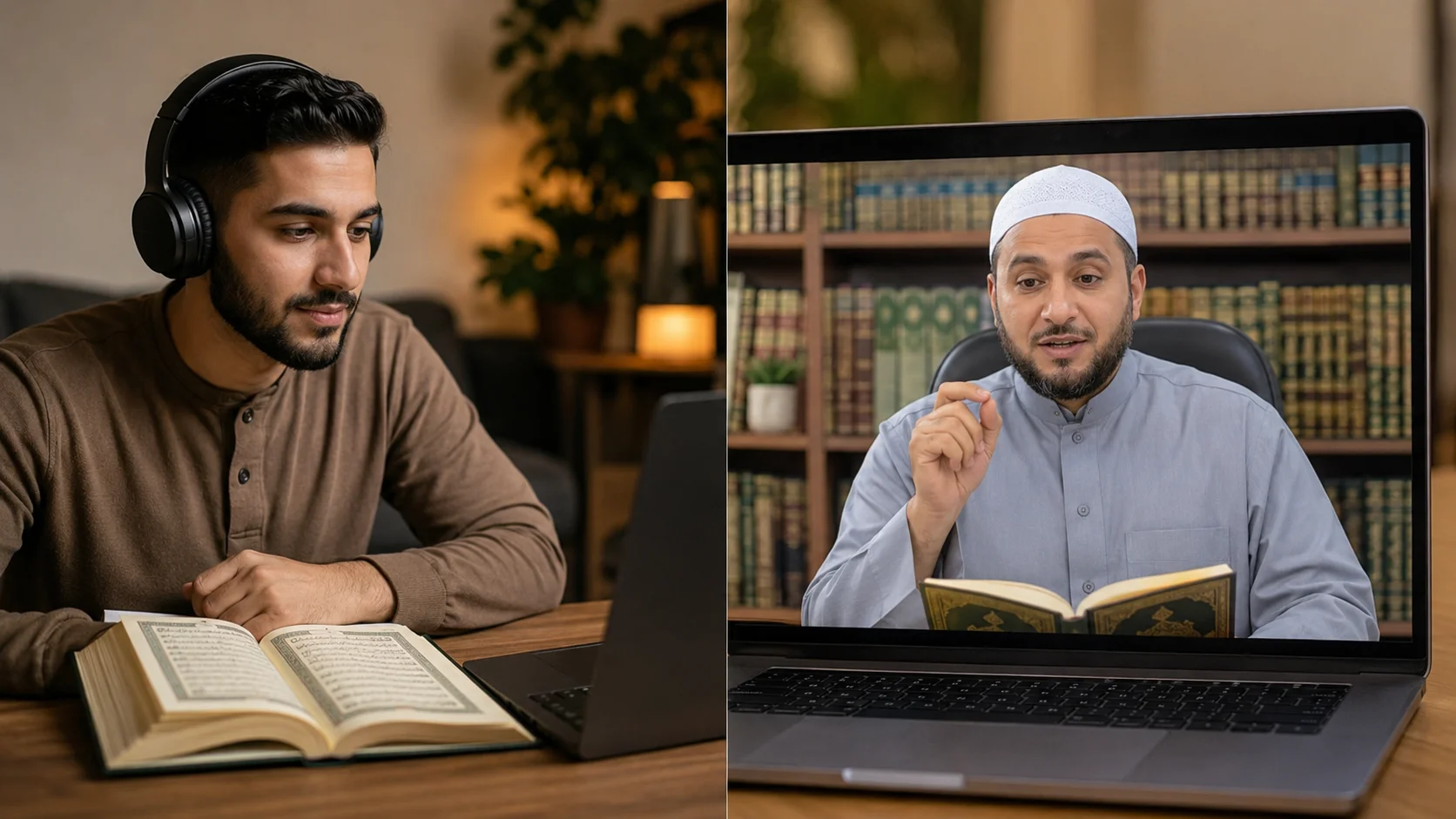
Reading about tajweed for beginners is a useful start, but tajweed is fundamentally an oral skill — you cannot verify your own Makharij by reading a rule written in English. This is the single biggest reason self-taught beginners plateau: there is no ear correcting them in the moment they make a mistake.
Rules of Tajweed for Beginners: Where Real Progress Starts
The rules of tajweed for beginners that matter most in the first few weeks are Noon Sakinah and Tanween (Izhar, Idgham, Iqlab, and Ikhfa), the three Madd letters, and Qalqalah on its five designated letters. These rule groups appear on almost every page of the Quran, which is why a good teacher drills them before anything else — mastering just these four groups changes how confidently a beginner reads from day one.
Real session recording: a native Egyptian tutor correcting a student’s pronunciation in real time during a live Tajweed session — pausing the moment a rule is missed rather than letting the mistake repeat. All videos are real, unedited screen-recordings from actual student sessions at Daan Academy, posted with student consent.
Seeing these rules applied in real recitation makes them click faster than any written explanation. Notice how the tutor above pauses the student mid-ayah the instant a Madd is under-held or a Noon Sakinah rule is skipped — that kind of real-time correction is difficult to replicate with an app or a pre-recorded course.
“The one who is proficient in reciting the Qur’an will be with the honourable, obedient scribes; the one who reads it with difficulty, struggling through it, will have a double reward.”
Narrated by Aisha (RA) — Sahih al-Bukhari 4937, Sahih Muslim 798
Quran teachers often share this hadith with nervous beginners for a reason: even a stumbling, effortful recitation is rewarded twice over. Learning the rules of tajweed for beginners was never meant to require perfection on day one — it requires steady, corrected practice. Every native Egyptian tutor at Daan Academy is trained to encourage exactly that kind of patient, rule-by-rule progress instead of rushing a student toward fluency.
By the time a beginner has these four rule groups under control — usually within four to eight weeks of consistent, once- or twice-weekly 1-on-1 lessons — the rest of tajweed becomes far easier to absorb.
How to Choose the Best Tajweed Program: What to Look For
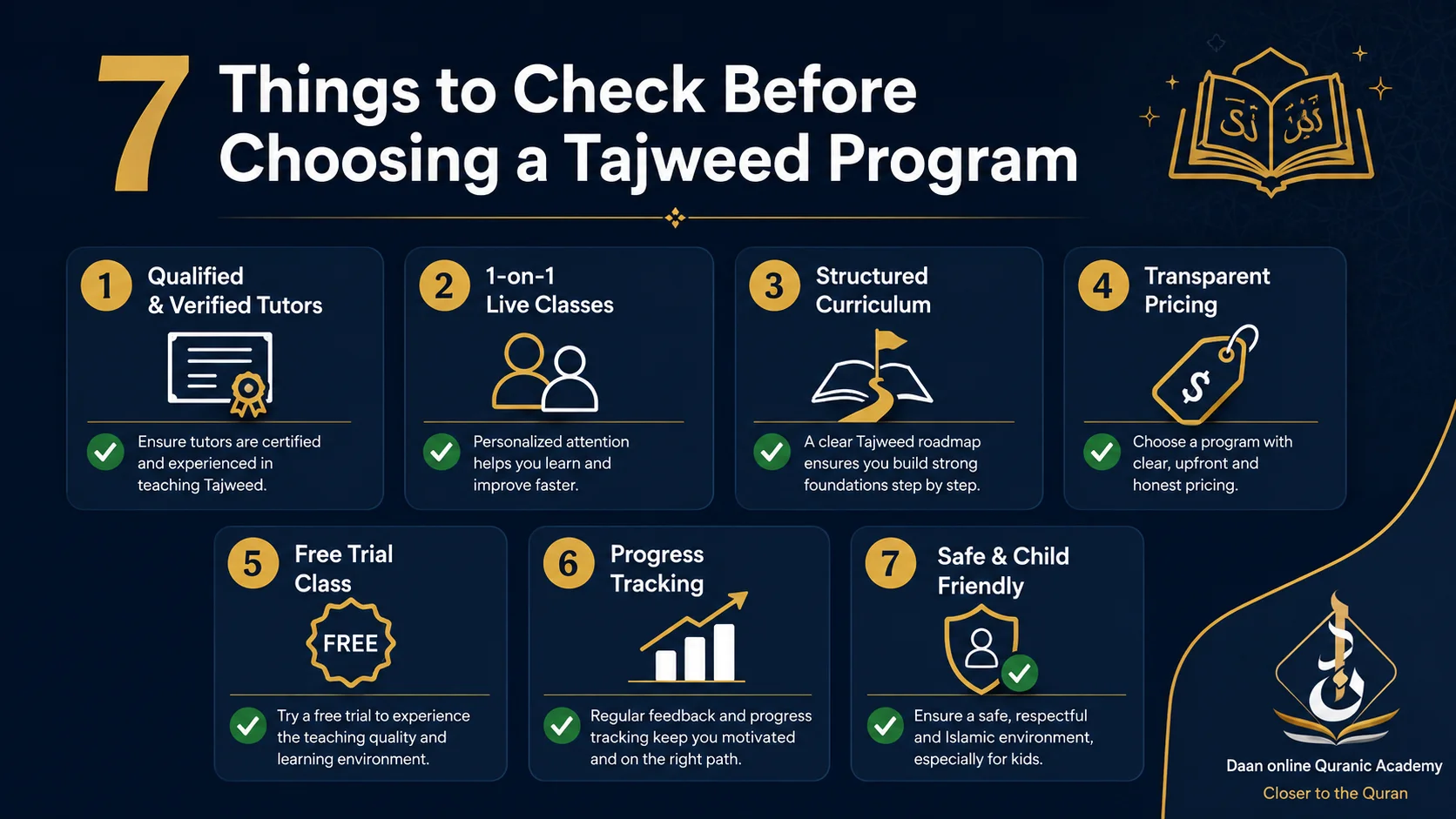
A quality tajweed program for beginners should offer live 1-on-1 correction from a native Arabic-speaking tutor, a clear beginner-to-advanced curriculum, transparent pricing, and a way to try a class before paying. Group classes, recorded videos, and apps can teach the theory, but none of them can hear your Makharij and correct it in real time.
Why Quran Tajweed for Beginners Should Start With a Native-Speaking Tutor
Arabic letters such as ض (Dhad), ع (Ain), and ق (Qaf) have no equivalent sound in English, and a non-native speaker’s ear often can’t detect small errors in a beginner’s articulation. This is one reason quran tajweed for beginners tends to progress fastest with tutors who grew up speaking Arabic themselves. Every tutor at Daan Quranic Academy is a native Egyptian Arabic speaker, formally trained in Quranic sciences and fluent in English, so beginners never lose a correction to a language barrier.
Live 1-on-1 Correction
Unlike group classes that dilute a tutor’s attention across several students, every Daan Academy session is private — the tutor’s full focus stays on your pronunciation, not the class average.
Certified, Native Egyptian Tutors
Many Daan Academy tutors hold Ijazah certifications in multiple Qira’at, with verified chains of transmission (asaneed) rooted in the Al-Azhar tradition of Quranic sciences.
A Real Curriculum, Not Just a Video Library
Where many platforms rely on generic recorded lessons, Daan Academy builds a personalized learning plan tracked through the Daan LMS student dashboard, with session notes and progress reports.
For a fuller breakdown of tutor vetting and how the curriculum is built around each student, see why families choose Daan Academy for their own or their children’s Quran education.
Quran Tajweed Rules for Beginners vs Learning Alone: A Fair Comparison
Self-study can teach the theory behind quran tajweed rules for beginners, but it can’t verify whether you’re actually applying them correctly — and that gap is exactly where guided, 1-on-1 lessons prove their value. The comparison below is intentionally honest about both paths.
| Aspect | Learning Alone (Apps / Books) | 1-on-1 With a Tutor |
|---|---|---|
| Real-time pronunciation correction | Not possible | Every session |
| Pace | Fixed by the app or book | Adjusted to the student |
| Native Arabic ear for feedback | Rare | Standard — native Egyptian tutors |
| Typical cost | Often “free” but slower progress | From $9/hr, faster measurable progress |
| Certification / Ijazah path | Not available | Available through structured courses |
| Accountability | Self-motivated only | Scheduled sessions + progress reports |
Neither path is wrong — plenty of confident reciters started with a book or an app. But for someone asking specifically how to apply quran tajweed rules for beginners correctly from the very first lesson, a tutor closes a feedback loop that self-study simply cannot. We cover this comparison in more depth in our complete guide to the best online Tajweed course in 2026.
Tajweed Classes Pricing: What Learning Tajweed for Beginners Really Costs
Learning tajweed for beginners with a private, certified tutor typically costs between $9 and $13 per hour online — noticeably less than in-person tutoring across the UK, USA, or Europe, and without any travel time. Some platforms keep pricing vague until after a signup call; a transparent academy lists its tiers upfront.
Plans start from just $9/hr with native Egyptian tutors. Compare our three flexible pricing tiers — Essential, Pro, and Elite — each designed for different learning goals and budgets.
The price difference between tiers usually reflects tutor experience level and session length, plus extras such as the family discount available on the Elite plan — not the core teaching quality, which stays private and native-Egyptian-led across every plan.
Learning Tajweed for Beginners: Your Step-by-Step Roadmap
A realistic roadmap for learning tajweed for beginners moves from Arabic letter recognition, to Noon Sakinah and Madd rules, to full-page fluency — usually across two to four months of consistent 1-on-1 practice.
Confirm Letter Recognition and Makharij
Before any tajweed rule makes sense, a beginner needs to correctly pronounce all 28 Arabic letters. If this is genuinely day one, a short Noorani Qaida refresher is usually the starting point.
Learn Noon Sakinah and Tanween
Izhar, Idgham, Iqlab, and Ikhfa appear constantly throughout the Quran; a tutor drills these using real ayahs rather than isolated examples.
Master the Madd Rules
Natural, connected, and obligatory elongations are practiced letter by letter until holding a Madd for the correct count becomes automatic.
Add Qalqalah and Basic Waqf
The five “bouncing” letters and basic stopping etiquette round out the core beginner rule set.
Practice Full-Page Fluency With Feedback
Sessions shift from isolated rules to reciting full pages, with a tutor correcting in real time and logging progress in the student dashboard.
The fastest way to find your starting point on this roadmap is a short assessment lesson — Daan Academy’s free trial session places most new students within the first two steps above before any payment is made.
Real Results: What Families Say About Learning Tajweed Online
Consistent, weekly 1-on-1 tajweed lessons produce measurable progress within weeks, not years — most beginners move from letter-level correction to confident short-Surah recitation within their first two to three months.
Daan Quranic Academy currently teaches students across the UK, USA, Europe, and beyond — families in more than 15 countries — through native Egyptian tutors, many of whom hold Ijazah certifications with documented chains of transmission (asaneed) going back through generations of scholars. Every completed course milestone comes with a verified certificate, and progress stays visible to parents at any time through the Daan LMS dashboard, rather than relying on a tutor’s word alone.
For families teaching younger children specifically, the 600+ game educational library keeps sessions engaging without turning tajweed into a chore — a common worry parents raise before their child’s very first class.
Common Tajweed Mistakes Beginners Make (And How to Fix Them)
The most common tajweed mistakes for beginners are rushing through Madd letters, flattening emphatic (Mufakhkham) letters like ص and ط, and skipping Ikhfa entirely by pronouncing the Noon clearly instead of nasalizing it.
- Rushing elongations — count Madd letters out loud (2, 4, or 6 counts) until holding them becomes automatic.
- Flattening emphatic letters — practice minimal pairs such as س vs ص and ت vs ط with a tutor who can hear the difference.
- Skipping the Ikhfa nasal sound — practice the ghunnah hum in isolation before applying it inside full words.
- Guessing at Waqf (stopping) signs — learn the core stop symbols before attempting to recite unaided.
We go deeper into each of these mistakes, with specific Quranic examples, in our dedicated post on common Tajweed mistakes non-Arabic speakers make and how to fix them.

Frequently Asked Questions
How much do tajweed classes cost for beginners?
Private, 1-on-1 tajweed classes typically start from $9/hr. Daan Quranic Academy runs three tiers — Essential, Pro, and Elite — so you can compare exactly what’s included on the pricing plans page before choosing one.
Can I really learn tajweed online, or do I need an in-person teacher?
Yes — tajweed is about correcting sound, and a video call with clear audio lets a tutor hear your pronunciation just as well as sitting in the same room. What matters more than the medium is whether the lesson is 1-on-1 and led by a tutor who can actually hear your mistakes.
Do I need to know Arabic before starting tajweed?
No. Most people searching for tajweed for beginners are complete beginners in Arabic too. A short Noorani Qaida foundation — letter recognition and basic joining — is taught first if needed, then tajweed rules build on top of it.
Is online Quran and tajweed learning safe for my child?
Reputable academies vet every tutor, keep sessions 1-on-1, and give parents visibility into progress. You can review Daan Academy’s tutor vetting and safety approach on the why choose us page.
Can I try a class before committing to a plan?
Yes. Daan Quranic Academy offers a free trial session with no payment or commitment required, so you can meet a tutor and confirm the fit before choosing a plan.
How long does it take to learn the basic rules of tajweed?
Most beginners grasp the core rules — Noon Sakinah, Madd, and Qalqalah — within four to eight weeks of consistent, weekly 1-on-1 lessons. Comfortable application across full pages usually takes two to four months.
Are Daan Academy’s tutors actually certified?
Yes. Every tutor is a native Egyptian Arabic speaker formally trained in Quranic sciences, and many hold Ijazah certifications in multiple Qira’at with verified chains of transmission. You can read individual tutor backgrounds on the our tutors page.
Start Reading Quran With Confidence — One Free Tajweed Session
Whether you’re a complete beginner or brushing up before Ramadan 2026, a single trial lesson will show you exactly where your tajweed journey should start.
No commitment required. One free session to experience the Daan Academy difference.
Final Thoughts on Learning Tajweed for Beginners
Tajweed for beginners is less about memorizing an entire textbook and more about building a handful of correct habits early, with someone qualified to catch mistakes before they set in. Start with Noon Sakinah, Madd, and Qalqalah, practice with real ayahs rather than isolated examples, and don’t be discouraged by a stumbling first few sessions — the reward, as the hadith above reminds us, is doubled for exactly that effort.
رَبِّ اشْرَحْ لِي صَدْرِي وَيَسِّرْ لِي أَمْرِي — “My Lord, expand for me my breast, and ease for me my task” (Surah Taha, 20:25–26). It’s a fitting dua for anyone starting this journey — ease in the task, with the reward already promised for the effort itself. Explore more guides like this one on the Daan Quranic Academy blog.