Mastering Articulation Points: The Secret to Perfect Quranic Pronunciation
Articulation points — known in Arabic as Makharij Al-Huruf — are the exact spots in the mouth, throat, lips, and nasal passage where each of the 29 Arabic letters is produced, and mastering all 17 of them is the foundation of correct, confident Quranic recitation. Whether you are a revert learning to read Arabic for the first time, a parent choosing a Tajweed teacher for your child, or an adult determined to finally recite with clarity, this guide walks you through every articulation point, shows you what to look for in a tutor, and explains what a quality Tajweed programme should offer in 2026.
📑 Table of Contents
- What Are Articulation Points (Makharij Al-Huruf) in Tajweed?
- Tajweed Articulation Points: The 5 Main Regions Explained
- How Many Articulation Points in Tajweed? The Complete List of 17
- What to Look For in a Quran Academy That Teaches Makharij Properly
- The Articulation of Arabic Letters: Common Mistakes Non-Arabic Speakers Make
- Online vs In-Person: Where to Learn Correct Articulation Points
- Affordable Tajweed Classes: What Articulation Points Training Costs in 2026
- Real Results: How Students Master Makharij Al-Huruf at Daan Academy
- Can You Learn Correct Articulation Points Without a Teacher?
- Frequently Asked Questions
What Are Articulation Points (Makharij Al-Huruf) in Tajweed?
Articulation points are the precise physical locations in the vocal tract — the throat, tongue, lips, and nasal passage — where each Arabic letter originates its sound, and getting them right is what separates clear, correct Quranic recitation from an approximation that changes meaning. In Arabic, this science is called Makharij Al-Huruf (مخارج الحروف), literally “the exit points of the letters.” Every single Tajweed rule you will ever learn — Noon Sakinah, Qalqalah, Madd, Ghunnah — is built on top of correct articulation points, so skipping this foundation means every later rule is applied to the wrong sound.
This matters more than most beginners realise. Arabic contains several letters that sound nearly identical to an English-speaking ear — ق and ك, ح and ه, ض and د, ص and س — and pronouncing one from the wrong exit point can quietly turn one word into another, changing the meaning of a verse. This is precisely why a structured Tajweed Rules Mastery course begins with articulation points before moving on to anything else.
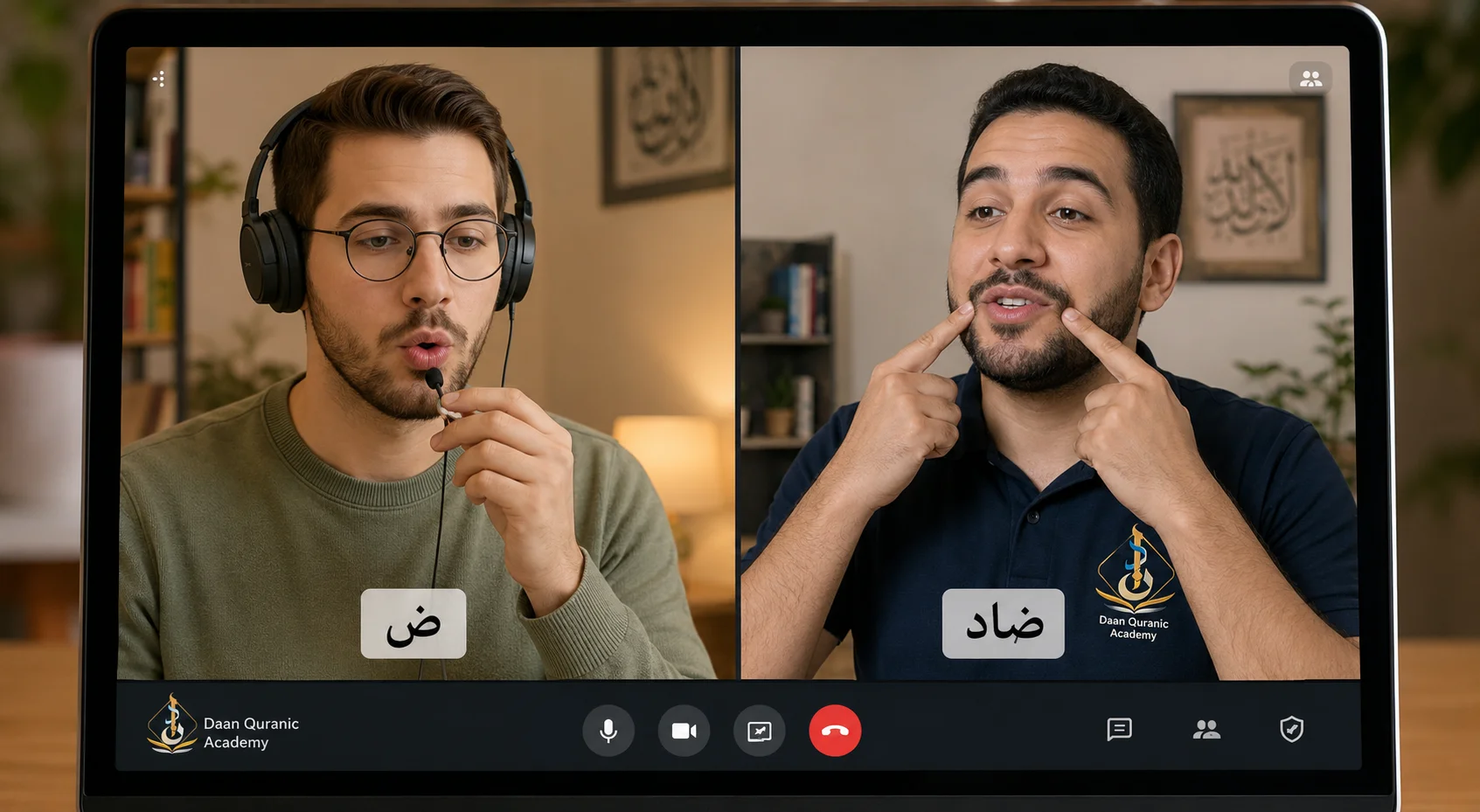
The Qur’an itself instructs believers to recite with precision and care, not haste. This is the essence of tartil — reciting slowly, distinctly, and with attention to every letter’s true sound.
أَوْ زِدْ عَلَيْهِ وَرَتِّلِ الْقُرْآنَ تَرْتِيلًا
“…and recite the Qur’an in slow, measured rhythmic tones.”
Classical scholars of Tajwid have taught for over a thousand years that correct articulation points are non-negotiable for anyone reciting the Qur’an, and this consensus is preserved through unbroken chains of oral transmission passed from teacher to student. Understanding articulation points is therefore not a stylistic preference — it is the discipline that keeps the Qur’an’s exact sound intact, generation after generation.
Tajweed Articulation Points: The 5 Main Regions Explained
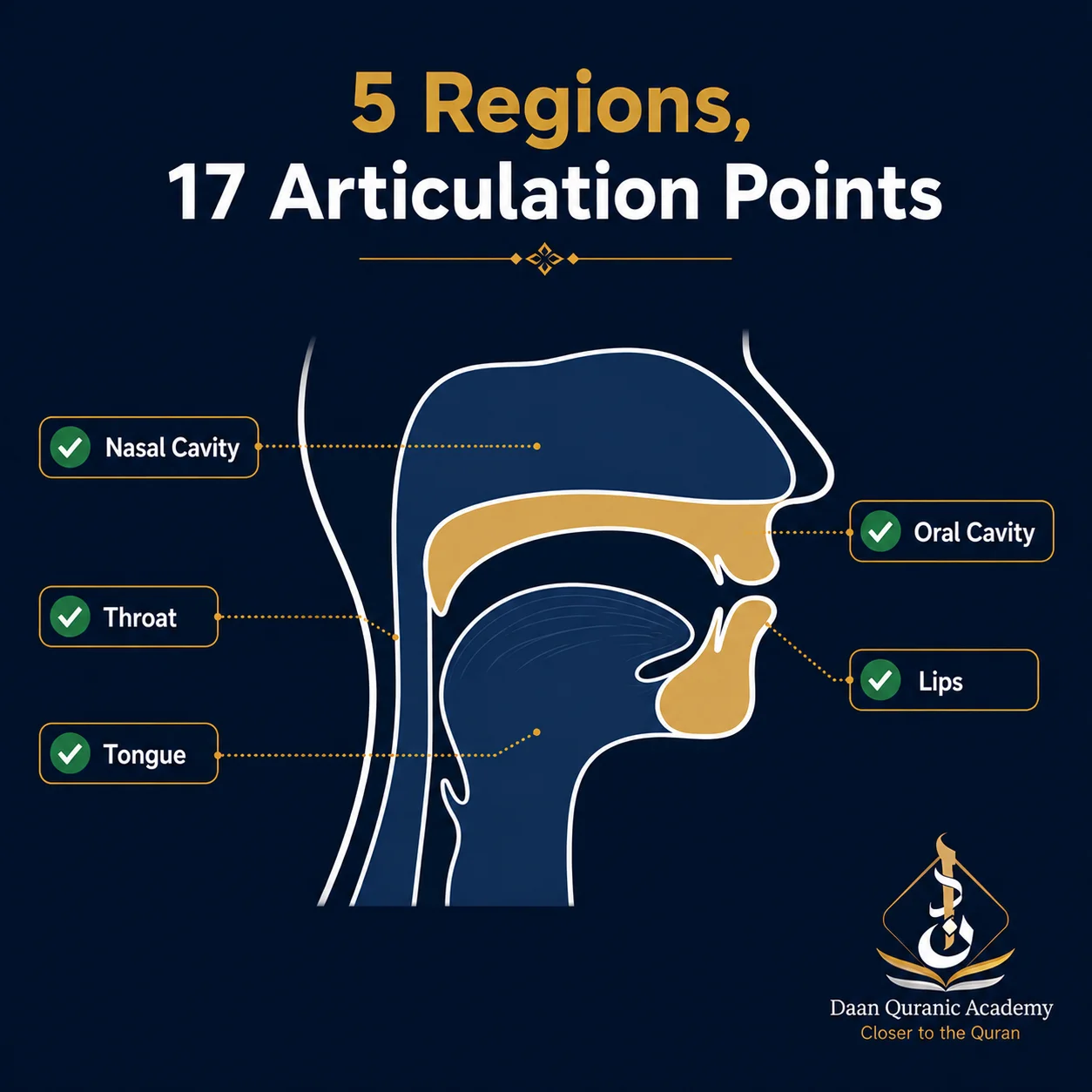
The 17 tajweed articulation points are grouped into 5 main regions of the vocal tract: Al-Jawf (the oral cavity), Al-Halq (the throat), Al-Lisan (the tongue), Ash-Shafatan (the two lips), and Al-Khaishum (the nasal passage). Every one of the 29 Arabic letters is produced from a point within one of these five regions, and learning the regions first gives you a mental map before you tackle each individual letter.
Real session recording: A Daan Academy tutor pausing mid-recitation to correct a student’s articulation point in real time, showing exactly how a 1-on-1 class catches errors a group class would miss. All videos are real, unedited screen-recordings from actual student sessions at Daan Academy, posted with student consent.
Here is a quick breakdown of what each region produces, moving from the deepest part of the vocal tract outward to the lips:
- Al-Jawf (الجوف) — the open space of the mouth and throat, responsible for the three elongated vowel sounds (long alif, waw, and ya).
- Al-Halq (الحلق) — the throat, split into three parts, producing letters like hamzah, ha, ain, ha, ghain, and kha.
- Al-Lisan (اللسان) — the tongue, the largest region, producing 18 letters across 10 distinct points.
- Ash-Shafatan (الشفتان) — the two lips, producing letters like fa, ba, meem, and waw.
- Al-Khaishum (الخيشوم) — the nasal passage, responsible for ghunnah, the nasal resonance that accompanies noon and meem in certain rules.
Once a student can confidently place a sound in the right region, refining it down to the exact point becomes far easier — this is exactly the progression tutors follow in Daan Academy’s Tajweed and Quran Reading courses, and it’s also covered step by step in our guide to the best online Tajweed course in 2026.
How Many Articulation Points in Tajweed? The Complete List of 17
There are 17 articulation points in Tajweed, distributed across the 5 regions described above — this is the position held by the majority of classical scholars, including Imam Ibn Al-Jazari, whose foundational work systematised the science of Tajwid. Some earlier scholars counted 16 points by treating Al-Jawf differently, but 17 is the widely accepted standard taught today.
| Region | Points | Example Letters |
|---|---|---|
| Al-Jawf (oral cavity) | 1 | Long ا، و، ي |
| Al-Halq (throat) | 3 | ء ه ع ح غ خ |
| Al-Lisan (tongue) | 10 | ق ك ج ش ي ض ل ن ر ط د ت ظ ذ ث ص س ز |
| Ash-Shafatan (lips) | 2 | ف ب م و |
| Al-Khaishum (nasal passage) | 1 | Ghunnah with نّ / مّ |
If you’ve ever typed “how many articulation points in Tajweed” into a search bar hoping for a quick answer, this table is it — 17 points, 5 regions, memorised once and used for the rest of your recitation journey.
Notice how the tongue alone accounts for 10 of the 17 articulation points, which is exactly why so many pronunciation errors trace back to subtle tongue placement — the difference between ط and ت, or ص and س, often comes down to a few millimetres of tongue position. This is one of the most common struggles we cover in our post on the top Arabic pronunciation challenges for English speakers. A tutor who can hear these micro-differences and correct them live, rather than in a recorded video lesson, makes an outsized difference to how quickly a student masters the full set of makharij.
What to Look For in a Quran Academy That Teaches Makharij Properly
A Quran academy that teaches articulation points properly should offer native Arabic-speaking tutors, one-on-one sessions, live correction, and a clear path from Noorani Qaida through to full Tajweed mastery. Here is what actually matters when comparing your options.
Native Arabic-Speaking Tutors
Many platforms hire tutors who learned Tajweed as a second language themselves, which makes it harder for them to model correct articulation points instinctively. At Daan Academy, every tutor is a native Egyptian Arabic speaker, formally trained in Quranic sciences, so the sound they model is the sound you’re trying to reproduce.
One-on-One, Not Group Classes
Unlike group classes that dilute attention across five or six students, articulation points require a tutor who can hear one voice clearly and correct it in the moment. Every class at Daan Academy is a private 1-on-1 session, so mispronunciations get caught and corrected before they become habits.
Certified, Ijazah-Holding Teachers
Where many platforms are vague about tutor credentials, look for certified Ijazah holders with a verified chain of transmission. Many tutors at Daan Academy hold Ijazah in multiple Qira’at, meaning their own recitation was certified letter-by-letter by a qualified teacher before them. You can review individual tutor backgrounds on our Our Tutors page.
Fluent English Communication
A tutor can have perfect Tajweed and still struggle to explain a concept if there’s a language barrier. Every tutor at Daan Academy speaks fluent English, so a parent or adult revert never has to guess what correction is being asked for.
These four criteria — native fluency, private sessions, verified certification, and clear communication — are the same standard we set out in more detail on our Why Choose Us page, and they apply whether you’re picking a course for yourself or for your child.
The Articulation of Arabic Letters: Common Mistakes Non-Arabic Speakers Make
The articulation of Arabic letters trips up most non-native learners in the same handful of places — the throat letters (ع، ح، خ، غ), the emphatic letters (ص، ض، ط، ظ), and the trilled ر. Because these sounds don’t exist in English, learners tend to substitute the nearest familiar sound instead, which is where meaning starts to drift.
The throat letters are usually the biggest hurdle, since English has almost no equivalent sounds produced that deep in the vocal tract. Many students initially pronounce ح like an English “h” and ع like a simple vowel, when both actually require a deliberate constriction further back in the throat. The emphatic letters are the second common trap: ط and ت sound almost identical to an untrained ear, but ط requires the back of the tongue to rise and the mouth to round slightly, giving the letter its distinctive heavier tone. We break down each of these specific fixes in our guide to 5 common Tajweed mistakes non-Arabic speakers make.
The good news is that none of these errors are permanent. With a tutor who demonstrates the correct articulation point directly and gives immediate feedback, most students correct their throat and emphatic letters within a matter of weeks, not years.
Online vs In-Person: Where to Learn Correct Articulation Points
Online Tajweed classes can teach correct articulation points just as effectively as in-person lessons, provided the platform uses live video, one-on-one sessions, and a qualified native tutor. The medium matters far less than the structure of the class.
In-person classes have one clear advantage: a teacher physically in the room. But this advantage disappears the moment a platform offers real-time, face-to-face video with a live tutor watching the student’s mouth and listening closely to their sound — which is exactly how every class at Daan Academy is delivered. What in-person classes often lack, by comparison, is flexibility: fixed schedules, travel time, and limited tutor choice. Where most local mosque classes or community groups are constrained to whichever teacher happens to be available, an online academy lets a family in Manchester learn from a certified tutor in Cairo without leaving the living room.
The honest answer is that “online vs in-person” is the wrong question — the right question is whether the class is private, live, and taught by someone qualified to model correct articulation points. Families across 15+ countries have found that a well-structured online programme meets or exceeds what they could access locally, which is the core promise on our Why Us page.
Affordable Tajweed Classes: What Articulation Points Training Costs in 2026
Quality Tajweed and articulation points training costs from as little as $9/hr online in 2026, which is often less than a single in-person group lesson package, while still delivering private, one-on-one attention.
Plans start from just $9/hr with native Egyptian tutors. Compare our three flexible pricing tiers — Essential, Pro, and Elite — each designed for different learning goals and budgets, including a family discount on the Elite plan for households enrolling more than one child.
Some platforms are vague about pricing until you’ve already booked a consultation call. Daan Academy’s three plans are listed transparently: Essential from $9/hr, Pro from $10.99/hr, and Elite from $12.99/hr, each including access to the Smart Student Dashboard for tracking sessions, balance, and progress reports in one place. For a child learning articulation points for the first time, the Essential plan paired with the 600+ educational games library is often enough to keep lessons engaging without feeling like a chore.
Real Results: How Students Master Makharij Al-Huruf at Daan Academy
Students who work consistently with a dedicated tutor typically master the 5 main regions of articulation points within their first few weeks, then spend the following months refining individual letters until the sound becomes automatic.
Every session is logged through transparent progress tracking, so parents and adult students alike can see exactly which letters have been mastered and which still need work, backed up with verified certificates at each course milestone. Smart notifications remind students before every session, and a 24/7 support team is available for anything technical or academic in between lessons. None of this replaces consistent practice, but it does mean progress on articulation points is visible rather than left to guesswork.
“One who is proficient in the Qur’an is associated with the noble, upright, recording angels; and he who falters in it, and finds it difficult for him, will have two rewards.”
Narrated by A’isha (RA) — Sahih Muslim 798a
This hadith is a comfort for every student on the path — the reward is given both to the one who recites with ease and to the one who is still struggling to place their tongue correctly. If you’d like to see what that steady progress looks like in practice, the fastest way is to book a free trial session and work through a few articulation points with a tutor directly.
Can You Learn Correct Articulation Points Without a Teacher?
It is very difficult to learn correct articulation points without a teacher, because most errors are inaudible to the learner themselves — you cannot hear the difference between your own incorrect ح and a correct one if you’ve never heard the correct version modelled directly at you.
Apps, YouTube videos, and books can help a self-taught learner understand the theory — which region a letter comes from, which letters share a point — but theory alone rarely fixes a mispronounced sound. A tongue placed one centimetre too far back, or a throat constriction that’s too shallow, needs a second set of ears to catch it, and ideally a second pair of eyes watching the mouth shape too. This is the single biggest reason self-study plateaus while guided study keeps progressing, a pattern we’ve also seen play out in our deeper look at overcoming Arabic pronunciation challenges for non-native speakers.
That said, self-study is a reasonable way to start building vocabulary and familiarity before committing to structured lessons — it simply shouldn’t be the only method for as long-term a skill as correct articulation points.

Frequently Asked Questions
How much do Tajweed classes for articulation points cost?
At Daan Academy, plans start from $9/hr for the Essential tier, with Pro and Elite tiers available for students who want additional features. You can compare all three tiers in detail on our pricing plans page.
Can I really learn to pronounce Arabic letters correctly online?
Yes, provided the class is live, one-on-one, and taught by a native Arabic speaker who can hear and correct your articulation points in real time — the same standard applied to every class at Daan Academy.
Is there a free trial before I commit to a Tajweed course?
Yes. Daan Academy offers a completely free trial session with no commitment required, so you can experience a live articulation points lesson before choosing a plan. You can book your free trial here.
How long does it take to master all 17 articulation points?
Most consistent students grasp the 5 main regions within a few weeks and continue refining individual letters over the following months. The exact timeline depends on prior exposure to Arabic and how often the student practises between sessions.
Are Daan Academy’s tutors qualified to teach Makharij Al-Huruf?
Yes — all tutors are native Egyptian Arabic speakers formally trained in Quranic sciences, and many hold Ijazah in multiple Qira’at with a verified chain of transmission. You can review individual tutor profiles on our Our Tutors page.
Is online Quran and Tajweed learning safe for my child?
Every class is a private, 1-on-1 live session, supervised by parents as they see fit, with transparent session logs and progress reports available through the Smart Student Dashboard, plus 24/7 support for any concerns that come up.
Ready to Master Your Articulation Points?
Reading about the 17 makharij is one thing — hearing them corrected in your own voice is another. Book a free session and let a native Egyptian tutor show you exactly where your articulation points need work.
No commitment required. One free session to experience the Daan Academy difference.
Final Thoughts
Articulation points can feel technical at first — 17 points, five regions, Arabic terms you’ve never seen before. But every hafiz, every qari, and every confident reciter you’ve ever admired started exactly where you are now: learning to place their tongue, throat, and lips in the right spot, one letter at a time. With patient, consistent guidance, this becomes second nature far sooner than most beginners expect.
We ask Allah to make the path of learning His Book easy for every student, young or old, wherever in the world they’re reciting from. Ameen. For more guidance on Tajweed, Arabic, and building a strong connection to the Qur’an, explore more guides on our Daan Academy blog.