
The Ultimate Guide on How to Learn Tajweed of Quran at Home
Learning how to learn tajweed of Quran at home comes down to three things: mastering the correct pronunciation points (Makharij), practicing the core tajweed rules with a knowledgeable corrector, and staying consistent every single day. Whether you are a busy parent guiding your child, a revert taking your first steps with the Arabic alphabet, or an adult who wants to finally recite with confidence, this guide walks you through building that skill from your own living room — and what to look for if a tutor will get you there faster.
If you have searched for how to learn Quran with Tajweed, you already know the problem: most resources online are either too academic, too generic, or assume you already read Arabic fluently. This guide breaks it down step by step, in plain English.
📑 Table of Contents
- What Tajweed Actually Is and Why It Matters
- A Step-by-Step Framework to Learn at Home
- Choosing the Right Learning Path
- Comparing Your Options
- How to Practice Tajweed Rules Every Day
- What to Look for in a Tajweed Teacher
- Online vs In-Person: Which Is Right for You?
- 2026 Pricing Guide
- Frequently Asked Questions
How to Learn Tajweed of Quran at Home: What It Is and Why It Matters
Tajweed is the set of Quranic recitation rules that govern how each Arabic letter is pronounced, where it originates in the mouth or throat, and how it connects to the letters around it. Getting this right is not a stylistic preference — mispronouncing a single letter can change the meaning of a word, which is exactly why the Prophet ﷺ and his companions took such care in how they recited.
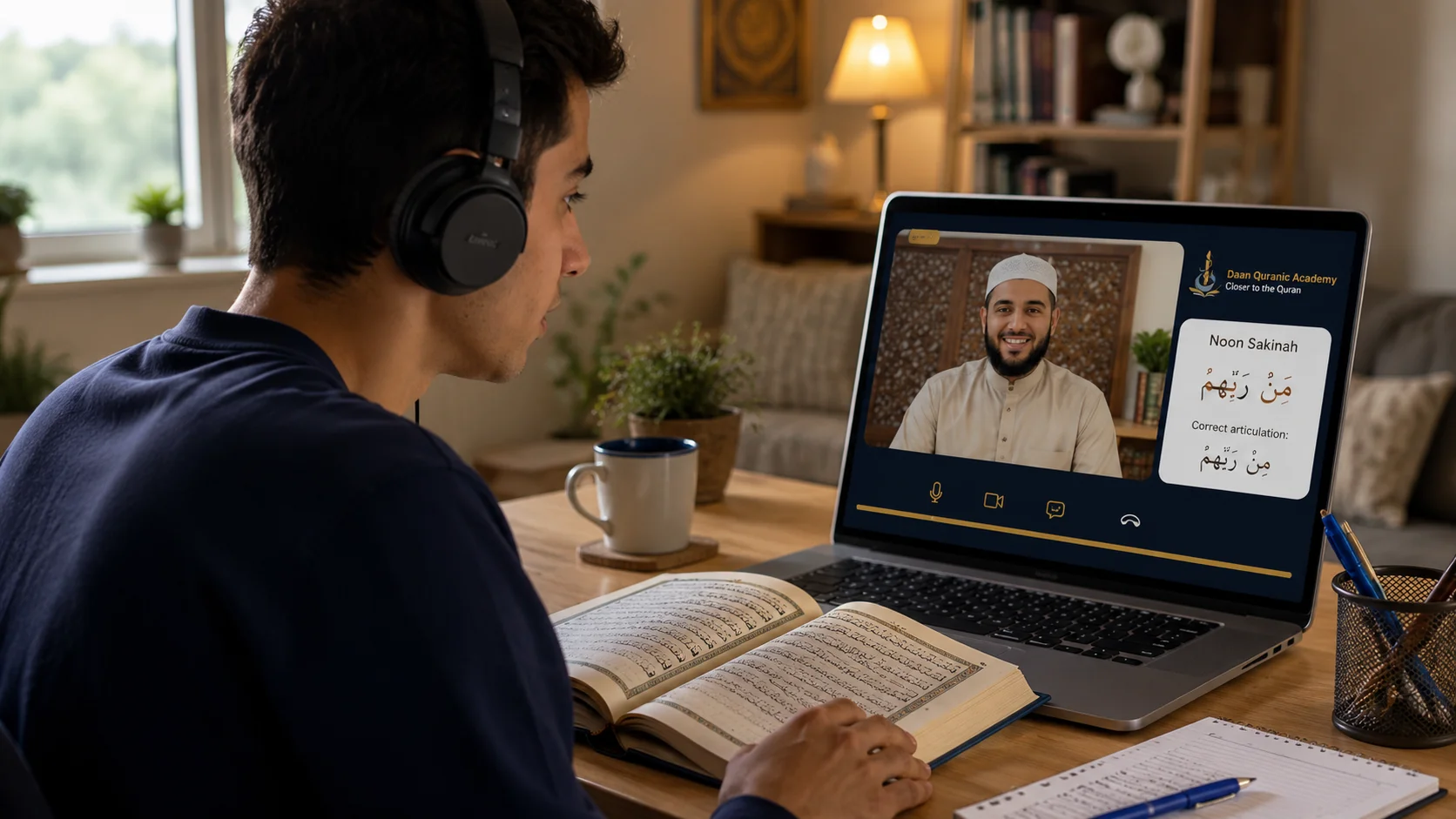
The word “tajweed” comes from an Arabic root meaning “to improve” or “to make excellent.” In practice it covers three layers: Makharij al-Huruf (the precise articulation point of every letter), Sifaat al-Huruf (the qualities of each letter — heavy or light, for example), and the rules that govern how letters interact, such as Idgham (merging), Ikhfa (concealment), Qalqalah (echoing), and Madd (elongation). None of this is arbitrary; it was preserved and transmitted orally, teacher to student, in an unbroken chain back to the Prophet ﷺ himself.
Allah commands this manner of recitation directly in the Quran:
أَوْ زِدْ عَلَيْهِ وَرَتِّلِ الْقُرْآنَ تَرْتِيلًا
“…or add to it, and recite the Qur’an with measured recitation.”
Classical commentators such as Ibn Kathir explained this verse as an instruction to recite slowly, articulate the letters clearly, and pause where pausing is due — precisely the discipline that tajweed formalizes into a learnable system.
If you have wondered how to learn Quran with Tajweed without years of formal study, the good news is that the rules themselves are learnable in a structured order — you do not need to be a scholar to start applying them correctly. What most self-taught reciters lack is not information, since there are hundreds of free videos online, but immediate, accurate correction, which is where a structured Tajweed course makes the difference between years of guessing and months of real progress.
How to Learn Quran with Tajweed at Home: A Step-by-Step Framework
You can learn Quran with Tajweed at home by working through a fixed sequence: alphabet and Noorani Qaida first, then articulation points, then the rules themselves, then supervised practice, and finally daily repetition. Skipping steps is the single biggest reason self-taught reciters plateau — they memorize rule names without ever training their tongue to apply them.
Real session recording: Watch a live 1-on-1 session where a Daan Academy tutor guides an adult student through the Madd (elongation) rules in real time, correcting pronunciation letter by letter. All videos are real, unedited screen-recordings from actual student sessions at Daan Academy, posted with student consent.
Here is the order that actually works, whether you are starting from zero or brushing up rules you learned years ago:
Learn the Arabic Alphabet and Noorani Qaida
Before any tajweed rule makes sense, you need to recognize every letter in its isolated, joined, and connected forms. Our complete guide to learning Noorani Qaida walks through this exact starting stage.
Master the Makharij (Articulation Points)
Practice each letter from its correct point of origin — throat, tongue, lips — using a mirror or a tutor who can watch your mouth shape, not just listen.
Learn the Core Tajweed Rules One at a Time
Start with Noon Sakinah and Tanween rules, then move to Qalqalah, then Madd. Trying to absorb all the rules at once is the most common reason people give up.
Practice With a Live Corrector, Not Just an App
Your own ear cannot always catch your own mistakes. A rule you apply incorrectly for a month becomes a habit that takes far longer to unlearn.
Record Yourself and Compare
Record a short passage weekly and compare it to a certified reciter. This is where slow, honest progress becomes visible.
Apply Tajweed While You Memorize
Do not memorize first and correct pronunciation later — bad habits set in memorization are notoriously difficult to reverse.
Practice a Little, Every Single Day
Fifteen focused minutes daily consistently outperforms two rushed hours once a week, because tajweed is a physical, muscle-memory skill.
Most of these steps you can genuinely do alone. The one that is hardest to replicate without help is step four — even native Arabic speakers train under a teacher before reciting professionally. Book a free trial session to see what live correction feels like before committing to anything.
How to Learn Quran with Tajweed: Choosing the Right Learning Path
There is no single right way to learn Quran with Tajweed — the right path depends on your starting level, your schedule, and whether you learn best from repetition alone or from real-time feedback. Some people are disciplined enough to work through a Mushaf and a tajweed textbook on their own. Most people, especially adults with jobs and children with short attention spans, need structure and accountability to actually finish.
At Daan Quranic Academy, every tutor is a native Egyptian Arabic speaker, formally trained in Quranic sciences — many hold Ijazah certifications with a verified chain of transmission back to the Prophet ﷺ. That matters because a tutor who grew up hearing correct Makharij will catch things a non-native speaker, however well-meaning, may miss entirely. You can read more about their backgrounds on our tutors page.
Families researching the best online Tajweed course in 2026 generally weigh the same handful of criteria: is the tutor native or non-native, is the class private or group-based, is there real accountability between sessions, and is the price transparent. We cover this comparison below.
The Best Way to Learn Tajweed: Comparing Your Options
The best way to learn Tajweed for most people is 1-on-1 live instruction with a qualified native tutor, because it is the only format that corrects your pronunciation the moment a mistake happens rather than days or weeks later. Below is an honest look at the three main paths people take.

| Learning Path | Personalized Feedback | Native Pronunciation Model | Certification Path | Typical Cost |
|---|---|---|---|---|
| Books & Self-Study Apps | None | Rarely | No | Low upfront, high time cost |
| Group Online Classes | Shared across 5–15 students | Sometimes | Sometimes | Moderate |
| 1-on-1 Online Tutoring | Every session, in real time | Always — native Egyptian tutors | Yes — Ijazah & certificates available | From $9/hr |
Group classes are cheaper per seat, but the tutor’s attention is split — if you mispronounce a Qalqalah letter, there is no guarantee it gets caught before the class moves on. Apps are useful for drilling vocabulary but cannot listen to you recite. When people ask about the best way to learn Tajweed, most qualified teachers point to some form of live, individual correction as the non-negotiable ingredient — the format matters less than whether a real person is actually listening to your voice.
Plans start from just $9/hr with native Egyptian tutors. Compare our three flexible pricing tiers — Essential, Pro, and Elite — each designed for different learning goals and budgets.
How to Practice Tajweed Rules Every Day
Knowing how to practice tajweed daily matters more than any single class, because tajweed is a physical skill your tongue and jaw need to rehearse, not just information your mind needs to understand. Fifteen focused minutes a day will move you further than a two-hour session once a week.
“The one who is skilled in the Qur’an is with the noble, righteous scribes, and the one who recites the Qur’an and finds it difficult, stumbling through it, will have a double reward.”
Narrated by Aisha (may Allah be pleased with her) — Sahih al-Bukhari 4937
This hadith is a reminder that struggle is not failure. The student who stumbles over Qalqalah letters every single day, and keeps showing up anyway, is promised a reward for the effort itself, not only for fluency.
- Begin with Isti’adhah and Basmalah before every recitation, even a short one.
- Recite the same short passage slowly for ten minutes rather than rushing through pages.
- Focus on a single rule for the week — Qalqalah one week, Madd the next — instead of fixing everything at once.
- Listen to a certified reciter and repeat after them, phrase by phrase.
- Get corrected in real time at least twice a week; a small mistake repeated daily becomes a habit.
- Keep a simple log of which rules you have mastered and which still trip you up.
Small, consistent mistakes are exactly what a guide to common Tajweed mistakes is built to catch — many are things learners repeat for years without realizing, simply because no one was listening closely enough to flag them.
How to Learn Tajweed of Quran the Right Way: What to Look for in a Teacher
If you want to know how to learn tajweed of Quran the right way, start with the teacher, not the app or the textbook — look for native pronunciation, verified certification, and one-on-one attention before anything else. These three criteria filter out almost every weak option on the market.
Many Daan Academy tutors trained in the classical Egyptian tradition associated with Al-Azhar, one of the oldest centers of Islamic learning in the world.
Native Pronunciation
A teacher who grew up speaking Arabic produces Makharij automatically and correctly, without having to think about them. At Daan Quranic Academy, every tutor is a native Egyptian Arabic speaker, so the model you are imitating is correct from day one.
Verified Ijazah Certification
An Ijazah is a formal license to teach Quran recitation, granted only after a student has recited the entire Quran correctly to a certified teacher whose own certification traces back through an unbroken chain to the Prophet ﷺ. Many Daan Academy tutors hold Ijazah in multiple Qira’at, a credential few academies can genuinely offer.
One-on-One, Not Group, Sessions
Unlike group classes that dilute attention across ten or fifteen students, every session at Daan Academy is private. Your specific mistakes — the ones an app or a recorded video can never catch — get flagged and fixed the moment they happen.
Families researching options across the UK, USA, Europe, and Australia have told us the same thing: fluent English communication matters as much as Arabic expertise, because a tutor who cannot explain a rule in plain English leaves a student memorizing without understanding. You can review the full course list, including Tajweed Rules Mastery, Quran Reading & Recitation, and Authentic Ijazah & Sanad Programs, to see which track fits your goals.
Is It Better to Learn Tajweed Online or In Person?
For most learners today, online Tajweed instruction is equal to or better than in-person classes, because it removes commute time, widens the pool of qualified native tutors, and still delivers real-time correction over live video. The quality gap that used to exist between online and in-person has closed almost entirely — you can see exactly how our approach compares on the Why Choose Us page.
The two objections we hear most from parents are worth addressing directly. The first is quality: can a tutor really correct pronunciation through a screen? Yes — tajweed correction relies on hearing, not just seeing, and a clear video call carries voice just as well as sitting in the same room. The second is safety: every session is 1-on-1, scheduled, and supervised, with parents welcome to sit in on any class their child takes. If you want to see this for yourself, a free trial session costs nothing and carries no obligation.
Scheduling flexibility is the other advantage that tends to tip the decision. Where a local teacher might only be available two evenings a week, online classes can be booked at almost any hour, across time zones — useful for a family in Manchester, Melbourne, or Minneapolis working around school, work, and Isha prayer.
How to Learn Tajweed of Quran on a Budget: 2026 Pricing Guide
Learning tajweed of Quran online in 2026 typically costs between $9 and $13 per hour for private tutoring, depending on the plan and how many sessions you book per week. That is often less than a single in-person tutoring session in the UK, USA, or Australia once travel time is factored in.
At Daan Quranic Academy, pricing is split into three transparent tiers on the pricing plans page: Essential starts from $9/hr, Pro from $10.99/hr, and Elite from $12.99/hr, which also includes a family discount for households enrolling more than one child. There are no hidden setup fees, and every plan includes access to the Smart Student Dashboard, where you can track session history, running balance, and monthly progress reports in one place.
If cost is the only thing holding you back from starting, remember that the free trial session is exactly that — free, with no card required and no obligation to continue. It is the fastest way to judge fit before spending anything.

Frequently Asked Questions
How much do online Tajweed classes cost?
Prices typically range from $9 to $13 per hour depending on the plan. Daan Quranic Academy’s three tiers — Essential, Pro, and Elite — are listed in full on the pricing plans page, starting from $9/hr.
Can I really learn tajweed of Quran at home without a live tutor?
You can learn the theory alone, but almost every student eventually needs a second set of ears to catch mistakes their own hearing cannot detect, which is why most people combine self-study with periodic live correction rather than going fully solo.
Is it safe for my child to learn Tajweed online?
Yes. Every class is a private, scheduled, 1-on-1 video session, and parents are welcome to sit in on any lesson. Read more about our approach on the Why Choose Us page.
Can I try a Tajweed class before I commit to a plan?
Yes — the free trial session lets you experience a real class with a native Egyptian tutor before you pay anything.
How long does it take to learn tajweed of Quran properly?
Most consistent students notice a real difference in their pronunciation within four to six weeks, and can comfortably apply the core rules within three to six months, depending on how often they practice.
What’s included in the free trial?
A full one-on-one session with a certified tutor, an assessment of your current level, and a recommended starting point among Daan Academy’s Tajweed and Quran courses.
How do I know if my Tajweed tutor is actually qualified?
Ask directly whether they hold an Ijazah, who certified them, and whether Arabic is their native language. Tutor credentials, including Ijazah chains, are listed on the tutors page.
Ready to Learn Tajweed of Quran the Right Way?
Reading about tajweed can only take you so far — real progress starts the moment a qualified tutor hears you recite. Book a free session and find out exactly where to start.
No commitment required. One free session to experience the Daan Academy difference.
Final Thoughts
Learning how to learn tajweed of Quran at home is not about finding one perfect trick — it is a sequence: alphabet, articulation, rules, correction, repetition. Books and apps can carry you through the first two stages. For the rest, especially the correction stage, a qualified native tutor will save you months, if not years, of practicing a mistake you did not know you were making.
“Rabbi zidni ‘ilma” — “My Lord, increase me in knowledge” (Surah Ta-Ha, 20:114) is a fitting dua for anyone starting this journey. Whichever path you choose, explore more guides on our blog as you continue building this skill, one letter at a time.