
Simple and Fun Tajweed Rules for Kids: How to Keep Them Engaged
Tajweed Rules for Kids are the set of pronunciation and recitation guidelines that teach a child to read the Quran exactly as it was revealed — and the good news is they can be taught in a way that feels like play rather than a chore. If you have searched for the basic tajweed rules for kids or wondered how to learn Quran online with tajweed rules for kids without daily battles over screen time and attention span, this guide walks through what actually works, what to look for in a program, and how families across the UK, USA, and Europe are getting real results with 1-on-1 online classes.
📑 Table of Contents
- What Are Tajweed Rules for Kids?
- Basic Tajweed Rules for Kids: The Building Blocks
- How to Learn Quran Online With Tajweed Rules for Kids
- Quran Tajweed Rules for Kids vs. Memorization-Only Classes
- Tajweed Rules for Kids in English
- Fun Ways to Keep Kids Engaged While Learning Tajweed
- What Does Tajweed Rules for Kids Cost?
- What Age Should a Child Start Learning Tajweed Rules?
- Frequently Asked Questions
What Are Tajweed Rules for Kids? A Simple Definition Parents Can Trust
Tajweed rules for kids are the beginner-friendly version of the classical Arabic pronunciation rules that govern correct Quran recitation — covering letter articulation points (Makharij), elongation (Madd), nasalization (Ghunnah), and stopping rules — introduced gradually through short, guided practice. Rather than memorizing dense terminology, children learn tajweed through repetition, listening, and gentle correction from a tutor who models the sound before asking them to repeat it.
The goal is not perfection on day one. It is building a habit of careful, mindful recitation that a child carries for life. This is exactly the instruction Allah gives in the Quran itself:
وَرَتِّلِ الْقُرْآنَ تَرْتِيلًا
“…and recite the Qur’an with measured recitation.”
This single ayah is why tajweed exists as a discipline at all — the Quran was never meant to be read carelessly. For children specifically, that means short daily sessions, one rule at a time, reinforced through sound rather than lectures. Many families exploring specialized Quran and Tajweed courses find that a structured curriculum, rather than a random YouTube video here and there, is what actually moves a child from hesitant reading to confident recitation.
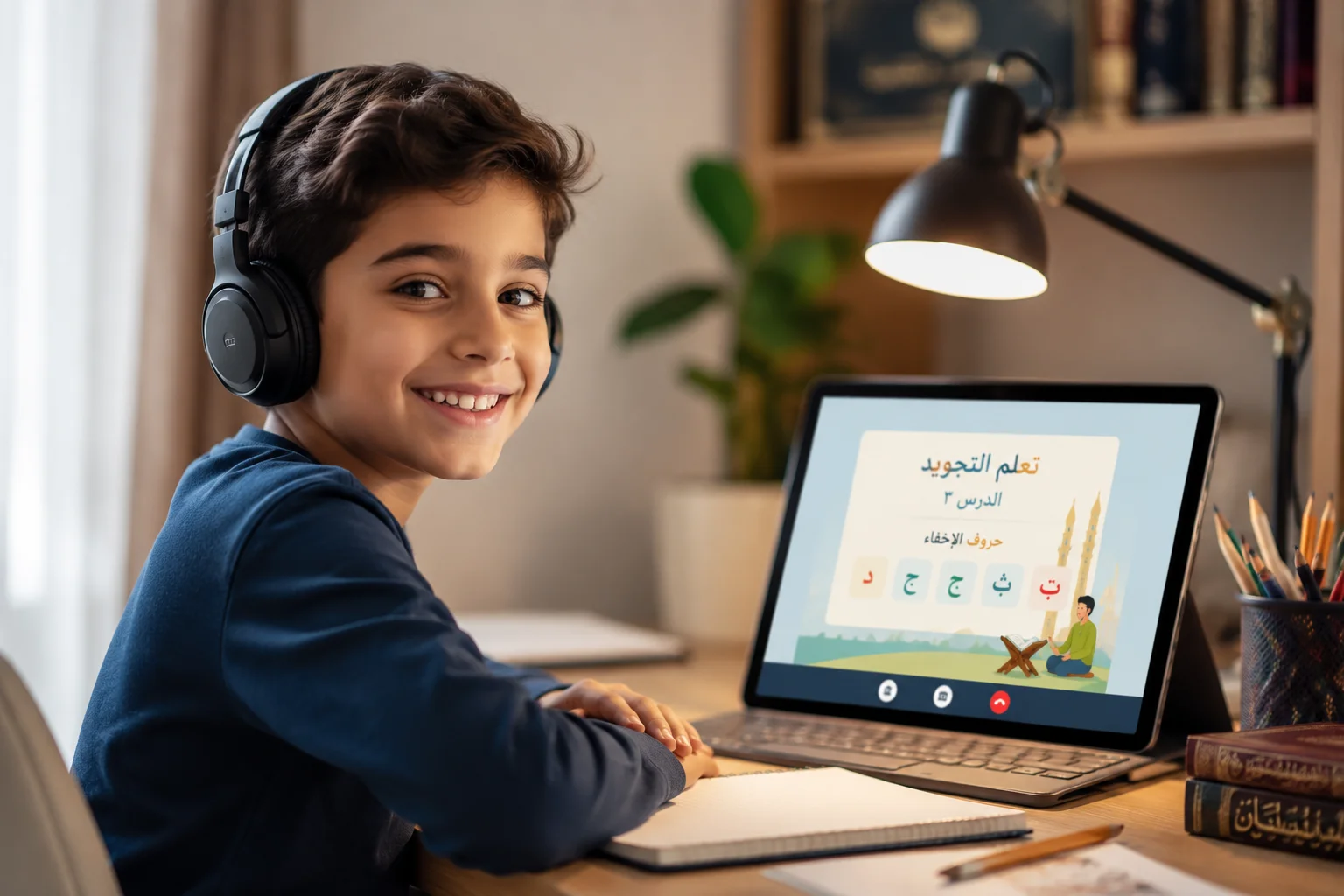
Basic Tajweed Rules for Kids: The Building Blocks Every Child Should Learn
The basic tajweed rules for kids that most programs start with are only four or five in number, introduced across weeks rather than all at once, so a child never feels overwhelmed by terminology before they can even hear the difference between two letters.
Real session recording: A native Egyptian tutor guiding a student through the Qalqalah rule — one of the core tajweed rules for kids to master early, since it is easy to hear and easy to practice. All videos are real, unedited screen-recordings from actual student sessions at Daan Academy, posted with student consent.
Once a child can hear and imitate a sound with a tutor modeling it live, the rule sticks far faster than it would from a written explanation alone. Here are the basic tajweed rules for kids that a well-structured beginner curriculum typically covers first:
- Makharij al-Huruf — the correct articulation point of each Arabic letter, so sounds are not mixed up with similar-looking letters
- Ghunnah — the nasal sound held for two counts on certain letters, easy for kids to practice by humming
- Qalqalah — the gentle “bounce” or echo on specific letters when they carry a sukoon
- Noon Sakinah and Tanween rules — how a silent noon or tanween changes sound depending on the letter that follows it
- Madd (elongation) — stretching certain vowel sounds for a set number of counts
Reinforcement matters as much as introduction. A tutor who authentically corrects a child’s Makharij in real time — rather than simply moving on — is doing the single most valuable thing a tajweed teacher can do, and it is the same principle behind why the Prophet ﷺ placed such high value on both learning and teaching the Quran:
“The best among you are those who learn the Qur’an and teach it.”
Narrated by Uthman ibn Affan (RA) — Sahih al-Bukhari 5027
If your child has already picked up a few mispronunciations, it can help to read our related guide on common tajweed mistakes and how to fix them before starting formal lessons, so you know what to listen for.
How to Learn Quran Online With Tajweed Rules for Kids: What to Look For
To learn Quran online with tajweed rules for kids effectively, look for a program built around 1-on-1 sessions, native Arabic-speaking tutors, a structured curriculum, and visible progress tracking — not a generic group class that treats tajweed as an afterthought. Group classes dilute a tutor’s attention across several children at once, which means the one thing tajweed correction actually needs — instant, individual feedback — gets lost.
What to Look For: Native, Formally Trained Tutors
A tutor’s own pronunciation is the model a child copies for months. Where many platforms rely on non-native speakers, at Daan Quranic Academy every tutor is a native Egyptian Arabic speaker, formally trained in Quranic sciences, and fluent in English — so instructions are clear and the sound a child hears is authentic. Many tutors are also certified Ijazah holders with verified chains of transmission back to the Prophet ﷺ.
What to Look For: True 1-on-1 Sessions
Unlike group classes that dilute attention across five or six students, every class at Daan Academy is private and personalized. That means a tutor hears every attempt a child makes and corrects it before an incorrect habit forms — which is the entire point of learning tajweed rules for kids in the first place, rather than just reading through a page.
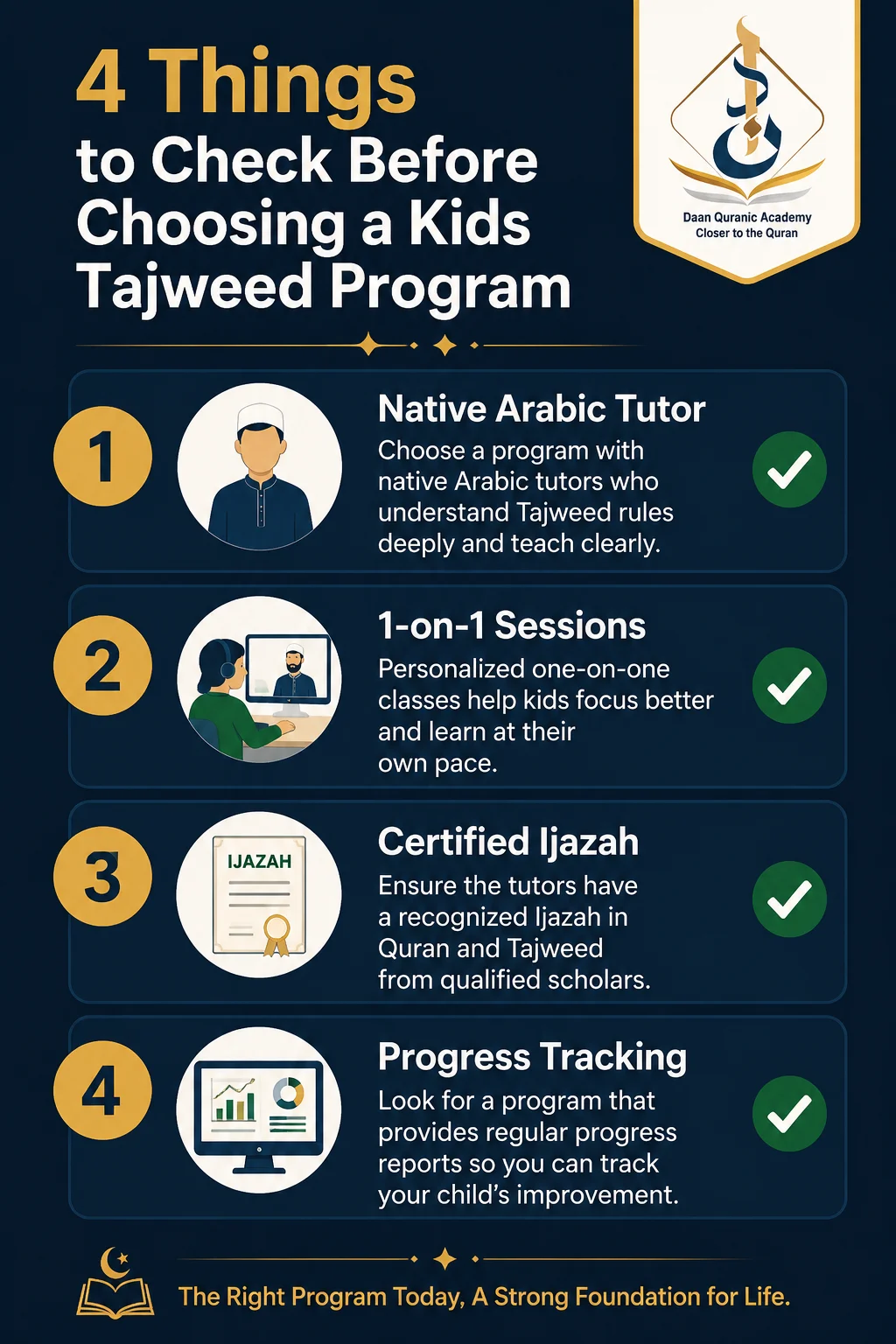
Once you know what to look for, getting started is straightforward. Here’s how families typically move from “just looking” to their child’s first live session:
Book a Free Trial Session
Try a real class with no payment and no commitment through the free trial page, so you can see how your child responds before deciding anything.
Get Matched With a Native Egyptian Tutor
Based on your child’s age, current level, and personality, the academy pairs them with a tutor experienced in teaching tajweed rules for kids specifically — not just adults.
Follow a Personalized Learning Plan
Each child moves at their own pace through Makharij, Ghunnah, Qalqalah, and beyond, rather than following a rigid one-size-fits-all timetable.
Track Progress in the Student Dashboard
Parents can log into the Daan LMS to see session reports, attendance, and skill milestones, so progress is visible rather than assumed.
If you want a broader look at what a full curriculum should include beyond just tajweed, our guide on the best online Quran classes for kids breaks down course structure in more depth. And if tutor quality is your main concern, it’s worth reading more on our Why Choose Us page before enrolling anywhere.
Quran Tajweed Rules for Kids vs. Memorization-Only Classes: A Clear Comparison
Quran tajweed rules for kids and pure memorization (Hifz) classes are not the same thing — tajweed focuses on correct pronunciation and articulation, while memorization-only classes prioritize retention of text, sometimes without correcting how it is being pronounced. Ideally a child gets both, but many parents don’t realize a program can be strong on one and weak on the other.
| Criteria | 1-on-1 Tajweed-Integrated Program | Memorization-Only / Group Class | Typical Weekend Arabic School |
|---|---|---|---|
| Live correction of Makharij | Every session, individually | Rare — shared attention | Rare |
| Native Arabic-speaking tutor | Always | Sometimes | Sometimes |
| Scheduling flexibility | Any time, anywhere | Fixed group timetable | Fixed weekly slot |
| Certified Ijazah instructor | Available | Occasionally | Rare |
| Progress reports for parents | Detailed, ongoing | Rare | Rare |
Where most academies offer a generic curriculum that treats every child the same, Daan Academy builds a personalized plan that blends tajweed correction with memorization goals from the start — so a child isn’t just repeating verses, they’re reciting them correctly. For families weighing tajweed against a dedicated Hifz track, our complete guide to the best online Tajweed course compares both paths in more detail.
Tajweed Rules for Kids in English: Making Pronunciation Click for Western Families
Tajweed rules for kids in English simply means every rule, correction, and instruction is explained in clear English rather than assuming a child already understands Arabic terminology — essential for reverts’ children and second-generation Muslim families in the UK, USA, and Europe. A child does not need to speak Arabic fluently before starting; they need a tutor who can bridge both languages patiently.
This is one area where tutor selection matters enormously. Where many platforms use non-native speakers who struggle to explain nuance in English, or native speakers with limited English fluency, Daan Academy’s tutors are native Egyptian Arabic speakers who are also fluent in English — so a child hears authentic pronunciation while still understanding every explanation given to them. That combination is genuinely rare, and it’s the reason so many English-speaking families and reverts specifically request it.
Beyond tajweed itself, the same bridge applies to vocabulary and meaning. Families wanting their child to eventually understand what they are reciting, not just pronounce it correctly, often pair tajweed lessons with a dedicated Quranic Arabic course once the basics are steady.
Fun Ways to Keep Kids Engaged While Learning Tajweed
Keeping kids engaged while learning tajweed comes down to short sessions, immediate positive feedback, and turning repetition into a game rather than a drill. Attention spans in young children are naturally short, so the format of the lesson matters just as much as the content.
A few things that consistently work across age groups:
- Sound games — having a child “hunt” for a specific letter’s Makharij across a page turns a dry drill into a challenge
- Interactive digital games — Daan Academy’s library of 600+ educational games gives children a reward-based way to revisit rules between live sessions
- Visible milestones — a verified certificate after completing a stage gives children something tangible to be proud of
- Consistency over intensity — 20 focused minutes, three times a week, consistently outperforms one long, exhausting session
- Smart reminders — automated notifications before each session help build a routine without parents having to nag
Families across more than 15 countries have used this exact structure to keep children motivated well past the first few weeks, which tends to be where most home-taught tajweed attempts quietly stall out. Consistency, not intensity, is what actually produces a confident reciter by the end of a school year.
What Does Tajweed Rules for Kids Cost? Pricing and Value Explained
Online tajweed rules for kids programs typically start from around $9 per hour for a private 1-on-1 session, with higher tiers adding features like family discounts and expanded course access. That is often less than a single hour of in-person private tutoring once travel time and fuel are factored in, while still giving a child the individual attention that group classes cannot.
Plans start from just $9/hr with native Egyptian tutors. Compare our three flexible pricing tiers — Essential, Pro, and Elite — each designed for different learning goals and budgets, with a family discount available on the Elite plan.
Some platforms are vague about pricing until you’ve already booked a call — Daan Academy’s three plans are listed clearly, in advance, with no hidden fees. If cost is the main thing holding you back from starting, the honest comparison to run is not “free YouTube videos vs. paid classes,” but rather “inconsistent, uncorrected recitation vs. a small weekly investment that builds a skill your child keeps for life.”
What Age Should a Child Start Learning Tajweed Rules?
Most tutors recommend introducing basic tajweed rules for kids between ages 5 and 7, once a child can recognize Arabic letters, though there is no strict cutoff — older beginners and even teenagers pick up tajweed just as effectively with the right pace. The key factor is readiness to sit for a short focused session, not a specific birthday.
If your child is already comfortable with the Arabic alphabet through a foundational course, tajweed is a natural next step. Our guide on the best age to start teaching Noorani Qaida is a useful companion read if you’re still deciding where to begin.

Frequently Asked Questions
How much do online tajweed classes for kids cost?
Plans start from $9/hr for the Essential tier, with Pro and Elite tiers offering additional features. Full details are on the pricing plans page, and every price is listed upfront with no hidden charges.
Is it safe for my child to learn tajweed rules online?
Yes. Every session is 1-on-1 with a verified, formally trained tutor, and parents can view session reports and progress at any time through the student dashboard. There is no group chat or unmonitored contact involved.
Can I try a class before committing to a plan?
Yes — every family can book a free trial session with no payment details required upfront, so you can see how your child responds before choosing a plan.
What’s included in the free trial session?
A full live 1-on-1 class with a native Egyptian tutor, matched to your child’s age and current level, so you experience the exact teaching style you’d get in a paid plan.
How do I know if the tutor is qualified to teach tajweed rules for kids?
Many tutors hold certified Ijazah credentials with verified chains of narration, alongside formal training in Quranic sciences. You can read tutor backgrounds on the Why Choose Us page.
Do you offer flexible scheduling across different time zones?
Yes, classes are available at any time from anywhere in the world, with smart notifications sent before every session so families never miss a slot.
Can my child learn tajweed rules in English if they don’t know Arabic yet?
Yes. Every tutor is fluent in English and experienced teaching non-Arabic-speaking beginners, so instructions and corrections are always explained clearly regardless of your child’s starting level.
Give Your Child a Confident Start With Tajweed Rules for Kids
A single free session is often enough to see how a native Egyptian tutor can turn hesitant reading into confident recitation. There’s no commitment required to find out.
No commitment required. One free session to experience the Daan Academy difference.
Final Thoughts
Learning tajweed rules for kids does not need to feel like a chore for you or for your child. With short, consistent sessions, a tutor who genuinely knows how to teach children rather than just recite well themselves, and a bit of playfulness built into the process, most children pick up the basics faster than parents expect. What matters most is starting somewhere and staying consistent — the rest tends to follow.
We ask Allah to make the Quran easy for every child learning it, and to place its light in their hearts for a lifetime. If you’d like to explore more guidance on raising confident young reciters, our blog has further reading on Quran education, Arabic learning, and building strong Islamic habits at home.