
📖 20 min read🎓 Kids & Adults🌍 UK · USA · Europe · Australia
The idgham rules of tajweed govern how Noon Sakinah (نْ) or Tanween merge into the letter that follows them, and getting this one rule right is often the difference between choppy recitation and recitation that flows the way the Quran was revealed. If you have ever heard a reciter’s voice glide smoothly from one word into the next with a gentle nasal hum, you were listening to idgham in action. In this guide, you will learn exactly how idgham works, see real examples from the Quran, and find out how to get personalized, native-tutor feedback on your own recitation — starting with a free trial class.
📑 Table of Contents
- What Are the Idgham Rules of Tajweed?
- Idgham Rules and Examples: The Two Types You Need to Master
- Idgham Examples from Quran: Real Ayahs You Can Practice Today
- Idgham with Ghunnah Examples: Letters, Pronunciation & Practice
- Idgham without Ghunnah Examples: How It Differs
- How to Choose the Best Place to Learn Idgham Rules of Tajweed in 2026
- Learning Idgham Online vs. Self-Study Apps: A Comparison
- Idgham & Tajweed Classes: What Should You Expect to Pay?
- Real Results: What Students Achieve When They Master Idgham
- Is Idgham Difficult to Learn?
- Frequently Asked Questions
- Final Thoughts on the Idgham Rules of Tajweed
What Are the Idgham Rules of Tajweed?
The idgham rules of tajweed state that when a Noon Sakinah (نْ) or Tanween appears at the end of a word and is immediately followed by one of six specific letters at the start of the next word, the two sounds merge into a single, stressed sound instead of being pronounced separately. Idgham (إدغام) literally means “to merge” or “to blend.” Rather than pronouncing the “n” sound and then the next letter as two distinct sounds, the reciter fuses them together, which is what gives fluent Quran recitation its smooth, connected quality.
This rule only applies across a word boundary — meaning the Noon Sakinah must end one word, and the idgham letter must begin the next. If both sounds appear inside a single word, the rule does not apply, and the letters are pronounced clearly (Izhar Mutlaq) instead. There are only four words in the entire Quran where this exception occurs: دُنْيَا (dunya), بُنْيَان (bunyaan), صِنْوَان (sinwaan), and قِنْوَان (qinwaan). Mastering this distinction is one of the small details that separates a self-taught reciter from one who has been corrected letter-by-letter by a qualified teacher — which is exactly what happens in a live class at Daan Quranic Academy.

Understanding idgham rules and examples is not just theory — it is a practical skill you apply every time you recite. Without it, your Quran reading will sound mechanical and disconnected, even if every individual letter is technically correct. With it, your recitation begins to carry the rhythm and beauty that Tajweed scholars have preserved for over 1,400 years. Because this skill is best learned by ear and corrected in real time, most serious students eventually move from books and apps to a live, structured Tajweed course with a qualified teacher.
Idgham Rules and Examples: The Two Types You Need to Master
There are two main categories under the idgham rules and examples framework: Idgham with Ghunnah (a nasalized merge) and Idgham without Ghunnah (a complete merge with no nasal sound). Which type applies depends entirely on which letter follows the Noon Sakinah or Tanween. Six letters trigger idgham in total, and Tajweed scholars split them into two neat groups so students can memorize them quickly.
Real session recording: Watch a native Egyptian tutor catch and correct a merging mistake mid-recitation, the exact kind of real-time feedback that makes these idgham rules click for students. All videos are real, unedited screen-recordings from actual student sessions at Daan Academy, posted with student consent.
The four letters of Idgham with Ghunnah are remembered using the mnemonic word “Yanmu” (ينمو): Yaa (ي), Noon (ن), Meem (م), and Waw (و). When Noon Sakinah or Tanween is followed by any of these letters at the start of the next word, the sound merges while holding a nasal hum — the Ghunnah — for approximately two counts. The two letters of Idgham without Ghunnah are Laam (ل) and Raa (ر). When either of these follows Noon Sakinah or Tanween, the merge happens completely, with no nasal resonance at all, because the articulation points of Laam and Raa leave no room for the nasal sound to emerge.
Getting this distinction right by ear takes guided repetition. This is precisely why 1-on-1 correction matters more than self-study for this particular rule — a recorded lesson can explain the theory, but only a live tutor can hear whether your Ghunnah lasted the correct duration. It’s a detail our tutors at Daan Academy walk through slowly with every new student inside our Tajweed Rules Mastery course.
Idgham Examples from Quran: Real Ayahs You Can Practice Today
The clearest idgham examples from Quran come from short, frequently recited surahs, which makes them ideal starting points for practice. Below are two authentic examples — one for each type of idgham — that you can find in almost any mushaf and practice out loud today.
فَمَن يَعْمَلْ مِثْقَالَ ذَرَّةٍ خَيْرًا يَرَهُ
“So whoever does an atom’s weight of good will see it.”
Notice the phrase “مَن يَعْمَلْ” (man ya’mal). The Noon Sakinah at the end of مَنْ is followed immediately by the letter Yaa (ي) at the start of يَعْمَلْ — a textbook case of Idgham with Ghunnah. Say it slowly: the “n” does not get its own separate sound. Instead, it dissolves into the “y” sound with a light nasal hum held for a beat.
أُولَـٰئِكَ عَلَىٰ هُدًى مِّن رَّبِّهِمْ وَأُولَـٰئِكَ هُمُ الْمُفْلِحُونَ
“Those are upon guidance from their Lord, and it is they who will succeed.”
Here, “مِّن رَّبِّهِمْ” (min rabbihim) shows Idgham without Ghunnah. The Noon Sakinah of مِنْ is followed by the letter Raa (ر) that begins رَّبِّهِمْ, so the two merge completely into one emphasized “r” sound — no nasal hum at all. Reciting these two ayahs side by side is one of the fastest ways to hear the difference between the two idgham types with your own ears. For a deeper look at how these small pronunciation rules commonly trip up new reciters, our guide on 5 common Tajweed mistakes non-Arabic speakers make covers several related errors and how to fix them.
Idgham with Ghunnah Examples: Letters, Pronunciation & Practice
Idgham with Ghunnah examples always involve one of four letters — ي، ن، م، و — and always include a nasal hum held for roughly two counts. This is the more commonly encountered of the two idgham types simply because four letters trigger it instead of two.
Here is a simple breakdown of how each letter combination sounds when merging occurs:
- Noon Sakinah/Tanween + ي (Yaa): as in مَن يَعْمَلْ — the “n” merges into a nasalized “y” sound.
- Noon Sakinah/Tanween + ن (Noon): as in مِن نِّعْمَةٍ — the two noon sounds fuse into one emphasized, nasalized noon.
- Noon Sakinah/Tanween + م (Meem): as in مِن مَّالٍ — the “n” merges into a nasalized “m” sound.
- Noon Sakinah/Tanween + و (Waw): as in مِن وَلِيٍّ — the “n” merges into a nasalized “w” sound.
A common mistake English-speaking reciters make is cutting the Ghunnah short, so it sounds clipped rather than held. Another is over-pronouncing it into an exaggerated hum that disrupts the flow of recitation. Because these errors are almost impossible to catch by listening to yourself, students in our Quran Reading & Tajweed courses practice these letter combinations aloud while a native Egyptian tutor listens live and corrects the exact moment the timing slips. Many of our tutors are certified Ijazah holders with verified chains of transmission, so the correction you receive traces back to a documented, authentic method of recitation — not a guess.
Idgham without Ghunnah Examples: How It Differs
Idgham without Ghunnah examples only involve two letters — ل (Laam) and ر (Raa) — and unlike Idgham with Ghunnah, there is no nasal sound at all during the merge. This makes it, in some ways, an easier rule to memorize but a harder one to execute cleanly, because English speakers often instinctively add a slight nasal tone out of habit from the Ghunnah rule.
- Noon Sakinah/Tanween + ل (Laam): as in هُدًى لِّلْمُتَّقِينَ (Surah Al-Baqarah, 2:2) — “a guidance for the righteous.”
- Noon Sakinah/Tanween + ر (Raa): as in مِّن رَّبِّهِمْ (Surah Al-Baqarah, 2:5) — “from their Lord.”
The key test for whether you are applying this rule correctly is simple: if you can still hear a faint hum through your nose while merging, you have not fully mastered Idgham without Ghunnah yet. This is one of the smaller details that a recorded course or app genuinely cannot teach, because it requires someone listening in real time to tell you the hum is still there. It is exactly the kind of correction our tutors give inside every private, 1-on-1 session — never in a group setting where individual mistakes get lost.
How to Choose the Best Place to Learn Idgham Rules of Tajweed in 2026
The best place to learn the idgham rules of tajweed in 2026 is one that offers live, 1-on-1 correction from a qualified native Arabic-speaking tutor — not a pre-recorded course or a rules-only app. Idgham is fundamentally a listening-and-speaking skill, so the platform you choose should be built around real conversation, not passive video content.
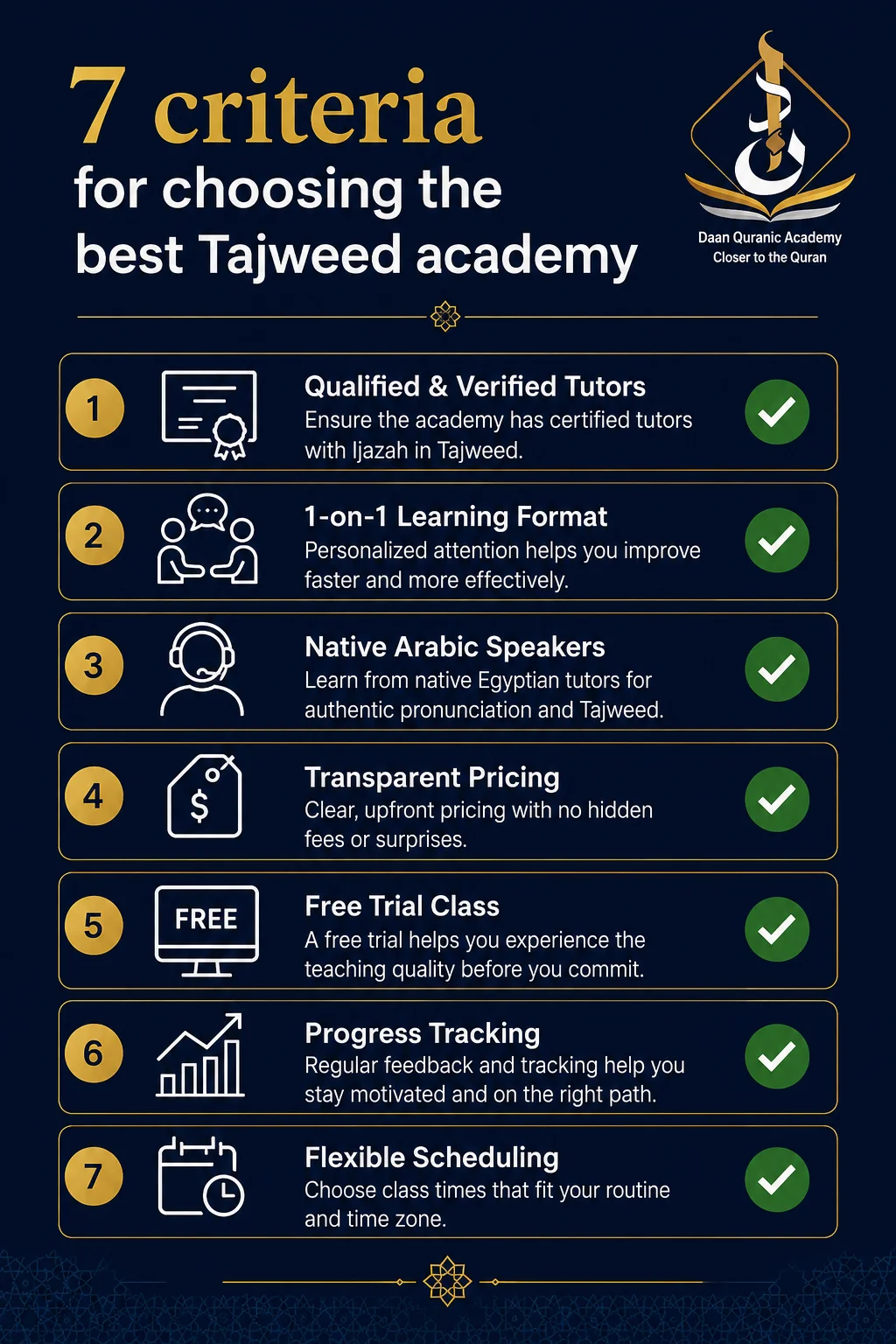
Use this checklist when comparing academies:
- Confirm the tutors are native Arabic speakers Many platforms use non-native instructors, which can pass along accent-based pronunciation habits. At Daan Academy, every tutor is a native Egyptian Arab, formally trained in Quranic sciences and fluent in English, so nothing is lost in translation during a correction.
- Check for verified Ijazah certification Look for academies with certified Ijazah holders. Many of Daan Academy’s tutors hold Ijazah in multiple Qira’at with documented chains of transmission back to the Prophet ﷺ — a meaningful marker of authenticity that a generic online course cannot offer.
- Make sure classes are 1-on-1, not group-based Unlike group classes that dilute individual attention, every Daan Academy session is private and personalized, which matters enormously for a rule like idgham that depends on precise, individual timing correction.
- Look for transparent, all-inclusive pricing Some platforms hide fees behind vague “contact us for pricing” pages. Daan Academy’s three plans are clearly listed starting from $9/hr, with no hidden charges.
- Insist on a free trial before you commit A risk-free free trial session lets you evaluate a tutor’s teaching style and correction method before spending a cent — something every reputable academy should offer without pressure.
- Check whether progress is actually tracked Where most academies offer no visibility into progress, Daan Academy’s Smart Student Dashboard lets students and parents track sessions, attendance, and monthly progress reports in one place, with verified certificates issued at each course milestone.
Meeting your future tutor before committing matters just as much as reading reviews. You can browse verified tutor profiles, qualifications, and specialties on our Our Tutors page, and see the full picture of what sets the academy apart on our Why Choose Us page.
Learning Idgham Online vs. Self-Study Apps: A Comparison
Learning idgham with a live online tutor consistently outperforms self-study apps because idgham is an auditory skill that requires real-time correction, which no algorithm can currently replicate reliably. Apps are useful for reviewing letter charts and theory, but they cannot hear whether your Ghunnah lasted two counts or whether your merge still carries a trace of nasal sound it shouldn’t.
| Factor | Self-Study App | Live 1-on-1 Tutor (Daan Academy) |
|---|---|---|
| Real-time pronunciation correction | Not available | Every session, in real time |
| Personalized feedback on Ghunnah timing | Generic or none | Individually corrected by a certified tutor |
| Native Arabic accent modeling | Varies, often synthetic audio | Native Egyptian tutors, fluent in English |
| Ijazah-certified instruction | Rarely verifiable | Many tutors hold certified Ijazah with verified chains |
| Progress tracking & certificates | Basic streaks/badges | Detailed dashboard, monthly reports, verified certificates |
| Pricing transparency | Subscription tiers, limited features | Clear plans from $9/hr, no hidden fees |
This does not mean apps are worthless — they are genuinely helpful for memorizing letter groups like “Yanmu” between lessons. But when it comes to actually applying these rules correctly in live recitation, a qualified human ear is still the gold standard. If you are also working on pronunciation more broadly, our post on the best online Tajweed course in 2026 compares learning formats in more depth.
Idgham & Tajweed Classes: What Should You Expect to Pay?
Online Tajweed and idgham classes typically range from roughly $9 to $15 per hour depending on the tutor’s qualifications, class format, and platform overhead. Group classes tend to sit at the lower end but sacrifice individual attention, while unstructured private tutoring from independent tutors can run considerably higher without any guarantee of certification.
Pricing Snapshot
Plans at Daan Academy start from just $9/hr with native Egyptian tutors. Compare our three flexible pricing tiers — Essential ($9/hr), Pro ($10.99/hr), and Elite ($12.99/hr) — each designed for different learning goals and budgets, with a family discount available on the Elite plan.
Where some platforms lack transparency on pricing, every plan at Daan Academy is listed clearly with no surprise add-ons. All three tiers include fully private, 1-on-1 sessions, access to specialized courses including Tajweed Rules Mastery, Quran Reading & Recitation, and Hifz, plus smart notifications so neither you nor your child ever misses a scheduled class. Families enrolling more than one child often find the Elite plan’s family discount brings the effective per-hour cost down further, and our referral program means both you and a friend receive a discount when you invite them to join.
Feature 01
What to Look For: Certified, Transparent Pricing
A trustworthy academy should never require a sales call just to learn its rates. Daan Academy publishes exact hourly pricing for all three plans upfront, so parents and adult learners alike can budget with confidence before ever booking a free trial session.
Real Results: What Students Achieve When They Master Idgham
Students who work through structured, tutor-corrected idgham practice typically notice smoother, more confident recitation within a few weeks, because the rule affects nearly every page of the Quran once Noon Sakinah and Tanween start appearing regularly. This is one of the most immediately rewarding Tajweed rules to master precisely because the improvement is so audible.
Families across 15+ countries currently learn with Daan Academy, from busy professionals in the UK squeezing in evening lessons to homeschooling parents in the US structuring daily Quran time for their children. Many students who complete our Hifz program report that a solid grasp of idgham and other Noon Sakinah rules made memorization noticeably smoother, since correctly merged sounds are easier to recall than choppy, disconnected ones. For children, our 600+ educational games library reinforces these rules playfully between live sessions, turning repetition into something kids actually look forward to.
Every completed course milestone comes with a verified certificate, and our Smart Student Dashboard gives parents visibility into exactly which Tajweed rules their child has mastered and which ones still need practice — no guessing required.
Is Idgham Difficult to Learn?
Idgham is not inherently difficult to learn — the two rules themselves can be memorized in a single sitting — but applying them correctly and consistently during live recitation takes guided practice, which is why most students benefit from working with a tutor rather than relying on memorization alone. The theory (six letters, two categories) is simple. The execution (timing, nasal resonance, word-boundary awareness) is what takes repetition and correction.
This is true for children and adults alike. Younger learners often pick up the sound patterns quickly through repetition and games, while adult reverts and busy professionals tend to benefit from a more structured, explanation-first approach that connects the rule to the Arabic grammar they are also learning. Either way, the path to mastering idgham is the same: hear it modeled correctly, try it yourself, and get corrected immediately when it slips — the exact loop built into every live class at Daan Quranic Academy.

Frequently Asked Questions
What are the idgham rules of tajweed in simple terms?
The idgham rules of tajweed say that when Noon Sakinah or Tanween is followed by one of six letters (ي، ن، م، و، ل، ر) at the start of the next word, the two sounds merge into one instead of being read separately. If the letter is ي، ن، م، or و, the merge includes a nasal hum (Ghunnah). If it is ل or ر, the merge happens with no nasal sound at all. How much do online Tajweed and idgham classes cost?
At Daan Academy, private 1-on-1 Tajweed classes start from $9/hr on the Essential plan, with Pro and Elite tiers available for learners who want additional features. You can compare all three plans on our pricing page. Can I try a class before committing to a plan?
Yes. Every new student can book a completely free trial session with no obligation to continue, so you can evaluate the tutor and teaching style firsthand before paying anything. Is it safe for my child to learn Quran and Tajweed online?
Yes, when the academy uses vetted, background-checked tutors and private, 1-on-1 sessions rather than open group calls. All Daan Academy tutors are formally trained and every session is one-on-one, giving parents full visibility through session recordings and progress reports. Do I need to know Arabic before learning idgham rules?
No. Idgham is taught by sound and repetition, not by reading Arabic grammar first. Tutors explain each rule in fluent English and demonstrate the correct pronunciation, which is especially helpful for reverts and non-Arabic-speaking families. How do I know if a Tajweed tutor is actually qualified?
Look for verified Ijazah certification, native Arabic fluency, and formal training in Quranic sciences. You can review tutor qualifications directly on our Our Tutors page before booking a session.
Take the Next Step
Ready to Finally Get Idgham Right?
Reading about idgham is a good start — hearing it corrected live, in your own recitation, is what actually makes it stick. Book a free session with a native Egyptian tutor and experience the difference for yourself.
✓ Native Egyptian Tutors✓ 1-on-1 Live Sessions✓ Certified Ijazah Holders✓ Flexible Scheduling✓ Free Progress Reports✓ From $9/hr
No commitment required. One free session to experience the Daan Academy difference.
Final Thoughts on the Idgham Rules of Tajweed
The idgham rules of tajweed are a small piece of a much larger discipline, but they carry real weight — every merged Noon Sakinah you recite correctly brings you a little closer to reciting the Quran the way it was taught, ayah after ayah, generation after generation. As the Prophet ﷺ said:
“The best among you are those who learn the Qur’an and teach it.”
Narrated by Uthman ibn Affan — Sahih al-Bukhari 5027
Whether you are a parent looking to give your child a strong foundation, or an adult revert working on your own recitation, the path forward is the same: consistent practice, corrected by someone qualified to hear the difference. May Allah make it easy for you to learn, and easier still to teach it to someone else. Explore more Tajweed and Quran learning guides on our blog, or take the next step today with a free trial class at Daan Quranic Academy.
Continue Your Journey
- 5 Common Tajweed Mistakes Non-Arabic Speakers Make and How to Fix Them
- Best Online Tajweed Course in 2026: Expert Guide for Kids & Adults
- The Comprehensive Guide to Learning Noorani Qaida: From Zero to Mastery
Tajweed OnlineOnline Quran ClassesQuran for KidsQuran for AdultsQuran for RevertsIslamic Education