A Complete Guide to the Features of Arabic Letters for Flawless Recitation | Daan Quranic Academy
The features of Arabic letters (Sifaat al-Huroof) are the manner-of-pronunciation rules — such as heaviness, lightness, breathiness, and vibration — that give every Arabic letter its correct sound, and mastering them is what separates approximate recitation from flawless, Tajweed-accurate Quran recitation. Whether you are a revert learning to read Arabic for the first time, a parent choosing a Quran class for your child, or an adult refining your Tajweed, understanding the characteristics of Arabic letters is the single most overlooked skill in Quran learning — and the one that makes the biggest difference in how your recitation sounds and is rewarded.
📑 Table of Contents
- What Are the Features of Arabic Letters?
- Makhraj vs Sifaat: Understanding the Difference
- The Paired Sifaat of Arabic Letters (With Opposites)
- The Unpaired Sifaat al-Huroof (Without Opposites)
- Why Sifaat al-Huroof in Tajweed Matters for Every Reciter
- How to Learn the Characteristics of Arabic Letters: A Step-by-Step Path
- Online vs In-Person: The Best Way to Learn Sifaat al-Huroof
- Common Sifaat Mistakes Non-Arabic Speakers Make
- Frequently Asked Questions
What Are the Features of Arabic Letters?
The features of Arabic letters, known in Tajweed as Sifaat al-Huroof, are the fixed qualities of sound — like softness, harshness, whistling, or echoing — that accompany each letter every time it is pronounced, regardless of its position in a word. While the makhraj (articulation point) tells you where a letter is produced in the mouth or throat, the sifaat tell you how it should sound once it leaves that point. Without them, letters that share the same makhraj — like ت (ta) and ط (ta emphatic) — would be indistinguishable, and Quranic meaning can genuinely change with a mispronounced letter.
At Daan Quranic Academy, this is one of the first building blocks taught in our Tajweed Rules Mastery course, because a student who understands sifaat al huroof meaning early on progresses far faster through Quran recitation than one who simply memorizes sounds by repetition.
وَرَتِّلِ الْقُرْآنَ تَرْتِيلًا
“And recite the Qur’an with measured, careful recitation.”
This verse is the foundation many scholars cite when explaining why Tajweed — and the characteristics of Arabic letters within it — is not an optional extra but part of reciting the Quran the way it was revealed. Explore our full Quran and Tajweed course options to see how this is taught step by step.
Makhraj vs Sifaat: Understanding the Difference
Makhraj refers to the exact point in the mouth, throat, or lips where a letter’s sound originates, while sifaat refers to the manner in which that sound is produced — together they form the complete identity of every Arabic letter. Think of makhraj as the “address” of a letter and sifaat as its “personality.” Two letters can share an address (the same makhraj) but have completely different personalities (different sifaat), which is exactly why students need both to recite correctly.
Real session recording: A certified native Egyptian tutor guiding an adult student through the Qalqalah characteristic and correcting pronunciation letter by letter in a live 1-on-1 Tajweed session. All videos are real, unedited screen-recordings from actual student sessions at Daan Academy, posted with student consent.
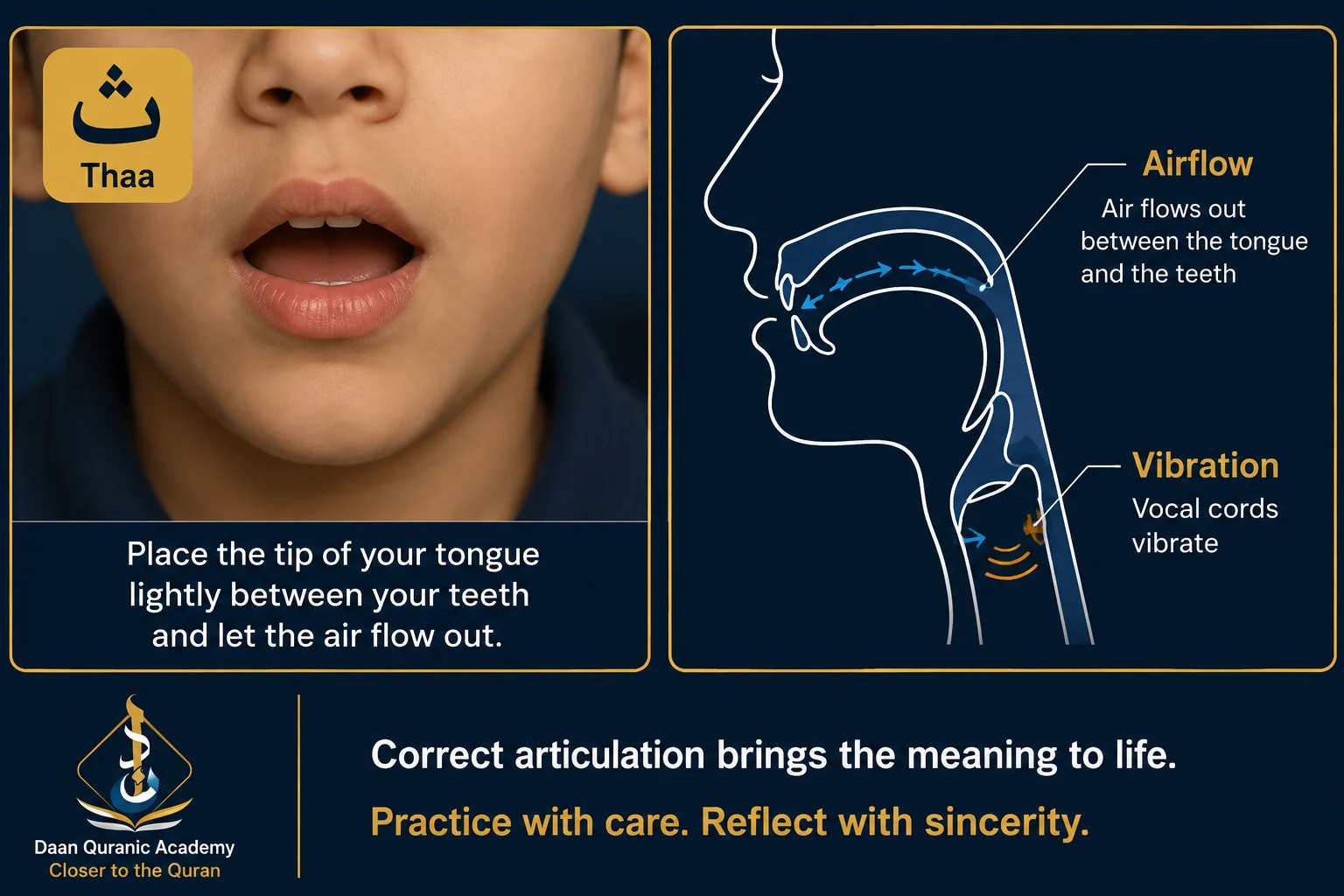
For example, ت (ta) and د (dal) are produced at the same makhraj — the tip of the tongue against the upper front teeth — but ت is hams (breathy) while د is jahr (voiced). Say them without the correct sifaat and they can sound almost identical, which is exactly the kind of error the features of Arabic letters framework exists to fix. Our native Egyptian tutors are trained specifically to isolate these near-identical sound pairs for English-speaking learners.
Sifaat al huroof meaning, in simple terms: the set of vocal qualities — 17 in total across paired and unpaired categories — that determine the correct “texture” of each of the 29 Arabic letters when recited.
The Paired Sifaat of Arabic Letters (With Opposites)
The paired characteristics of Arabic letters are five sets of opposite qualities — every letter carries one trait from each pair, and together these five pairs account for most of the tonal differences reciters must master. These are the Sifaat of Arabic letters most Tajweed teachers introduce first, because they explain why some letters sound “heavy” and others “light.”
| Pair | Trait 1 | Trait 2 | What It Means |
|---|---|---|---|
| 1 | Hams (breathy) | Jahr (voiced) | Whether breath escapes freely or the vocal cords vibrate |
| 2 | Shiddah (stopped) | Rakhawah (flowing) | Whether airflow is fully blocked or allowed to flow |
| 3 | Isti’la (raised) | Istifal (lowered) | Whether the back of the tongue rises toward the palate |
| 4 | Itbaq (closed) | Infitah (open) | Whether the tongue presses fully against the palate |
| 5 | Ithlaq (fluent) | Ismat (restrained) | Whether the letter is easy or effortful to articulate quickly |
The four letters of Itbaq (ص، ض، ط، ظ) are often the hardest for English-speaking students because English has no equivalent “heavy” consonant — this is precisely the kind of nuance covered in depth in our guide to common Tajweed mistakes non-Arabic speakers make.
The Unpaired Sifaat al-Huroof (Without Opposites)
The unpaired characteristics of Arabic letters are qualities that belong only to specific letters with no true opposite trait, and they include distinctive effects like the echoing “bounce” of Qalqalah and the whistling of Safeer. These add texture and are frequently tested points in Ijazah-level Tajweed evaluation.
- Safeer (whistling): ص، س، ز — a hissing sound as air passes narrowly between the tongue and teeth
- Qalqalah (echoing/bouncing): ق، ط، ب، ج، د — a slight bounce when the letter carries sukoon
- Leen (softness): و and ي when preceded by a letter with fatha and followed by sukoon
- Inhiraf (deviation): ل، ر — the sound is deflected toward another articulation point
- Takreer (repetition/trilling): ر — a light vibration of the tongue tip
- Tafashi (spreading): ش — airflow spreads across the mouth
- Istitalah (elongation): ض — the sound stretches along the side of the tongue
- Ghunnah (nasalization): م، ن — a nasal resonance, especially prominent with tashdid
What to Look For: A Tutor Who Teaches Sifaat, Not Just Sounds
Many platforms teach letters by rote repetition without ever naming the underlying sifaat, which leaves students unable to self-correct. At Daan Academy, tutors explicitly teach the characteristics of Arabic letters — Qalqalah, Safeer, Ghunnah and the rest — by name, so students understand why a letter sounds a certain way, not just that it does.
Why Sifaat al-Huroof in Tajweed Matters for Every Reciter
Sifaat al-Huroof in Tajweed matters because correct pronunciation directly affects the meaning and validity of Quranic recitation — a letter recited without its proper characteristic can subtly or drastically change a word’s meaning. This is not a minor stylistic detail; scholars consider correct articulation part of reciting the Quran as it was revealed to the Prophet Muhammad ﷺ.
“The one who is proficient in the Quran will be with the noble, righteous scribes (angels), and the one who recites the Quran with difficulty, stammering, and struggling through it, will have a double reward.”
Narrated by Aisha (RA) — Sahih Muslim, Hadith 798
This hadith is often cited by teachers to encourage struggling students — even imperfect effort toward mastering the features of Arabic letters is rewarded, and consistent practice under a qualified tutor is what turns effort into fluency. Families across 15+ countries have used this exact approach through Daan Academy’s structured Tajweed curriculum.
How to Learn the Characteristics of Arabic Letters: A Step-by-Step Path
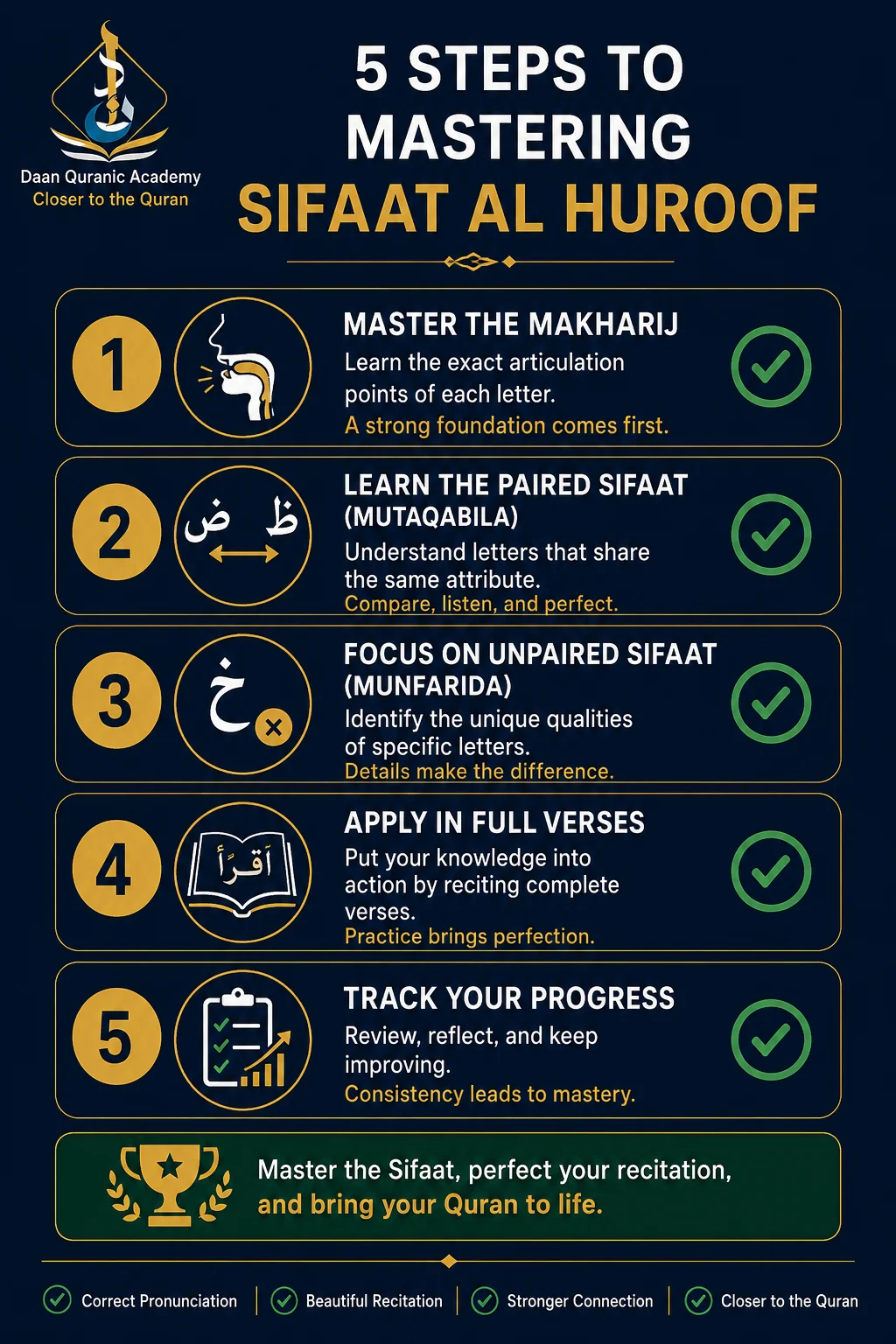
The most effective way to learn the characteristics of Arabic letters is a structured progression from individual letter sounds to paired sifaat to full-word application under live correction — not passive video-watching alone.
Master the Makhraj First
Before sifaat can make sense, a student must consistently locate each letter’s articulation point — the throat, tongue, lips, or nasal passage.
Learn the Five Paired Sifaat
Introduce Hams/Jahr, Shiddah/Rakhawah, Isti’la/Istifal, Itbaq/Infitah, and Ithlaq/Ismat one pair at a time, with live demonstration and repetition.
Add the Unpaired Sifaat
Layer in Qalqalah, Safeer, Ghunnah, Leen, and the remaining unpaired characteristics using short practice words that isolate each one.
Apply Sifaat Within Full Verses
Move from isolated letters to Quranic ayat, where a live tutor listens for and corrects blended errors in real time.
Get Ongoing Correction and Feedback
Sifaat mastery is refined over weeks of consistent, personalized correction — a smart student dashboard tracking session-by-session progress helps both student and parent see measurable improvement.
This exact five-step path is how Daan Academy structures its Tajweed Rules Mastery course, supported by a 600+ game educational library that keeps younger learners engaged while reinforcing each sifaat through interactive practice.
Plans start from just $9/hr with native Egyptian tutors. Compare our three flexible pricing tiers — Essential, Pro, and Elite — each designed for different learning goals and budgets, including dedicated Tajweed and Sifaat al-Huroof focus.
Online vs In-Person: The Best Way to Learn Sifaat al-Huroof
Online 1-on-1 Tajweed classes are, for most English-speaking families, a more effective way to learn the features of Arabic letters than group in-person classes, because correcting subtle sound differences requires focused, individual listening that group settings rarely allow.
Unlike group classes that dilute attention across many students, Daan Academy provides 1-on-1 live sessions where the tutor’s full focus is on one learner’s mouth shape, airflow, and sound. While many platforms use non-native or non-specialist speakers, Daan’s tutors are all native Egyptian Arabs, many holding certified Ijazah in multiple Qira’at with verified chains of transmission back to the Prophet ﷺ. Where most academies offer a generic, one-size-fits-all curriculum, Daan builds a personalized learning plan around each student’s specific sifaat weaknesses.
Flexible scheduling also matters: students can book sessions at any time, from anywhere in the world, with smart notifications reminding them before each class — removing the scheduling friction that causes many families to abandon in-person lessons. See how this compares across programs on our Why Choose Us page.
Common Sifaat Mistakes Non-Arabic Speakers Make
The most common mistake English-speaking learners make with the characteristics of Arabic letters is substituting a similar-sounding English consonant for an Arabic letter that has no true English equivalent, especially the heavy (Itbaq) letters.
- Pronouncing ط (heavy) the same as ت (light) — losing the Isti’la quality entirely
- Flattening the whistling Safeer letters (س، ص، ز) into a generic “s” sound
- Skipping the bounce of Qalqalah letters when they carry sukoon at the end of a word
- Under-holding Ghunnah on ن and م, especially with tashdid or Idgham rules
- Confusing ح and هـ, both throat letters but with very different hams/jahr qualities
These are exactly the errors covered in our related guide on top Arabic pronunciation challenges for English speakers, and they are also why real-time, human correction outperforms app-based self-study — a mispronounced sifaat often feels correct to the learner’s own ear until an experienced tutor points it out.

Frequently Asked Questions
What are the features of Arabic letters called in Tajweed?
They are called Sifaat al-Huroof, meaning the “characteristics of the letters” — the set of pronunciation qualities, paired and unpaired, that every Arabic letter carries.
How much do online Tajweed classes cost?
At Daan Quranic Academy, classes start from $9/hr on the Essential plan, with Pro and Elite tiers available for more intensive study. See full details on our pricing plans page.
Can I try a class before committing?
Yes — every new student can book a free trial session with no commitment required. It’s the easiest way to experience how a native Egyptian tutor teaches sifaat al huroof before signing up for a plan.
Is it safe for my child to learn Arabic pronunciation online?
Daan Academy uses vetted, certified tutors, private 1-on-1 sessions, and a monitored student dashboard, giving parents full visibility into every class and progress report.
How do I know if a tutor is qualified to teach Sifaat al-Huroof?
Look for native Arabic speakers with formal Tajweed training and, ideally, Ijazah certification. Learn more about our tutors’ credentials on the Our Tutors page.
Do I need to learn Sifaat al-Huroof before starting Hifz?
It’s strongly recommended. Memorizing with incorrect sifaat can embed errors that are harder to correct later, so most structured programs teach correct pronunciation before or alongside memorization.
Are online Tajweed classes as effective as in-person ones?
For most learners, yes — and often more so, since 1-on-1 online sessions give a tutor undivided attention to correct subtle sound differences that get lost in group in-person classes.
Master the Features of Arabic Letters With a Native Egyptian Tutor
Understanding Sifaat al-Huroof in theory is one thing — hearing it corrected live, letter by letter, is what actually builds flawless recitation. Book a free trial and experience it for yourself.
No commitment required. One free session to experience the Daan Academy difference.
Final Thoughts
The features of Arabic letters may seem like a technical detail at first, but they are the difference between reciting the Quran and reciting it beautifully and correctly, as the Prophet Muhammad ﷺ taught his companions. Whether you are just starting with Noorani Qaida or refining Tajweed at an advanced level, learning Sifaat al-Huroof with a qualified, native-speaking tutor at Daan Quranic Academy in 2026 gives you a clear, structured path forward.
We ask Allah to make the Quran a source of light, guidance, and reward for every student on this journey. Ameen.