Arabic Tongue Letters in Tajweed: Makharij, Articulation Points, and Guide
Arabic tongue letters are the largest single group of Tajweed articulation points, made up of eighteen letters that are all produced by the tongue touching a different part of the mouth. Confuse one point of contact with another — and a word can change meaning entirely. This guide maps out every tongue makhraj, shows you exactly where each sound begins, and explains how a certified native tutor at Daan Quranic Academy can help you correct your pronunciation for good.
📑 Table of Contents
- What Are Arabic Tongue Letters in Tajweed?
- The 10 Articulation Points of the Tongue Makhraj
- How to Choose the Best Teacher for Arabic Tongue Letters
- Tongue Letters in Arabic vs Throat, Lip, and Nasal Makharij
- Common Mistakes with Tongue Letters in Tajweed
- Why Mastering Arabic Tongue Letters Transforms Your Recitation
- How to Practice Tongue Letters at Home: A Step-by-Step Guide
- Frequently Asked Questions
What Are Arabic Tongue Letters in Tajweed?
Arabic tongue letters (Huroof al-Lisan) are the 18 letters of the Quran whose sound is produced by the tongue touching or approaching the palate, the molars, the gums, or the front teeth. They are the biggest of the five major makhraj groups — alongside the oral cavity, the throat, the lips, and the nasal cavity — and getting them right is the single most important skill in learning correct Tajweed.
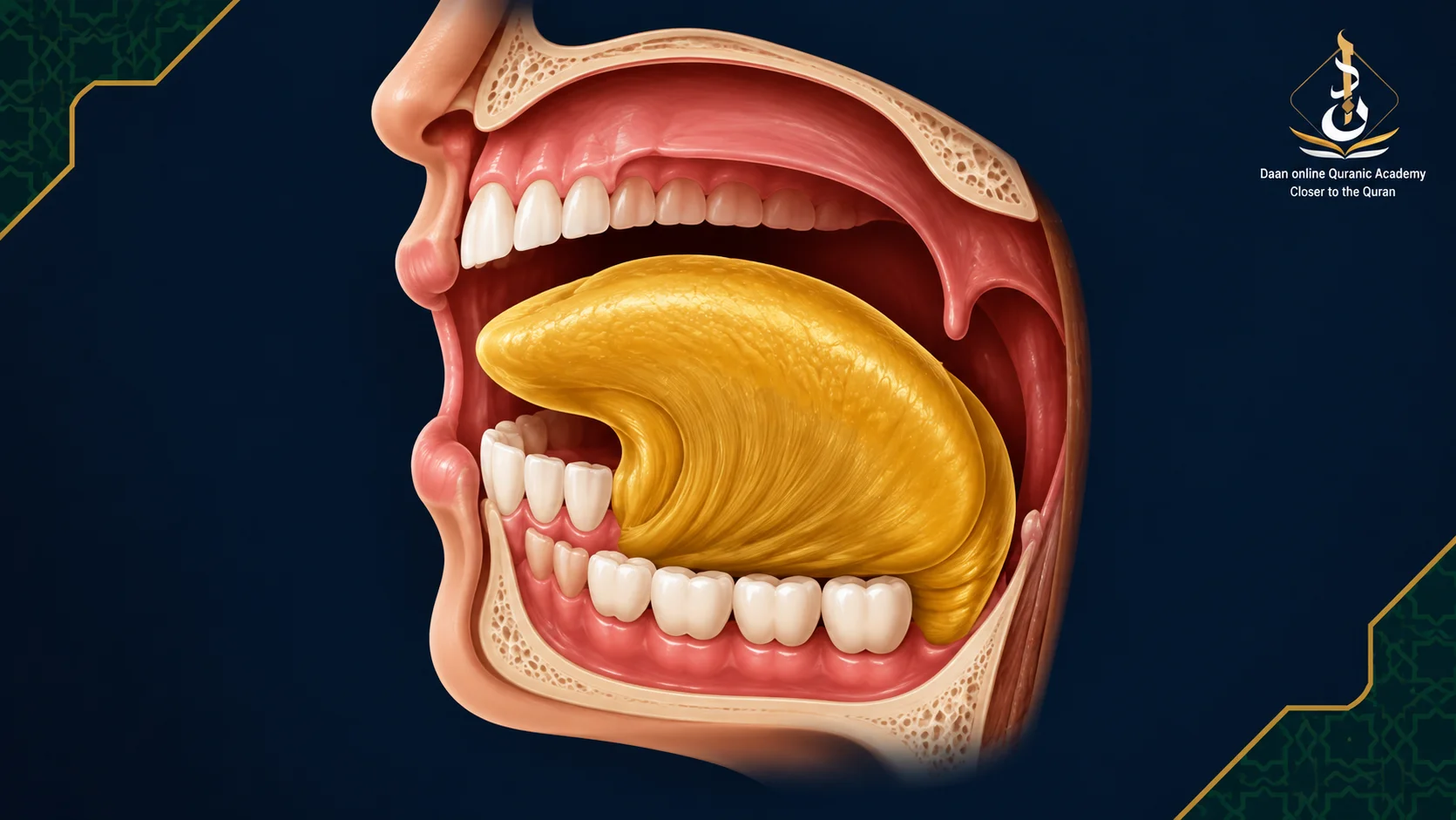
Because so many letters share the tongue as their articulator, small differences in exactly where the tongue touches make the difference between letters that look similar in transliteration but sound completely different in Arabic — such as ت and ط, or س and ص. This is why tongue letters in Tajweed are usually taught as a dedicated unit, rather than folded into general pronunciation lessons.
At Daan Academy’s Tajweed Rules Mastery course, every tongue letter is drilled individually with a native Egyptian tutor before students move on to combining them inside real ayahs — a method that mirrors how these makharij have been taught for over a thousand years.
The 10 Articulation Points of the Tongue Makhraj
The tongue makhraj is not one single point — it is divided into ten distinct sub-points, running from the very back of the tongue to its tip, each producing a different set of letters. Classical Tajweed scholars mapped these points precisely so that reciters could reproduce the exact sound the Prophet ﷺ used, letter for letter.
Real session recording: A certified native Egyptian tutor guiding an adult student through the exact tongue-to-palate contact points for the tongue makhraj in a live 1-on-1 Tajweed session. All videos are real, unedited screen-recordings from actual student sessions at Daan Academy, posted with student consent.
Here is how the ten points break down, moving from the back of the mouth to the front:
| # | Tongue Position | Contact Point | Letters |
|---|---|---|---|
| 1 | Very back of tongue | Soft palate (uvula) | ق (Qaf) |
| 2 | Back of tongue, slightly forward | Hard palate | ك (Kaf) |
| 3 | Middle of tongue | Hard palate (roof of mouth) | ج ش ي (Jeem, Sheen, Ya) |
| 4 | Edge of tongue (one or both sides) | Upper molars | ض (Dad) |
| 5 | Edge of tongue, just in front of Dad | Gums above front teeth | ل (Lam) |
| 6 | Tip of tongue, just below Lam’s point | Gums above front teeth | ن (Noon) |
| 7 | Tip of tongue, slightly further back than Noon | Gums (with a light flick) | ر (Ra) |
| 8 | Tip of tongue | Base of the upper front teeth | ط د ت (Ta, Dal, Ta) |
| 9 | Tip of tongue | Near the edge of the lower front teeth | ص س ز (Sad, Seen, Zay) |
| 10 | Tip of tongue protruding slightly | Between the upper and lower front teeth | ظ ذ ث (Dha, Dhal, Tha) |
Together these ten points account for eighteen letters — over 60% of the Arabic alphabet used in the Quran. That is exactly why the tongue makhraj takes up the largest share of any structured Tajweed curriculum, and why our tutors treat it as a standalone module rather than a footnote inside general recitation classes. Every tutor on our team is a certified Ijazah holder, many with chains of transmission (sanad) that trace back through generations of qualified scholars, so the version of these makharij you learn is verified, not approximate.
How to Choose the Best Teacher for Arabic Tongue Letters
The best teacher for arabic tongue letters is a certified, native Arabic-speaking tutor who teaches 1-on-1, can hear and correct your exact point of articulation in real time, and communicates fluently in your own language. Group classes and pre-recorded courses simply cannot do this — a tongue-position error is often inaudible to an untrained ear, and by definition invisible on video without live feedback.

Native Fluency, Not Just a Certificate
A certificate alone doesn’t guarantee a tutor can hear a subtle Dad-versus-Dha slip. Every tutor at Daan Quranic Academy is a native Egyptian Arabic speaker, trained in the Quranic sciences from childhood, which means these contact points are instinctive to them — not memorized theory.
1-on-1 Sessions, Not Group Calls
Unlike group classes that dilute attention across six or eight students, Daan Academy runs every class as a private, 1-on-1 session, so a tutor can stop you mid-word the moment your tongue lands on the wrong spot.
Transparent Pricing You Can Compare
Some platforms bury their pricing behind a sales call. Daan Academy’s three plans are listed openly, starting from just $9/hr, so you know exactly what you are paying for before you book a single session.
You can review tutor bios, Ijazah chains, and teaching specialties yourself on our Our Tutors page, or read more about our approach on the Why Choose Us page before booking a session.
Tongue Letters in Arabic vs Throat, Lip, and Nasal Makharij
Tongue letters in Arabic make up the largest of five makharij families, but Tajweed also groups letters by the throat, the lips, the nasal cavity, and the open oral cavity — and each family carries its own common mistakes. Understanding where tongue letters sit in this bigger picture helps students avoid mixing up correction techniques that only apply to a different articulator.
- Al-Jawf (oral cavity): produces the three long vowel (madd) letters — ا و ي
- Al-Halq (throat): produces six letters across three throat depths — ء ه ع ح غ خ
- Al-Lisan (tongue): produces eighteen letters across ten points, covered above
- Ash-Shafatan (the two lips): produces four letters — ف و ب م
- Al-Khaishoom (nasal cavity): produces the ghunnah (nasal resonance) heard on Noon and Meem in specific Tajweed rules
Where throat letters are corrected by adjusting depth and airflow, and lip letters by adjusting lip shape, tongue letters in Tajweed are corrected by adjusting exact contact point — a far more precise skill that benefits enormously from a tutor watching and listening live. If you want to go deeper on the throat group specifically, our guide on Top Arabic Pronunciation Challenges for English Speakers covers it in detail.
Common Mistakes with Tongue Letters in Tajweed
The most common mistake with tongue letters in Tajweed is collapsing two neighboring points into one sound — for example, pronouncing ض (Dad) as if it were ظ (Dha), or flattening the emphatic letters ط ص into their light counterparts ت س. English speakers are especially prone to this because English has no equivalent emphatic (mufakhkham) consonants.
- Dad and Dha confusion: Arabic is sometimes called “Lughat al-Dad” (the language of Dad) precisely because this letter’s molar-edge contact point is unique among world languages and rarely mastered without direct correction.
- Losing emphasis (tafkheem): letters like ط ض ص ظ require a raised back of the tongue that most transliteration systems don’t capture at all.
- Rushing the tip-of-tongue letters: ت د ط and س ص ز sit close together, and reciting quickly often blurs their distinct contact points.
- Skipping the interdental letters: ث ذ ظ require the tongue tip to protrude slightly — a habit that needs repetition to feel natural for adult learners.
These are exactly the kind of errors a 600+ game educational library in Daan Academy’s Smart Student Dashboard is built to reinforce for younger learners — turning repetitive makhraj drills into something children actually enjoy practicing between live sessions. For a broader look at pronunciation pitfalls beyond the tongue group, see our post on 5 Common Tajweed Mistakes Non-Arabic Speakers Make and How to Fix Them.
Why Mastering Arabic Tongue Letters Transforms Your Recitation
Mastering arabic tongue letters transforms recitation because it removes the single biggest source of meaning-changing errors in the Quran — many minimal pairs in Arabic differ only by tongue contact point, so precision here directly protects the integrity of what is being recited.
أَوْ زِدْ عَلَيْهِ وَرَتِّلِ الْقُرْآنَ تَرْتِيلًا
“Or add to it, and recite the Qur’an with measured recitation.”
This command for tartil — slow, distinct, letter-by-letter recitation — is precisely what correct tongue makhraj practice enables. The Prophet ﷺ also praised the reward of working through pronunciation difficulty rather than avoiding it:
“Such a person as recites the Qur’an and masters it by heart will be with the noble, righteous scribes. And such a person exerts himself to learn the Qur’an and recites it with difficulty will have a double reward.”
Narrated by Aisha (RA) — Sahih al-Bukhari 4937
Students who complete our Tajweed Rules Mastery course with correct tongue letters in Arabic report noticeably smoother recitation within weeks, not months — because so many separate letters share one learning curve. Families across more than 15 countries have gone through this same course structure with Daan Academy’s native Egyptian tutors.
Plans start from just $9/hr with native Egyptian tutors. Compare our three flexible pricing tiers — Essential, Pro, and Elite — each designed for different learning goals and budgets, with a family discount available on the Elite plan.
How to Practice Tongue Letters at Home: A Step-by-Step Guide
To practice tongue letters at home, isolate one articulation point at a time, use a mirror to check tongue position, record yourself, and get live correction from a qualified tutor at least once a week. Self-study alone rarely catches subtle contact-point errors, which is why home practice works best as a supplement to — not a replacement for — live sessions.
Isolate One Point at a Time
Pick a single row from the makhraj table above — for example the tip-of-tongue letters ت د ط — and repeat only those letters slowly for five minutes before moving on.
Use a Mirror
Watch your tongue’s contact point directly. For interdental letters like ث ذ ظ, you should visibly see the tongue tip between the teeth.
Record and Compare
Record short clips of yourself reciting minimal pairs (like ض vs ظ) and compare them against a certified tutor’s pronunciation.
Book a Live Correction Session
Bring your recordings to a free trial session so a native tutor can pinpoint exactly which contact points still need adjustment.
Track Progress Consistently
Use the Smart Student Dashboard to log sessions and review monthly progress reports, so improvement in your tongue letters is measured, not guesswork.
Smart notifications remind you before every scheduled session, so consistent practice doesn’t depend on remembering — and if you’re working through the alphabet from the very beginning, our Comprehensive Guide to Learning Noorani Qaida is a useful companion to this one.

Frequently Asked Questions
How much do online Tajweed classes for tongue letters cost?
Daan Academy’s plans start from $9/hr for the Essential tier, with Pro at $10.99/hr and Elite at $12.99/hr. Full details are on our Pricing Plans page.
Can I try a class before committing?
Yes. Every new student can book a free trial session with no commitment required, so you can experience a tongue-letter correction session firsthand before choosing a plan.
Is it safe for my child to learn tongue letters online?
All sessions are private, 1-on-1, and recorded within the platform, with dedicated support available around the clock for any technical or academic concern that comes up during a class.
How do I know if the tutor is qualified to teach Makharij?
Every tutor is a native Egyptian Arabic speaker, and many are certified Ijazah holders with a verified chain of transmission. You can review individual tutor credentials on our Our Tutors page.
How long does it take to master arabic tongue letters?
Most students notice a clear improvement within a few weeks of consistent 1-on-1 correction, though full mastery across all ten articulation points typically takes a few months of regular sessions.
What’s the difference between tongue letters and throat letters?
Tongue letters are corrected by adjusting the tongue’s exact contact point against the palate, molars, gums, or teeth, while throat letters are corrected by adjusting depth and airflow further back in the throat — two entirely different techniques.
Can adults and reverts learn arabic tongue letters from scratch?
Yes — many of our students are adult reverts starting with no prior Arabic background. Sessions are paced individually, so there is no age limit or prerequisite level to begin.
Perfect Your Arabic Tongue Letters with a Certified Native Tutor
Reading about the ten articulation points is only the first step — a live tutor listening to your recitation is what actually corrects them. Book a free session and find out exactly which tongue letters need work.
No commitment required. One free session to experience the Daan Academy difference.
Final Thoughts
The eighteen arabic tongue letters carry more of the Quran’s sound than any other articulator, which is exactly why they deserve focused, patient practice rather than a quick pass-through. Whether you are a parent looking to start your child on Noorani Qaida or an adult revert building your recitation from the ground up, getting these ten points right with a native, certified tutor is one of the most valuable investments you can make in your relationship with the Quran.
We ask Allah to make the learning of His Book easy for you, and to grant you the reward of every letter recited correctly. Explore more guides like this one on our blog.