
How Long Does It Take to Learn Tajweed? A Complete Timeline for Students
Most students can learn to read the Qur’an with correct Tajweed rules in 6 to 12 months of consistent, 1-on-1 practice — but the honest answer to how long does it take to learn Tajweed depends on your starting point, how often you practice, and whether your tutor corrects you live, session by session. This guide breaks down the real timeline stage by stage, compares kids vs. adults and online vs. in-person routes, and shows you exactly what to look for in a course so you don’t waste months on the wrong method.
At Daan Quranic Academy, students work 1-on-1 with native Egyptian tutors who are trained in the Quranic sciences, which is why so many of our learners reach confident, correct recitation faster than the timelines below assume. You can test this for yourself with a free trial Tajweed session before committing to anything.
📑 Table of Contents
- What Is Tajweed and Why Does the Timeline Vary?
- How Long Does It Take to Learn Tajweed? A Realistic Timeline
- The Duration to Learn Tajweed Rules: Stage-by-Stage Breakdown
- Tajweed Learning Duration for Kids vs. Adults
- How Long Does It Takes to Learn Quran Tajweed With a Native Tutor
- Learning Tajweed Rules Timeline: Online vs. In-Person vs. Self-Study
- What to Look for in a Tajweed Course (to Learn Faster)
- How Much Does It Cost to Learn Tajweed? Pricing and Value
- Real Results: How Long It Actually Takes Daan Academy Students
- Tips to Learn Tajweed Faster: 6 Steps That Cut Your Timeline in Half
- Frequently Asked Questions
What Is Tajweed and Why Does the Timeline Vary?
Tajweed is the set of rules governing how each Arabic letter of the Qur’an should be pronounced, joined, and elongated — covering Makharij al-Huroof (points of articulation), Sifaat al-Huroof (letter characteristics), and rules like Noon Sakinah, Madd, and Waqf. It exists so that the Qur’an is recited exactly as it was revealed, letter for letter.
The timeline to learn it varies because every student starts from a different point. A child who has already completed Noorani Qaida moves through Tajweed faster than an adult revert starting from the Arabic alphabet. Someone practicing daily with a live tutor progresses faster than someone relying on an app or a YouTube playlist. This is exactly why a single generic number doesn’t tell the full story — but a realistic range absolutely can, which is what the next section covers.
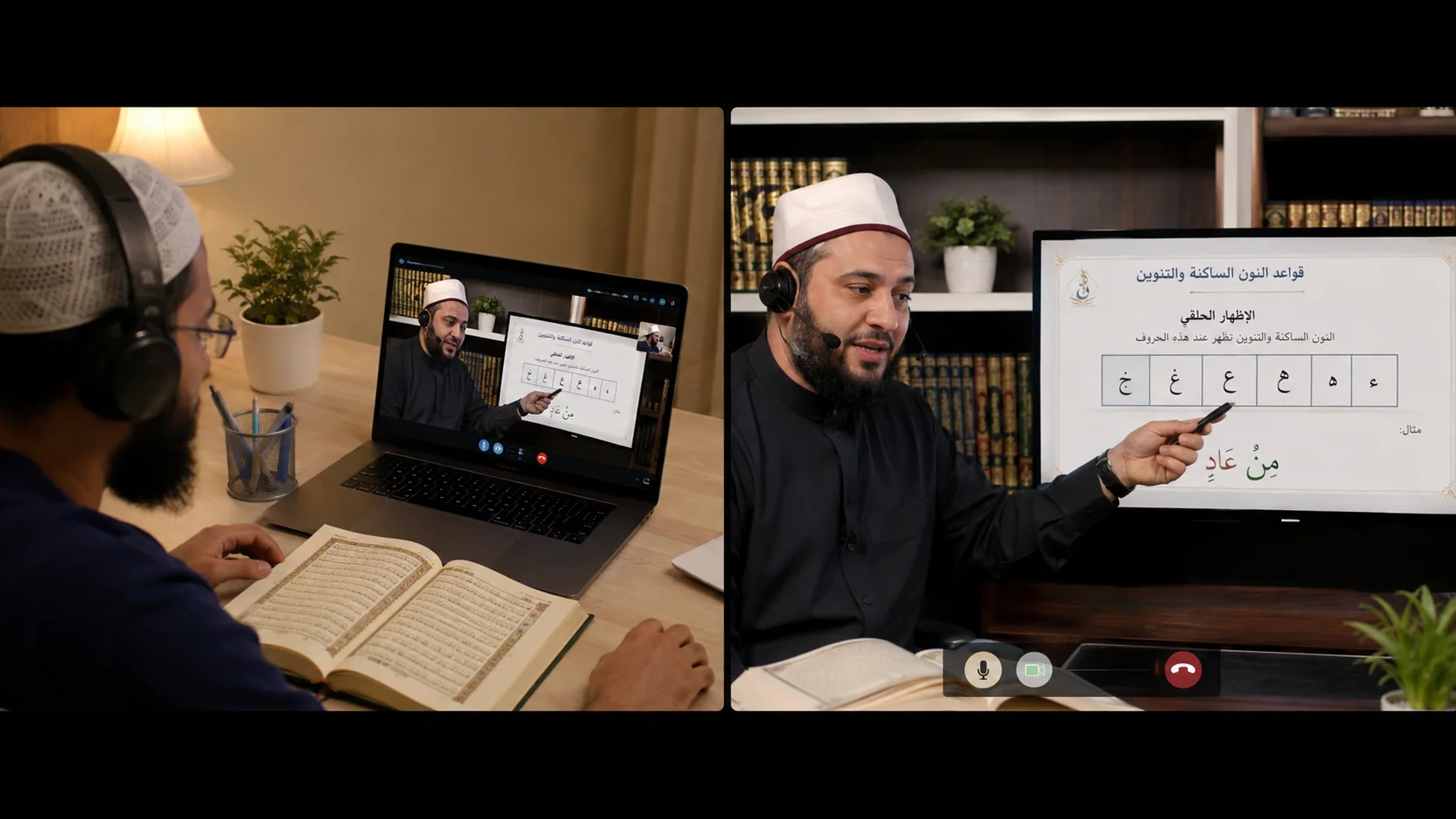
Before Tajweed even begins, most academies require a student to be comfortable reading Arabic script. If you haven’t reached that stage yet, our comprehensive guide to learning Noorani Qaida covers that foundation in detail.
How Long Does It Take to Learn Tajweed? A Realistic Timeline
On average, it takes 6 to 12 months of consistent 1-on-1 practice (2–3 sessions per week) to read Qur’an fluently with correct Tajweed rules applied, and 2–4 months just to grasp the foundational rules well enough to start correcting your own mistakes. Students who already read Arabic confidently often finish faster; complete beginners, especially adults learning a new script, should expect the longer end of that range.
Real session recording: Watch a native Egyptian tutor correct a student’s Makharij and Madd rules in real time during a live Tajweed lesson — this is the kind of moment-by-moment feedback that shortens the tajweed learning duration compared to self-study. All videos are real, unedited screen-recordings from actual student sessions at Daan Academy, posted with student consent.
Why the range? Tajweed isn’t memorized once — it’s a physical skill, closer to learning to pronounce a musical note correctly than memorizing a fact. That means progress depends on repetition and feedback, not just study hours. The Qur’an itself commands attentive, measured recitation rather than rushed reading:
أَوْ زِدْ عَلَيْهِ وَرَتِّلِ الْقُرْآنَ تَرْتِيلًا
“…or add to it, and recite the Qur’an with measured recitation.”
That instruction to recite with “tarteel” — slow, measured, rule-correct recitation — is essentially the goal Tajweed training exists to achieve. It’s also why rushing the process rarely works: a student pushed through rules too quickly tends to develop habits a tutor then has to unlearn later, which extends the timeline rather than shortening it.
The Duration to Learn Tajweed Rules: Stage-by-Stage Breakdown
The duration to learn Tajweed rules breaks down into five stages, most students moving through them in this order over roughly 6–12 months:
- Makharij al-Huroof (2–4 weeks): Learning the exact articulation point of each Arabic letter — where in the mouth or throat each sound originates.
- Sifaat al-Huroof (3–5 weeks): The characteristics of each letter — heavy vs. light letters, whispered vs. voiced sounds.
- Noon Sakinah and Tanween rules (4–6 weeks): Idghaam, Ikhfa, Iqlab, and Izhar — how these letters change sound depending on what follows them.
- Meem Sakinah and Qalqalah rules (2–3 weeks): Additional consonant rules that affect flow and clarity.
- Madd rules and Waqf (6–10 weeks): Elongation rules and correct stopping points — usually the longest stage because it requires ear training as much as memorization.
After these five stages, most students spend an additional 8–12 weeks applying every rule simultaneously across full pages of Qur’an, which is where fluency actually solidifies. If you’re comparing this against generic curricula, our Tajweed Rules Mastery course is structured around exactly this five-stage progression, with a tutor checking application on every page you read rather than just the rules in isolation.
Tajweed Learning Duration for Kids vs. Adults
The tajweed learning duration for kids is typically 8–14 months because sessions are shorter and lessons are paced around attention span, while motivated adults often finish core rules in 4–8 months since they can sustain longer, more focused sessions and grasp abstract grammar concepts faster.
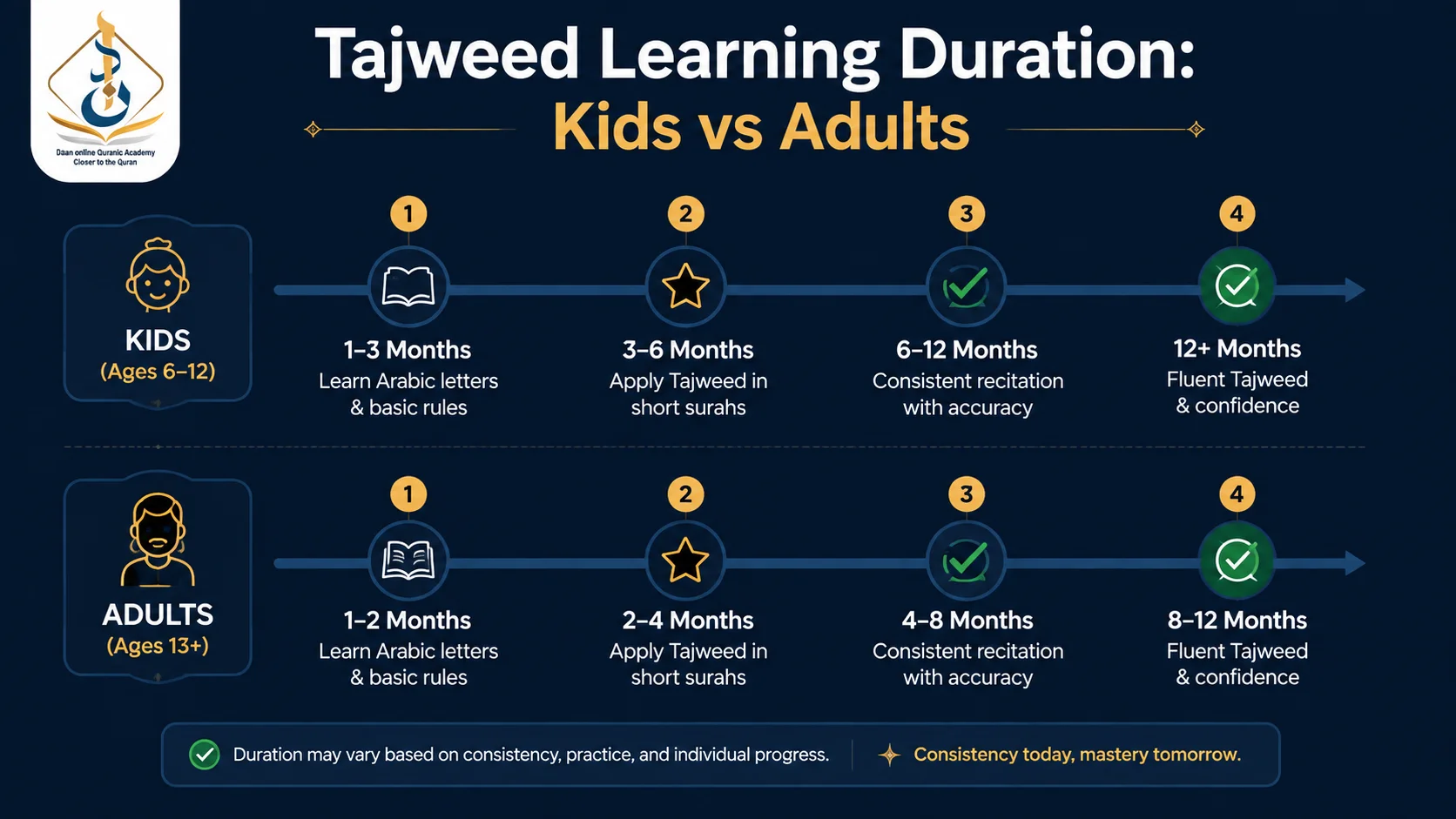
| Factor | Kids (ages 6–12) | Adults |
|---|---|---|
| Typical session length | 25–30 minutes | 45–60 minutes |
| Sessions per week | 2–3 | 2–4 |
| Estimated timeline to fluency | 8–14 months | 4–8 months |
| Main challenge | Attention span, retention | Unlearning old reading habits |
| Best format | 1-on-1 with games and rewards | 1-on-1 with grammar-based explanation |
Neither age group benefits from group classes for this particular skill, since Tajweed correction has to be individual — a tutor needs to hear each student’s specific mispronunciation to fix it. This is one reason Daan Academy runs every class, for children and adults alike, as a private 1-on-1 session rather than a shared classroom.
How Long Does It Takes to Learn Quran Tajweed With a Native Tutor
Students working with a native Arabic-speaking tutor typically learn Quran Tajweed 30–40% faster than those learning from non-native instructors, simply because a native speaker can model exact pronunciation rather than approximate it, and can hear subtle articulation errors an English-speaking tutor might miss entirely.
Where many platforms use non-native or part-time instructors, Daan Academy’s tutors are all native Egyptian Arabs, many trained through Al-Azhar-linked institutions and holding certified Ijazah in multiple Qira’at with verified chains of transmission. Every tutor also speaks fluent English, so explanations of grammar and articulation points never get lost in translation — a common complaint with academies that rely on tutors who don’t communicate well in the student’s first language.
You can review individual tutor qualifications, teaching style, and specialization before booking on our tutors page, and see the broader case for native-speaker instruction on our why choose us page.
Learning Tajweed Rules Timeline: Online vs. In-Person vs. Self-Study
An online learning tajweed rules timeline with a live tutor closely matches in-person timelines — both averaging 6–12 months — while self-study through apps or books commonly takes 18 months or longer and often produces incorrect habits that go uncorrected.
The gap isn’t really about “online vs. in-person” as formats — it’s about whether a real person is listening to you recite and correcting you in real time. A parent, sibling, or app can’t catch a subtle Makharij error the way a trained tutor can. This is also the main child-safety and quality question families ask before signing up: is a screen really equivalent to sitting with a teacher? With verified, background-checked native tutors, live video, and session recordings available for parents to review, a well-run online academy closes that gap almost entirely — while adding scheduling flexibility that in-person classes in the UK, USA, and Europe often can’t match for busy families.
Self-study isn’t without value as a supplement, but it should never replace tutor feedback for Tajweed specifically. Rules like Ikhfa and Qalqalah are genuinely difficult to self-assess by ear.
What to Look for in a Tajweed Course (to Learn Faster)
To learn Tajweed faster, look for a course offering 1-on-1 sessions, a native-speaking certified tutor, structured progress tracking, and a clear curriculum that moves through Makharij, Sifaat, Noon/Meem rules, and Madd in that order.
1-on-1 Sessions, Not Group Classes
Unlike group classes that dilute a tutor’s attention across several students, 1-on-1 sessions mean every minute is spent correcting your specific pronunciation. Every class at Daan Academy is private for exactly this reason.
Certified, Native-Speaking Tutors
Look for verifiable Ijazah certification and native Arabic fluency. Many Daan Academy tutors hold Ijazah in multiple Qira’at with documented chains back to the Prophet ﷺ, and all are native Egyptian Arabs.
Transparent Progress Tracking
Where most academies offer little visibility into actual progress, Daan Academy’s Smart Student Dashboard gives students and parents detailed session reports and monthly progress updates, so you can see the timeline moving in real numbers rather than guessing.
A Real, Risk-Free Trial
Some platforms lock you into a subscription before you’ve heard the tutor recite a single letter. A genuine free trial session lets you judge tutor quality and teaching style before spending anything.
How Much Does It Cost to Learn Tajweed? Pricing and Value
Learning Tajweed online with a certified native tutor typically costs between $9 and $13 per hour, depending on the plan and tutor experience level, making a full 6–12 month course a modest, predictable investment rather than a one-off expense.
Plans at Daan Academy start from just $9/hr with native Egyptian tutors. Compare our three flexible pricing tiers — Essential, Pro, and Elite — each designed for different learning goals and budgets, with a family discount available on the Elite plan for households enrolling more than one child.
Some platforms lack transparency on pricing until after a sales call. Daan’s three plans are clearly listed on our pricing page, so you can calculate the full cost of your expected Tajweed timeline before you ever book a session. A referral program is also available — invite a friend and both households receive a discount.
Real Results: How Long It Actually Takes Daan Academy Students
Families across 15+ countries have completed Tajweed training at Daan Academy, with most consistent students (2–3 sessions weekly) reaching confident, rule-correct recitation within the 6–12 month range described above.
Progress is documented through verified completion certificates at each course milestone, and reinforced for younger learners through a library of 600+ educational games that keep Tajweed drills engaging rather than repetitive. For students who find certain rules genuinely difficult — Ikhfa and Madd trip up even motivated adults — there’s real comfort in how this struggle is regarded:
“The one who is skilled in reciting the Qur’an is with the honorable, obedient scribes (angels), and the one who recites the Qur’an and finds it difficult, doing their best to recite it, will have a double reward.”
Narrated by Aisha (RA) — Sahih al-Bukhari, Hadith 4937
That’s a meaningful reframe for anyone worried their timeline is “too slow” — the effort itself is rewarded, not just the finished result. For a deeper look at where students typically get stuck, our post on common Tajweed mistakes non-Arabic speakers make covers the specific errors that most often extend a learning timeline.
Tips to Learn Tajweed Faster: 6 Steps That Cut Your Timeline in Half
The fastest way to learn Tajweed faster is daily short practice with immediate correction — students who practice 15–20 minutes daily with a tutor reviewing recordings often finish 30–40% faster than those attending sessions alone with no practice in between.
Practice Daily, Even Briefly
15–20 minutes of daily recitation beats a single long weekly session. Muscle memory for Makharij builds through repetition, not duration.
Record Yourself Between Sessions
Send short recordings to your tutor between lessons so mistakes get caught within days, not weeks.
Master One Rule Before Moving On
Rushing past Makharij to get to Madd rules just means revisiting Makharij later — slower learners who master fundamentals first usually finish sooner overall.
Read Aloud, Never Silently
Tajweed is a spoken skill. Silent reading builds no muscle memory for articulation or elongation.
Ask for a Written Rule Summary
A one-page reference sheet per rule set helps you self-check between sessions instead of guessing.
Choose a Tutor Who Corrects in Real Time
A tutor who waits until the end of a page to correct you lets errors repeat. Live, mid-sentence correction is what actually shortens the timeline.

Frequently Asked Questions
How long does it take to learn Tajweed as a complete beginner?
Most complete beginners take 8–12 months of consistent 1-on-1 practice to read Qur’an fluently with correct Tajweed, starting from learning the Arabic alphabet through Noorani Qaida before Tajweed rules begin.
Can adults learn Tajweed as effectively as children?
Yes — motivated adults often learn Tajweed rules faster than children because they can sustain longer sessions and grasp grammar-based explanations more quickly, though they may need to unlearn incorrect reading habits picked up earlier in life.
How much do online Tajweed classes cost?
Online Tajweed classes typically range from $9 to $13 per hour depending on the plan. Daan Academy’s full pricing breakdown, including Essential, Pro, and Elite tiers, is available on our pricing page.
Is it safe for my child to learn Tajweed online?
With verified, background-checked tutors, 1-on-1 private video sessions, and parent-visible progress reports, online Tajweed learning can be as safe and closely monitored as in-person tuition — often more so, since parents can review session history at any time.
Can I try a Tajweed class before committing to a course?
Yes. Daan Academy offers a completely free trial session with no commitment required, so you can evaluate tutor quality and teaching style before enrolling in any plan.
Do I need to know Arabic before starting Tajweed?
You need to be able to read Arabic script, typically through a Noorani Qaida foundation, before Tajweed rules are introduced. You do not need to speak or understand Arabic as a language first.
See Your Own Tajweed Timeline in One Free Session
The fastest way to find out how long it will actually take you to learn Tajweed is to sit with a certified tutor and find out where you stand. Book a free session and get a personalized timeline instead of a generic guess.
No commitment required. One free session to experience the Daan Academy difference.
Final Thoughts
So, how long does it take to learn Tajweed? For most consistent students, 6 to 12 months brings confident, rule-correct recitation — faster with daily practice and a native tutor correcting you live, slower with self-study alone. What matters most isn’t hitting a specific number of months; it’s steady weekly progress with someone qualified enough to catch the mistakes you can’t hear in your own voice.
We ask that Allah make this journey easy for you and reward every session of effort along the way. If you’d like to see more guidance like this, explore further reading on our blog.