
Iqlab in Tajweed: Letters, Rules & 10 Examples from Quran
Iqlab in Tajweed is the rule that converts a Noon Sakinah or Tanween into a light Meem sound whenever it is immediately followed by the letter Ba (ب) — and getting it right is one of the fastest ways to sound like a truly trained reciter. If you have been searching for the iqlaab letters, trying to apply iqlab tajweed rules with confidence, or looking for real iqlab examples from Quran to practise out loud, this guide walks through the definition, the pronunciation steps, and 10 examples with exact Surah and Ayah references — plus how a certified, native Egyptian tutor can correct your Ghunnah in your very first free session.
📑 Table of Contents
- What Is Iqlab in Tajweed?
- Iqlaab Letters: Why Only One Letter Triggers Iqlab
- Iqlab Tajweed Rules: How to Pronounce It Correctly
- What to Look For When Choosing Iqlab in Tajweed Training
- 10 Examples of Iqlab in Quran You Can Practice Today
- Iqlab vs Ikhfa vs Idgham: What’s the Difference?
- Common Mistakes Non-Arabic Speakers Make
- How Much Does It Cost to Learn Iqlab Online?
- Frequently Asked Questions
What Is Iqlab in Tajweed? A Clear Definition
Iqlab in Tajweed is one of the four rulings applied to Noon Sakinah and Tanween. It occurs when a Noon Sakinah (نْ) or Tanween is immediately followed by the letter Ba (ب); the Noon or Tanween sound is converted into a light Meem (م), held for roughly two counts with Ghunnah, before flowing smoothly into the Ba. The word “Iqlab” comes from the Arabic root ق ل ب, meaning “to turn” or “to convert” — a fitting name, since the entire rule is a sound conversion.
In the Mushaf, Iqlab is marked visually with a small Meem (ۢ) written above the Noon Sakinah or Tanween, so reciters know exactly where to apply it. This is different from the other three Noon Sakinah rulings — Izhar (clear pronunciation before throat letters), Idgham (merging into the following letter), and Ikhfa (partial concealment before 15 letters). Iqlab in Tajweed stands apart because it has only one trigger letter and produces a completely new sound rather than a merge or a concealment.
Scholars of Tajweed classify Iqlab as obligatory (wajib) for anyone reciting the Quran correctly, because skipping it changes the acoustic shape of the word and can make recitation sound abrupt or foreign to trained ears. This is exactly why iqlab tajweed rules are taught early in structured Quran curricula, right after Noorani Qaida — you can read our comprehensive guide to learning Noorani Qaida if you are starting from the very basics.
Iqlaab Letters: Why Only One Letter Triggers Iqlab in Tajweed
Unlike Ikhfa, which is triggered by 15 different letters, or Idgham, which involves six, the iqlaab letters are limited to exactly one: Ba (ب). No other letter in the Arabic alphabet causes this conversion, which is part of why Iqlab is often the easiest Noon Sakinah rule to memorise once you understand the logic behind it.
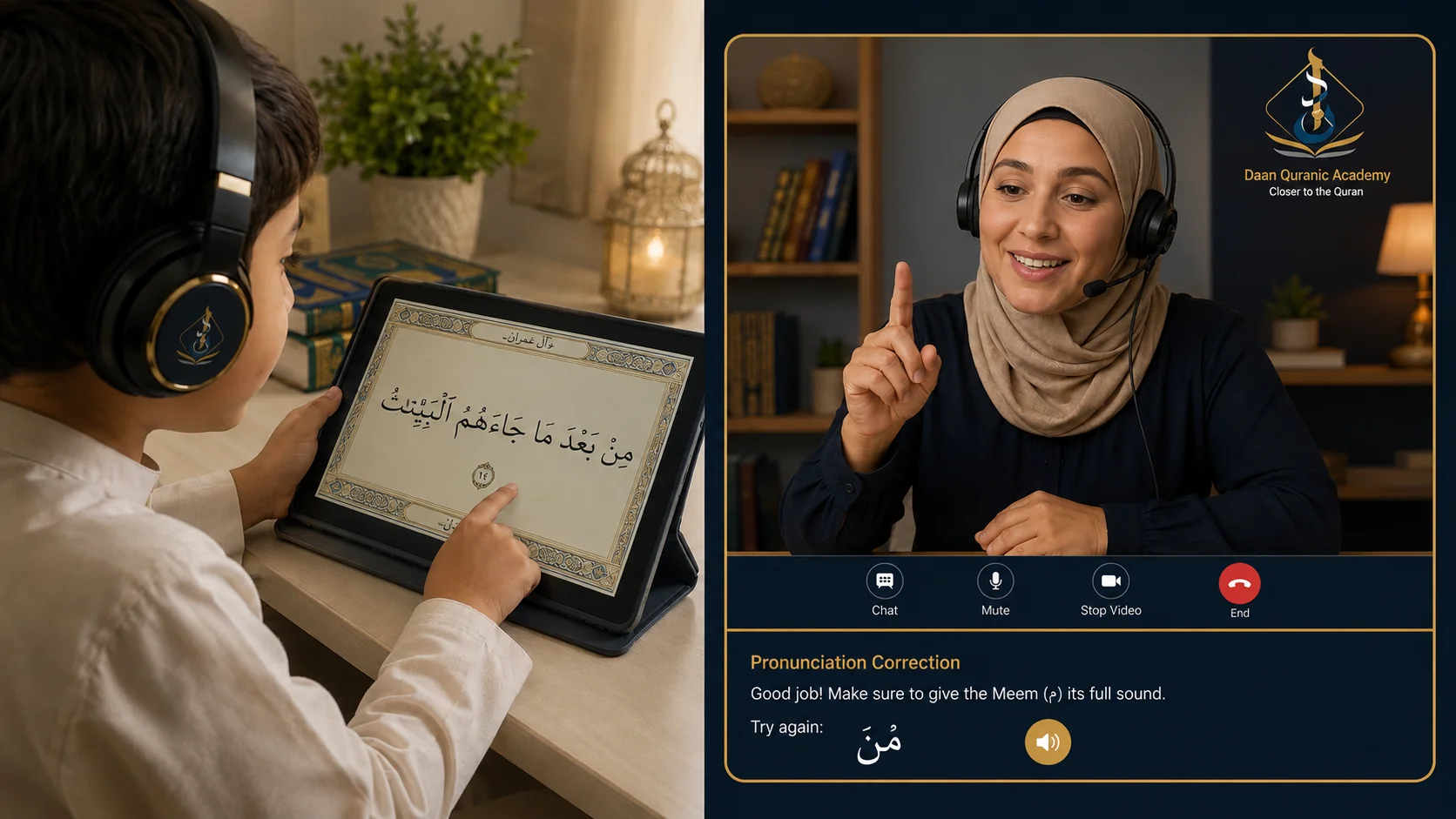
Real session recording: A Daan Academy tutor giving live, real-time pronunciation correction as a student practises Noon Sakinah and Iqlab tajweed rules during recitation. All videos are real, unedited screen-recordings from actual student sessions at Daan Academy, posted with student consent.
The reason Ba is the only trigger comes down to Makharij, the articulation points of Arabic letters. Both Meem and Ba are bilabial sounds, produced by closing the two lips, while Noon is produced from the tip of the tongue against the upper gum ridge. Forcing a tongue-based Noon sound directly before a lip-based Ba creates an awkward, clipped transition — so Tajweed masters standardised the shift to Meem, which shares the same articulation point as Ba and lets the reciter’s lips stay closed throughout both sounds.
اللَّهُ يَصْطَفِي مِنَ الْمَلَائِكَةِ رُسُلًا وَمِنَ النَّاسِ ۚ إِنَّ اللَّهَ سَمِيعٌۢ بَصِيرٌ
“Allah chooses messengers from among the angels and among the people. Indeed, Allah is Hearing and Seeing.”
Notice how “سَمِيعٌ بَصِيرٌ” (Samee’un Baseer) carries a Tanween followed directly by Ba — the Noon sound of the Tanween becomes a Meem, held with Ghunnah, before moving into the Baseer. This single pattern repeats across dozens of ayat, which is exactly why practising with real Tajweed Rules Mastery coursework rather than isolated flashcards builds lasting muscle memory.
Iqlab Tajweed Rules: How to Pronounce Iqlab Correctly
Applying iqlab tajweed rules correctly comes down to four repeatable steps that any student can practise, though a live tutor listening in real time is what turns the theory into a habit.
Identify the Noon Sakinah or Tanween
Scan the word or the end of the previous word for a Noon with no vowel (نْ) or any of the three Tanween marks (ً ٍ ٌ).
Check Whether Ba Follows Immediately
Look at the very next letter. If it is Ba (ب) — whether inside the same word or at the start of the next word — the Iqlab rule applies.
Convert the Sound to a Light Meem with Ghunnah
Close your lips gently and produce a nasalised Meem sound for approximately two counts, rather than pronouncing the original Noon or Tanween.
Flow Smoothly into the Ba
Keep your lips closed as you move directly from the Meem into the Ba, avoiding any gap, hard stop, or reopening of the mouth in between.
Reading about these iqlab tajweed rules is a useful starting point, but Tajweed is fundamentally an oral science — it was transmitted from teacher to student for over 1,400 years for a reason. A certified tutor can hear the difference between a two-count Ghunnah and a rushed one-count attempt within seconds, which is far harder to self-diagnose from an app or a book alone.
What to Look For When Choosing Iqlab in Tajweed Training
The best iqlab in Tajweed training combines a certified native Arabic-speaking tutor, one-on-one correction, and a structured curriculum — three things that generic apps and pre-recorded videos simply cannot replicate. Here is what to check before committing to any course or academy.

Certified, Native Arabic-Speaking Tutors
Look for tutors formally trained in Quranic sciences, ideally certified Ijazah holders with a documented chain of transmission. At Daan Quranic Academy, all tutors are native Egyptian Arabs, and many hold Ijazah in multiple Qira’at with verified chains tracing back to the Prophet ﷺ.
1-on-1 Sessions, Not Group Classes
Iqlab requires listening closely to your individual Ghunnah length and lip closure — something a tutor cannot do while managing a group of ten students. Every class at Daan Academy is private and personalised, so mistakes get corrected the moment they happen.
A Structured Curriculum, Not Random Lessons
Where many platforms offer generic, unsequenced lessons, a strong programme builds from Noorani Qaida through Tajweed Rules Mastery and into full Quran recitation. Explore Daan Academy’s full course pathway to see how each stage builds on the last.
Transparent Pricing and a Real Free Trial
Some platforms are vague about cost until after sign-up. Daan Academy’s three plans are clearly listed starting from $9/hr, and you can experience a full class before paying anything through the free trial session.
Beyond these four criteria, ask any prospective academy how they track progress. At Daan Academy, the Smart Student Dashboard (Daan LMS) lets you and your child see session history, balance, and detailed progress reports in one place — so you always know exactly how close you are to mastering iqlab in Tajweed and the rules that follow it. See why families across 15+ countries choose Daan Academy for a closer look at how these pieces fit together.
10 Examples of Iqlab in Quran You Can Practice Today
The fastest way to internalise iqlab tajweed rules is to practise real ayat, not isolated letter drills. Below are 10 examples of iqlab in Quran, each with the exact Surah and Ayah so you can look them up, listen to a qualified reciter, and repeat them aloud.
| # | Arabic Phrase | Where Iqlab Occurs | Surah : Ayah |
|---|---|---|---|
| 1 | أَنۢبِئْهُم | Within a single word | Al-Baqarah 2:33 |
| 2 | يُنۢبِتُ لَكُم بِهِ | Within a single word | An-Nahl 16:11 |
| 3 | لَيُنۢبَذَنَّ | Within a single word | Al-Humazah 104:4 |
| 4 | مِنۢ بَعْدِ وَصِيَّةٍ | Across two words | An-Nisa 4:11 |
| 5 | وَاللَّهُ عَلِيمٌۢ بِذَاتِ الصُّدُورِ | Tanween across two words | Ali ‘Imran 3:154 |
| 6 | وَأَمَّا مَنۢ بَخِلَ | Across two words | Al-Layl 92:8 |
| 7 | أَنۢ بُورِكَ مَن فِي النَّارِ | Across two words | An-Naml 27:8 |
| 8 | وَاللَّهُ سَمِيعٌۢ بَصِيرٌ | Tanween across two words | Al-Hajj 22:75 |
| 9 | ذُرِّيَّةًۢ بَعْضُهَا مِن بَعْضٍ | Tanween across two words | Ali ‘Imran 3:34 |
| 10 | كِرَامٍۢ بَرَرَةٍ | Tanween across two words | ‘Abasa 80:16 |
Why These Iqlab Examples from Quran Work So Well
Notice the pattern: five of these iqlab examples from Quran occur inside a single word, while the other five occur across two separate words where the first word ends in Noon or Tanween and the next begins with Ba. Practising both types matters, because many students master Iqlab within a word but forget to apply it across a word boundary during natural, flowing recitation.
Recite each example slowly at first, exaggerating the two-count Ghunnah, then gradually speed up until the Meem-to-Ba transition feels natural. A tutor in a live 1-on-1 session can confirm your Ghunnah length is accurate rather than too short or too long.
Iqlab vs Ikhfa vs Idgham: What’s the Difference?
Iqlab, Ikhfa, and Idgham are all rulings for Noon Sakinah and Tanween, but they differ in trigger letters and the resulting sound. Understanding the contrast makes each rule easier to remember individually.
| Rule | Trigger Letters | What Happens to the Sound | Example |
|---|---|---|---|
| Iqlab | 1 letter: ب (Ba) | Noon/Tanween converts fully into a Meem sound with Ghunnah | سَمِيعٌۢ بَصِيرٌ |
| Ikhfa | 15 letters | Noon/Tanween is partially concealed, nasalised but not fully pronounced | مِن شَيْءٍ |
| Idgham | 6 letters (ي ن م و ل ر) | Noon/Tanween merges into the following letter, with or without Ghunnah | مَن يَقُولُ |
| Izhar | 6 throat letters | Noon/Tanween is pronounced clearly with no change | مِنْ خَيْرٍ |
Some platforms teach these four rules as an abstract list to memorise, without connecting them to real recitation. A stronger approach — the one used across Daan Academy’s Tajweed Rules Mastery course — is to apply every rule inside live ayat from your very first lesson, so the distinction between Iqlab and its neighbouring rules becomes instinctive rather than memorised.
For a deeper look at how these rules trip up new reciters specifically, read our guide on 5 Common Tajweed Mistakes Non-Arabic Speakers Make and How to Fix Them.
Common Mistakes Non-Arabic Speakers Make with Iqlab in Tajweed
The most common error with iqlab in Tajweed is simply pronouncing the original Noon or Tanween sound and rushing straight into the Ba, skipping the Meem conversion entirely. This is especially common among adult learners and reverts who are reading transliterated text rather than the Arabic script itself.
- Skipping the conversion: Pronouncing “an buurika” with a clear N sound instead of converting to “am buurika.”
- Dropping the Ghunnah: Moving straight to the Meem-Ba transition without holding the nasalised hum for two counts.
- Rushing the Meem: Compressing the Meem to less than a full count, which erases the rule’s audible effect.
- Reopening the lips too early: Breaking lip closure between the Meem and the Ba, creating an audible gap.
These patterns are hard to catch through self-study because they sound “close enough” to an untrained ear. Across families we work with in over 15 countries, the fastest correction happens when a certified native Egyptian tutor listens live and flags the exact syllable where the Ghunnah drops — something Daan Academy’s 1-on-1 model is built specifically to catch.
“One who is skilled in the Qur’an is associated with the noble, upright, recording angels; and he who falters when he recites it and finds it difficult will have a double reward.”
Narrated by Aisha (RA) — Sahih al-Bukhari, 4937
This hadith is a reminder that mastering details like iqlab tajweed rules is a means of drawing closer to that description of proficiency — and that consistent, corrected practice, even when difficult at first, carries its own reward.
How Much Does It Cost to Learn Iqlab Tajweed Rules Online in 2026?
Online Tajweed classes with a certified native tutor typically start from $9/hr, making structured, 1-on-1 correction more affordable than most people expect compared to in-person tutoring or private academies.
Daan Academy’s three flexible plans start from just $9/hr with native Egyptian tutors: Essential, Pro, and Elite, each designed for different learning goals and budgets. Compare the full breakdown on the pricing plans page, including the family discount available on the Elite tier.
Where many platforms keep pricing vague until after sign-up, Daan Academy lists Essential from $9/hr, Pro from $10.99/hr, and Elite from $12.99/hr — each covering the full course pathway from Noorani Qaida through Tajweed Rules Mastery and Ijazah-level recitation. A referral programme also lets existing families invite a friend for a discount on both accounts, and 24/7 dedicated support handles any technical or academic question along the way.

Frequently Asked Questions
What is Iqlab in Tajweed and why does it matter?
Iqlab in Tajweed is the conversion of a Noon Sakinah or Tanween into a Meem sound when followed by the letter Ba. It matters because skipping it changes how a word sounds and is considered an obligatory rule for correct Quran recitation.
How many iqlaab letters are there in Tajweed?
There is only one: the letter Ba (ب). This makes Iqlab unique among the Noon Sakinah rulings, since Ikhfa involves 15 letters and Idgham involves six.
How much do online Tajweed and Quran classes cost?
At Daan Quranic Academy, 1-on-1 classes with native Egyptian tutors start from $9/hr. Full details on all three plans are available on the pricing plans page.
Can I try a Tajweed class before committing to a paid plan?
Yes. Daan Academy offers a completely free trial session with no commitment, so you can experience a live class before choosing a plan.
Is it safe for my child to learn Tajweed rules like Iqlab online?
Every class is a private, 1-on-1 video session with a formally trained, native Egyptian tutor, and parents can monitor progress, session history, and reports directly through the student dashboard at any time.
How do I know if an online tutor is qualified to teach Iqlab and Tajweed?
Look for verifiable credentials such as an Ijazah with a documented chain of transmission, native fluency in Arabic, and demonstrated teaching experience. You can review tutor backgrounds on the Our Tutors page.
Ready to Master Iqlab in Tajweed With a Real Tutor?
Reading about iqlab tajweed rules is a start, but real progress happens when a certified tutor corrects your Ghunnah live. Book a free session and experience the Daan Academy difference today.
No commitment required. One free session to experience the Daan Academy difference.
Final Thoughts
Iqlab in Tajweed is a small rule with an outsized effect on how natural your recitation sounds. Once you can recognise the iqlaab letters instantly, apply the four pronunciation steps, and recognise the pattern across real iqlab examples from Quran, the rest of the Noon Sakinah rulings become far easier to learn.
We ask Allah to make the Quran easy for every reader striving to recite it correctly, and to reward the effort behind every stumble along the way. Explore more guides like this on our Quran and Tajweed blog, or take the next step with a certified tutor who can guide you through iqlab in Tajweed from your very first session.