Manufacturing Pride: How to Build a Leading Muslim Identity in Western Societies?
Introduction: From Defensive to Proactive Parenting For decades, the philosophy of raising Muslim children in the West was centered on “protection” and “prevention”—attempting to stop children from dissolving into the surrounding culture. However, in the age of digital and social openness, protection alone is no longer sufficient. Today, we need to shift from a “siege mentality” to a “leadership mentality.” The goal is not just for the child to keep their identity, but to see this identity as a source of strength and a Unique Selling Point (USP) that makes them a leader in their community. “Manufacturing Pride” is the process through which we transform belonging to Islam from a heavy obligation into a badge of honor worn with confidence. I. The Psychology of Pride: Why Does a Child Need to Feel Proud? In their early years, children are instinctively looking for a sense of belonging. If a child feels that their religion or culture puts them in a position of constant defense or apology for actions they didn’t commit, they will subconsciously begin to detach. II. Practical Steps to Building a Leading Muslim Identity 1. Instilling a “Global Worldview” A child must understand their place in the universe. They are not just a “minority” in a Western country; they are part of an Ummah that spans 1.5 billion people, with a scientific and civilizational history that changed the face of humanity. 2. Distinction, Not Isolation (Integration without Assimilation) A Muslim leader in the West is someone who understands their society perfectly, speaks the language fluently, and excels in its sciences, yet retains their moral compass. 3. Achievement is the Universal Language In the West, respect is earned through achievement. To be a leader, a child must be encouraged to excel academically, athletically, and socially. III. Navigating the “Identity Conflict” Children in the West face contradictions between what they hear at home and what they see at school (such as certain celebrations or different moral concepts). IV. The Five Leadership Skills for the Young Muslim Leader To transform your child from a “follower” into an “influencer,” they must be trained in specific skills: V. The Academy’s Role in Manufacturing This Pride At Daan Quranic Academy, we realize that teaching the Noorani Qaida or Quranic memorization is not an end in itself, but a means to build a human being. Conclusion: The Most Valuable Investment Building a leading Muslim identity in the West is the “project of a lifetime.” It may require double the effort, long patience, and innovative educational tools, but the fruits are worth it. When you see your child standing in their university or workplace in the future, respected not just for their intelligence, but for their ethics and pride in their identity, you will realize that you didn’t just raise a child—you manufactured a leader. Remember: We don’t raise our children to hide; we raise them to shine. Experience our unique approach first-hand. Book your free free trial sessions now with no strings attached.
The Art of Celebration.. How to Restore the Spark of Eid in the West?

Introduction: Eid.. More Than Just a Day In the heart of Western societies, where streets glitter and decorations fill every corner during non-Islamic festive seasons, Muslim parents face a profound challenge: How do we plant the love of Eid in our children’s hearts? In the West, Eid is not just a religious ritual; it is a “Battle of Identity.” If a child doesn’t feel that their Eid is “more beautiful” and “more joyful,” they may seek belonging in others’ celebrations. At our Academy, we believe that “Manufacturing Joy” is an act of worship, and making your home a beacon of happiness is the first step in connecting your child to their roots. I. The Psychology of Celebration (Why Are Children Attracted to the ‘Other’?) Children are inherently visual beings. They are drawn to colors, lights, and music. In the West, celebrations engage all five senses: the scent of cinnamon, the glowing street lights, and meticulously wrapped gifts. To compete with this momentum, we must do more than say “Eid Mubarak.” We must embody Eid. A child needs to see Eid, smell it, taste it, and touch it. II. Transforming Your Home into an “Eid Kingdom” Don’t wait for the streets to celebrate you; create your own festival within your home. III. Creating Exclusive “Family Rituals” (The Power of Traditions) What makes a child anticipate Eid is the “ritual” that precedes it. IV. Gifts: The Art That Outshines the Material In the West, wrapping is often as important as the gift itself. V. Community Connection and Pride in Identity Do not let Eid be a time of isolation; let it be an opening with dignity. VI. The Eid Prayer: The Grand Festival Eid prayer in the West is often held in Islamic centers or rented halls. VII. The Academy’s Role in Reinforcing These Values At Daan Quranic Academy, we don’t just teach letters and verses; we teach a “Lifestyle.” Through our courses, we focus on linking the Arabic language and Islamic upbringing to lived reality. Eid is the true laboratory where we see the fruits of what the child learns. Conclusion: Eid is a Trust in Our Hands Dear parents, Eid in the West is not a burden; it is a golden opportunity to show them the beauty of our faith. When you make the Muslim Eid an artistic masterpiece that surpasses what they see on screens, you aren’t just providing fun—you are protecting their faith and planting an unshakable pride in their souls. Experience our unique approach first-hand. Book your free free trial sessions now with no strings attached.
How to Learn Quran for Non-Arabic Speakers: The Ultimate 2026 Guide
“And We have indeed made the Quran easy to understand and remember, then is there any that will remember?” (Surah Al-Qamar, 17) Introduction: A Divine Invitation For many non-Arabic speakers, the desire to connect with the Holy Quran often comes with a sense of hesitation. You might ask yourself: “How can I recite a book in a language I don’t speak?” or “Is it too late for me to start?” The truth is, the Quran is not just a book for Arabs; it is a divine message for all of humanity. In 2026, with the advancement of educational technology and online learning, the barriers to entry have vanished. Whether you are a convert, a busy professional in the West, or a parent wanting the best for your children, this ultimate guide will take you from the basics of the alphabet to the beauty of Tajweed. The Myth of the “Arabic Barrier” One of the biggest misconceptions is that you must be fluent in conversational Arabic to read the Quran. While understanding the language is beneficial, recitation (Tilawah) is a distinct science. It is a phonetic discipline. Many of the world’s greatest Qaris (reciters) come from Indonesia, Pakistan, or Bosnia and did not grow up speaking Arabic. They mastered the vocal mechanics of the language. This guide focuses on how you can do the same. Phase 1: The Foundation – Building Your Phonetic Base 1. The Power of Noorani Qaida You wouldn’t build a house without a solid foundation. In Quranic studies, that foundation is Noorani Qaida. 2. Training the “Makharij” (Articulation Points) Arabic is known as the “Language of Dad” ($\text{ض}$) because of its unique sounds. As a non-native, your tongue and throat muscles aren’t used to these positions. Phase 2: Mastering Tajweed – The Art of Beautiful Recitation Tajweed is the science that gives every letter its right. For a non-native speaker, mastering Tajweed is what transforms a “mechanical” reading into a “spiritual” one. 1. Understanding the Rules of Silence and Sound 2. The Role of “Mushaaf Al-Muallim” In 2026, digital resources are everywhere. We recommend using the “Teaching Quran” (Al-Mushaf Al-Muallim) by Sheikh Al-Husary. He recites with extreme clarity, leaving a gap for the student to repeat after him. This “Listen and Repeat” method is the fastest way to fix your accent. Phase 3: Consistency Over Intensity The secret to learning the Quran isn’t studying for 5 hours once a week; it’s studying for 15 minutes every single day. Why a Native Arabic Tutor is Irreplaceable While apps and YouTube videos are great supplements, they cannot hear you. FAQ: Common Questions from Non-Arabic Students Q: How long does it take to read the Quran fluently? A: For most dedicated beginners, it takes 6 to 12 months of consistent study to read comfortably. Memorization (Hifz) takes longer, depending on your goals. Q: I am an adult; is it too late for me to learn? A: Absolutely not. In fact, many adults find they have more discipline than children. Remember, the Sahaba (companions of the Prophet) were adults when they began learning the Quran. Q: Should I learn Arabic grammar (Nahw) at the same time? A: Focus on reading first. Once you can glide through the verses comfortably, adding grammar will help you understand the meaning, which adds a new layer of beauty to your prayers. Conclusion: Your Double Reward The road may seem long, but every struggle you face is being recorded as a good deed. The Prophet Muhammad (PBUH) gave the ultimate encouragement to non-Arabs when he said: “The one who recites the Quran and stammers over it, finding it difficult, will have a double reward.” (Sahih Muslim) One reward for the recitation, and another for the effort. You are not just learning a book; you are responding to a call from your Creator. Start Your Journey Today! Don’t let another year pass by wishing you could read the Quran. Our academy specializes in bridging the gap for non-Arabic speakers. With certified native tutors and a curriculum designed for the Western lifestyle, we make your dream a reality. Experience our unique approach first-hand. Book your free free trial sessions now with no strings attached.
5 Common Tajweed Mistakes Non-Arabic Speakers Make and How to Fix Them

“The best among you are those who learn the Quran and teach it.” > — Prophet Muhammad (PBUH) [Sahih Al-Bukhari] The journey of reciting the Holy Quran is one of the most rewarding spiritual paths a Muslim can take. This beautiful citation reminds us that every effort we make to perfect our recitation is a step toward excellence. However, for non-Arabic speakers, the Arabic language presents unique phonetic challenges. The science of Tajweed (the rules governing the pronunciation of the Quran) is essential because a slight change in a letter’s sound can alter the entire meaning of a Divine Verse. In this comprehensive guide, we will explore the 5 most common Tajweed mistakes made by non-native speakers and provide practical, step-by-step solutions to fix them. Why Tajweed Matters for Non-Arabic Speakers Before diving into the mistakes, it is crucial to understand that Tajweed is not just about “sounding beautiful.” It is about precision. Arabic contains sounds that do not exist in English, French, or Urdu. If you replace a “Haa” ($\tau$) with a “Ha” ($\text{هـ}$), you might change a word from “Praised” to “Perished.” Learning Tajweed online with a native Arabic tutor is the most effective way to identify these subtle errors that your own ears might not catch. Mixing Up Heavy and Light Letters (Tafkheem vs. Tarqeeq) One of the most frequent errors is failing to distinguish between Tafkheem (heavy/thick letters) and Tarqeeq (light/thin letters). The Mistake: Many students pronounce the heavy letter Saad {ص} like the light letter Seen t{س}, or the heavy Taa {ط} like the light Taa {ت}. For example, in Surah Al-Fatiha, pronouncing “Mustaqeem” with a heavy “Taa” changes the phonetic integrity of the word. How to Fix It: Mispronouncing the Throat Letters (Al-Halq) The Arabic alphabet has six letters that originate from the throat. For non-natives, the middle and deep throat sounds are particularly difficult. The Mistake: The most common struggle is with the letter ‘Ayn and Haa How to Fix It: Neglecting or Overextending Madd (Elongation) The Madd rules determine how long a vowel sound should be held (2, 4, or 6 counts). The Mistake: Non-Arabic speakers often either “clip” the vowels too short (making a long vowel short) or extend short vowels into long ones. This is a Lahn Jali (clear mistake) because it changes the grammar of the sentence. How to Fix It: Incorrect Application of Ghunnah (Nasalization) Ghunnah is the nasal sound produced through the nose, primarily with the letters Noon ($\text{ن}$) and Meem ($\text{م}$). The Mistake: Students often forget to apply Ghunnah during Idgham (merging) or Ikhfa (hiding). Conversely, some students add a nasal sound to every letter, making their recitation sound “stuffy.” How to Fix It: Confusion Between the Two “Z” and “T” Sounds English speakers tend to group several Arabic letters into one English equivalent. The Mistake: How to Fix It: Conclusion: How to Perfect Your Recitation Correcting Tajweed mistakes is a marathon, not a sprint. The goal is not just to read fast, but to read as the Prophet (PBUH) received the revelation. As mentioned in our opening citation, learning the Quran places you among the best of people—so keep going! Steps to take now: Ready to Master Tajweed? At Daan Quranic Academy , we specialize in helping non-Arabic speakers overcome these 5 mistakes and more. Our native tutors use proven linguistic methods to perfect your Makharij and Tajweed from the comfort of your home. Experience our unique approach first-hand. Book your free free trial sessions now with no strings attached.
How to Effectively Memorize the Holy Quran While Busy with Work or Studies?

Memorizing the Holy Quran is a profound spiritual journey that every Muslim aspires to undertake. It brings immense elevation in this life and the hereafter, filling the soul with divine light. However, many face a significant challenge: how to memorize the Quran while busy with professional life or demanding academic requirements. Some believe that Quranic Hifz requires total isolation, but the truth is that the Quran was revealed to organize life, not to hinder it. In this comprehensive guide, we will draw a clear and practical roadmap for memorizing the Book of Allah effectively, even if your schedule is packed with tasks. First: Preparing the Spiritual and Faith-Based Foundation Before taking any practical steps, one must realize that memorizing the Quran is a divine selection. The foundation of successful Hifz is not just innate intelligence, but rather sincerity and spiritual connection. Second: Time Management for Quran Memorization he secret to memorizing the Quran for busy professionals and students is not in “finding” new time, but in “investing” available time wisely through the following strategies: 1. The “Golden Hours” Rule for Hifz The best time for memorization is the time of Fajr (dawn). At this time, the mind is at its peak clarity, and the house is quiet. Dedicating just 30 to 45 minutes after Fajr for new memorization is a proven strategy for long-term success. 2. Utilizing “Dead Time” (Micro-Moments) We spend hours weekly in commuting, waiting in lines, or performing routine chores. This is a “lost treasure”: 3. The “Consistent Small Amount” Strategy Do not set impossible goals like memorizing a full page daily when you are overwhelmed. Consistency is more important than quantity. Memorizing just two verses daily with consistency is far better than memorizing a whole page once a week and then stopping due to burnout. Third: Proven Technical Methods for Effective Hifz To ensure your memorization is solid and doesn’t fade, follow this Hifz methodology: Fourth: Addressing the Dilemma of Forgetfulness and Revision The major challenge in Hifz is not the initial memorization, but the “retention.” As the saying goes, “Revision is the true memorization.” Fifth: Specific Advice for Students and Employees For Students: For Employees: Sixth: Utilizing Modern Technology and Apps We live in the digital age, and there are wonderful tools to help you: Seventh: Finding a Motivating Environment Individual memorization can lead to boredom. Look for a Hifz Buddy or join a community: Eighth: Dealing with Slumps and Despair Slumps are natural. When you feel your memory is weak, do not give up. Conclusion: Your Journey with Daan Quranic Academy Memorizing the Holy Quran is a lifelong journey, not a race. For those busy with work or study, every minute spent with a verse is a great spiritual investment. Allah rewards the effort and the sincerity, not just the speed of completion. Start today, even with a single verse. If you are looking for a professional, flexible, and structured environment to help you maintain discipline, Daan Quranic Academy is a leading platform designed specifically for busy individuals. They offer specialized programs and expert tutors who understand the challenges of modern life, guiding you step-by-step through this blessed journey. Always remember: “The small, consistent act is better than the large, interrupted one.” May Allah make you among the people of the Quran. Experience our unique approach first-hand. Book your free free trial sessions now with no strings attached.
“The Best of You Are Those Who Learn the Qur’an and Teach It”
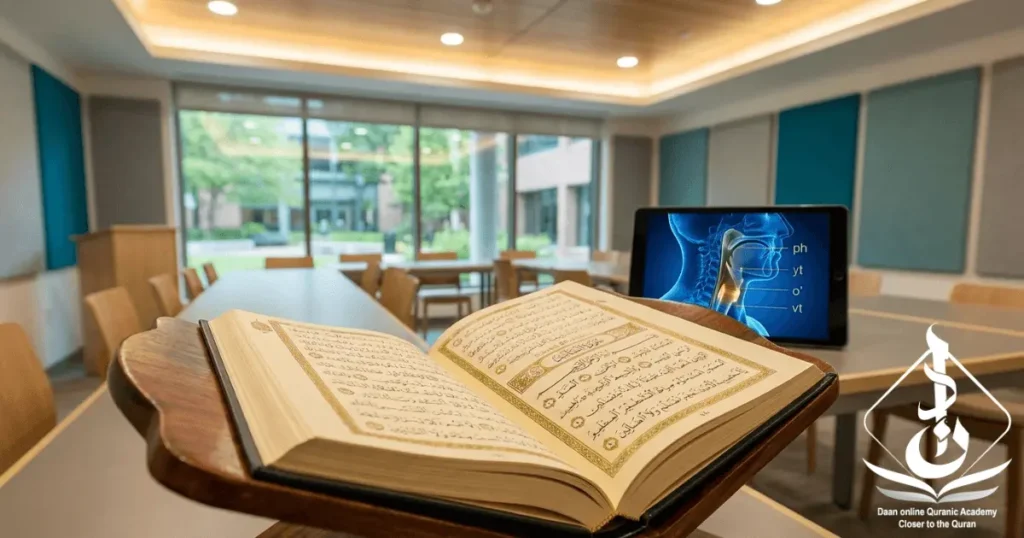
The Journey of Mastery: Overcoming Arabic Pronunciation Challenges for Non-Native Speakers The Arabic language is the language of “Bayan” (eloquence) and miracles. It is the language of the Holy Qur’an, chosen by Allah to be the vessel for His revelation. For non-native speakers, Arabic represents a fascinating world of intricate details, yet it simultaneously presents unique phonetic challenges. “Correct pronunciation” is not merely a linguistic luxury; it is the foundation for understanding meaning—especially when reciting the Qur’an, where shifting the articulation point of a single letter can entirely alter the verse’s meaning. In this comprehensive guide, we dive deep into the human vocal apparatus to explore how to tame difficult Arabic letters such as (Ḍād, ‘Ayn, Ghayn, Khā’, Ḥā’, Hā’, and Hamzah), providing practical and scientific strategies to help students achieve mastery. First: The Philosophy of the Arabic Sound System Arabic is distinguished by what are known as “Guttural sounds” and “Emphatic articulation”—qualities often lacking in many European and Asian languages. English, for instance, focuses most of its sounds at the front of the mouth and lips, while Arabic extends to the deepest parts of the throat. Therefore, the first step in treatment is “Retraining the speech muscles” and expanding the student’s vocal range. Second: The Guttural Letters (Hamzah, Hā’, ‘Ayn, Ḥā’, Ghayn, Khā’) 1. The Hamzah (أ) and Hā’ (هـ): Deepest Throat These two letters originate from the furthest point in the throat. 2. The ‘Ayn (ع) and Ḥā’ (ح): Middle Throat This area is the most difficult as it requires control over the “epiglottis.” 3. The Ghayn (غ) and Khā’ (خ): Upper Throat This region is closest to the mouth (the root of the tongue with the soft palate). Third: The Language of Ḍād.. The Mystery of the Letter (Ḍād) Arabic is famously called “The Language of Ḍād” because of this unique sound. Fourth: Educational Strategies for Academies (The Remedial Approach) Explaining the articulation point theoretically is not enough; practical steps must be followed: 1. Phonological Awareness Before a student speaks, they must hear. 2. Utilizing Technology and Visual Aids 3. The “Static to Dynamic” Rule A “Sākin” (vowel-less) letter shows the articulation point more clearly. Fifth: The Psychological and Motivational Aspect Learning Arabic articulation points can be frustrating initially. The teacher’s role is: Sixth: The Importance of Face-to-Face Transmission (Mushafahah) Articulation points cannot be learned from books alone. “Mushafahah” (direct interaction) is the backbone of teaching Arabic. Conclusion Arabic pronunciation challenges are not impossible barriers; they are “thresholds of mastery” that increase a student’s ability to taste the beauty of this language. Through a scientific understanding of articulation, consistent practice, and the help of modern tools, any student—regardless of their mother tongue—can speak Arabic with an eloquent tongue. In our academy, we believe every student has the potential to excel. We are here to take your hand through every letter, from Hamzah to Yā’, making you an ambassador for the language of the Qur’an everywhere. Experience our unique approach first-hand. Book your free free trial sessions now with no strings attached.
Unlocking the Beauty of Arabic: Discover the Most Effective Path to Fluency and Mastery”
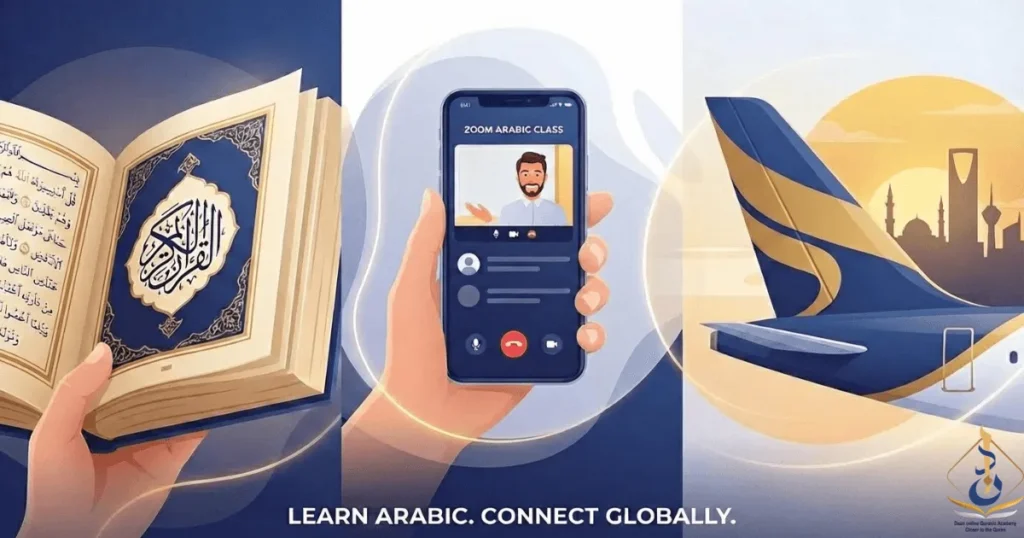
A Comprehensive Guide to Modern and Traditional Learning Methods Learning Arabic is widely regarded as one of the most challenging linguistic endeavors for non-native speakers. This difficulty stems not only from its complex grammar and unique phonetics but also from its diverse linguistic layers—ranging from Classical Arabic (the language of the Quran) to Modern Standard Arabic (MSA) and various regional dialects. As global demand for Arabic grows for religious, economic, and academic purposes, a pivotal question arises: What is the most effective way to learn? Should we stick to traditional textbooks, immerse ourselves in an Arabic-speaking environment, or leverage the digital revolution? In this article, we provide an in-depth analytical comparison between three prominent approaches: The Immersion Method, Online Learning, and The Traditional Method. The Traditional Method (Grammar-Translation) This approach relies heavily on structured textbooks and intensive explanations of syntax (Nahw) and morphology (Sarf), focusing primarily on reading, writing, and translation. Characteristics and Fundamentals: Advantages: Disadvantages: The Immersion Method This method is based on the principle: “Live the language, don’t just study it.” This is achieved either by traveling to an Arabic-speaking country or by creating a “strictly Arabic” environment where no intermediary language (like English) is allowed. Characteristics and Fundamentals: Advantages: Disadvantages: Online Learning and Digital Platforms (E-Learning) This is the modern alternative that has established itself as a powerhouse, especially post-COVID-19, by merging technology with educational curricula. Characteristics and Fundamentals: Advantages: Disadvantages: Analytical Comparison (Summary Table) Feature Traditional Method Immersion Method Online Learning Primary Goal Grammatical Accuracy Oral Fluency Flexibility & Accessibility Speed of Results Slow (Requires patience) Very Fast (Speaking) Moderate (Student-dependent) Cost Moderate Very High Low to Moderate Acquired Skill Writing & Analysis Listening & Speaking Balanced (Platform-dependent) The Ideal Solution: An Integrative Vision Modern research in Applied Linguistics suggests that the “Eclectic Approach” is the most effective. Learners should not rely on a single path but rather adopt “Blended Learning.” Practical Application: Conclusion Learning Arabic for non-native speakers is more than just acquiring a new tongue; it is a bridge to a rich culture, history, and civilization. While traditional methods provide the skeleton, and technology provides the tools, direct connection provides the soul. Ultimately, passion and consistency remain the true benchmarks of success. Arabic is not mastered through quick leaps, but through steady, deliberate steps. Experience our unique approach first-hand. Book your free free trial sessions now with no strings attached.
The Ultimate Guide: A Plan for Teaching Salah to Non-Arabic Speaking Children
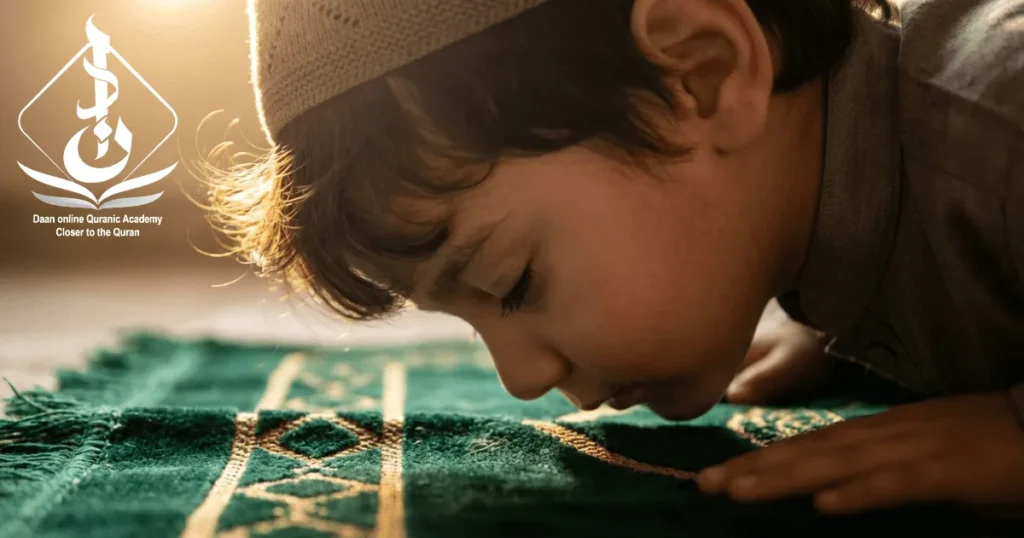
(An Educational and Spiritual Roadmap) Introduction Salah (prayer) is the second pillar of Islam and the direct link between a servant and their Creator. For children growing up in non-Arabic speaking environments, learning Salah presents a double challenge: it is not just about physical movements, but about learning a new language and a deep spiritual context. The goal of this plan is not merely to have children “memorize” words, but to build a relationship of love and belonging to this great ritual. Daan Academy stands as a leading educational partner in this journey, offering specialized courses designed specifically to help non-Arabic speaking children master Salah and its Adhkar (remembrances) through engaging and systematic methods. Phase 1: Psychological and Spiritual Foundation (Before Teaching) Before moving to “How do we pray?”, we must answer the child’s question: “Why do we pray?”. 1. Instilling the Love of Allah (Internal Motivation) Teaching Salah shouldn’t start with commands, but with introducing the Bestower of Blessings. The child should realize that Salah is a “special time” to talk to Allah, who loves them and gave them everything. 2. Leading by Example A child sees prayer before they learn it. When they see their parents happily leaving everything at the sound of the Adhan (not as a heavy burden), a natural curiosity to participate is born. Phase 2: Breaking the Language Barrier The biggest challenge for non-Arabic speakers is pronunciation and understanding meanings. This is a core focus at Daan Academy. 1. Connecting Sound to Meaning (Functional Translation) Do not settle for having the child repeat words they do not understand. In our courses at Daan Academy, we explain the meanings of the Adhkar in the child’s native language so their heart can connect with what their tongue utters. 2. Phonetic Transliteration We use phonetic writing (e.g., Al-ham-du lil-lah) in our educational materials to help the child with correct pronunciation in the early stages until they master reading Arabic script. Phase 3: The Role of Dan Academy in the Educational Journey At Daan Academy, we believe education must be interactive and professional. Our programs include: 1. Specialized Salah Courses We provide live online classes focusing on the correct performance of Salah. Our teachers are qualified to work with non-Arabic speakers, using the latest visual and educational tools to ensure clarity. 2. Comprehensive Adhkar Curriculum We don’t stop at the physical movements. Daan Academy offers a specific course for “Adhkar of Salah” and “Daily Remembrances.” Children learn the virtues of each Thikr and how to pronounce it correctly (Makharij al-Huruf), ensuring their tongue remains moist with the remembrance of Allah. 3. Monitoring and Assessment We understand the importance of consistency. We provide tracking schedules and conduct periodic assessments to ensure the child is praying with confidence and proficiency. Phase 4: Step-by-Step Implementation (Gradual Learning) Salah should be divided into “micro-learning” units to prevent the child from feeling overwhelmed. Week 1: Movements and Intention (Niyyah) Focus only on the physical actions (Standing, Bowing/Ruku, Prostrating/Sujud). Let the child perform the movements with you in congregation without demanding full memorization of the words yet. Week 2: Surah Al-Fatiha and Transition Phrases Surah Al-Fatiha is the essence of Salah. At Dan Academy, we focus on memorizing it slowly, emphasizing the articulation of difficult Arabic letters (like Haa, ‘Ayn, and Qaf) that non-native speakers often find challenging. Week 3: Postures and Adhkar Teach them what to say during Ruku (Subhana Rabbiyal ‘Adheem) and Sujud (Subhana Rabbiyal ‘A’la). Explain the spiritual logic: we glorify Allah’s greatness while we are in our humblest position (prostration). Phase 5: Innovative Teaching Strategies 1. Leveraging Technology and Visual Aids Dan Academy utilizes attractive presentations and educational videos in its lessons that explain Wudu (ablution) and Salah step-by-step, making the lesson an enjoyable time the child looks forward to. 2. Educational Flashcards We always recommend using colorful cards: one side featuring a picture of the movement, and the other containing the Thikr in Arabic, transliteration, and translation. 3. Building Identity through Community Taking the child to the Masjid helps them realize that Salah is a universal language. At the Academy, we provide a virtual classroom environment where the child sees peers from all over the world learning with them, reinforcing their sense of belonging to the global Ummah. Phase 6: Habit Building and Consistency 1. The 21-Day Rule and Motivation Charts A child needs consistent repetition to build a habit. Use a “Star Chart” for every prayer performed. At Daan Academy, we encourage students with certificates of appreciation and symbolic rewards upon completing each level. 2. Linking Prayer to Daily Routine For children in the West, the clock can be confusing. Link prayer to daily events: “Dhuhr is after lunch,” “Isha is before the bedtime story.” Special Challenges and How to Overcome Them 1. Shyness and Pronunciation Non-native children may feel shy about pronouncing Arabic letters. Our role at the Academy is to break this barrier through constant encouragement. We remind them of the Hadith: “The one who recites the Quran and stutters in it… will have a double reward.” 2. Environmental Pressure Teach them how to explain to their schoolmates with pride that Salah is their “special time for meditation and connection with the Creator.” Conclusion Teaching Salah to non-Arabic speaking children is a long-term investment in their identity. Combining the parents’ efforts at home with the professional, specialized education provided by Daan Academy ensures that the child reaches a stage of mastery, Khushu (devotion), and a deep heart-connection with Allah. Our courses at Daan Academy are not just lessons; they are a spiritual journey where we take your child’s hand to become a lover and establisher of prayer. We are here to make the task easier for you and to make learning Adhkar and Salah a sacred, enjoyable experience that stays with your child for a lifetime. Join us at Daan Academy, and let us begin the journey of planting the light of Salah in the hearts of our little ones. Book your free free trial
Arabic: The Golden Key to Unlocking the Divine Treasures of the Quran
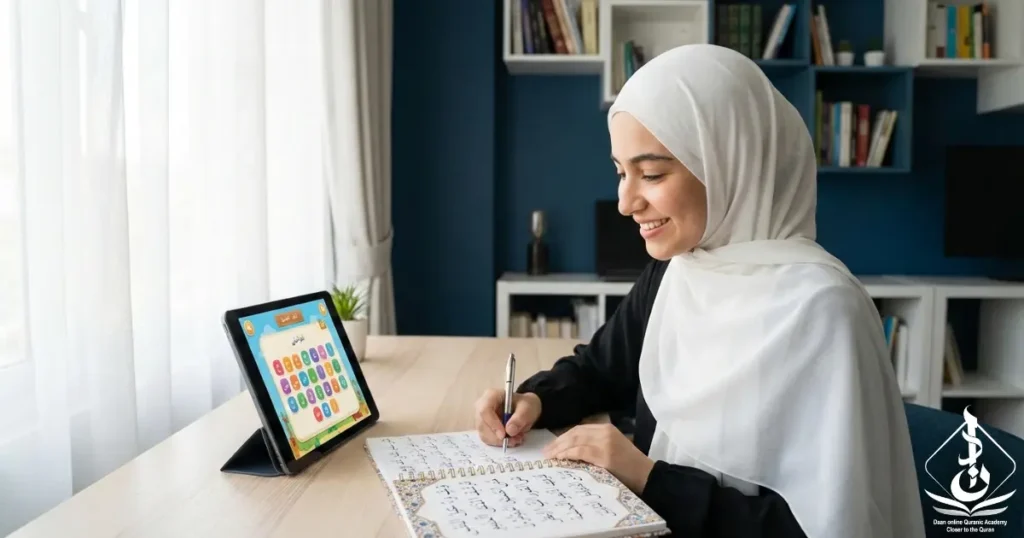
The Holy Quran is the eternal miracle of Islam, a divine message revealed as a guidance for all humanity. Among the hundreds of languages spoken by mankind, Allah (SWT) chose Arabic to be the vessel for His words. As He states in the Quran: “Indeed, We have sent it down as an Arabic Quran that you might understand” (Yusuf: 2). This divine selection was not random; it carries profound wisdom related to the nature of this language and its unique ability to carry deep, precise, and multifaceted meanings. For non-Arabic speaking Muslims or those living in Western societies, a persistent question often arises: “Are translations enough to truly understand the Quran? Why should I put effort into learning a new language?” In this article, we dive deep into the essential relationship between the Quran and the Arabic language, illustrating why learning it is an indispensable key to unlocking the treasures of revelation. 1. The Quran and Language: The Relationship Between Body and Soul In the Quran, Arabic is not merely a medium for transmitting information; it is the “structure” of the text itself. In any literary work, you can translate the “meaning,” but in the Quran, the “Nazm” (the specific arrangement of words) is part of its miraculous nature. 2. The Limitations of Translation: Why Translations are “Interpretations,” Not the Quran It is vital for every Muslim to realize that any “translation of the Quran” is, in reality, a “translation of the meanings of the Quran according to the translator’s understanding.” No language in the world can fully encompass the weight and depth of a single Quranic Arabic word. 3. The “Roots System”: The Magic of Derivation Arabic is characterized by a system of derivation from three-letter roots, a logic that does not exist in Latin or Germanic languages. This system connects words in an incredible logical network. For example, the root (ع-ل-م – ‘A-L-M): From it, we derive: ‘Alima (He knew), ‘Allama (He taught), ‘Alim (Scholar), Ma’lum (Known), Ta’leem (Education), and ‘Ulum (Sciences). When you read these words in the Quran, your mind immediately recognizes the hidden link between “Knowledge,” “The Scholar,” and “Education,” providing a holistic understanding of the verse. In English, words like “Knowledge,” “Science,” and “Teacher” have no etymological link, which can fragment the overall meaning for a non-Arabic reader. 4. Conciseness and Eloquence (I’jaz and Wajaza) Arabic is the language of “brevity.” A single word in the Quran can express an entire sentence in English. 5. Khushoo in Prayer and Tasting Worship For Muslims living abroad, Salah is their daily connection with their Creator. When a worshiper stands and recites Al-Fatiha or short Surahs while understanding every word “directly”—without needing to recall a translation—the quality of their prayer changes completely. 6. Safeguarding Creed and Understanding Legal Objectives (Maqasid) Many misconceptions about Islam stem from a “misunderstanding” of Arabic word meanings or their linguistic context. 7. Arabic and the Identity of the Modern Muslim In the era of globalization, Arabic serves as the “common bond” between Muslims from the East and the West. 8. The Journey of Learning Arabic: Is It Impossible? Many believe that Arabic is an extremely difficult language, but in reality, it is highly “logical.” 9. How to Start? Practical Steps for Expatriates and Non-Arabic Speakers If you make the decision today to learn Arabic, here is a simplified roadmap: Conclusion: The Key is in Your Hands Arabic is not just a subject to be studied; it is the “key” to a treasure room. The Holy Quran is Allah’s banquet on earth, and its Arabic language is the “vessel” in which this spiritual food is served. Does it make sense to be satisfied with looking at the vessels from afar, or relying on others to describe what is inside? The effort you put into learning the “Language of Dad” is, in reality, an act of worship and a pursuit of understanding Allah’s will. Do not let life pass while you read the Quran as if it were a foreign text; instead, make it your goal to speak to Allah and hear His message in the language of revelation. Are you ready to open a new chapter with the Book of Allah? At Daan Quranic Academy, we take you by the hand on an enjoyable and organized journey to learn the language of the Quran. Our programs are specifically designed to meet the needs of non-Arabic speakers, using modern methods that combine fun and depth. Book your free free trial sessions and start your journey of understanding and reflection!
The Quran: A Guiding Light and a Gift for Every Child’s Future

In a rapidly changing world, our children in the West and non-Arabic speaking societies face significant cultural and identity challenges. The Holy Quran emerges not just as a book of worship, but as a comprehensive way of life and a compass guiding the new generation toward success in both worlds. Teaching the Quran to children at an early age, especially for those living in environments where Arabic is not the primary language, is an investment that transcends linguistic boundaries to shape personality and develop the mind. In this article, we explore in detail the multifaceted benefits of learning the Holy Quran and how it empowers “expatriate” Muslim children with the tools for academic success and psychological balance. 1. Building Islamic Identity in an Open Environment For a child growing up in Europe, America, or any non-Muslim country, “identity” is the greatest challenge. Learning the Quran gives them a sense of belonging to a great Ummah with a glorious history and a sacred language. 2. Linguistic Milestone: The Quran as a Gateway to Arabic For non-Arabic speakers, the Holy Quran represents the “Supreme Standard” of the language. Learning the Quran is not just about memorizing verses; it is intensive linguistic training. 3. Cognitive and Neurological Benefits: Developing Intelligence and Focus Educational studies have shown that children who memorize the Quran often excel academically in other fields such as mathematics and science. Why? 4. Psychological Balance and Spiritual Health Children abroad often experience psychological pressure from trying to reconcile two cultures. The Quran provides the “tranquility” they need. 5. Instilling Moral Values and Good Character The Quran is not just a text to be read; it is a constitution of ethics. For parents abroad, the Quran represents the “First Teacher” of morals. 6. Challenges for Non-Arabic Speakers and How to Overcome Them We understand that teaching the Quran to a child who does not speak Arabic may seem difficult, but with modern technology and specialized academies, it has become enjoyable. 7. The Role of Online Quran Academies In many places abroad, nearby mosques or full-time teachers may not be available. This is where specialized academies come in, providing: Conclusion: An Investment That Never Fails Teaching your child the Holy Quran while living in the West is the greatest gift you can give them. You are not just teaching them a religion and a language; you are building a leader, a thinker, and a balanced human being with a solid identity and an open mind. Start your child’s journey with the Quran today, to reap the fruits tomorrow in their academic success, their blessed character, and their high ranks with Allah. Looking for the best way to start your child’s Quran journey? At Daan Quranic Academy, we provide specialized programs for non-Arabic speaking children, with expert tutors and interactive methods that make Hifz an unforgettable joy. Book your free free trial sessions now !