The Art of Eid in the West: How to Restore the Spark of Celebration for Your Muslim Family
Restoring the spark of Eid for Muslim families in the West is not just possible — it is one of the most powerful acts of Islamic parenting you will ever undertake. In societies where streets fill with lights, scents, and spectacle for every holiday except yours, Muslim children quietly ask a question they may never voice aloud: “Is our Eid truly as special?” This guide provides a complete, practical, and psychologically grounded framework for transforming Eid — both Eid al-Fitr and Eid al-Adha — into the most anticipated, most joyful, and most identity-affirming experience of your Muslim child’s year, every year.
This ayah — describing the completion of Ramadan and the arrival of Eid al-Fitr — reveals something profound: Eid celebration is not simply a cultural tradition or a social occasion. It is a divinely prescribed expression of gratitude, a moment when the entire Muslim community lifts its voice in تَكْبِير (Takbeer — glorification of Allah) as a collective act of worship. When we invest in making Eid celebration in the West genuinely beautiful, meaningful, and unforgettable, we are not competing with secular culture. We are fulfilling the spirit of this ayah — helping our children experience the gratitude and joy that Islam intends for them from the very words of the Quran itself.
📑 Table of Contents
- The Psychology of Celebration: Why Children Are Drawn to Festive Culture
- Transforming Your Home into an “Eid Kingdom”
- Creating Exclusive Family Rituals: The Power of Eid Traditions
- Gifts: The Art That Outshines the Material
- Community Connection: Making Eid an Act of Da’wah
- The Eid Prayer: Turning a Sunnah into a Grand Festival
- Deepening Eid Through Quranic and Arabic Education
- Frequently Asked Questions
The Psychology of Celebration: Why Children Are Drawn to Festive Culture
Before we can restore the spark of Eid celebration in the West, we need to understand the psychological reality Muslim parents are actually navigating. Children are not drawn to secular celebrations because those celebrations are inherently superior to Eid. They are drawn to them because those celebrations are engineered — deliberately and at enormous cultural expense — to engage every human sense simultaneously. The scent of cinnamon and pine. The sight of glowing lights against a winter sky. The sound of familiar music in every shop and on every screen. The texture of beautifully wrapped packages. The taste of special foods made only at this time of year.
This is not magic — it is sensory saturation combined with consistent annual repetition. And the lesson for Muslim parents is not to retreat from it but to replicate it: to make Eid celebration in the West an experience so rich in sensory detail, so embedded in warm family memory, and so emotionally associated with joy and belonging, that no secular alternative can compete with the feeling your child has come to associate with Eid. Children do not compare celebrations intellectually — they compare them emotionally. The celebration they feel most, remember most vividly, and anticipate most eagerly is the one that will anchor their identity most powerfully.
“The Messenger of Allah came to Madinah and the people had two days in which they used to play and entertain themselves. He said: ‘What are these two days?’ They said: ‘We used to entertain ourselves on these days during the pre-Islamic period.’ The Messenger of Allah said: ‘Allah has substituted for them something better: the day of Sacrifice (Eid al-Adha) and the day of the breaking of the fast (Eid al-Fitr).'”
This hadith is one of the most important texts for Muslim parents raising children in the West. The Prophet ﷺ did not tell the Companions to abandon celebration and festivity. He replaced what they had with something better — the Islamic Eids. The word used is أَبْدَلَكُمْ (Abdalakum — He has substituted for you): a divine replacement, not a prohibition. Islam is not anti-celebration; it is pro-celebration — but with purpose, with gratitude, and with the name of Allah at the centre. The challenge for Muslim parents in the West is not theological. It is entirely practical: how do we make the Eid we provide for our children worthy of that divine replacement?
Transforming Your Home: Making Eid in the West Come Alive
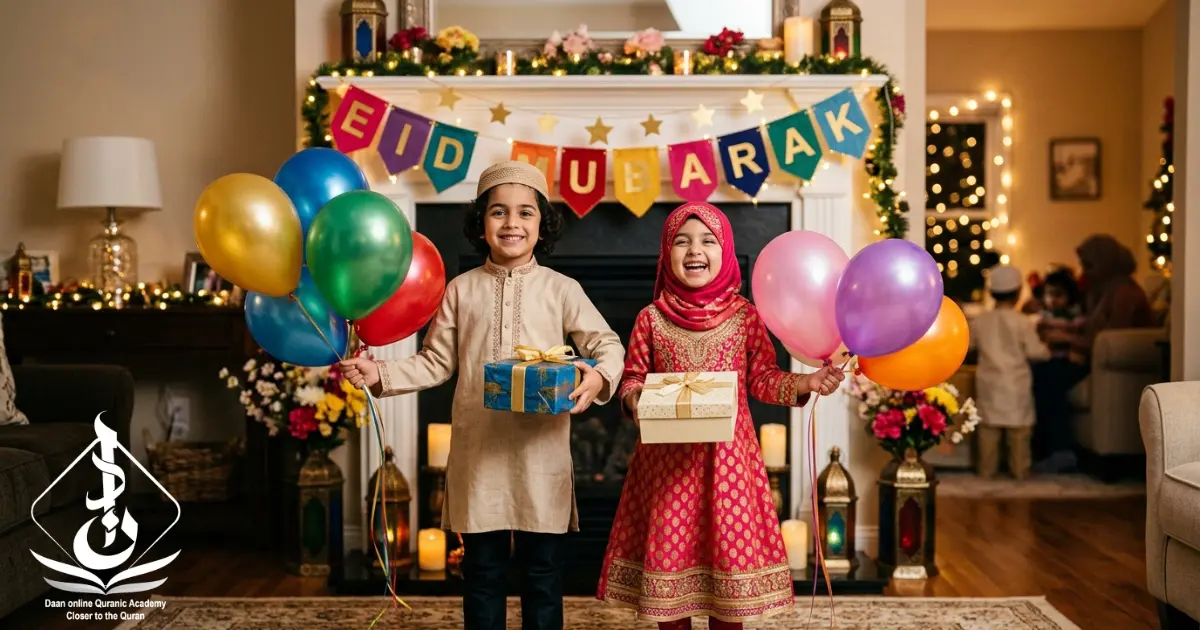
The first and most powerful arena for Eid celebration in the West is the home itself. A child’s emotional memory of Eid is built primarily from the domestic environment — what the house looks like, smells like, sounds like, and feels like in the days surrounding the celebration. The investment in transforming your home for Eid is not a decorating luxury; it is a deliberate act of identity formation. When a child’s home becomes more festive, more beautiful, and more extraordinary during Eid than at any other time of year, the child’s mind begins building a powerful association: Eid equals the most beautiful, most alive version of home.
The Corner of Light
Dedicate a large corner of your main living room exclusively to Eid — a permanent, recognisable installation that your children help build each year. Use warm LED string lights shaped as crescents and stars, hang Arabic calligraphy panels featuring the names of Allah, and arrange traditional lanterns (فَوَانِيس — Fawanees) in a deliberate display. Lighting is the single most psychologically powerful environmental element in creating festive atmosphere — it signals to the brain immediately that this time is different, special, and worth remembering. Install this corner three to five days before Eid and let your children help arrange it from the very first year. The act of building the celebration together with their own hands is half the emotional magic of the celebration itself.
The Dedicated Eid Scent
Select a specific fragrance and use it exclusively for Eid — pure Oud wood, Bakhoor incense, or a distinctive Arabic attar that appears nowhere else in your family’s year. The Pavlovian link between scent and memory is the strongest and most durable sensory association in human neuroscience — a smell encountered in early childhood can trigger vivid emotional memories decades later with a power that no other sense can match. When your child grows up and encounters that specific scent as an adult, it will return them instantly and emotionally to the safety, joy, and pride of Eid in their childhood home. This single investment, costing almost nothing, builds a lifelong anchor to Eid celebration in the heart of your child that neither distance nor time can easily dissolve.
The Eid Gift Display
Create a dedicated, beautifully decorated Eid gift display rather than leaving presents in plain bags. Arrange gifts beneath a miniature خَيْمَة العِيد (Khayymat al-Eid — Eid Tent), or around a decorative Kaaba model or illuminated crescent centrepiece. The aesthetic of the presentation sends a message that the gift itself cannot: what is inside this space is precious, intentional, and worthy of care and ceremony. This stands in direct contrast to the accidental informality that often characterises Eid gifting in Western Muslim homes — the gift in the plastic shopping bag — and creates, instead, an experience of celebration that children can see and feel before they have opened a single thing.
The Eid Soundtrack
Begin playing traditional أَناشِيد العِيد (Anasheed al-Eid — Eid songs and Takbeerat) throughout the home from the night before Eid. Many families severely underestimate the power of a dedicated auditory environment in creating festive atmosphere. When a child wakes on Eid morning to the sound of Takbeerat filling the house, the auditory cue alone communicates with certainty: today is different. Today is joyful. Today is ours. In the West, where secular celebrations have dominant, instantly recognisable soundtracks, creating an equally distinctive Eid celebration soundscape is one of the simplest and most impactful identity tools available to Muslim parents.
The Special Eid Table
Transform the dining table for Eid with a dedicated tablecloth, special crockery reserved exclusively for this occasion, and the display of traditional foods emotionally associated with Eid in your family’s heritage — Kahk, Maamoul, Baklava, or whatever dishes carry the identity of your family’s celebration. Food is one of the most powerful cultural identity markers in any tradition; the dishes associated with Eid become, over years of repetition, emotionally inseparable from the celebration itself. The child who grows up knowing the specific taste of Eid carries an identity anchor that no Western holiday can replicate because no Western holiday can produce that specific flavour memory.

Creating Exclusive Family Rituals: The Power of Eid Traditions
What makes a child anticipate Eid — what creates the building excitement that shapes identity and love — is not the day itself but the rituals that precede and surround it. Research in family psychology consistently demonstrates that children’s emotional security and cultural identity are more powerfully reinforced by repeated, predictable annual rituals than by any single spectacular event. The traditions you establish around Eid celebration in the West are the building blocks of your child’s Islamic identity not just at Eid time, but across the entire year — because the rituals are anticipated all year long.
The Grand Baking Night
Make the eve of Eid a dedicated family baking night — flour on every surface, children’s hands shaping dough, the scent of Kahk or spiced cookies filling the house from early evening until late. This “beautiful productive mess” is precisely what children remember most vividly about celebrations when they grow up. The ritual is not about perfect pastries. It is about the shared experience of creating something together for the celebration — and it answers, viscerally and joyfully, the child’s question: “Is our Eid worth caring about?” When they are covered in flour and laughing with the people they love most, the answer is unmistakably and memorably yes.
The Eid Eve Bag
Place a carefully prepared “Eid Bag” at the foot of each child’s bed on the night before Eid — their new Eid clothes, neatly folded and wrapped; a small bottle of special perfume; a handwritten card with words of love and pride in their Muslim identity; and a selection of sweets chosen specifically for them. The psychological effect of this ritual is remarkable: the child goes to sleep in anticipation and wakes on Eid morning to an immediate, tangible confirmation that today is genuinely special and they are personally celebrated. This mirrors the Prophetic tradition of wearing new clothes and applying perfume on Eid — but delivers it as a personal, loving gift rather than a parental instruction, which is a profoundly different emotional experience for a child.
The Eid Countdown Calendar
Beginning ten days before Eid, create a simple pocket board with ten numbered pockets — one for each day. Each morning, the child opens that day’s pocket to find something small: a piece of candy, a printed hadith about Eid with a child-friendly explanation, a fun Islamic fact about the history of Eid celebrations, a mini activity, or a small note of encouragement. The countdown transforms the ten days before Eid into a daily event, building anticipation incrementally in exactly the way that secular holiday countdowns do in Western culture. The child is not simply waiting for Eid — they are celebrating the approach of Eid every single day. That cumulative, growing excitement is one of the most powerful drivers of identity: the thing you look forward to most is the thing you most deeply feel you belong to.
The Eid Morning Wake-Up
Make the moment of waking on Eid morning into a small ceremony. Enter each child’s room with Takbeerat playing softly, open the curtains to let in the morning light, place a small tray of dates and something sweet by their bed, and greet them with عِيدُكَ مُبَارَك (Eiduka Mubarak — Blessed Eid to you) with a warmth and joy that communicates: this moment was prepared for you. The first minutes of Eid morning set the emotional tone for the entire day. Investing in that specific moment costs nothing except intention — and the return is a child who carries, for the rest of their life, a memory of waking on Eid and feeling profoundly loved, celebrated, and happy to be Muslim.
Gifts: The Art That Outshines the Material
In Western culture, gift-giving during celebrations is a refined art — the presentation, the wrapping, the ceremony of opening, and the experience of discovery are often as emotionally significant as the gift itself. Muslim families in the West sometimes approach Eid gifting with an understandable minimalism that, in practice, leaves children feeling that the experience of receiving gifts at Eid celebration is simply less special than at secular occasions. The solution is not to spend more money — it is to invest more care and ceremony in the entire experience of giving.
Invest in the Wrapping
Never present an Eid gift in a plain plastic bag. Wrap every gift — however small — in rich, colourful paper; tie it with a satin ribbon in gold or Islamic green; attach a handwritten card with the child’s name and a personal message that expresses your pride in who they are as a Muslim. The wrapping is not superficial. It is the ceremony of giving — it communicates to the child that this gift was prepared specifically for them, with thought, with love, and with the intention that they feel celebrated. That experience of being personally and deliberately celebrated is one of the most powerful identity-affirming moments in a child’s emotional development.
The Strategy of Multiple Gifts
Rather than giving one large gift, give several smaller ones — each wrapped separately, each opened one at a time. This allows the child to experience multiple moments of discovery and surprise, extending the “joy of opening” across a morning rather than concluding it in a single moment. From a psychological standpoint, a sequence of smaller anticipations produces greater cumulative pleasure than a single large one. Crucially, the child spends more total time inside the experience of Eid celebration — opening, discovering, reacting — rather than passing through it quickly. More time spent in the celebration means more memory formation around it, and more memory means stronger identity attachment.
The Eid’iyya Tradition
The tradition of عِيدِيَّة (Eid’iyya — Eid monetary gift) — giving money to children from grandparents, aunts, uncles, and family friends — is a beautiful Islamic tradition that carries deep identity significance. In Western Muslim families, particularly those far from extended family networks, this tradition can be preserved and replicated: coordinate with relatives overseas and community members in the weeks before Eid to arrange Eid’iyya envelopes for your children. The child who receives Eid’iyya from multiple family members learns viscerally that their celebration is communal and widely loved — that their Eid matters not only to their parents but to an entire extended community that celebrates them.
Among the most powerful Eid gifts you can give a Muslim child are those that simultaneously celebrate them and strengthen their Islamic identity: beautifully illustrated books about Islamic civilisation and the Prophets; educational Arabic alphabet games; a personalised Quran with their name embossed on the cover; or — most meaningfully — the gift of structured Islamic education. A season of private Quran or Arabic lessons gifted at Eid communicates to your child that their Islamic learning is precious enough to receive as a celebration. It also makes an immediate, lasting investment in the very foundation of their identity. Explore our flexible plans starting from $9/hr for a genuinely meaningful Eid gift that grows with your child all year.
Community Connection: Sharing Eid in the West with Pride
One of the most powerful and consistently underutilised dimensions of Eid celebration in the West is Eid’s extraordinary potential as an act of دَعْوَة (Da’wah — invitation and outreach). In a society where Islam is frequently misrepresented or misunderstood, the authentic beauty of an Eid celebration shared generously with neighbours, classmates, and colleagues is one of the most effective forms of living Da’wah available to any Muslim family. And for the child who participates in this outreach, the experience of being an ambassador of their faith — rather than a defender of it — is profoundly identity-affirming in ways that no amount of parental instruction can fully replace.
- Gifts for neighbours. Prepare elegantly wrapped plates of Eid sweets and traditional pastries, and encourage your children to deliver them personally to non-Muslim neighbours with a small card that reads: “Eid Mubarak — our festival of gratitude and celebration. With joy from our family to yours.” The child who knocks on a neighbour’s door carrying a gift and explains their celebration with confidence is not simply sharing food. They are presenting their Muslim identity to the world with pride, experiencing the warmth of a positive reception, and learning — in the most direct way possible — that their faith is something to share rather than something to hide.
- The Eid wreath. Place a beautifully crafted “Eid Mubarak” wreath, crescent decoration, or illuminated panel on your front door so that Eid is visible to every passerby on the street. When a child sees their home wearing Eid openly and proudly in a neighbourhood that does not share their celebration, something important happens in their identity: the public display validates their celebration as real, worthy, and unashamed. Their faith is not a private matter tucked away inside four walls. It is something their family wears with dignity — visible to the world and not dependent on the world’s approval.
- The open Eid party. Organise an open Eid day and invite your children’s classmates — including their non-Muslim friends — for an afternoon of games, traditional food, simple storytelling about the meaning of Eid, and the sharing of Eid’iyya. The Muslim child who sees their non-Muslim peers genuinely enjoying and participating in their holiday experiences one of the most powerful moments of identity validation available: external confirmation that their celebration is beautiful, interesting, and worth sharing.
The Eid Prayer: Turning a Sunnah into a Grand Festival
The صَلاةُ العِيد (Salat al-Eid — Eid Prayer) is the spiritual centrepiece of the entire celebration — the communal act of worship around which all the joy and festivity revolves. In the West, Eid prayers are held in Islamic centres, rented sports halls, or open parks — contexts that may lack the visual grandeur of historical Eid prayer grounds but that carry something uniquely powerful: the particular beauty of a Muslim community gathering in the midst of a society that does not share their faith, lifting their voices in collective Takbeer with dignity, conviction, and visible joy.
“Every nation has its Eid, and this is our Eid.”
The Prophet ﷺ said this with a clarity and a pride that every Muslim child in the West needs to hear and internalise. This is our Eid. Not a borrowed celebration, not an imitation of someone else’s festival, not something to be shy or apologetic about. Our Eid, given to us by Allah. For the child who hears this hadith and understands it, the Eid prayer becomes not a religious formality to be completed before the day’s activities begin — it becomes the declaration from which everything else flows. For a comprehensive guide to the Prophetic traditions that make the Eid prayer so beautiful, see our post on The Sunnahs of Eid. And to help your children understand the meaning and Arabic of what they say during Eid prayer, our certified native Egyptian tutors specialise in exactly this kind of living, contextual Islamic education.
- Make the journey a celebration. Play Takbeerat loudly in the car on the way to the prayer. Distribute balloons to children when you arrive. Take professional family photos in your full Eid clothes before or after the prayer — these photographs are the visual documentation of Eid that children return to for the rest of their lives, the images that will one day tell their own children: this is who we were, and this is how joyfully we celebrated who we were.
- Dress with distinction. Wearing new, beautiful clothes on Eid is a confirmed Sunnah of the Prophet ﷺ. In a Western context, dressing distinctively for the Eid prayer — traditional Islamic clothing, or simply the most beautiful and intentional outfit the family owns — communicates to the child: today we show the world exactly who we are, and we are proud of every part of it.
- Narrate the meaning. Before the prayer, take five minutes to explain to your children in simple, age-appropriate language what the Eid prayer is and why the entire Muslim community gathers for it. What are the Takbeerat declaring? Why has Allah given us this day? A child who understands what they are doing does not merely perform a ritual — they participate consciously in an act of worship they are proud to be part of, and that conscious participation is the seed of a lifelong love for the prayer.
Deepening Eid Through Quranic and Arabic Education
All the practical strategies above produce their deepest and most durable effect when supported by something that no amount of decoration, gifting, or ritual can replace: a child who genuinely understands what Eid means. A child who knows the Arabic of the Takbeerat — اللَّهُ أَكْبَرُ، اللَّهُ أَكْبَرُ، لَا إِلَهَ إِلَّا اللَّهُ (Allahu Akbar, Allahu Akbar, La Ilaha Illallah — Allah is Greater, Allah is Greater, there is no god but Allah) — and who understands what they are declaring, does not merely recite a chant on Eid morning. They participate in a declaration that connects them to every Muslim who has ever lived, on every Eid, in every part of the world across fourteen centuries of Islamic history. That level of understanding is the difference between Eid celebration as a cultural habit and Eid as a deeply personal act of faith.
The Arabic language is the key that unlocks this depth. A child who reads Arabic can access the Quran’s descriptions of Eid directly, in the language of the revelation itself. A child who understands the prayers of Eid knows, word by word, what they are asking of Allah. A child who has studied the Sunnahs of Eid from the words of the Prophet ﷺ in Arabic carries a connection to their celebration that transcends geography and generation. Building this foundation is precisely the purpose of our Quran and Arabic education courses at Daan Quranic Academy — designed for Muslim children and adults across the UK, USA, Europe, and Australia who want a living, meaningful, and intellectually rich relationship with their faith rather than a surface-level familiarity with its rituals.
In the weeks leading up to Eid, integrate your child’s Arabic and Quran learning directly into Eid preparation: learn the meaning of the Takbeerat together; read and understand the Quranic passage about completing Ramadan and glorifying Allah (Al-Baqarah 2:185); study the child-friendly stories of how the Companions celebrated Eid with the Prophet ﷺ. This connection between Islamic education and Eid preparation transforms learning from an academic exercise into a living preparation for the celebration your child already loves. When the words they have studied in their lessons are the same words filling your home on Eid morning, Islamic education stops being something separate from Islamic joy and becomes the very source of it.
Frequently Asked Questions About Eid Celebration in the West
How do I make Eid exciting for my child when they see how big secular holidays are celebrated around them?
The key is sensory saturation and consistent annual ritual. Children are drawn to secular celebrations primarily because those celebrations engage all five senses simultaneously and build anticipation through repeated traditions across years. You can replicate — and genuinely surpass — this effect by investing in the atmosphere of your home (lights, scents, sounds, and special food), creating annual family rituals your children look forward to all year, and using countdown calendars and Eid Eve preparations to build excitement in the days before the celebration. When Eid celebration becomes the most anticipated and most sensory-rich experience in your child’s year, the question of comparison with secular holidays simply stops arising — because there is no comparison they reach for.
What are the best Eid gift ideas for Muslim children in the West?
The most impactful Eid gifts combine celebration with identity reinforcement: beautifully illustrated books of Islamic history and Prophets’ stories; a personalised Quran with the child’s name; Arabic alphabet learning games; traditional Islamic clothing for Eid day; or a term of private Quran and Arabic lessons as a gift of Islamic education. Alongside these, use the strategy of multiple smaller wrapped gifts rather than one large item to extend the experience of discovery across the morning. And coordinate the Eid’iyya tradition with relatives and family friends in advance — a child who receives Eid’iyya from multiple family members experiences their celebration as communally loved, not just a household event.
Is it Islamically allowed to decorate the home and celebrate Eid with gifts and activities?
Yes — emphatically and unambiguously. The Prophet ﷺ actively encouraged joy and celebration on the days of Eid. He explicitly allowed singing and entertainment for children on Eid (Sahih Bukhari 952). He told the Companions that Allah had given them two celebrations better than anything they had before (Sunan Abu Dawud 1134). He encouraged new clothes, good food, festive gatherings, communal prayers, and making the day memorably special. Decorating the home beautifully, preparing special foods, giving gifts, playing games, and gathering with the community are all expressions of the Prophetic spirit of Eid — not departures from it. The condition is that celebrations remain within Islamic ethical boundaries, not that they be minimal or joyless.
My children seem more excited about non-Islamic holidays than about Eid — what should I do?
This is a common and completely understandable situation, and it is not a sign of religious failure — it is a sign that the secular celebrations your children encounter have been invested in more consistently and sensorially than your family’s Eid celebrations have been. The solution is not guilt or restriction; it is deliberate, sustained investment. Begin implementing the strategies in this guide: the countdown calendar, the home transformation, the Eid Eve rituals, the gift ceremony, the community outreach. Do this consistently for two or three Eids and you will see a measurable shift in your children’s anticipation and attachment. Identity is built through repeated joyful experience — the celebration your child feels most strongly and anticipates most eagerly is the one that will root their identity most deeply.
How do I explain Eid to my child’s non-Muslim school and friends?
Prepare your child with a confident, positive, brief explanation: “Eid is our festival — we celebrate at the end of Ramadan (or on the day of Eid al-Adha) with prayer, special food, new clothes, gifts, and time with family and community. It is one of the most joyful days of our year.” The framing should always be positive and pride-based, never apologetic or defensive. Many Muslim families also send a plate of Eid sweets to school or to a favourite teacher with a brief card explaining the occasion — this transforms the explanation from a child managing a religious difference into a family generously sharing a celebration, which is received completely differently by peers and teachers and creates genuine warmth and curiosity rather than awkwardness.
How does learning Arabic help my child appreciate and connect with Eid more deeply?
More than almost any other single factor. A child who understands the Takbeerat of Eid — who knows precisely what اللَّهُ أَكْبَرُ (Allahu Akbar) means and feels the declaration when reciting it — has a qualitatively different experience of Eid than a child who recites the words phonetically. A child who has studied Al-Baqarah 2:185 in Arabic understands, from the Quran itself, why Eid al-Fitr exists. This depth of understanding transforms Eid from a cultural celebration into a deeply personal act of faith — which is the most durable and most identity-anchoring form of Eid celebration you can build in your child’s heart. Our Arabic and Quran courses are designed specifically to provide this living foundation for Muslim children across the UK, USA, Europe, and Australia.
What is the difference between Eid al-Fitr and Eid al-Adha and how should we celebrate each?
Both Eids share the core elements of communal prayer, family gathering, special food, gifts, and celebration — but carry distinct spiritual emphases that are worth teaching children clearly. Eid al-Fitr follows the completion of Ramadan and is the festival of gratitude and joy after a month of worship, discipline, and closeness to Allah. Eid al-Adha coincides with the Hajj pilgrimage and commemorates the profound sacrifice of Prophet Ibrahim (AS), with the distinctive practice of the Udhiyya (animal sacrifice) and the sharing of its meat with family, neighbours, and the poor. Giving each Eid its own distinct identity and teaching children the different meanings ensures they understand and appreciate both rather than experiencing them as interchangeable occasions. For the Prophetic practices specific to Eid al-Adha, see our guide on The Most Important Sunnahs of Eid al-Adha.
Give Your Child the Islamic Education That Makes Every Eid Deeply Meaningful
The most powerful and lasting investment in your child’s love of Eid is a living, understood relationship with the Quran and Arabic — the language in which Eid is declared, in which its prayers are performed, and in which its full meaning is expressed. At Daan Quranic Academy, our certified native Egyptian tutors help Muslim children across the UK, USA, Europe, and Australia build exactly this foundation — in private, live, 1-on-1 sessions that fit your family’s schedule year-round.
No commitment required. One free session to experience the Daan Academy difference.
Final Thoughts: Eid Is a Trust in Our Hands
Eid in the West is not a burden to be managed or a competition to be won against secular culture. It is a golden, recurring opportunity — perhaps the greatest in the Islamic calendar — to show your children the beauty, depth, and irreplaceable joy of their faith. When you invest in making Eid celebration in the West a genuinely extraordinary experience — richer in sensory beauty, warmer in family ritual, and deeper in meaning than anything your child encounters on a screen or a high street — you are not simply providing entertainment. You are protecting their identity, building their pride, and planting in their hearts a love for Islam that no external pressure will easily reach.
The child who grows up anticipating Eid — who can close their eyes as an adult and smell the Oud, hear the Takbeerat, taste the Kahk, and feel the warmth of their family gathered in joy and gratitude — carries something the world cannot take from them. They carry a home. And that home is Islam. For more guides on Islamic parenting, Eid traditions, and raising confident Muslim children, explore our Islamic education and parenting blog.
May Allah bless your homes with the light and joy of Eid, fill your children’s hearts with a deep and lasting love for this deen, and make every Eid a celebration of gratitude, community, and closeness to Him. Ameen.