
Solving the Meeting of 2 Sakin Letters Rules: A Simple Tajweed Guide
The meeting of 2 sakin letters rules — known in Arabic as Iltiqa Sakinain — govern what happens when a silent (sakin) letter at the end of one word meets another silent letter at the start of the next word during continuous Quran recitation. Arabic does not allow two unvoweled sounds to be pronounced back-to-back, so reciters either drop a letter or add a short “helping” vowel to keep the flow smooth. It sounds technical on paper, but once you see it broken into three clear cases with real Quran examples, it becomes one of the easiest Tajweed rules to apply consistently — especially with a tutor who can hear and correct you in real time.
📑 Table of Contents
- What Is the Meeting of 2 Sakin Letters Rules in Tajweed?
- Why Can’t Two Sakin Letters Meet in Arabic Recitation?
- Iltiqa Sakinain Rules: The 3 Cases Every Reciter Must Know
- Meeting of Two Sukoon Tajweed: Real Quran Examples
- Common Mistakes English Speakers Make with This Rule
- What to Look for in a Tajweed Teacher Who Can Fix This
- Online vs In-Person Tajweed Classes: Which Helps More?
- How Much Do Online Tajweed Classes Cost in 2026?
- Is the Meeting of 2 Sakin Letters Rules Hard to Learn?
- Frequently Asked Questions
What Is the Meeting of 2 Sakin Letters Rules in Tajweed?
The meeting of 2 sakin letters rules describe how Arabic resolves two consecutive silent (sakin) letters that would otherwise collide when one word ends and the next begins during continuous recitation. In classical Tajweed terminology this is called Iltiqa Sakinain (التقاء الساكنين), and it almost always occurs at the point where a word ends in a sakin letter and the next word opens with hamzat al-wasl — the “connecting hamza” found in the definite article “al-” (ال) and in many command verbs.
Arabic simply does not permit two silent sounds to be spoken one after another mid-sentence. So the language resolves the collision in one of two ways: either the first sakin letter is dropped entirely, or it is given a short “helping” vowel so the recitation can continue smoothly. Which method applies depends on what kind of letter is doing the meeting — and that’s exactly what the three rules in this guide will walk you through.
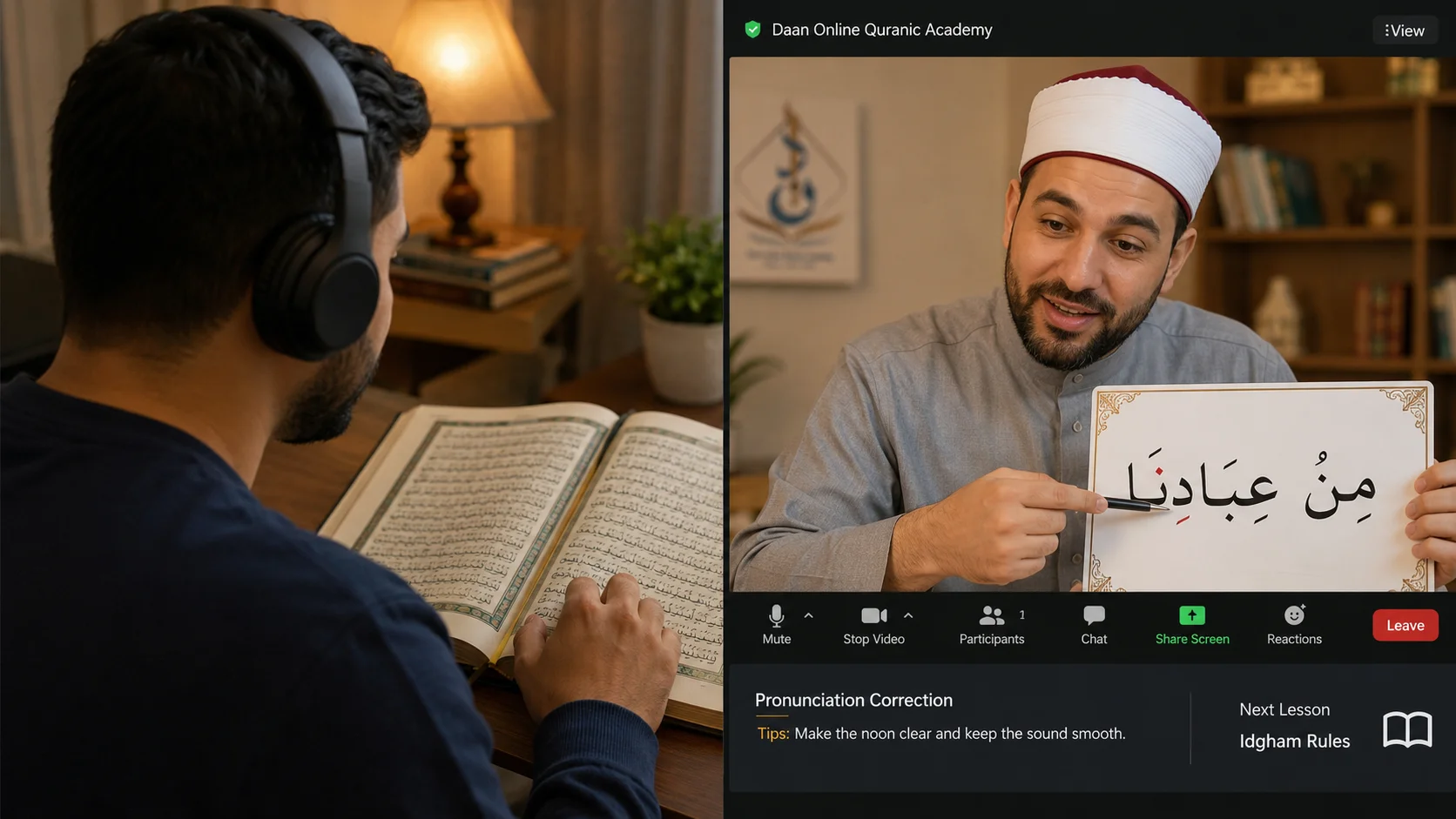
This rule matters for anyone reading the Quran aloud without pausing after every word, which is how the Quran is meant to be recited in continuous portions (wasl). If you’ve ever heard a reciter smoothly connect “قُمِ اللَّيْلَ” instead of choppily stopping between the two words, you’ve heard Iltiqa Sakinain being applied correctly. Getting it right is part of what separates fluent, confident recitation from hesitant, word-by-word reading — something every student can build with structured practice through our Tajweed Rules Mastery course.
Why Can’t Two Sakin Letters Meet in Arabic Recitation?
Two sakin letters can’t meet in Arabic because the language is built for continuous, connected speech, and pronouncing two unvoweled consonants back-to-back mid-word or mid-sentence breaks that flow and makes the sounds nearly impossible to articulate clearly. Classical Arabic grammarians identified this as a structural feature of the language centuries before Tajweed was codified as a science — it isn’t a Quran-specific rule, it’s a rule of spoken Arabic that the Quran, as the standard of eloquent Arabic, follows precisely.
Real session recording: An adult student practises Madd (elongation) rules with a certified tutor — the same madd letters that get dropped when the meeting of two sukoon Tajweed rule applies before hamzat al-wasl. All videos are real, unedited screen-recordings from actual student sessions at Daan Academy, posted with student consent.
Hamzat al-wasl is the main trigger you’ll encounter. It’s written like a regular alif but carries a small ص symbol above it, and it only gets pronounced when you start a sentence with it — in every other position, it simply disappears in continuous speech. That disappearing act is precisely what creates the “meeting” of two sakins: the letter before it is sakin, and once the hamzat al-wasl drops away, the letter that was hiding behind it is sakin too. Something has to give, and that’s where the three Iltiqa Sakinain rules come in.
Iltiqa Sakinain Rules: The 3 Cases Every Reciter Must Know
The Iltiqa Sakinain rules fall into three cases based on what the first sakin letter is: a long vowel (madd) letter, an ordinary consonant, or a tanween ending — and each case is resolved differently. Once you can identify which case you’re looking at, applying the correct fix becomes almost automatic.
Case 1 — A Madd Letter Meets Hamzat al-Wasl
When a word ends in a madd (elongation) letter — alif, waw, or ya — and the next word opens with hamzat al-wasl, the madd letter is dropped in continuous recitation. Only its corresponding short vowel remains: alif leaves a fatha, waw leaves a damma, and ya leaves a kasra. The recitation flows straight into the next word without the elongation being sounded.
Case 2 — An Ordinary Sakin Consonant Meets Hamzat al-Wasl
When the sakin letter is a normal consonant rather than a madd letter, dropping it isn’t an option, so Arabic instead adds a short helping vowel — almost always a kasra — to break up the two sakins. This is the case students find most useful to memorize first, because it appears constantly in everyday recitation, including in daily prayer.
Case 3 — Tanween Meets Hamzat al-Wasl
When a word ends in tanween (fathatain, dammatain, or kasratain) and the next word begins with hamzat al-wasl, the hidden “n” sound of the tanween is pronounced with a kasra to connect smoothly into the next word — regardless of which of the three tanween marks it originally carried.
Each of these three Iltiqa Sakinain rules has a small number of well-known exceptions — for example, the preposition “min” (مِنْ) takes a fatha instead of a kasra, and the plural pronoun endings “-kum” and “-hum” take a damma instead. These exceptions are exactly the kind of detail that’s hard to catch from a book but easy to catch with a tutor listening live, which is one reason 1-on-1 sessions matter so much for mastering Tajweed rules like this one.
Meeting of Two Sukoon Tajweed: Real Quran Examples
The meeting of two sukoon Tajweed rule appears throughout the Quran, and seeing it in real verses makes the three cases far easier to remember than any explanation alone. Here are two of the clearest examples, each illustrating a different case.
يَٰٓأَيُّهَا ٱلَّذِينَ ءَامَنُوا۟ ٱتَّقُوا۟ ٱللَّهَ وَٱبْتَغُوٓا۟ إِلَيْهِ ٱلْوَسِيلَةَ وَجَٰهِدُوا۟ فِى سَبِيلِهِۦ لَعَلَّكُمْ تُفْلِحُونَ
“O you who have believed, be mindful of Allah, seek the means of nearness to Him, and strive in His cause, so that you may succeed.”
Here, “آمَنُوا” ends in a waw madd letter (sakin), and “اتَّقُوا” opens with hamzat al-wasl. This is Case 1: the waw is dropped in continuous recitation, and only its damma is pronounced, connecting the two words smoothly — “āmanuttaqullāh.”
قُمِ ٱلَّيْلَ إِلَّا قَلِيلًا
“Stand [in prayer] through the night, except for a little.”
Here, “قُمْ” originally ends in a sakin meem, and “اللَّيْلَ” opens with hamzat al-wasl. This is Case 2: a helping kasra is added to the meem, giving us “Qumil-layl” instead of an awkward, choppy stop between the two words.
More Iltiqa Sakinain Examples to Practice
Two well-known exceptions worth memorizing appear at Surah An-Nas, 114:6, where the preposition “min” before hamzat al-wasl takes a fatha rather than a kasra, and at Surah At-Takathur, 102:1, where the “-kum” ending takes a damma. Spotting these exceptions in your own recitation is exactly the kind of pattern-recognition skill our native Egyptian tutors train students to build session after session.
Common Mistakes English Speakers Make with the Meeting of 2 Sakin Letters Rules
The most common mistake English-speaking students make with the meeting of 2 sakin letters rules is pausing awkwardly between the two words instead of resolving the collision — essentially treating every word as if it stood alone. This habit is understandable: English doesn’t have an equivalent rule, so there’s no instinct to fall back on.
A second common error is applying the wrong case — for instance, dropping a letter that should have received a helping kasra instead, or vice versa. This usually comes from memorizing the rule in the abstract without enough repetition on real ayahs. A third mistake is missing the exceptions entirely (like “min” taking a fatha), because they’re easy to overlook in a self-study guide but obvious the moment a tutor points them out live.
These patterns overlap closely with other pronunciation challenges non-native speakers face — we cover several of them in more depth in our guide to top Arabic pronunciation challenges for English speakers and in 5 common Tajweed mistakes non-Arabic speakers make, both of which pair well with this guide if Iltiqa Sakinain is one of several rules you’re working through right now.
What to Look for in a Tajweed Teacher Who Can Fix Sakinain Mistakes
The right Tajweed teacher for fixing Iltiqa Sakinain mistakes is a native Arabic speaker with formal Qira’at training who teaches you 1-on-1 and corrects errors the moment they happen, rather than at the end of a recorded lesson. Rules like this one live in the ear, not just the textbook, so the quality of live correction matters more than the quality of the written explanation.
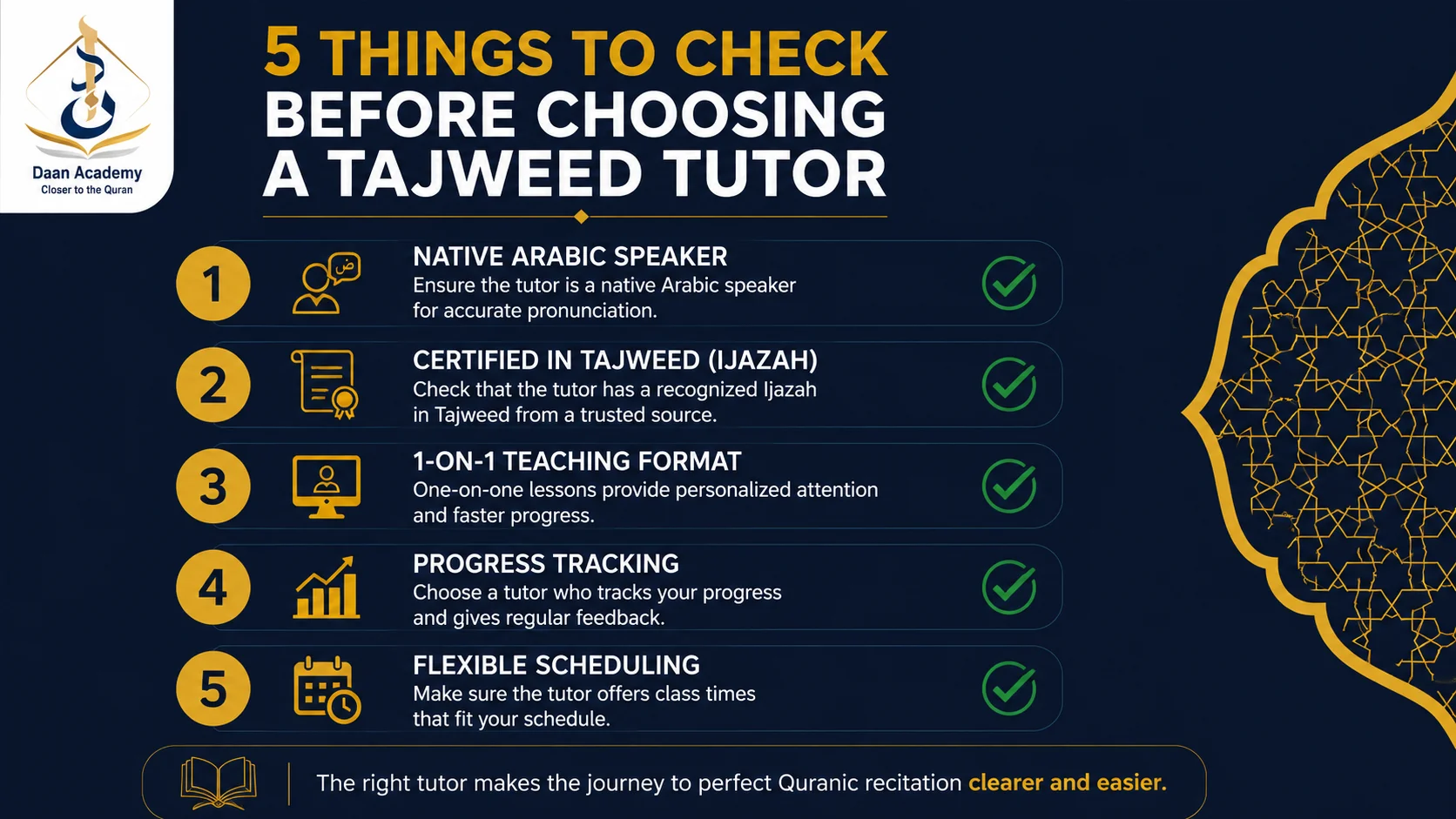
What to Look For: A Native Arabic Speaker
Many platforms rely on non-native instructors reading from a script, which makes it harder to model the exact sound and rhythm of Iltiqa Sakinain naturally. At Daan Quranic Academy, every tutor is a native Egyptian Arab, formally trained in Quranic sciences, so the correction you hear is drawn from lived fluency, not memorized notes.
What to Look For: Certified Qualifications
Look for tutors with verifiable Ijazah certification, ideally with a documented chain of transmission. Many of our tutors hold Ijazah in multiple Qira’at with chains tracing back to the Prophet ﷺ, which you can review on our tutor profiles before your first session.
What to Look For: True 1-on-1 Sessions
Unlike group classes that dilute individual attention, Daan Academy provides private, 1-on-1 sessions for every student, so a tutor hears your specific handling of Iltiqa Sakinain and corrects it in real time rather than addressing the class in general terms.
Online vs In-Person Tajweed Classes: Which Helps More?
Online 1-on-1 Tajweed classes generally help students master rules like Iltiqa Sakinain faster than typical in-person group classes, mainly because private online sessions guarantee individual correction every single class, while group settings often don’t. In-person classes still have real advantages, particularly for very young children who benefit from a physical classroom routine — but for the specific skill of catching and fixing pronunciation rules in real time, individual attention is what actually moves the needle.
| Criterion | Typical In-Person / Group Class | Daan Academy (Online, 1-on-1) |
|---|---|---|
| Individual correction every class | Often shared across 10–20 students | Every minute is 1-on-1 |
| Native Egyptian tutor guarantee | Varies by center | Guaranteed for every tutor |
| Scheduling flexibility | Fixed weekly slot | Any time, from anywhere |
| Progress tracking | Rarely formalized | Session reports via Daan LMS |
| Starting price | Varies widely | From $9/hr |
Where many platforms lack transparency on what you’re actually paying for, our pricing plans lay out exactly what’s included at each tier, so you can compare the value directly rather than guessing.
How Much Do Online Tajweed Classes Cost in 2026?
Online Tajweed classes in 2026 typically start from around $9 per hour for 1-on-1 instruction, with pricing rising based on tutor experience, session frequency, and added features like progress tracking or family discounts. That range makes consistent, private correction of rules like Iltiqa Sakinain realistically affordable on a weekly basis, rather than a one-off investment.
Plans start from just $9/hr with native Egyptian tutors. Compare our three flexible pricing tiers — Essential, Pro, and Elite — each designed for different learning goals and budgets, with a family discount available on the Elite plan.
Cost is often the biggest hesitation for families comparing options, and it’s worth asking exactly what’s included at each price point — live correction, recorded progress notes, access to a student dashboard, and completion certificates all vary between providers. Every plan at Daan Academy includes a free trial session with no commitment required, so you can judge the teaching quality firsthand before comparing it against the price.
Is the Meeting of 2 Sakin Letters Rules Hard to Learn?
The meeting of 2 sakin letters rules are not inherently hard to learn — most students master the three cases within a few focused sessions — but they are easy to apply inconsistently without live listening practice, since the rule only really “clicks” once you hear it corrected in your own recitation. Reading the explanation is step one; hearing yourself get it right, repeatedly, is what makes it permanent.
Students who’ve completed structured Tajweed coursework with us report that Iltiqa Sakinain becomes automatic faster than rules involving longer memorized letter groups, precisely because there are only three cases to internalize. Families across 15+ countries currently work through this exact rule as part of our Tajweed Rules Mastery course, usually alongside Noorani Qaida or Hifz coursework.

Frequently Asked Questions
How much do online Tajweed classes cost?
Plans typically start from $9/hr for private 1-on-1 sessions. You can compare all three tiers — Essential, Pro, and Elite — on our pricing plans page.
Can I learn the meeting of two sakin letters rule online?
Yes. Iltiqa Sakinain is taught as part of our structured Tajweed curriculum, with a native Egyptian tutor listening live and correcting your application of each of the three cases as you recite.
Is it safe for my child to take live Quran classes online?
All sessions are private, 1-on-1, and led by formally trained tutors, with parents able to monitor progress through the Daan LMS dashboard and reach 24/7 support at any time.
Can I try a class before I commit to a plan?
Yes — every new student can book a free trial session with no commitment required, so you can experience the teaching style before choosing a plan.
How do I know if a Tajweed tutor is properly qualified?
Check for native fluency, formal Qira’at training, and verifiable Ijazah certification. You can review these credentials directly on our Why Choose Us page before booking.
Do I need to already know Arabic before learning rules like Iltiqa Sakinain?
No. Most students learn this rule as part of a broader Tajweed course that starts wherever they currently are, whether that’s Noorani Qaida basics or advanced recitation refinement.
What’s included in the free trial session?
A full live session with a real tutor matched to your level and goals, so you can assess teaching style, pacing, and communication before deciding on a plan.
Ready to Master Iltiqa Sakinain and Every Other Tajweed Rule?
Reading about the meeting of 2 sakin letters rules is a good start — hearing them corrected live, in your own recitation, is what makes them permanent. Book a free trial and see the difference a native Egyptian tutor makes.
No commitment required. One free session to experience the Daan Academy difference.
Final Thoughts
The meeting of 2 sakin letters rules can feel intimidating the first time you read the terminology, but in practice they come down to three simple questions: is the first letter a madd letter, an ordinary consonant, or a tanween ending? Once you can answer that in the moment, the correct resolution follows naturally — and with enough live practice, it stops being a rule you think about and becomes part of how you recite.
We ask Allah to make the recitation of His Book easy for every student working through this guide, and to grant reward for every effort spent refining it — struggling through a rule and getting it right is itself part of the reward described in the hadith above. Ameen.
“The one who is skilled in reciting the Qur’an will be among the honorable, righteous angelic scribes, while the one who recites it with difficulty, struggling through it, will receive a double reward.”
Narrated by Aisha (RA) — Sahih al-Bukhari 4937, also Sahih Muslim 798