Short Vowels in Arabic: Fatha, Kasra, Damma with Examples and Guide for Kids
Short vowels in Arabic — Fatha, Kasra, and Damma — are the three small marks that give every Arabic letter its sound, and they are the very first skill a child or adult needs before reading a single word of the Quran. Get these three marks right and reading opens up almost overnight; skip them, and even confident readers stumble over basic words for years. This guide walks through what each short vowel looks like, how it sounds, how to teach it step by step, and how a structured programme with certified native tutors can take a complete beginner from confused symbols to confident recitation in a matter of weeks.
📑 Table of Contents
What Are Short Vowels in Arabic? Fatha, Kasra, and Damma Explained
Short vowels in Arabic are three small diacritical marks — Fatha, Kasra, and Damma — placed above or below a letter to tell the reader exactly which vowel sound follows the consonant. Unlike English, where vowels are full letters sitting inside a word, Arabic vowels are tiny symbols added on top of the letters, and without them the same three consonants could be read a dozen different ways.
Every Arabic letter is a bare consonant sound until a harakah (vowel mark) is added to it. The three short vowels are:
- Fatha (ـَ) — a small diagonal stroke above the letter, producing a short “a” sound, as in the English word “cat.”
- Kasra (ـِ) — the same diagonal stroke placed below the letter, producing a short “i” sound, as in “sit.”
- Damma (ـُ) — a small curl above the letter resembling a miniature waw, producing a short “u” sound, as in “put.”
A fourth mark, the sukun (ـْ), shows that a letter carries no vowel at all, and pairs of these marks — known as tanween — add a soft “n” sound to the end of a word. Together, these marks make up what is formally called tashkil or harakat, and mastering them is the foundation every Noorani Qaida course is built on.
إِنَّآ أَنزَلْنَـٰهُ قُرْءَٰنًا عَرَبِيًّا لَّعَلَّكُمْ تَعْقِلُونَ
“Indeed, We have sent it down as an Arabic Qur’an that you might understand.”
That verse is a reminder that the Quran was revealed with precise Arabic pronunciation in mind, and short vowels in Arabic are exactly what carries that precision from the page into the voice. A single misplaced Fatha or Kasra can change a word’s meaning entirely, which is why getting comfortable with short vowels in Arabic is treated as non-negotiable groundwork rather than an optional extra, at Daan Quranic Academy and in any serious Qaida programme.
Short Vowels in Arabic with Examples: Every Letter, Sound by Sound
Short vowels in Arabic with examples are easiest to learn one letter at a time, pairing each of the 28 Arabic letters with Fatha, Kasra, and Damma until the sound becomes automatic. Most Noorani Qaida books begin here, and for good reason: once a student can instantly read a lone letter with any of the three marks, full words stop looking like a wall of symbols.
| Vowel Mark | Symbol | Sound | Example Letter | Pronunciation |
|---|---|---|---|---|
| Fatha | ـَ | short “a” | بَ | ba |
| Kasra | ـِ | short “i” | بِ | bi |
| Damma | ـُ | short “u” | بُ | bu |
| Fatha | ـَ | short “a” | تَ | ta |
| Kasra | ـِ | short “i” | تِ | ti |
| Damma | ـُ | short “u” | تُ | tu |
Once a learner can read a table like this without hesitation across all 28 letters, the same skill transfers directly into full ayahs. This is precisely the drilling method used inside Daan Academy’s Noorani Qaida course, where a native Egyptian tutor listens to every sound in real time and corrects it before the mistake becomes a habit.
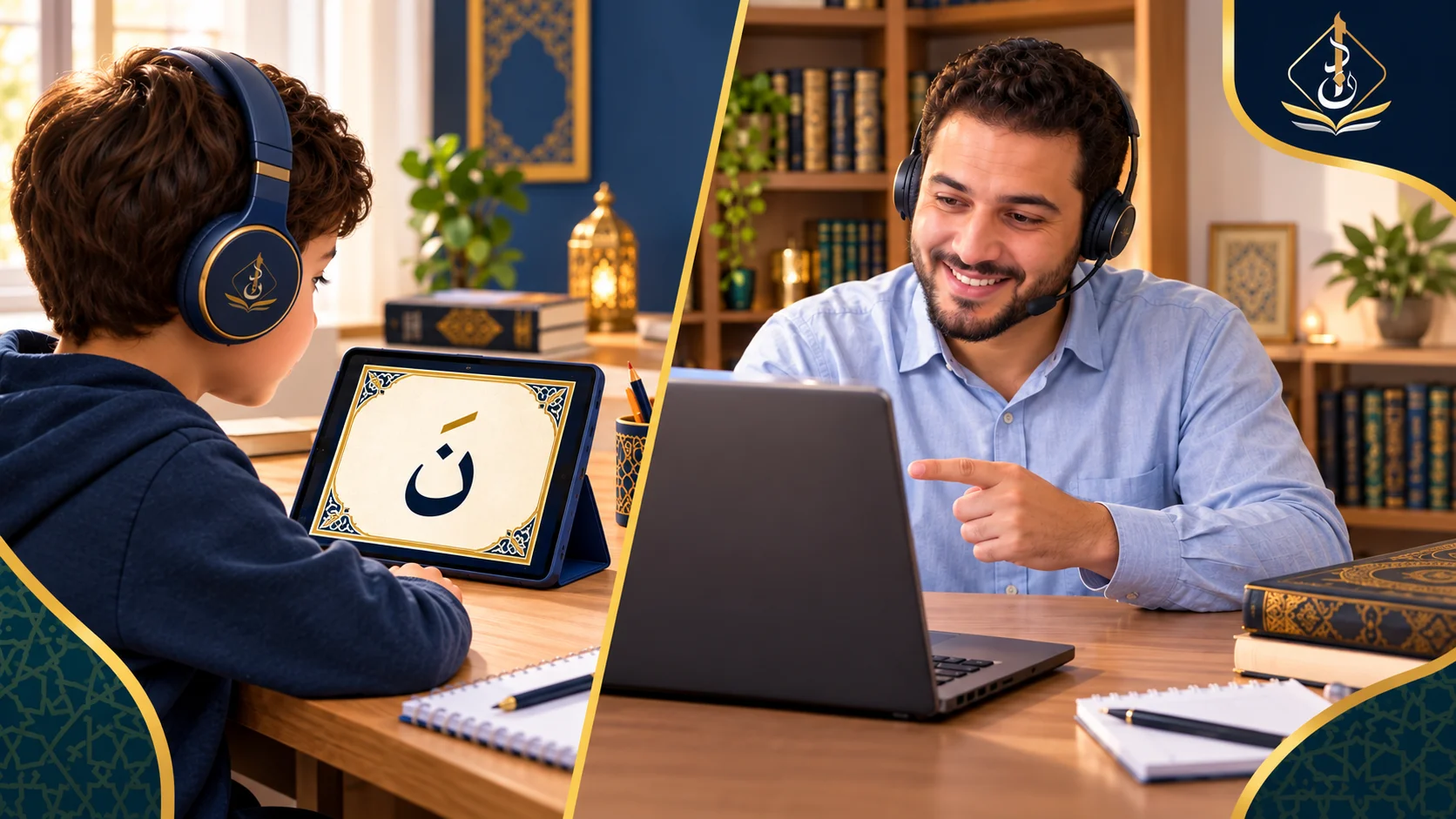
Real session recording: A beginner student reads short vowels in Arabic aloud while a native Egyptian tutor corrects the length and clarity of each Fatha, Kasra, and Damma in real time. All videos are real, unedited screen-recordings from actual student sessions at Daan Academy, posted with student consent.
Watching a real class is often the fastest way to understand why one-on-one correction matters so much for short vowels in Arabic — a recorded app or a static workbook cannot hear whether a child’s Kasra sounds like a genuine short “i” or has drifted toward a long “ee.” For a deeper breakdown of the entire Qaida sequence, from single letters through joined words, see our comprehensive guide to learning Noorani Qaida, which picks up exactly where this lesson on short vowels in Arabic leaves off.
How to Teach Short Vowels in Arabic for Kids: A Step-by-Step Guide
The best way to teach short vowels in Arabic for kids is to isolate one vowel at a time, drill it across every letter, and only combine vowels once each one is instant on its own. Rushing straight into full words before the marks are automatic is the single biggest reason children plateau early in Qaida.
Start with Fatha Alone
Go through all 28 letters with only the Fatha mark until the short “a” sound is instant and effortless, with no sounding-out delay.
Move to Kasra
Repeat the same drill with Kasra, comparing it directly against Fatha so the child hears the difference between “a” and “i” rather than guessing.
Add Damma
Introduce Damma last, since the short “u” sound is the one English-speaking children most often confuse with Damma’s long cousin, the waw madd.
Mix the Three Vowels Randomly
Once each vowel is solid alone, drill all three in random order on flashcards or a Qaida chart so recognition becomes reflexive rather than sequential.
Introduce Sukun and Tanween
Layer in the “no vowel” sukun mark and the double-vowel tanween endings only after Fatha, Kasra, and Damma are fully secure.
Read Short, Real Words
Move from isolated letters into two- and three-letter Quranic words, applying short vowels in Arabic in context while a tutor listens for accuracy on every syllable.
A structured 1-on-1 curriculum matters here more than almost anywhere else in Quran education, because a group class simply cannot pause on every child’s Fatha long enough to fix it before moving on.
Parents often ask what age to begin. Our detailed answer is in the best age to start teaching your child Noorani Qaida, but most tutors find that once a child can recognize the Arabic alphabet by sight, they are ready to begin short vowels in Arabic the very same week. Taught patiently, short vowels in Arabic for kids becomes an early, confidence-building win rather than a stumbling block.
Fatha, Kasra Damma in Arabic vs Long Vowels: What’s the Difference?
Fatha, Kasra Damma in Arabic are short vowels held for one beat, while long vowels — huroof al-madd — are held for two beats and are written as separate letters (alif, waw, and yaa) rather than small marks. Confusing the two is one of the most common pronunciation errors among English-speaking learners, since English does not distinguish vowel length the way Arabic does.
| Feature | Short Vowels (Fatha, Kasra, Damma) | Long Vowels (Madd Letters) |
|---|---|---|
| Written as | Small marks above or below the letter | Full letters (alif ا, waw و, yaa ي) |
| Duration | One beat / one count | Two beats / two counts |
| Example | بَ (ba) | بَا (baa) |
| Common error | Stretched into a long vowel by mistake | Clipped short, losing the madd |

Getting this length distinction right is a core part of Tajweed, and it is exactly the kind of nuance a recorded course cannot correct. For more on pronunciation pitfalls, our post on top Arabic pronunciation challenges for English speakers covers several related issues in depth.
What to Look For in a Course That Teaches Short Vowels Arabic
A course that properly teaches short vowels Arabic should offer live one-on-one correction, native Arabic-speaking tutors, and a clear, structured Qaida sequence, rather than a self-paced app with no listening feedback. Here is what separates a genuinely effective programme from one that merely looks good on a website.
Native, Formally Trained Tutors
Look for tutors who are native Arabic speakers with formal training in Quranic sciences, not just fluent volunteers. At Daan Quranic Academy, every tutor is a native Egyptian speaker who also communicates fluently in English, removing the language barrier that trips up many self-taught families, and many hold Ijazah certifications in multiple Qira’at with a verified chain of transmission back to the Prophet ﷺ.
Genuine 1-on-1 Sessions
Unlike group classes that dilute attention across several students, a private session lets the tutor catch a mispronounced Kasra the moment it happens. Every class at Daan Academy is one-on-one and personalized to the student’s pace.
A Transparent, Structured Curriculum
Where many platforms offer a generic, one-size-fits-all curriculum, a quality programme builds a personalized learning plan starting from short vowels in Arabic, then progressing methodically toward full recitation. See our full course list for how each stage connects.
A Real, Risk-Free Trial
Some platforms are vague about what a “trial” actually includes. A proper free trial session should be a full, unedited class with a real tutor, exactly what enrolling would be like, with no commitment required.
Families evaluating options should also weigh child safety, scheduling flexibility, and progress tracking. Our Why Choose Us page walks through how Daan Academy’s Smart Student Dashboard, 600+ educational games library, and monthly progress reports address each of these concerns directly. These four criteria are exactly why so many families comparing options for short vowels arabic instruction end up choosing a 1-on-1, native-tutor model over a self-paced app.
Common Mistakes When Learning Short Vowels in Arabic (And How to Fix Them)
The most common mistakes when learning short vowels in Arabic are stretching a short vowel into a long one, confusing Kasra with Damma under time pressure, and skipping sukun practice too early. Each of these is fixable with focused, corrected repetition rather than more unsupervised reading.
- Over-stretching Fatha or Damma — turning a one-beat sound into a two-beat madd letter by accident, usually from reading too slowly and “leaning” on the vowel.
- Mixing up Kasra and Damma — common among English speakers because short “i” and short “u” sounds are less distinct in Arabic than in English.
- Rushing past sukun — treating a consonant with no vowel as if it still carries a faint sound, which distorts word rhythm. Getting Fatha, Kasra Damma in Arabic right early prevents most of these habits from ever taking root.
- Guessing instead of reading — memorizing the shape of a word rather than actually reading each mark, which collapses the moment an unfamiliar word appears.
A native Egyptian tutor who can hear these errors in real time, rather than a self-correcting app, remains the fastest way to fix them permanently. This is one of the reasons Daan Academy’s tutors are trained specifically in Makharij and correction technique; our guide on overcoming pronunciation challenges goes further into how live correction accelerates progress.
Short Vowels in Arabic: Pricing and How to Get Started in 2026
Learning short vowels in Arabic through a structured, tutor-led programme typically costs far less than parents expect, with private sessions at Daan Academy starting from just $9/hr. Cost is often the biggest hesitation for families, so here is exactly what is included at each tier.
Daan Academy offers three transparent pricing plans — Essential from $9/hr, Pro from $10.99/hr, and Elite from $12.99/hr — each including live 1-on-1 sessions, access to the Smart Student Dashboard, and monthly progress reports. The Elite plan also includes a family discount for households enrolling more than one child.
There is no long-term contract required to begin, and every new family can start with a completely free trial session before paying anything. Existing families can also take advantage of the referral program, where inviting a friend earns a discount for both households.
Is Learning Short Vowels in Arabic the First Step to Reading the Quran?
Yes — short vowels in Arabic are universally the first structured skill taught in Noorani Qaida, because every word in the Quran depends on correctly reading Fatha, Kasra, Damma, sukun, and tanween. Skipping this stage and moving straight into Quran reading is the single most common reason students develop pronunciation habits that take years to unlearn later.
“The best among you are those who learn the Qur’an and teach it.”
Narrated by Uthman ibn Affan — Sahih al-Bukhari 5027
That hadith is often quoted in the context of memorization, but it applies just as directly to these first building blocks: a child who is taught short vowels in Arabic properly, and later teaches a sibling or a friend, is living out exactly what the hadith describes. According to the historical record on Arabic diacritics, these marks were formalized centuries ago specifically to protect the Quran’s pronunciation from drifting as Islam spread beyond native Arabic speakers, the same goal every Noorani Qaida lesson still serves today.

By 2026, thousands of families across the UK, USA, Europe, and Australia have used exactly this sequence — short vowels in Arabic, then sukun and tanween, then full words — to move from zero Arabic literacy to confident Quran reading, often within a single year of consistent one-on-one lessons.
Frequently Asked Questions
What are the three short vowels in Arabic?
The three short vowels in Arabic are Fatha (short “a”), Kasra (short “i”), and Damma (short “u”). They are written as small marks above or below a letter rather than as separate letters, and they are the very first reading skill taught in a Noorani Qaida course. Together, Fatha, Kasra Damma in Arabic form the foundation that every later reading and Tajweed skill is built on.
How much do online classes for short vowels in Arabic cost?
At Daan Quranic Academy, live 1-on-1 sessions start from $9/hr on the Essential plan, with Pro and Elite tiers available for families who want additional features. Full details are on our pricing plans page.
Can I try a class before committing to a plan?
Yes. Every new family can book a completely free trial session with a native Egyptian tutor before enrolling in any paid plan, with no commitment required.
Is it safe for my child to learn Arabic online?
Every session is private and one-on-one with a formally trained, verified tutor, and parents can sit in on any class. Progress is also visible in real time through the Smart Student Dashboard, so nothing happens off a parent’s radar.
What age should a child start learning short vowels in Arabic?
Most tutors find that once a child can recognize the Arabic alphabet by sight, they are ready to begin. Our guide on the best age to start Noorani Qaida covers this in more depth for different age groups.
Do I need to already know Arabic to learn short vowels in Arabic?
No. Short vowels in Arabic are typically the very first thing a complete beginner learns, before any vocabulary or grammar. A structured Qaida course assumes zero prior Arabic knowledge.
How long does it take to master short vowels in Arabic?
With consistent one-on-one practice, most students become fluent in reading Fatha, Kasra, and Damma across all 28 letters within a few weeks, though full comfort with sukun and tanween on top of them can take a little longer.
Give Your Child a Confident Start with Short Vowels in Arabic
Every strong Quran reader started exactly here — with Fatha, Kasra, and Damma taught patiently by someone who can hear every sound. Book a free trial and see how a native Egyptian tutor teaches short vowels in Arabic in a single live session.
No commitment required. One free session to experience the Daan Academy difference.
Final Thoughts
Short vowels in Arabic can look intimidating on a page full of unfamiliar marks, but in practice they are just three small sounds, taught patiently, one letter at a time. Once Fatha, Kasra, and Damma become automatic, everything that follows in Quran reading becomes dramatically easier, and a child’s confidence tends to grow just as quickly as their fluency.
We ask Allah to make the path to reading His Book easy for every student taking their first steps with short vowels in Arabic, and to reward every parent and tutor patiently guiding them through it. Explore more guides like this one on our blog, or book a free trial to begin today.