How to Master the Rules of Connecting Hamza (Hamzatul Wasl) Easily
The rules of connecting hamza — known in Tajweed as Hamzatul Wasl — govern when the small “extra” alif at the start of certain Arabic words is pronounced and when it silently disappears into the word before it. Get it wrong and your recitation sounds choppy, hesitant, or grammatically incorrect; get it right and your Quran reading flows the way the Prophet ﷺ and his Companions recited it. In this guide, you will learn exactly where Hamzatul Wasl occurs, how to pronounce it correctly in every situation, and how a certified native Egyptian tutor at Daan Quranic Academy can help you master it in live, one-on-one sessions from just $9/hr.
📑 Table of Contents
- What Is Hamzatul Wasl in Tajweed?
- What Are the Hamzatul Wasl Rules? A Step-by-Step Guide
- Hamzatul Wasl Examples in the Quran
- Hamzatul Wasl vs Hamzatul Qat’: How to Tell Them Apart
- How to Choose the Best Online Tajweed Course for Hamzatul Wasl Rules
- Hamzatul Wasl Rules for Beginners, Kids, and Reverts
- How Much Does It Cost to Learn Tajweed Online?
- Common Mistakes When Applying Hamzatul Wasl Rules — and How to Fix Them
- Frequently Asked Questions
What Is Hamzatul Wasl in Tajweed?
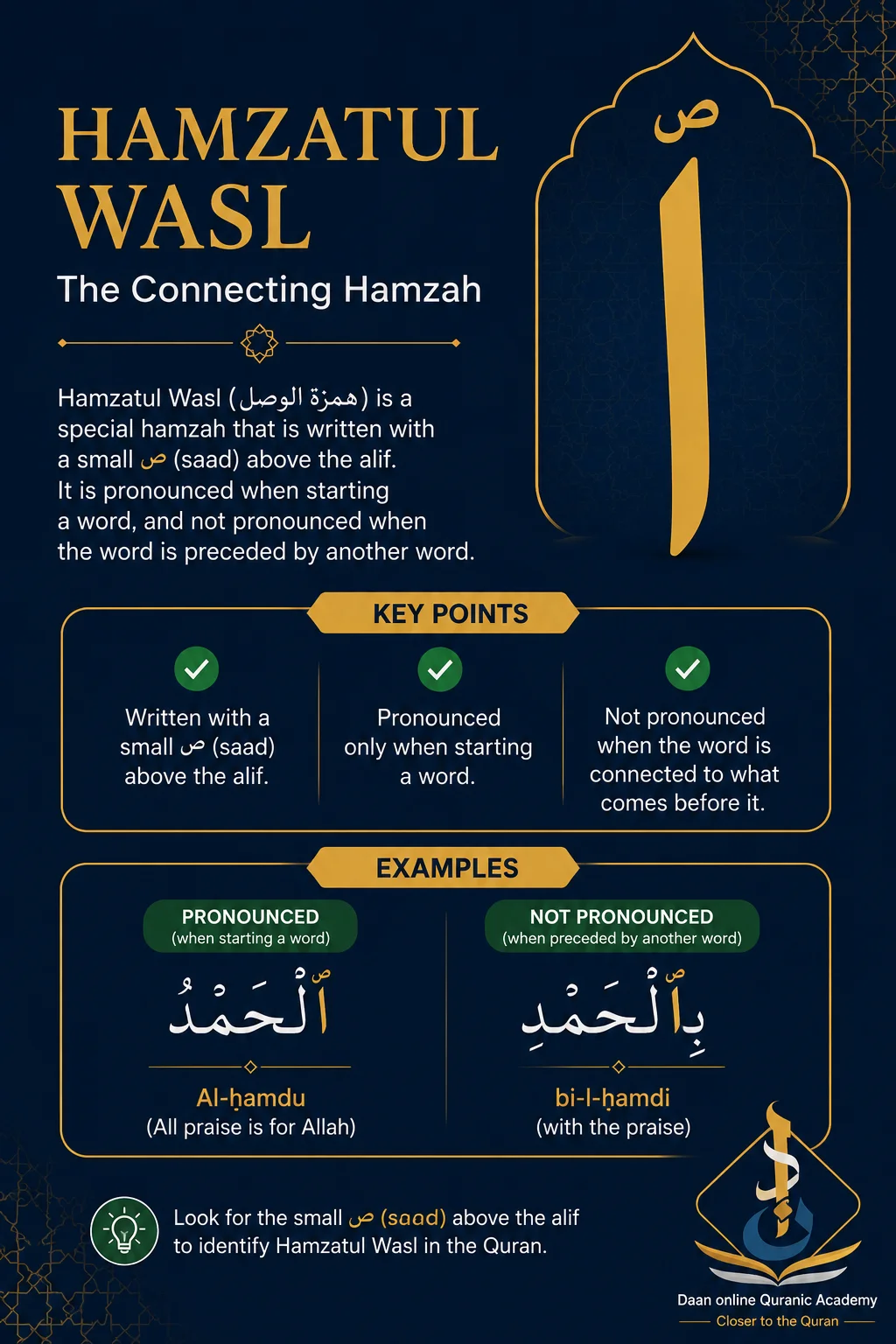
Hamzatul Wasl (هَمْزَة الْوَصْل), or the “connecting hamza,” is a prosthetic hamza added to the start of certain Arabic words so they can be pronounced when read in isolation — but it is dropped completely when the word is connected to the word before it. Arabic phonology does not allow a word to begin with a vowel-less (sākin) letter, so this hamza exists purely as a starting point.
Written on top of an alif, Hamzatul Wasl is distinguished in the Uthmani script by a small ص (saad) symbol placed above the letter. That symbol is a signal to the reciter: sound this hamza only if you are beginning your recitation here — otherwise glide over it silently. Understanding this single rule removes one of the most common sources of hesitation for English-speaking students learning to read the Quran, and it is one of the very first Tajweed rules covered in the Tajweed Rules Mastery course at Daan Quranic Academy.
What Are the Hamzatul Wasl Rules? A Step-by-Step Guide
The Hamzatul Wasl rules can feel overwhelming in a textbook, but they break down into a handful of predictable situations. Below is the order most qualified tutors teach them in, moving from the simplest case to the more advanced exceptions.
Real session recording: A Daan Academy student is corrected in real time as they decide whether to sound or drop a connecting hamza mid-verse — exactly the kind of live feedback that turns the Hamzatul Wasl rules from theory into habit. All videos are real, unedited screen-recordings from actual student sessions at Daan Academy, posted with student consent.
Step 1: Locate the Three Word Categories
Hamzatul Wasl only ever appears in three grammatical categories: certain nouns (such as ٱسْم and ٱبْن), the definite article “ال” (al-), and specific verb forms — namely the past tense, command form, and verbal noun of five- and six-letter root verbs (such as ٱسْتَغْفِرْ, “seek forgiveness”).
Step 2: Pronounce It When You Start a Sentence or Verse
If you are beginning your recitation on a word that carries Hamzatul Wasl, you must pronounce it clearly with a short vowel — usually a fatha (a-sound), though a small number of verb forms take a kasra (i-sound) or damma (u-sound) instead.
Step 3: Drop It When Connecting from a Previous Word
This is the rule that gives Hamzatul Wasl its name. When the preceding word ends in a vowel sound, your tongue simply flows straight through — the hamza is not pronounced at all, and the recitation moves directly into the next letter.
Step 4: Handle the Sukoon Exception
If the word before Hamzatul Wasl ends in a sukoon (a vowel-less letter), a short helping vowel is inserted to avoid two silent letters colliding — for example, after the preposition مِنْ (min), a kasra is added so the phrase reads smoothly.
Step 5: Practise the Rare Exceptions with a Qualified Tutor
A handful of unusual cases — such as the “hamza of questioning” meeting Hamzatul Wasl before the name of Allah, which stretches into a long “Āllāhu” sound — appear only a few times across the entire Quran. These are best learned live, which is why they are a focus area in Daan Academy’s specialised Tajweed course.
Hamzatul Wasl Examples in the Quran
Hamzatul Wasl examples appear on nearly every page of the Quran, most commonly inside the definite article “ال,” which is why recognising this rule quickly is essential for smooth, natural recitation rather than a word-by-word stumble.
Notice that ٱهْدِنَا (ihdina) begins with Hamzatul Wasl — pronounced clearly if you start reciting from here, but dropped if the verse before it ends in a vowel sound. A few more high-frequency Hamzatul Wasl words worth memorising early on include:
- ٱلْحَمْدُ (al-hamdu) — “the praise,” from Surah Al-Fatiha, 1:2
- ٱلرَّحْمَٰنِ (ar-Rahman) — “the Most Merciful,” found throughout the Quran
- ٱسْتَغْفِرُوا۟ (istaghfiru) — “seek forgiveness,” from Surah Hud, 11:3
- ٱبْنَ (ibna) — “son of,” a Hamzatul Wasl noun used in Quranic genealogies
- ٱسْمُ (ismu) — “the name of,” the opening word pattern of Bismillah when isolated
For a deeper understanding, read our guide on Top Arabic Pronunciation Challenges for English Speakers, which covers several related sounds that often trip up new reciters.
Hamzatul Wasl vs Hamzatul Qat’: How to Tell Them Apart
Hamzatul Wasl and Hamzatul Qat’ look almost identical on the page but behave in opposite ways — Wasl disappears in connected speech, while Qat’ is pronounced every single time, regardless of what comes before it. Confusing the two is one of the most common errors among self-taught readers.
| Feature | Hamzatul Wasl (Connecting) | Hamzatul Qat’ (Cutting) |
|---|---|---|
| Pronounced when connected to a previous word? | No — always silent | Yes — always sounded |
| Script marker | Small ص (saad) above the alif | Full hamza symbol (ء) above or below the alif |
| Found in | Definite article, specific nouns, specific verb forms | Regular nouns, verbs, and particles |
| Example | ٱلْقُرْآن (al-Quran) | أَكَلَ (akala — “he ate”) |
Where many self-study apps leave this distinction as a footnote, a live tutor can point it out the moment it appears in your recitation. Meet the people who teach this every day on our Our Tutors page.
How to Choose the Best Online Tajweed Course for Hamzatul Wasl Rules
The best online Tajweed course for mastering the rules of connecting hamza combines a certified native Arabic-speaking tutor, one-on-one live correction, and a structured curriculum that revisits the rule until it becomes automatic. Here is what to actually check before enrolling.
What to Look For: Native Arabic Pronunciation
Hamzatul Wasl is a subtle sound distinction that is genuinely difficult to hear correctly from a non-native speaker. Where many platforms use non-native or part-time instructors, every tutor at Daan Quranic Academy is a native Egyptian Arab, formally trained in Quranic sciences, so students hear the correct sound modelled from day one.
What to Look For: Certified Ijazah Credentials
An Ijazah is a formal certification confirming a teacher’s chain of transmission for Quranic recitation back through their own teachers. Many tutors at Daan Academy hold Ijazah in multiple Qira’at, giving students confidence that the Tajweed rules they are being taught — including the rules of connecting hamza — are being passed down accurately.
What to Look For: One-on-One, Not Group, Instruction
Unlike group classes that dilute individual attention and make it hard for a tutor to catch a single mispronounced hamza, Daan Academy runs every session as a private, 1-on-1 class, so mistakes are corrected the moment they happen rather than weeks later.

Beyond tutor quality, check whether the academy tracks your progress. Daan Academy’s Smart Student Dashboard lets students and parents review session history, recitation accuracy notes, and monthly progress reports in one place — explore the full course catalogue to see how Tajweed fits alongside Hifz, Noorani Qaida, and Quranic Arabic tracks.
Getting Hamzatul Wasl rules wrong doesn’t just sound unnatural — in a small number of cases it can change the grammatical meaning of a phrase. This is exactly why why-us page outlines our emphasis on certified, native-speaking correction rather than app-based self-study alone.
Hamzatul Wasl Rules for Beginners, Kids, and Reverts
Hamzatul Wasl rules are typically introduced early — right after basic letter recognition — because the definite article “ال” appears on almost every page a beginner will read. How the rule is taught, however, should differ by audience.
For children, Daan Academy uses its library of 600+ educational games to turn hamza recognition into a visual pattern-spotting activity rather than a grammar lecture, keeping young learners engaged while they build the habit. For adult reverts who are learning Arabic script for the first time, tutors slow the pace and connect the rule to spoken Arabic patterns the student may already recognise from daily life. For UK, US, and European families juggling school and work schedules, flexible scheduling means a lesson can be booked at any time, from anywhere in the world, without disrupting a family’s routine.
Whichever category you fall into, the starting point is the same: a free trial session lets a tutor assess exactly where you are with Hamzatul Wasl and the surrounding Tajweed rules before any commitment is made.
How Much Does It Cost to Learn Tajweed Online?
Online Tajweed classes focused on rules like Hamzatul Wasl typically start from around $9 per hour for a private, one-on-one session with a qualified tutor, with higher tiers adding features like family discounts and expanded scheduling options.
Plans start from just $9/hr with native Egyptian tutors. Compare our three flexible pricing tiers — Essential, Pro, and Elite — each designed for different learning goals and budgets, with the Elite plan including a family discount for households learning together.
Where some platforms are vague about what a monthly fee actually includes, Daan Academy’s three plans are clearly listed on the Pricing Plans page, so families across 15+ countries can compare Essential, Pro, and Elite tiers before ever entering payment details. A referral program also lets existing students invite a friend for a discount on both accounts.
Common Mistakes When Applying Hamzatul Wasl Rules — and How to Fix Them
The most common mistake with Hamzatul Wasl rules is pronouncing the hamza even when the previous word should connect straight through, creating an unnatural pause mid-verse. A close second is the reverse error — dropping a hamza that should have been sounded because recitation genuinely started on that word.
- Over-pausing: Students who read word-by-word often add a small stop before every alif, sounding every Hamzatul Wasl as if it were Hamzatul Qat’. Fix: practise reading full phrases aloud rather than isolated words.
- Confusing script markers: Mistaking the small saad (ص) symbol for a full hamza (ء) symbol. Fix: review a certified Mushaf with a tutor who can point out the difference letter by letter.
- Skipping the sukoon exception: Missing the short helping vowel needed after a word ending in sukoon. Fix: this is best caught live — read our related guide on 5 Common Tajweed Mistakes Non-Arabic Speakers Make and How to Fix Them.
Because these mistakes are subtle to hear in your own voice, they are also the reason choosing the right online Tajweed course for 2026 matters more than any app or worksheet — a live tutor catches what a self-check cannot.

Frequently Asked Questions
What are the basic rules of connecting hamza in Tajweed?
Hamzatul Wasl is pronounced only when you begin your recitation on the word that carries it, and it is dropped when that word follows another word in continuous, connected recitation. It appears in the definite article “ال,” certain nouns, and specific verb forms.
How much do online Quran and Tajweed classes cost?
At Daan Quranic Academy, plans start from $9/hr for the Essential tier, with Pro and Elite tiers offering additional features. Full details are available on our Pricing Plans page.
Is it safe for my child to learn Tajweed rules online?
Yes. Every class at Daan Academy is a private, 1-on-1 session with a vetted, native Egyptian tutor, and parents can review session activity and progress through the Smart Student Dashboard at any time.
Can I try a Hamzatul Wasl or Tajweed lesson before committing?
Yes, Daan Academy offers a completely free trial session so you can experience a live class and have your current level assessed before choosing a plan.
Do I need to know Arabic already to learn Hamzatul Wasl rules?
No. Tutors work with complete beginners, including reverts and non-Arabic speakers, building up from letter recognition to full Tajweed rules like Hamzatul Wasl at a pace suited to the student.
How do I know if my Quran tutor is properly qualified?
Look for native Arabic fluency, formal training in Quranic sciences, and ideally an Ijazah with a verified chain of transmission. You can review tutor backgrounds on our Our Tutors page.
What is the difference between Hamzatul Wasl and Hamzatul Qat’?
Hamzatul Wasl is only pronounced at the very start of recitation and disappears when connected to a prior word, while Hamzatul Qat’ is pronounced every time, in every position, without exception.
Ready to Recite the Rules of Connecting Hamza with Confidence?
Reading about Hamzatul Wasl is a good start, but hearing it corrected live is what makes it stick. Book a free session with a native Egyptian, Ijazah-certified tutor and see exactly where your recitation stands.
No commitment required. One free session to experience the Daan Academy difference.
Final Thoughts
The rules of connecting hamza might look intimidating in a textbook, but in practice they come down to a single question repeated across the Quran: are you starting here, or connecting from before? With consistent practice and a tutor who can correct you in real time, this rule becomes second nature within weeks rather than months. As the Prophet ﷺ was taught to recite: “Beautify the Quran with your voices, for the beautiful voice increases the Quran in beauty” — a reminder that correct, flowing recitation is itself an act of care for the words of Allah.
“Beautify the Quran with your voices, for the beautiful voice increases the Quran in beauty.”
Narrated by Al-Bara’ bin ‘Azib — Sunan Abu Dawud, Hadith 1468
May Allah make the learning of His Book easy for you, and grant you a tongue that recites it as it deserves to be recited. Explore more guides like this on our blog.