
The 3 Meem Sakinah Rules in Tajweed (With Quran Examples)
The meem sakinah rules in Tajweed — Ikhfa Shafawi, Idgham Shafawi, and Izhar Shafawi — govern how a silent Meem (مْ) is pronounced based on the single Arabic letter that follows it, and mastering them is one of the earliest milestones in accurate Quran recitation. Whether you’re a revert reciting for the first time or a parent comparing online Tajweed courses for your child, this guide breaks down all three rules with real Quran examples, a practice framework, and exactly what to look for in a qualified tutor before you commit to one.
📑 Table of Contents
- What Are the Meem Sakinah Rules in Tajweed?
- Rule 1: Ikhfa Shafawi – Before Ba
- Rule 2: Idgham Shafawi – When Two Meems Meet
- Rule 3: Izhar Shafawi – Examples You Already Know
- Meem Sakinah Rules Chart
- Practice Drills for Mastery
- How to Choose the Best Online Tajweed Course in 2026
- Meem Sakinah Rules vs Noon Sakinah Rules
- Why Students Trust Daan Academy
- Frequently Asked Questions
What Are the Meem Sakinah Rules in Tajweed?
Meem Sakinah rules are the three Tajweed principles — Ikhfa Shafawi, Idgham Shafawi, and Izhar Shafawi — that determine how a Meem carrying a sukoon (مْ) is pronounced, depending entirely on the Arabic letter that comes directly after it. These rules exist because Meem is a labial letter, articulated by closing the lips, so its sound naturally shifts shape depending on whether the next letter shares that same point of articulation.
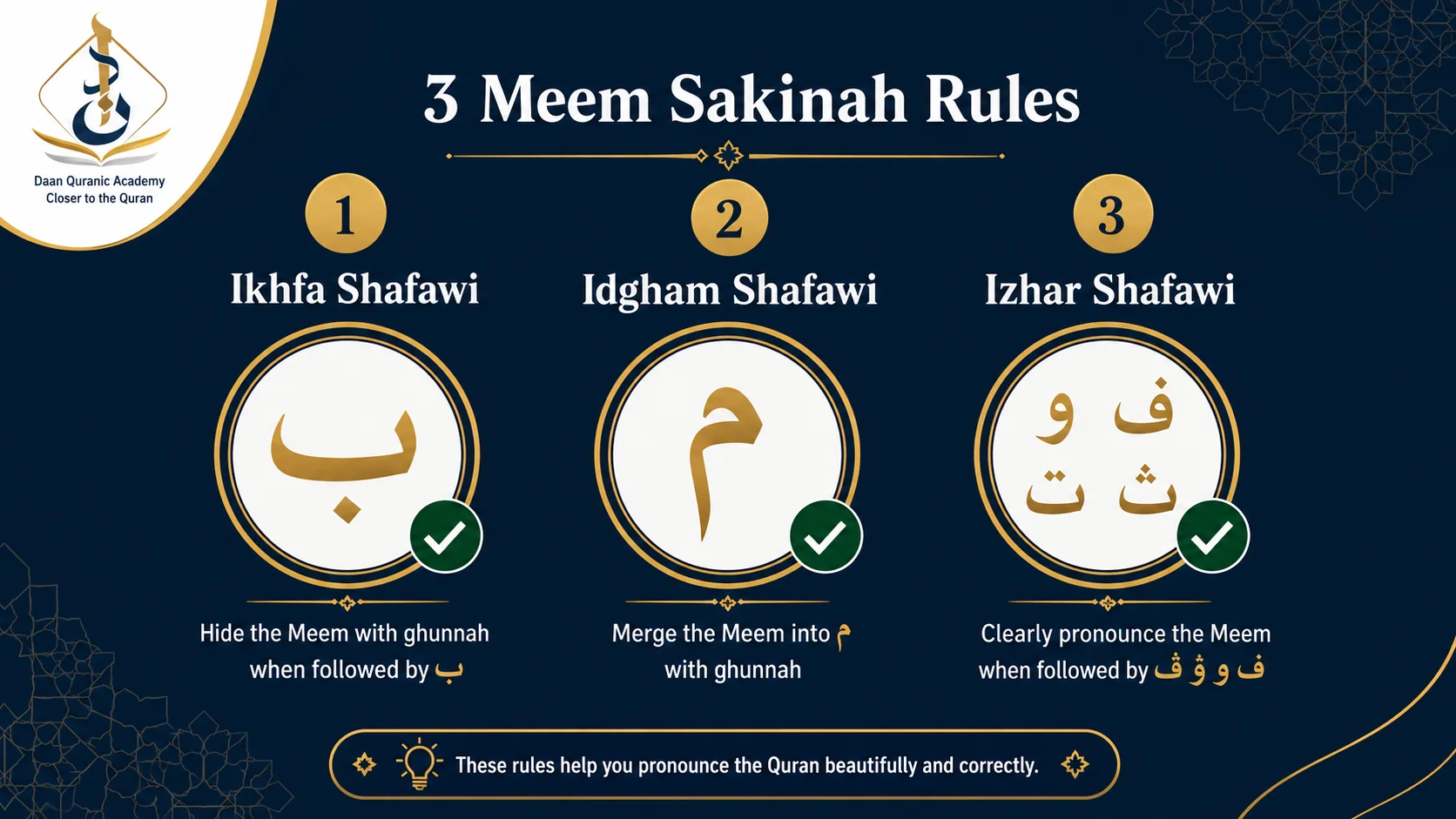
Every reciter runs into Meem Sakinah constantly — it shows up in verb endings, plural pronouns, and possessive suffixes throughout the Quran. Get the meem sakinah rules wrong, and a sound that should be gently hidden becomes clipped, or a sound that should be crisp gets swallowed into the next word. Get them right, and the recitation flows the way it was revealed.
Learning the meem sakinah rules is usually one of the first checkpoints inside a structured Tajweed Rules Mastery course, taught right alongside Noon Sakinah and Tanween. At Daan Quranic Academy, this topic is introduced in the earliest weeks of the curriculum, with a native Egyptian tutor listening and correcting in real time, live, on every single attempt.
Rule 1: Ikhfa Shafawi – Meem Saakin Tajweed Rules Before Ba
Ikhfa Shafawi is the meem saakin tajweed rule that applies only when a Meem Sakinah (مْ) is immediately followed by the letter Ba (ب). Rather than fully closing the lips (as in Idgham) or opening them clearly (as in Izhar), the reciter lightly conceals the Meem with a nasal ghunnah held for two counts, letting the sound melt gently into the Ba that follows.
Real session recording: A student receives live, real-time pronunciation correction while applying Tajweed rules with a certified tutor — the same kind of moment-by-moment feedback used to correct Ikhfa Shafawi and the other meem sakinah rules. All videos are real, unedited screen-recordings from actual student sessions at Daan Academy, posted with student consent.
The reasoning behind Ikhfa Shafawi is purely articulatory. Meem and Ba share the exact same makhraj — الشفتان, the two lips — so pressing them fully together would blur the two letters into one, while snapping them fully apart would sound harsh and disconnected. Ikhfa Shafawi is the middle ground the Prophet ﷺ himself recited with, and it is preserved in the recitation chains passed down ever since.
تَرْمِيهِم بِحِجَارَةٍ مِّن سِجِّيلٍ
“Striking them with stones of hard-baked clay.”
Notice how تَرْمِيهِم ends in a Meem Sakinah and بِحِجَارَةٍ begins with Ba — the lips barely touch as the ghunnah carries the sound smoothly across the word boundary. This exact pattern in the meem saakin tajweed rules repeats throughout the Quran, including in وَمَا صَاحِبُكُم بِمَجْنُونٍ (Surah At-Takwir, 81:22) and أَلَمْ يَعْلَم بِأَنَّ اللَّهَ يَرَىٰ (Surah Al-‘Alaq, 96:14).
Rule 2: Idgham Shafawi – When Two Meems Meet
Idgham Shafawi occurs when a Meem Sakinah (مْ) is followed directly by another Meem (م) — the two identical letters merge into one elongated nasal sound held for two counts. Because both letters share the same makhraj and the same sifah (characteristics), there is nothing left to conceal or clarify; they simply become one sound.
Scholars sometimes call this Idgham Mithlain Sagheer — “the merging of two identical small letters” — because a vowel-less Meem meets another Meem with no sound breaking them apart. Reciters hold the ghunnah noticeably longer here than in ordinary speech, and that deliberate elongation is one of the more distinctive sounds among the three meem sakinah rules.
A second example many students learn early is وَلَهُم مَّا يَشَاءُونَ عِندَ رَبِّهِمْ (Surah Ash-Shura, 42:22), where لَهُم carries the Meem Sakinah and مَّا supplies the second Meem. In the Uthmani script you’ll usually see a small shadda (ّ) written directly over the second Meem — a visual cue that Idgham Shafawi is required at that exact spot.
Rule 3: Izhar Shafawi – Meem Saakin Examples in Quran You Already Know
Izhar Shafawi applies whenever a Meem Sakinah (مْ) is followed by any Arabic letter other than Ba or Meem — all 26 remaining letters — and it requires the Meem to be pronounced clearly and crisply, with no nasal ghunnah at all. This is the default, most common outcome of the three meem sakinah rules, simply because most letters in the Arabic alphabet are neither Ba nor Meem.
Chances are you already recite a textbook Izhar Shafawi example every single day without realizing it.
أَنْعَمْتَ عَلَيْهِمْ غَيْرِ الْمَغْضُوبِ عَلَيْهِمْ
“…those You have blessed, not of those who have incurred [Your] wrath…”
In عَلَيْهِمْ غَيْرِ, the Meem Sakinah at the end of عَلَيْهِمْ meets the letter Ghain (غ) — not Ba, not Meem — so it stays fully open and clear, with no hidden nasal sound whatsoever. The same pattern appears in لَكُمْ دِينُكُمْ وَلِيَ دِينِ (Surah Al-Kafirun, 109:6), where the Meem Sakinah in لَكُمْ meets Dal (د). Because 26 of the Arabic alphabet’s 28 letters fall into this category, Izhar Shafawi is the rule you’ll lean on most often once you start applying the meem sakinah rules across the wider Quran.
Meem Sakinah Rules Chart: All 3 Rules Side by Side
Use this table as a quick reference whenever you’re unsure which of the three meem sakinah rules applies — just check the single letter that comes immediately after the Meem Sakinah.
| Rule | Trigger Letter | How It Sounds | Ghunnah | Quran Example |
|---|---|---|---|---|
| Ikhfa Shafawi | Ba (ب) only | Concealed, lips barely touch | 2 counts | تَرْمِيهِم بِحِجَارَةٍ — Al-Fil 105:4 |
| Idgham Shafawi | Meem (م) only | Fully merges into the next Meem | 2 counts | إِن كُنتُم مُّؤْمِنِينَ — Aal ‘Imran 3:139 |
| Izhar Shafawi | Any of the other 26 letters | Clear, crisp, no nasal sound | None | عَلَيْهِمْ غَيْرِ — Al-Fatiha 1:7 |
The Rules of Meem Sakinah With Example: Practice Drills for Mastery
Reading through the rules of meem sakinah with example verses is a solid start, but Tajweed is a spoken skill — it only becomes automatic through guided, corrected repetition. Here is the process a Daan Academy tutor typically walks a student through in a single practice session.
Identify Every Meem Sakinah
Read through the verse slowly and mark every مْ that carries a sukoon rather than a vowel. These are the only letters the meem sakinah rules apply to.
Check the Very Next Letter
Look only at the single Arabic letter that comes immediately after the Meem Sakinah — not the whole next word, just the first letter.
Apply the Correct Rule
Ba (ب) triggers Ikhfa Shafawi, Meem (م) triggers Idgham Shafawi, and any of the other 26 letters triggers Izhar Shafawi. There are no exceptions to memorize beyond these three.
Recite Out Loud and Get Corrected
Say the example aloud to a tutor who can hear whether your ghunnah duration and lip closure are accurate — this is the step self-study alone cannot replace.
Repeat With New Verses
Apply the same three-step check to a fresh page of Quran each week until spotting the correct rule becomes instinctive rather than a conscious calculation.
How to Choose the Best Online Tajweed Course in 2026 to Master Meem Saakin
The best online Tajweed course for learning the meem sakinah rules pairs a native Arabic-speaking tutor with one-on-one live correction, transparent pricing, and a structured curriculum — not a library of pre-recorded videos. Below are the four criteria worth checking before you commit to any academy in 2026.

Native Arabic-Speaking Tutors
Where many platforms rely on non-native instructors, look for tutors who grew up speaking Arabic and were formally trained in Quranic sciences. At Daan Academy, every tutor is a native Egyptian Arab, so the difference between a concealed Ikhfa Shafawi and a fully clear Izhar Shafawi is something they can demonstrate instantly, not just describe. You can review individual backgrounds on the tutors page.
Certified Ijazah Credentials
An Ijazah is a formal certification confirming a teacher’s recitation was verified, letter by letter, against an unbroken chain of transmission. Many tutors at Daan Academy hold Ijazah in multiple Qira’at with chains that trace back to the Prophet ﷺ — a credential worth asking about before you enrol anywhere.
One-on-One Live Correction, Not Group Classes
Unlike group classes that dilute individual attention across several students, one-on-one sessions mean a tutor hears every single attempt at the meem sakinah rules and corrects it before the mistake becomes a habit. Every class at Daan Academy is private and personalized.
Transparent, Affordable Pricing
Some platforms make pricing difficult to compare across plans. Daan Academy’s three tiers are clearly listed, starting from just $9/hr, so you know exactly what a course covering the meem sakinah rules and the rest of Tajweed will cost before you ever book a lesson.
Plans start from just $9/hr with native Egyptian tutors. Compare our three flexible pricing tiers — Essential, Pro, and Elite — each designed for different learning goals and budgets.
The safest way to judge fit before spending anything is a live trial lesson. Book a free trial session and ask the tutor to walk through a live Ikhfa Shafawi and Idgham Shafawi example on the spot — a genuinely qualified tutor should demonstrate both instantly, without hesitation.
Meem Sakinah Rules vs Noon Sakinah Rules: What’s the Difference?
Meem Sakinah rules cover three possible outcomes — Ikhfa, Idgham, and Izhar Shafawi — triggered by just two letters, Ba and Meem, while Noon Sakinah and Tanween rules cover four outcomes (Izhar, Idgham, Iqlab, and Ikhfa) triggered by a much wider group of letters. Students frequently mix up the two systems because several rule names overlap, but the trigger letters and the total number of outcomes are genuinely different.
- Meem Sakinah has 3 rules; Noon Sakinah and Tanween have 4 (they add Iqlab, which Meem Sakinah does not have).
- Meem Sakinah’s Ikhfa is triggered by exactly 1 letter (Ba); Noon Sakinah’s Ikhfa is triggered by 15 different letters.
- Meem Sakinah never converts into a different letter; Noon Sakinah converts into a Meem sound during Iqlab, before Ba.
- The word “Shafawi” (labial) marks the Meem Sakinah system specifically, since Meem and Ba are both pronounced with the lips.
If Noon Sakinah rules are tripping you up too, our companion guide on 5 common Tajweed mistakes non-Arabic speakers make covers the most frequent overlap errors between the two systems, and how to fix them.
Why Thousands of Students Trust Daan Academy to Learn Meem Saakin Rules
Daan Quranic Academy teaches the meem sakinah rules to students across the UK, USA, Europe, and beyond through native Egyptian tutors, many of them Ijazah-certified with verified chains of transmission. Every class is one-on-one, so a tutor catches a mispronounced Ikhfa Shafawi the moment it happens, rather than after a group lesson has already moved on to the next verse.
Families across more than 15 countries have used Daan Academy’s structured Tajweed curriculum to move from hesitant, halting Arabic to confident, correct recitation of the meem sakinah rules — often within a matter of weeks rather than years.
Progress isn’t left to guesswork either. The Daan LMS student dashboard logs every session, tracks which Tajweed rules a student has mastered, and issues a verified certificate at each course milestone, so parents and adult learners alike can see measurable progress on the meem sakinah rules and everything that comes after them. Younger students also get access to a library of 600+ educational games that turn Tajweed drills into something they actually look forward to.
For students who are still working through the alphabet before tackling rules like these, our guide to the Noorani Qaida from zero to mastery is the right place to start.
“Such a person as recites the Qur’an and masters it by heart will be with the noble, righteous scribes (in Heaven). And such a person who exerts himself to learn the Qur’an by heart, and recites it with great difficulty, will have a double reward.”
Narrated by Aisha (RA) — Sahih al-Bukhari 4937
Careful application of rules like Ikhfa Shafawi, Idgham Shafawi, and Izhar Shafawi is part of what this hadith calls being “skilled” with the Quran — and skill, in Tajweed as in anything else, is built through correction, not repetition alone.

Frequently Asked Questions
What are the 3 rules of meem saakin?
The three rules of meem saakin are Ikhfa Shafawi (concealed with ghunnah before Ba), Idgham Shafawi (merged with ghunnah into a following Meem), and Izhar Shafawi (pronounced clearly before all other letters). Which rule applies depends entirely on the single Arabic letter that comes right after the Meem Sakinah.
How much do online Tajweed classes cost at Daan Academy?
Daan Quranic Academy’s plans start from just $9/hr on the Essential tier, with Pro and Elite options for students who want additional features like a family discount. You can compare all three pricing plans before choosing one.
Can I try a Tajweed class before committing to a paid plan?
Yes. Every new student can book a free trial session with no commitment required, so you can see how a tutor teaches the meem sakinah rules live before paying for anything.
Are Daan Academy’s tutors qualified to teach Tajweed rules like Meem Sakinah?
All tutors are native Egyptian Arabic speakers formally trained in Quranic sciences, and many hold Ijazah certification in multiple Qira’at with verified chains of transmission. You can review individual tutor backgrounds on the tutors page.
Is it safe for my child to learn Tajweed online?
Every class is a private, one-on-one video session, never a group setting with strangers, and parents are welcome to sit in on any lesson. Sessions are scheduled at times you choose, and progress is visible in real time through the student dashboard.
How long does it take to master the meem sakinah rules?
Most students grasp the theory behind all three meem sakinah rules within one or two focused lessons, but consistent accuracy — applying Ikhfa Shafawi and Idgham Shafawi correctly without pausing to think — usually takes several weeks of guided practice with regular correction.
What age can a child start learning Tajweed rules like Meem Sakinah?
Children typically begin structured Tajweed rules, including meem sakinah rules, once they’re comfortable reading Noorani Qaida — often between ages 6 and 8, though this varies by child. A tutor can assess readiness during a free trial session.
Ready to Master the Meem Sakinah Rules With a Real Tutor?
Reading about Ikhfa Shafawi, Idgham Shafawi, and Izhar Shafawi is only the first step — real progress happens when a native Egyptian tutor corrects your recitation live, verse by verse.
No commitment required. One free session to experience the Daan Academy difference.
Final thoughts: The meem sakinah rules are a small piece of Tajweed with an outsized effect on how a recitation sounds — three rules, two trigger letters, and a lifetime of correct application ahead. Whether you’re revising alone with the reference table above or working weekly with a tutor, the goal stays the same: to recite the words of Allah exactly as they were revealed. We ask Allah to make this knowledge easy for you and to place barakah in every verse you recite. Explore more Tajweed and Quran-learning guides on our blog to keep building your recitation skills.