
📖 15 min read🎓 Beginners to Intermediate🌍 UK · USA · Europe · Australia
The rules of Noon Sakinah and Tanween in Tajweed are the four pronunciation laws — Izhar, Idgham, Iqlab, and Ikhfa — that govern how the “n” sound is recited whenever it appears as a still Noon (نْ) or as the double-vowel marks of Tanween. Get these four rules right and your recitation instantly sounds clearer, more connected, and closer to how the Prophet ﷺ and his Companions recited. Get them wrong, and even a fluent reader can distort the meaning of a word. Below you’ll find every rule explained in plain English, real Noon Sakinah examples from the Quran with full references, and honest guidance on how to find a tutor who can actually correct your recitation live — not just describe the rules to you.
📑 Table of Contents
- What Is Noon Sakinah in Tajweed?
- What Is Tanween in Tajweed?
- The 4 Rules (With Quran Examples)
- How to Choose the Best Course for These Rules
- Tajweed Course Pricing in 2026: What Should You Expect to Pay?
- Online vs In-Person: Where Are These Rules Taught Better?
- Why Native Egyptian Tutors Make These Rules Easier to Learn
- Common Mistakes Non-Arabic Speakers Make
- Frequently Asked Questions
What Is Noon Sakinah in Tajweed?
Noon Sakinah is a written letter Noon (ن) carrying a sukoon — meaning it has no vowel of its own and is pronounced as a plain, still “n” sound. You’ll see it marked with a small circle (ـْـ) above the letter. Because it has no vowel to anchor it, the way a Noon Sakinah is actually pronounced depends entirely on which letter comes right after it — and that dependency is exactly what the four Tajweed rules are built to explain.
This single letter appears constantly throughout the Quran, which is why mastering its rules changes your recitation more than almost any other Tajweed topic. Whether you’re a revert building your foundation, a parent choosing a program for your child, or an adult refining years of self-taught recitation, understanding Noon Sakinah is usually the first real milestone after finishing Noorani Qaida and moving into proper Quran reading.

What Is Tanween in Tajweed?
Tanween is a double vowel mark — fathatain (ـً), dammatain (ـٌ), or kasratain (ـٍ) — placed at the end of a word, and every one of these marks produces the exact same hidden “n” sound as a Noon Sakinah, even though no Noon letter is physically written. This is the detail that trips up most non-Arabic speakers: Tanween looks like “just a vowel,” but Tajweed treats it as a Noon in disguise.
Because Tanween and Noon Sakinah produce an identical sound, they are governed by the same four rules. Once a student truly understands what is Noon Sakinah and what is Tanween in Tajweed, applying the rules to either one becomes automatic rather than a memorized checklist. This is also where watching a real recitation correction helps far more than reading a definition — seeing exactly where a tutor pauses, merges, or nasalizes the sound makes the rule click in a way text never quite can.
Real session recording: A Daan Academy tutor guiding a student through live application of the Noon Sakinah rules during Quran recitation, correcting Ikhfa and Idgham in real time. All videos are real, unedited screen-recordings from actual student sessions at Daan Academy, posted with student consent.
The 4 Rules of Noon Sakinah and Tanween in Tajweed (With Quran Examples)
There are exactly four rules: Izhar, Idgham, Iqlab, and Ikhfa. Together they cover every letter of the Arabic alphabet with no gaps and no overlap, so once you learn all four, you have a complete, closed system — not a partial rule you’ll need to guess around later. Below are genuine Noon Saakin and Tanween examples in Quran recitation for each rule, with the exact Surah and Ayah so you can look them up and hear them recited on Quran.com.
1. Izhar (Clear Pronunciation)
Izhar means “clarity.” When a Noon Sakinah or Tanween is followed by one of the six throat letters — ء ه ع ح غ خ — it is pronounced clearly and fully, with no merging and no nasal hum. The sound simply comes out plainly, from its normal place of articulation.
إِنَّ الَّذِينَ آمَنُوا وَالَّذِينَ هَادُوا وَالنَّصَارَىٰ وَالصَّابِئِينَ مَنْ آمَنَ بِاللَّهِ وَالْيَوْمِ الْآخِرِ
“Indeed, those who believed and those who were Jews or Christians or Sabeans — whoever believed in Allah and the Last Day…”
Notice “مَنْ آمَنَ” (man aamana) — the Noon Sakinah is followed directly by a Hamza (ء), one of the six throat letters, so it is pronounced with full clarity. This is one of the most common Izhar patterns you’ll encounter as you build your reading fluency.
2. Idgham (Merging)
Idgham means “merging.” When Noon Sakinah or Tanween is followed by one of six letters — ي ر م ل و ن, remembered with the word “yarmalun” — the Noon sound merges into that letter instead of being pronounced on its own. There are two versions: Idgham with Ghunnah (nasal hum) before ي ن م و, and Idgham without Ghunnah before ل ر.
فَمَن يَعْمَلْ مِثْقَالَ ذَرَّةٍ خَيْرًا يَرَهُ
“So whoever does an atom’s weight of good will see it.”
فَأَمَّا الَّذِينَ آمَنُوا فَيَعْلَمُونَ أَنَّهُ الْحَقُّ مِن رَّبِّهِمْ
“As for those who believe, they know that it is the truth from their Lord.”
In “فَمَن يَعْمَلْ,” the Noon merges into the following Ya with a nasal hum (Idgham with Ghunnah). In “مِن رَّبِّهِمْ,” the Noon merges fully into the Ra with no nasal hum at all (Idgham without Ghunnah) — you’ll even see it written with a shaddah on the Ra in Tajweed-marked mus-hafs.
3. Iqlab (Conversion)
Iqlab means “to convert.” It is the simplest rule to spot because it applies to only one single letter: Baa (ب). Whenever Noon Sakinah or Tanween is followed by Baa, the Noon sound is converted into a light Meem sound, held with a Ghunnah of about two counts.
الَّذِينَ يَنقُضُونَ عَهْدَ اللَّهِ مِن بَعْدِ مِيثَاقِهِ
“…who break the covenant of Allah after contracting it…”
“مِن بَعْدِ” is one of the clearest Noon Saakin and Tanween examples in Quran recitation for practicing Iqlab, and it repeats often enough throughout the Quran that once you can hear it correctly here, you’ll start catching it everywhere.
4. Ikhfa (Concealment)
Ikhfa means “to hide.” When Noon Sakinah or Tanween is followed by any of the remaining fifteen letters (ت ث ج د ذ ز س ش ص ض ط ظ ف ق ك), the Noon sound is neither fully pronounced nor fully merged — it sits in a middle ground, partially concealed and held with a nasal hum whose weight shifts slightly depending on the letter that follows.
وَبَشِّرِ الَّذِينَ آمَنُوا وَعَمِلُوا الصَّالِحَاتِ أَنَّ لَهُمْ جَنَّاتٍ تَجْرِي مِن تَحْتِهَا الْأَنْهَارُ
“And give good tidings to those who believe and do righteous deeds that they will have gardens beneath which rivers flow.”
“مِن تَحْتِهَا” is a phrase repeated dozens of times across the Quran, which makes it one of the most useful Noon Sakinah examples for practicing Ikhfa specifically, since you’ll get near-daily repetition of the same sound pattern once you start reciting regularly.
| Rule | Trigger Letters | What Happens | Quran Example |
|---|---|---|---|
| Izhar (Clarity) | ء ه ع ح غ خ | Pronounced clearly, no merging | مَنْ آمَنَ (2:62) |
| Idgham with Ghunnah | ي ن م و | Merges with a nasal hum | فَمَن يَعْمَلْ (99:7) |
| Idgham without Ghunnah | ل ر | Merges fully, no hum | مِن رَّبِّهِمْ (2:26) |
| Iqlab (Conversion) | ب | Becomes a light Meem sound | مِن بَعْدِ (2:27) |
| Ikhfa (Concealment) | 15 remaining letters | Partially hidden, nasal hum | مِن تَحْتِهَا (2:25) |
“The best among you are those who learn the Qur’an and teach it.”
Narrated by Uthman ibn Affan — Sahih al-Bukhari, 5027
Learning to pronounce the Quran correctly isn’t a technicality reserved for scholars — it’s an act the Prophet ﷺ singled out for praise. That’s the spirit Daan Academy tries to bring to every Tajweed session: not rote rule memorization, but genuine, careful correction that helps you recite with confidence and precision.
How to Choose the Best Course for These Rules
The best course for learning the rules of Noon Sakinah and Tanween in Tajweed is one built around live, 1-on-1 correction from a certified native Arabic-speaking tutor — not pre-recorded lessons or group classes where mistakes go unheard. These rules are about sound, not just theory, and sound can only be corrected in real time.
Feature 01
What to Look For: Native, Certified Tutors
A tutor who grew up speaking Arabic hears the difference between a rushed Ikhfa and a proper one instinctively — a distinction that’s much harder for a non-native speaker to catch by ear. At Daan Quranic Academy, every tutor is a native Egyptian Arabic speaker, formally trained in Quranic sciences, and many hold certified Ijazah in multiple Qira’at with a traceable chain of narration back to the Prophet ﷺ.
Feature 02
What to Look For: True 1-on-1 Sessions
Unlike group classes that dilute a tutor’s attention across five or six students, a private session means the tutor hears every single Noon Sakinah you recite and can stop you the moment a rule slips. Every class at Daan Academy is a private, 1-on-1 session — never a group format.
Feature 03
What to Look For: Structured Progress Tracking
Where many platforms use generic curricula that never adapt to the individual student, look for a program that logs exactly which rules you’ve mastered and which still need work. Daan Academy’s Smart Student Dashboard gives students and parents detailed session reports and monthly progress updates, so improvement is visible, not just assumed.
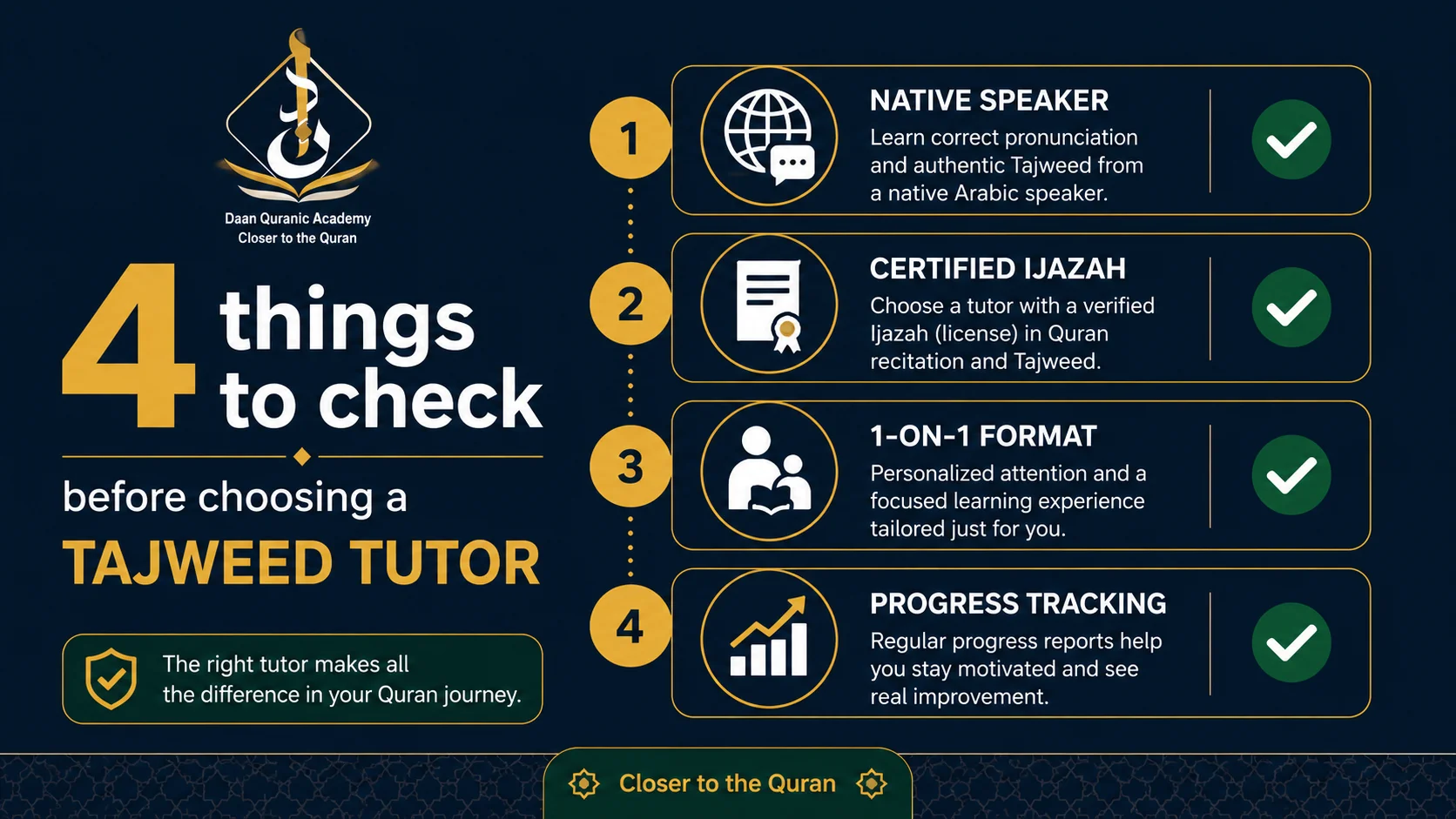
You can browse exactly how these rules fit into a full learning path on our Tajweed and Quran recitation courses page, which lays out the progression from Noorani Qaida through full Tajweed mastery.
Tajweed Course Pricing in 2026: What Should You Expect to Pay?
Quality online Tajweed instruction with a certified native tutor typically ranges from roughly $9 to $13 per hour in 2026, depending on the plan and how personalized the curriculum is. Some platforms hide their pricing behind a “book a call” wall — a transparent price list is one of the simplest ways to judge whether an academy respects your time.
Pricing Snapshot
Plans at Daan Academy start from just $9/hr with native Egyptian tutors. Compare our three flexible pricing tiers — Essential, Pro, and Elite — each designed for different learning goals and budgets.
| Plan | Price | Best For | Includes |
|---|---|---|---|
| Essential | $9/hr | Getting started with Tajweed basics | 1-on-1 sessions, Noon Sakinah & Tanween foundations, session reports |
| Pro | $10.99/hr | Steady, structured Tajweed progress | Everything in Essential + full Tajweed Rules Mastery track, LMS dashboard |
| Elite | $12.99/hr | Families & Hifz/Ijazah tracks | Everything in Pro + family discount, priority scheduling, Ijazah-track tutors |
Some providers charge more simply for a recognizable brand name without any real difference in tutor quality, while others cut price by skipping certification altogether. Where most academies force you to choose between affordability and credentials, Daan Academy’s pricing is built to give you both — and every plan includes a family discount option on Elite, plus a referral program where inviting a friend earns both of you a discount.
Online vs In-Person: Where Are These Rules Taught Better?
For Izhar, Idgham, Iqlab, and Ikhfa specifically, online 1-on-1 instruction with screen-sharing and recorded feedback often out-performs in-person group lessons. The tutor can isolate and repeat a single word as many times as needed, without a room full of other students waiting. Correcting a nasal hum or a merge sound is fundamentally an audio-correction task, and that transfers cleanly to a video call with good audio.
In-person classes still have real advantages — body language, in-room energy, and no dependence on a stable connection. But many families in the UK, USA, and across Europe simply don’t have a certified, native-speaking Tajweed teacher nearby. That’s exactly the gap online academies were built to close. Flexible scheduling means classes are available at any time, from anywhere in the world. A working parent in London or a student in Toronto can book a session that actually fits their week, instead of rearranging their life around one fixed class slot.
What matters more than the medium is whether the format still lets the tutor hear you clearly and correct you immediately — which is the standard every Daan Academy session is built around, whether the student is 7 years old or 70.
Why Native Egyptian Tutors Make the Rules of Noon Sakinah and Tanween in Tajweed Easier to Learn
Native Egyptian tutors make these rules easier to learn because Egypt has one of the world’s most established, continuous traditions of Quranic recitation instruction, rooted in institutions like Al-Azhar, and native speakers hear subtle pronunciation errors that non-native ears often miss entirely.
This is one of the areas where the difference between academies is genuinely stark. Where many platforms use non-native tutors reading from a script, Daan Academy’s tutors are all native Egyptian Arabs, formally trained in Quranic sciences and fluent in English. This eliminates the language barrier that so often leaves English-speaking students unsure whether they’ve actually understood a correction. You can review individual tutor backgrounds, Ijazah chains, and specializations on our Our Tutors page before ever booking a session.
Families across more than a dozen countries have used this exact model to move from hesitant, disconnected recitation to fluent, rule-correct reading — not because the rules themselves changed, but because someone who could actually hear the mistakes was correcting them in real time, session after session.
Common Mistakes Non-Arabic Speakers Make When Applying the Rules of Noon Sakinah and Tanween in Tajweed
The most common mistake is treating Tanween as “just a vowel” and skipping its hidden Noon sound entirely — but several other habits quietly undo months of practice if nobody corrects them early. Reviewing real Noon Saakin and Tanween examples in Quran recitation with a tutor is usually the fastest way to catch these before they become permanent habits.
- Skipping the hidden Noon sound in Tanween because it isn’t a written letter
- Rushing Ikhfa into a full Idgham merge instead of holding the partial, nasalized sound
- Cutting the Ghunnah short — it should be held for roughly two counts, not a quick tap
- Applying Iqlab to letters other than Baa out of habit or confusion with Ikhfa
- Missing the Izhar Mutlaq exception, where Noon and a Yarmalun letter fall inside the same single word and Izhar applies instead of Idgham
These aren’t rare beginner slips — they show up constantly in the most common Tajweed mistakes non-Arabic speakers make. Almost every one of them is caused by learning these four rules as definitions to memorize, rather than sounds to hear, apply, and have corrected live.
- Pick a Short Surah and Mark Every Noon Sakinah and Tanween Start with something like Surah Al-Ikhlas or the opening pages of Al-Baqarah. Go line by line and circle every Noon Sakinah and Tanween you find.
- Predict the Rule Before You Recite Look at the very next letter and decide — out loud, before you say the word — whether it calls for Izhar, Idgham, Iqlab, or Ikhfa.
- Record Yourself and Compare Record a short passage, then listen back specifically for Ghunnah length and merge clarity. Most learners are surprised by what they actually hear.
- Get Live Correction From a Certified Tutor Bring your recording — or better, recite live — to a qualified teacher who can confirm whether each rule was applied correctly and fix it on the spot.
If you’d like structured practice built around exactly this process, our full online Tajweed course guide walks through what a complete curriculum looks like from first lesson to fluency, and Wikipedia’s overview of Tajwid is a useful starting point if you want the broader historical and scholarly context behind these rules.

Frequently Asked Questions
How much do online Tajweed classes cost?
At Daan Academy, plans start from $9/hr on the Essential plan, with Pro at $10.99/hr and Elite at $12.99/hr. You can compare exactly what’s included in each tier on our pricing plans page. Is it safe for my child to learn Noon Sakinah and Tanween rules online?
Yes — every session is a private, 1-on-1 video call, never a group setting, and parents can review session reports and progress through the Smart Student Dashboard at any time. Dedicated support is available 24/7 for any technical or academic concern. Can I try a Tajweed class before committing to a plan?
Yes. Every new student can book a completely free trial session with no commitment required, so you can experience how a tutor corrects Noon Sakinah and Tanween rules live before choosing a plan. What’s included in the free trial session?
The free trial is a full 1-on-1 live session with a certified native Egyptian tutor, including a quick assessment of your current recitation level so your ongoing lessons can be tailored from day one. You can book it directly on our free trial page. How do I know if a Tajweed tutor is properly qualified?
Look for verified Ijazah certification, formal training in Quranic sciences, and native fluency in Arabic. Daan Academy’s tutors are all native Egyptian Arabs, and many hold Ijazah in multiple Qira’at with a documented chain of narration. How long does it take to master the rules of Noon Sakinah and Tanween in Tajweed?
Most students grasp the four rules conceptually within a few weeks, but comfortably applying them at natural reading speed usually takes a few months of consistent, corrected practice — which is why live 1-on-1 feedback matters more than the rules themselves. Do I need to already know Arabic to learn Tajweed rules online?
No. Every Daan Academy tutor is fluent in English, so beginners with no prior Arabic knowledge can start directly with Noorani Qaida and build up to Tajweed rules step by step, with every explanation given in clear English.
Take the Next Step
Ready to Actually Hear Your Noon Sakinah and Tanween Corrected?
Reading about these four rules only gets you so far — real progress happens when a certified tutor listens to you recite and corrects you on the spot. Book a free session and find out exactly where your recitation stands.
✓ 1-on-1 Live Tajweed Sessions✓ Native Egyptian Tutors✓ Certified Ijazah Holders✓ Flexible Scheduling✓ Smart Progress Dashboard✓ From $9/hr
No commitment required. One free session to experience the Daan Academy difference.
Final Thoughts
The rules of Noon Sakinah and Tanween in Tajweed aren’t a hurdle to memorize once and forget — they’re a lifelong habit that shapes how every Surah you ever recite actually sounds. Izhar, Idgham, Iqlab, and Ikhfa cover the entire alphabet between them, and once you can hear each one clearly, the Quran itself starts to feel more connected, more musical, and more meaningful to recite. Whether you learn through our blog’s guides first or jump straight into a live session, the goal is the same: reciting the words of Allah with the care and precision they deserve. We ask Allah to make this journey easy for you and to place barakah in every letter you recite correctly.
Continue Your Journey