
📖 12 min read🎓 All Levels — Kids & Adults🌍 UK · USA · Europe · Australia
The dua before leaving house is a short Prophetic supplication — “Bismillahi tawakkaltu ‘ala Allah, wa la hawla wa la quwwata illa billah” (“In the Name of Allah, I place my trust in Allah; there is no might and no power except with Allah”) — recited every time a Muslim steps out the front door. Paired with the dua for entering house, it turns two ordinary moments of the day into acts of worship. Below you’ll find the exact Arabic, transliteration, and English meaning of both duas, the authentic hadith behind them, and how to actually make them stick as a daily habit for yourself and your children — with the right tutor, the right method, and a little consistency.
📑 Table of Contents
- What Is the Dua Before Leaving the House?
- The Dua Before Leaving the House: Arabic, Transliteration & Meaning
- Dua Before Entering Home: What to Say at Your Doorstep
- Dua for Entering House vs Dua for Leaving House: What’s the Difference?
- Dua of Entering Home: The Meaning Behind Every Phrase
- How to Choose an Academy to Teach the Dua on Entering the House
- Is Learning Duas and Quran Online Affordable in 2026?
- Do You Need a Tutor to Learn the Dua Before Leaving House Correctly?
- Frequently Asked Questions
What Is the Dua Before Leaving the House?
The dua before leaving house is a one-sentence declaration of trust in Allah that the Prophet ﷺ taught his companions to say at the threshold, before stepping outside. It is short enough to memorize in one sitting, yet it carries a promise: according to authentic hadith, whoever recites it is described by the angels as guided, sufficed, and protected, and the shaytan is turned away from them for that outing.

This dua belongs to a wider category in Islam called adhkar al-yawm wa’l-layl — the remembrances of day and night — small, repeatable phrases that keep the heart connected to Allah through ordinary moments. Leaving the house is one of the most frequent transitions in a person’s day, which is exactly why the Prophet ﷺ attached a specific dua to it. For non-Arabic speakers, learning it correctly means getting three things right at once: the Arabic pronunciation, the meaning behind the words, and the habit of saying it every single time — which is where structured, one-on-one instruction makes the difference between memorizing a phrase and actually living it. You can explore how this fits into a broader curriculum on our Quran and Islamic Studies courses page.
The Dua Before Leaving the House: Arabic, Transliteration & Meaning
The exact wording of the dua before leaving the house is preserved word-for-word in the hadith of Anas ibn Malik, recorded in Sunan Abu Dawud and Jami’ at-Tirmidhi. Below is the full Arabic text, transliteration, and English translation, followed by the hadith itself.
“Whoever says — upon leaving his house — ‘Bismillahi tawakkaltu ‘ala Allah, wa la hawla wa la quwwata illa billah’ (In the Name of Allah, I place my trust in Allah; there is no might and no power except with Allah), it will be said to him: ‘You are guided, sufficed, and protected,’ and the shaytan will turn away from him.”
Narrated by Anas ibn Malik (may Allah be pleased with him) — Sunan Abu Dawud 5095 / Jami’ at-Tirmidhi 3426 (graded Hasan Sahih by At-Tirmidhi)
Real session recording: A qualified Daan Academy tutor walks an adult student through the source and wording of an authentic hadith, the same method used to teach short daily duas like the dua before leaving house. All videos are real, unedited screen-recordings from actual student sessions at Daan Academy, posted with student consent.
Notice how compact the Arabic is — five words carrying the entire creed of tawakkul (reliance on Allah). This is a good example of why **Tajweed and pronunciation matter even for short duas**: mispronouncing “hawla” or “quwwata” changes the sound of words that are meant to be recited with precision. At Daan Quranic Academy, this kind of correction happens in real time during 1-on-1 live sessions with native Egyptian tutors, rather than being left to guesswork from a transliteration alone.
Dua Before Entering Home: What to Say at Your Doorstep
The dua before entering home is a longer supplication asking Allah for “the best of entering and the best of exiting,” recited as you step through the door, and followed by greeting your family with salam. It is reported in Sunan Abu Dawud through Abu Malik al-Ash’ari.
“When a man enters his house, let him say: ‘Allahumma inni as’aluka khayral mawlaji wa khayral makhraji, bismillahi walajna, wa bismillahi kharajna, wa ‘ala Allahi rabbina tawakkalna’ (O Allah, I ask You for the best of entering and the best of exiting; in the Name of Allah we enter, and in the Name of Allah we exit, and upon Allah our Lord we place our trust) — then let him greet his family with salam.”
Reported via Abu Malik al-Ash’ari — Sunan Abu Dawud, Hadith 5096 (scholars differ on the strength of this chain; the underlying practice of saying Bismillah and salam on entering is well established from other authentic reports)
Because part of this hadith’s chain has been discussed by scholars of hadith science, it’s worth knowing that the two individual actions it describes — saying Bismillah on entering, and greeting your household with salam — are each independently confirmed by other authentic sources, including the Quran itself. That command is exactly where our next section picks up.
Dua for Entering House vs Dua for Leaving House: What’s the Difference?
The dua for entering house asks Allah for a good entrance and closes the day’s outing with the remembrance of family and salam, while the dua before leaving house opens the outing by placing full trust in Allah before facing the world. They are companion duas — one for departure, one for return.
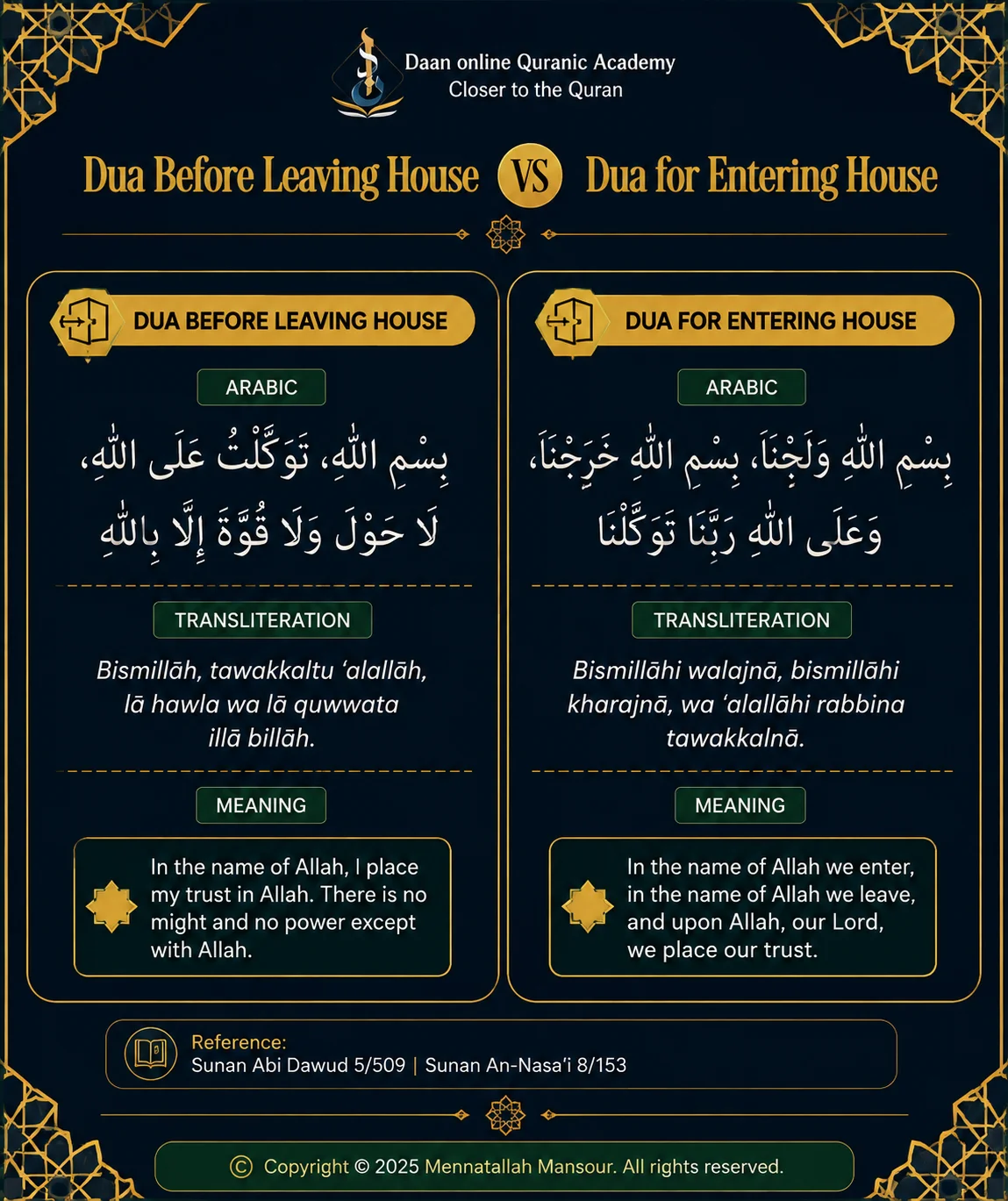
| Aspect | Dua Before Leaving House | Dua for Entering House |
|---|---|---|
| When to recite | At the doorstep, before stepping out | At the doorstep, right after stepping in |
| Core request | Trust in Allah for the journey ahead | Good in both the entering and the exiting |
| Primary source | Sunan Abu Dawud 5095 / Tirmidhi 3426 | Sunan Abu Dawud 5096 |
| Narrator | Anas ibn Malik (RA) | Abu Malik al-Ash’ari (RA) |
| Promised outcome | Guided, sufficed, protected; shaytan turns away | Barakah in the home; followed by greeting family with salam |
Where many people go wrong is treating these as interchangeable “house duas” and mixing up the wording. Learning them as a matched pair — with a tutor who can drill the Arabic until it’s automatic — is far more effective than trying to memorize both from a single web page. This is precisely the kind of structured, personalized learning plan our tutors build for students inside the Islamic Studies course, unlike generic curricula that lump dozens of duas together without any repetition strategy.
Dua of Entering Home: The Meaning Behind Every Phrase
The dua of entering home is built from just three root ideas — mawlaj (entrance), makhraj (exit), and tawakkul (trust) — repeated in a rhythm that’s designed to be memorized quickly. Breaking it down word by word makes it far easier to retain than memorizing it as a single unbroken string of sound.
Word 01
Mawlaj & Makhraj
These twin words come from the same Arabic root as “entering” and “exiting.” Asking for “khayral mawlaj wa khayral makhraj” is asking Allah to make good every entrance and exit in your life — not just this one.
Word 02
Walajna & Kharajna
These are the “we” forms of the same root — “we have entered” and “we have exited” — a small grammatical shift that turns the dua from a private request into a statement that includes your whole household.
Word 03
Tawakkalna
From the same root as tawakkul (trust/reliance), this is the closing declaration: “upon our Lord we have placed our trust.” It links the entering-house dua back to the same spirit as the leaving-house dua.
This kind of root-word breakdown is a core part of how Quranic Arabic is taught at Daan Academy — students don’t just memorize sounds, they learn the roots so that dozens of other duas and Quranic phrases start becoming recognizable on their own. If this kind of word-by-word Arabic study interests you, it’s worth reading our guide on 10 Arabic phrases every Muslim should know and their deep meanings.
How to Choose an Academy to Teach the Dua on Entering the House
The best way to properly learn the dua on entering the house — and dozens of other daily adhkar — is through a live, one-on-one tutor who can correct your pronunciation in real time, rather than a pre-recorded video or an app. Here’s what actually matters when comparing options.
- Native Arabic-speaking tutors Look for tutors who grew up speaking Arabic, not just studying it. At Daan Quranic Academy, every tutor is a native Egyptian Arab, formally trained in Quranic sciences, which means Makharij (correct letter pronunciation) is taught by ear, not by approximation.
- Certified Ijazah holders An Ijazah is a chain of certification tracing a tutor’s recitation authority back through generations of scholars, ultimately to the Prophet ﷺ. Many Daan Academy tutors hold Ijazah in multiple Qira’at, which is a meaningful marker of expertise most casual apps simply cannot offer.
- 1-on-1 sessions, not group classes Unlike group classes that dilute individual attention across a dozen students, Daan Academy runs every class as a private, 1-on-1 session — so a child who mispronounces “tawakkaltu” gets corrected immediately, not lost in the crowd.
- Transparent, tiered pricing Some platforms make it hard to know what you’re actually paying for. Daan Academy’s three plans are clearly listed starting from just $9/hr, with no hidden fees, on the Pricing Plans page.
- A free trial before you commit You should never have to pay before you know whether a tutor and your child (or you) are a good fit. A no-obligation free trial session lets you experience an actual lesson before deciding anything.
Built for Families Learning Together
Daan Academy currently serves families across 15+ countries, and every student — child or adult — gets access to the Smart Student Dashboard (Daan LMS), where progress on daily adhkar, Tajweed rules, and memorization is tracked session by session. For kids specifically, a library of 600+ educational games helps make repetition of short duas feel like play rather than homework.
The point of all this structure isn’t to make a simple dua complicated — it’s the opposite. A short phrase like the dua before entering home is easy to say incorrectly for years without anyone noticing, which is exactly the kind of small, fixable gap a good tutor closes in a single session.
Is Learning Duas and Quran Online Affordable in 2026?
Yes — online Quran and Islamic Studies education in 2026 is generally more affordable than hiring a local, in-person tutor, with quality live instruction available from as little as $9/hr. The key is understanding what’s actually included in the price.
Pricing Snapshot
Plans at Daan Quranic Academy start from just $9/hr with native Egyptian tutors. Compare our three flexible pricing tiers — Essential, Pro, and Elite — each designed for different learning goals and budgets, with a family discount available on the Elite plan.
Some platforms lack transparency on pricing, tacking on registration fees or bundling classes you don’t need. Daan Academy’s structure is straightforward: Essential from $9/hr, Pro at $10.99/hr, and Elite at $12.99/hr, each unlocking more features like verified completion certificates, priority scheduling, and family discounts. For a household wanting to teach children daily adhkar (like the dua before leaving house), the Essential plan alone is often enough to build the habit properly within a few weeks of consistent 1-on-1 sessions.
It’s also worth weighing cost against outcome rather than price alone. A cheaper option that leaves pronunciation uncorrected, or a free app with no live feedback, can end up costing more time in the long run than a modest hourly rate with a qualified, native-speaking tutor. You can browse the full breakdown of what’s covered in each tier, plus the referral program that gives both you and a friend a discount, on the Pricing Plans page.
Do You Need a Tutor to Learn the Dua Before Leaving House Correctly?
Technically no — but in practice, most non-Arabic speakers who try to learn the dua before leaving house from text alone end up mispronouncing at least one letter, most commonly the heavy “ha” in “hawla.” A tutor closes that gap in minutes.
This is really a question of self-teaching versus guided learning, and it applies to Tajweed rules just as much as it applies to a five-word dua. Reading a transliteration off a page tells you roughly what to say; it doesn’t tell you whether your tongue placement, vowel length, or emphasis is correct. Where most academies offer generic, pre-recorded content, Daan Academy builds a personalized learning plan around live correction — every session comes with automated smart notifications before class and a detailed progress report afterward, so nothing gets lost between lessons.
For families raising children in the UK, USA, or Europe — often without daily access to a mosque community that speaks Arabic — this kind of consistent, native-speaker correction is frequently the missing piece. It’s also why 24/7 dedicated support is built into every plan: questions about a word’s pronunciation, or a missed session, get resolved quickly rather than derailing the habit entirely. If you’d like to see how this fits into a fuller picture of what makes a strong academy, our Why Choose Us page breaks down tutor credentials in more depth, and our guide to the best Islamic Studies course online in 2026 covers how daily adhkar fit into a broader curriculum.

Frequently Asked Questions
What is the dua before leaving house?
It is “Bismillahi tawakkaltu ‘ala Allah, wa la hawla wa la quwwata illa billah” — “In the Name of Allah, I place my trust in Allah; there is no might and no power except with Allah,” recited when stepping out the door. It is reported from Anas ibn Malik in Sunan Abu Dawud 5095 and Jami’ at-Tirmidhi 3426. Is it necessary to recite the dua for entering house every single time?
It isn’t obligatory (fard), but it is a confirmed Sunnah practice the Prophet ﷺ encouraged. Saying it consistently — even just “Bismillah” when you forget the longer version — is what turns it into a lasting habit rather than an occasional one. How much do online Quran and Islamic Studies classes cost?
At Daan Quranic Academy, plans start from $9/hr for the Essential tier, up to $12.99/hr for Elite, which includes family discounts. Full details are on the Pricing Plans page. Is it safe for my child to learn duas and Quran online?
Yes — every class at Daan Academy is 1-on-1 with a formally trained, native Egyptian tutor, sessions are tracked through the Smart Student Dashboard, and parents can monitor progress reports at any time. There is no group chat or unsupervised contact involved. Can I try a class before committing to a plan?
Yes. Daan Academy offers a completely free, no-obligation trial session so you can experience a real lesson — including pronunciation correction on duas like the ones covered here — before paying anything. Book it on the Free Trial page. How do I know if the tutor teaching me is actually qualified?
Ask about their training and certification. Daan Academy tutors are native Egyptian Arabic speakers, many holding Ijazah in multiple Qira’at with verified chains, and all communicate fluently in English so nothing gets lost in translation. What’s the difference between the dua before leaving house and the dua of entering home?
The leaving dua is a declaration of trust in Allah before facing the outside world; the entering dua asks for goodness in both the entrance and exit, and is followed by greeting your family with salam. They are meant to be learned as a pair.
Take the Next Step
Learn the Dua Before Leaving House — and Every Daily Sunnah — the Right Way
A short dua is easy to mispronounce for years without knowing it. One live session with a native Egyptian tutor can fix that permanently, for you and your children.
✓ Native Egyptian Tutors✓ 1-on-1 Live Sessions✓ Ijazah-Certified Teachers✓ Flexible Scheduling✓ Smart Progress Tracking✓ From $9/hr
No commitment required. One free session to experience the Daan Academy difference.
Final Thoughts
The dua before leaving house and the dua for entering house are two of the smallest, most repeatable acts of worship in a Muslim’s day — and two of the easiest to get wrong when learned alone from a page. Said correctly and consistently, they turn a routine trip out the door and back into a quiet, ongoing conversation of trust with Allah. Whether you’re a revert building your daily adhkar from scratch, or a parent wanting your children to grow up saying these words without a second thought, structured, live guidance from a qualified native tutor is what makes the difference between memorizing a phrase and living it. Explore more guides like this one on our blog, and may Allah make every entrance and every exit of your home a source of goodness — Allahumma inni as’aluka khayral mawlaji wa khayral makhraj.
Continue Your Journey
- Best Islamic Studies Course Online in 2026 — Kids & Adults Guide
- 10 Arabic Phrases Every Muslim Should Know and Their Deep Meanings
- A Plan for Teaching Salah to Non-Arabic Speaking Children
Islamic Studies OnlineOnline Quran ClassesQuran for KidsQuran for AdultsQuran for RevertsArabic Online