Dua Before Eating & Duas After Eating: Complete Sunnah Guide (In English)
Duas after eating are short Sunnah words the Prophet Muhammad ﷺ taught Muslims to say once a meal is finished, thanking Allah for food and strength that came from Him alone. Paired with the dua before eating, these two habits turn an ordinary meal into a small act of worship — and at Daan Quranic Academy, native Egyptian tutors teach children and adults these everyday duas, correct pronunciation, and the wider adab of eating in live 1-on-1 online sessions, from just $9/hr.
📑 Table of Contents
- What Is the Dua Before Eating in Islam?
- Dua for Eating: The Full Prophetic Sunnah
- What to Look For When Teaching Duas After Eating to Your Family
- Dua Before and After Eating: Side-by-Side Comparison
- Dua Before Eating in English: Word-for-Word Meaning
- Duas After Eating: The Longer Sunnah That Forgives Past Sins
- How Much Does It Cost to Learn Everyday Duas Properly?
- Online vs In-Person: Where Should Duas After Eating Be Taught?
- What Do Muslims Say Before and After Eating?
- How Daan Quranic Academy Teaches Duas After Eating Worldwide
- Frequently Asked Questions
What Is the Dua Before Eating in Islam?
The dua before eating is simply the word “Bismillah” (بِسْمِ اللَّهِ), meaning “In the name of Allah,” said the instant a Muslim is about to take the first bite of food or the first sip of a drink. It is one of the shortest duas in the Sunnah, yet the Prophet ﷺ treated it as essential table manners, not an optional extra.

Learning dua before eating and its companion after-meal dua is usually one of the first things a child memorises, right alongside the Fatiha and the five daily prayers. It is also one of the first habits reverts are taught, because it is short, practical, and instantly changes how a meal feels. At Daan Quranic Academy, this kind of everyday dua is folded naturally into our Islamic Studies course, so children and new Muslims learn it with correct pronunciation from day one rather than picking it up secondhand.
What happens if the words are forgotten until halfway through the meal? The Prophet ﷺ gave a clear answer for exactly this situation, narrated by his wife Aisha (may Allah be pleased with her):
“When one of you eats, let him mention the name of Allah. If he forgets to mention the name of Allah at the beginning, let him say: ‘Bismillahi fi awwalihi wa akhirihi’ (In the name of Allah, at its beginning and its end).”
Narrated by Aisha (RA) — Sunan Abi Dawud 3767
Why Muslims Say Bismillah Before Every Meal
- It invites blessing (barakah) into the food, rather than treating the meal as a purely physical routine.
- It keeps Shaytan from sharing in the food, as explained in several authentic narrations about mealtime etiquette.
- It builds mindfulness and gratitude before the very first bite, instead of after the plate is already empty.
Because this single word carries so much weight in the Sunnah, many parents want more than a memorised sound — they want their child to actually understand what they are saying and why. That understanding is exactly what a live, native Arabic-speaking tutor can give in a way a printed worksheet cannot.
Dua for Eating: The Full Prophetic Sunnah
The full Sunnah for dua for eating goes beyond Bismillah — it includes eating with the right hand and eating from what is directly in front of you, exactly as the Prophet ﷺ taught a young companion in one of the most well-known hadiths on food etiquette. The companion in question, Umar ibn Abi Salamah, was just a boy at the time, and his own words paint the scene vividly.
Real session recording: A native Egyptian tutor walking an adult student through the fiqh of everyday worship, the same style of 1-on-1 teaching used to explain duas after eating, table manners, and daily Sunnah practices. All videos are real, unedited screen-recordings from actual student sessions at Daan Academy, posted with student consent.
Umar ibn Abi Salamah recalled: “I was a boy under the care of the Messenger of Allah ﷺ, and my hand used to wander about the dish. So he said to me: ‘O boy, mention the name of Allah, eat with your right hand, and eat from what is nearest to you.'” (Sahih al-Bukhari 5376). Three simple instructions from a single childhood memory — and Muslims have followed them at every meal since.
يَا أَيُّهَا الَّذِينَ آمَنُوا كُلُوا مِن طَيِّبَاتِ مَا رَزَقْنَاكُمْ وَاشْكُرُوا لِلَّهِ إِن كُنتُمْ إِيَّاهُ تَعْبُدُونَ
“O you who have believed, eat from the good things which We have provided for you and be grateful to Allah, if it is Him that you worship.”
This verse is the backdrop for every dua for eating a Muslim recites — gratitude is not a suggestion, it is directly tied to worship. That single idea is why Daan Academy tutors don’t just teach the words of the dua; they explain the verse behind it, so a child or new Muslim understands the “why,” not only the “what.”
What to Look For When Teaching Duas After Eating to Your Family
The most effective way to teach duas after eating is through a live tutor who models correct Arabic pronunciation, explains the meaning in fluent English, and repeats the habit at real meals — not a worksheet memorised once and forgotten. If you’re evaluating any Quran or Islamic Studies programme for this purpose, three things matter most.
Native Arabic Pronunciation
A dua is only as good as its pronunciation. Look for tutors who are native Arabic speakers, not just fluent readers — the difference shows up immediately in Makharij (letter articulation points). Every tutor at Daan Quranic Academy is a native Egyptian Arab, formally trained in Quranic sciences, so children hear the sounds correctly from the very first class.
Certified, English-Fluent Teachers
A tutor can be an excellent reciter and still struggle to explain a hadith’s meaning to a seven-year-old in London or a revert in Chicago. Daan Academy tutors are fluent in English and many hold Ijazah in multiple Qira’at with certified chains of transmission, so explanations land clearly in the student’s own language.
Genuinely 1-on-1 Sessions
Unlike group classes that dilute attention across many students, Daan Academy runs every class as a private, personalised session — so a tutor can pause, correct, and repeat a single dua as many times as one child needs, without thirty other students waiting their turn.
Model It Yourself First
Say the dua before eating out loud at your own table for a week before asking your child to join in — children copy what they hear repeated, not what they’re told once.
Start With the Short Version
Begin with just “Bismillah” before every meal until it’s automatic, then introduce the fuller “Bismillahi fi awwalihi wa akhirihi” for when it’s forgotten.
Add the After-Meal Dua Once the First Is Solid
Only once Bismillah is second nature should you layer in the longer duas after eating — trying to teach both at once often means neither sticks.
These are exactly the kind of small, practical habits our tutors reinforce week after week. You can see the full breakdown of what’s covered on our Why Choose Us page, including tutor credentials and teaching approach.
Dua Before and After Eating: Side-by-Side Comparison
Dua before and after eating are two separate Sunnah practices with different wording, different timing, and different rewards — the first invites blessing at the start of a meal, the second gives thanks and forgiveness once the meal is finished. Seeing them side by side makes the distinction, and the sequence, much easier to remember.
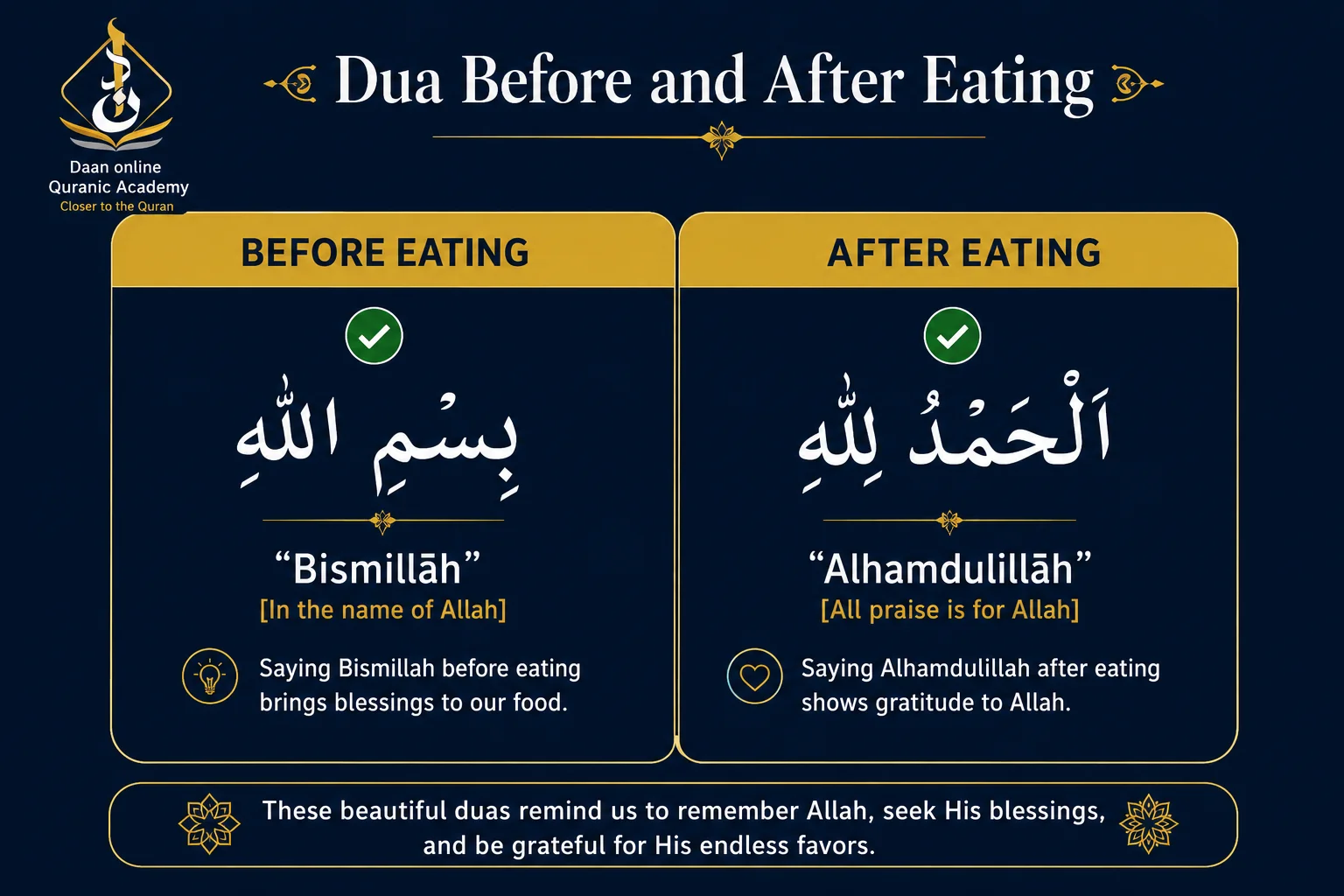
| Aspect | Dua Before Eating | Duas After Eating |
|---|---|---|
| When it’s said | At the very start of the meal, before the first bite | Once the meal is completely finished |
| Primary wording | Bismillah (بِسْمِ اللَّهِ) | Alhamdulillahil-ladhi at’amani hadha wa razaqanihi min ghayri hawlin minni wa la quwwah |
| If forgotten | Bismillahi fi awwalihi wa akhirihi | No “forgotten” version — it is only said once the meal has ended |
| Core benefit | Invites blessing and keeps Shaytan from sharing the food | Brings forgiveness of previous sins, per the hadith |
| Hadith reference | Sunan Abi Dawud 3767 (Aisha, RA) | Jami’ at-Tirmidhi 3458 / Sunan Ibn Majah 3285 (Mu’adh ibn Anas, RA) |
Notice that the two duas aren’t interchangeable — a family that only ever says Bismillah is still missing half of the Sunnah of the table. Building both into a daily routine, in the right order, is where a structured curriculum on our Islamic Studies and Quran courses makes the biggest difference over simply reading a list online.
Dua Before Eating in English: Word-for-Word Meaning
The dua before eating in English breaks down to just two words: “Bismillah” is a contraction of “Bi-ism” (in the name of) and “Allah” (Allah), together meaning “In the name of Allah.” Short as it is, understanding the grammar helps students appreciate why nothing needs to be added to it.
Word-for-Word Breakdown
- Bi (بِ) — “in” or “with,” a prefix attached to the next word.
- Ism (اسْم) — “name,” shortened here to “sm” when joined with “Bi.”
- Allah (اللَّهِ) — the proper name of God, used only for Him.
For English-speaking students, the hardest part usually isn’t the meaning — it’s pronouncing the letter “ismillah” cluster correctly, especially the soft “s” sound and the emphasis on “Allah.” This is a common stumbling block we cover in more depth in our guide to Arabic pronunciation challenges for English speakers. A tutor who can hear the difference in real time, live over video, catches these small slips long before they become a fixed habit.
Understanding the dua before eating in English is a natural stepping stone toward learning duas after eating too, since both use similar sentence patterns — praise (Alhamdulillah) followed by a description of what Allah has done. Once a student is comfortable with one pattern, the other becomes far easier to pick up.
Duas After Eating: The Longer Sunnah That Forgives Past Sins
The main duas after eating thank Allah for providing food “without any might or power” on the person’s own part, and according to an authentic hadith, reciting this specific wording after a meal brings forgiveness of previous sins. It is one of the few daily duas directly tied to that promise.
“Whoever eats food and then says: ‘Al-hamdu lillahil-ladhi at’amani hadha wa razaqanihi min ghayri hawlin minni wa la quwwatin’ (Praise be to Allah who has fed me this and provided it for me without any might or power on my part) — his previous sins will be forgiven.”
Narrated by Mu’adh ibn Anas (RA) — Jami’ at-Tirmidhi 3458
There is also a longer version, narrated by the companion Abu Umamah, that many families learn once the shorter dua is memorised: it praises Allah with “abundant, good, and blessed praise that is never sufficient, never abandoned, and never dispensed with” — a phrase reported in Sahih al-Bukhari describing what the Prophet ﷺ would say when he finished eating. Teaching a child both the short and long versions of duas after eating, and knowing when each is appropriate, is exactly the kind of nuance covered in our post on 15 meaningful Arabic phrases and Islamic sayings for everyday use.
Because this dua is tied so directly to forgiveness, many parents want their children to understand its meaning deeply, not just recite it by rote. A tutor who can pause mid-sentence and explain “min ghayri hawlin minni” — “without any strength of my own” — in plain English gives that meaning a chance to actually sink in.
How Much Does It Cost to Learn Everyday Duas Properly?
Learning duas after eating and other everyday Sunnah practices with a certified, native-speaking tutor costs as little as $9/hr at Daan Quranic Academy — often less than a single hour of in-person private tutoring in the UK, USA, or Europe. Cost is usually the first objection families raise, so it’s worth being transparent about it.
Plans start from just $9/hr with native Egyptian tutors. Compare our three flexible pricing tiers — Essential, Pro, and Elite — each designed for different learning goals and budgets, with a family discount available on the Elite plan.
What that price actually buys matters more than the number itself. It covers a genuinely 1-on-1 session, not a shared group slot, plus access to the Daan LMS student dashboard where parents can see session history, balance, and progress reports in one place. Kids’ lessons also draw from a library of 600+ educational games, which turns something as small as a dua into an interactive activity rather than a memorisation drill.
Where many platforms are vague about what’s included at each price point, Daan Academy’s three plans are listed clearly and openly, so a family can weigh options before ever booking a class.
Online vs In-Person: Where Should Duas After Eating Be Taught?
Online 1-on-1 sessions with a native Arabic tutor generally beat in-person group classes for teaching duas after eating, simply because pronunciation correction happens instantly and privately, without the scheduling and travel constraints of a physical class. That said, both formats have a place depending on a family’s situation.
In-person classes can offer a physical community and face-to-face bonding that online sessions can’t fully replace. But where most local options run as group classes with fixed weekly slots, online learning lets a family in Manchester or Melbourne book a session at 6 a.m. or 9 p.m., whenever it actually fits their routine — and reschedule without losing the week entirely. Where in-person tutors are limited to whoever is available nearby, an online academy can match a student with a tutor who specifically suits their level, age, and learning pace.
If safety is a concern for a child learning online, that’s a fair question to ask any provider directly. You can read more about our approach, tutor vetting, and teaching philosophy on the Why Choose Us page, and try a session yourself before deciding — the free trial session exists precisely so a family doesn’t have to commit before seeing how a class actually runs.
What Do Muslims Say Before and After Eating?
Before eating, Muslims say “Bismillah” (In the name of Allah); after eating, the most common dua is “Alhamdulillahil-ladhi at’amani hadha wa razaqanihi min ghayri hawlin minni wa la quwwah” (Praise be to Allah who fed me this and provided it without any power of my own). Together, these two short phrases frame the entire meal, from the first bite to the last, as an act of gratitude rather than routine.
Some households also add a simpler after-meal phrase — just “Alhamdulillah” (All praise is due to Allah) — which the Prophet ﷺ confirmed is sufficient on its own, even for a young child who hasn’t yet learned the longer wording. It’s a good starting point before working up to the fuller duas after eating described earlier in this guide.
How Daan Quranic Academy Teaches Duas After Eating Worldwide
Daan Quranic Academy has taught everyday Sunnah practices like duas after eating to families across 15+ countries, using native Egyptian, Al-Azhar-trained tutors who teach entirely in fluent English. Small daily habits like this are woven into our wider Islamic Studies curriculum rather than treated as an afterthought.
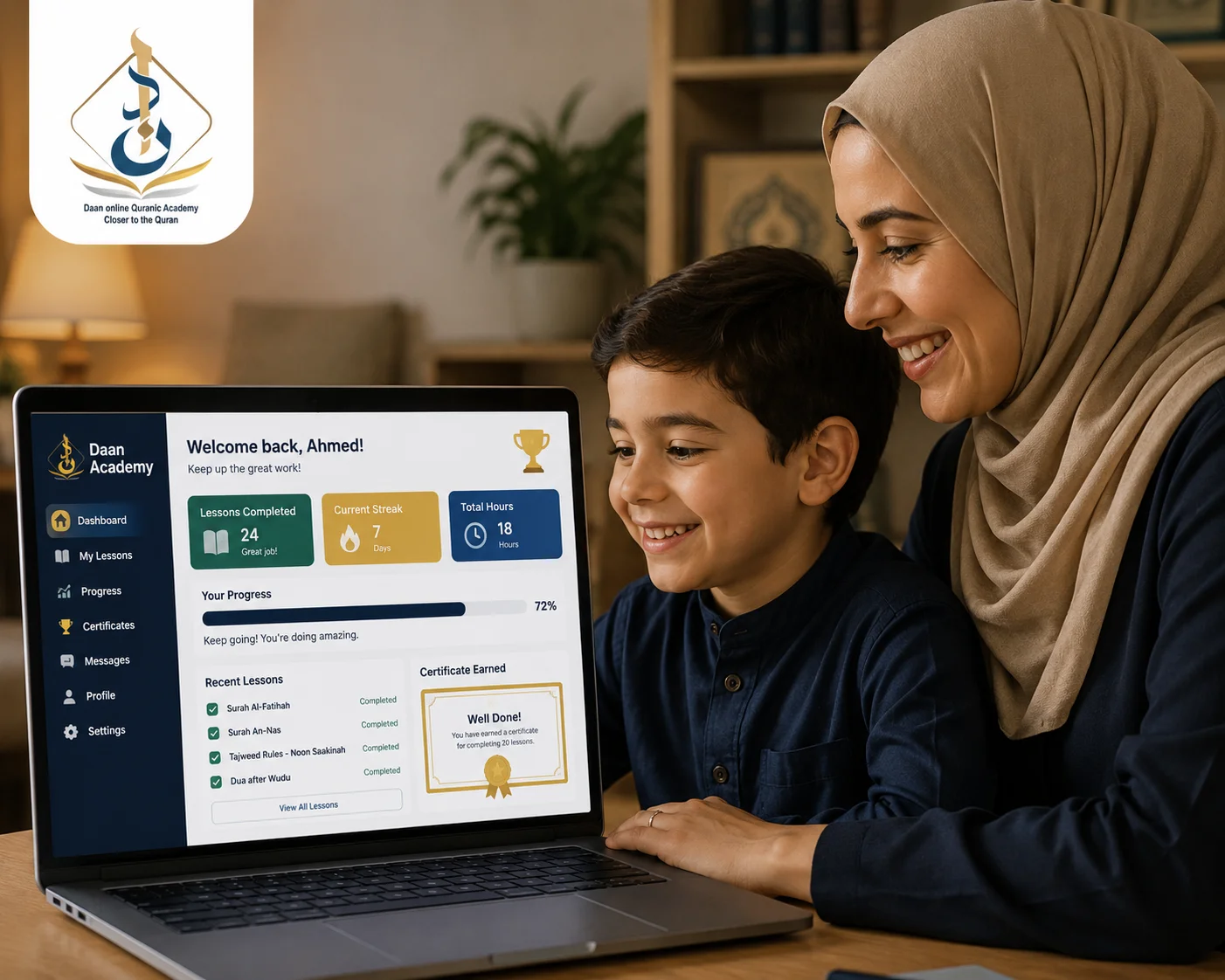
Every completed unit — including everyday duas — comes with a verified certificate, and smart notifications remind students before each session so nothing gets missed in a busy week. For families who want the fuller picture of what a structured Islamic Studies programme covers beyond duas, our guide to the best Islamic Studies course online in 2026 walks through the full curriculum. You can also browse more everyday guidance and Sunnah explainers on our blog.
Frequently Asked Questions
What is the dua before eating in English?
The dua before eating is “Bismillah,” meaning “In the name of Allah.” If you forget to say it before the first bite, you can say it as soon as you remember: “Bismillahi fi awwalihi wa akhirihi” — “In the name of Allah, at its beginning and its end.”
What do you say after finishing a meal in Islam?
The most common of the duas after eating is: “Alhamdulillahil-ladhi at’amani hadha wa razaqanihi min ghayri hawlin minni wa la quwwah” — “Praise be to Allah who fed me this and provided it for me without any power or strength on my part.” A simple “Alhamdulillah” is also acceptable.
Is it sinful to forget to say Bismillah before eating?
No. Forgetting is not sinful — the Sunnah simply provides an alternative dua to say the moment you remember, so the blessing of the meal isn’t lost.
Can I learn duas after eating online with a live tutor?
Yes. At Daan Quranic Academy, everyday duas, Tajweed, and Islamic Studies are all taught in live 1-on-1 sessions with native Egyptian tutors. You can explore the full curriculum on our courses page.
How much do online Quran and dua classes cost?
Plans start from $9/hr. Full pricing details for all three tiers — Essential, Pro, and Elite — are listed on our pricing plans page.
Is the free trial session really free, with no commitment?
Yes. The free trial lets you or your child experience a full live class with a native Egyptian tutor before deciding on a plan. You can book it directly on our free trial page.
Give Your Family a Real Foundation in the Sunnah of Eating
From the first “Bismillah” to the full duas after eating, these small daily habits are best learned live, from a tutor who can correct, explain, and repeat until it truly sticks.
No commitment required. One free session to experience the Daan Academy difference.
Every meal is a small opportunity to remember Allah — from the “Bismillah” said before the first bite to the words of praise said once the plate is empty. Learning duas after eating properly, alongside the dua before eating, is a habit worth building carefully and correctly, whether you’re a parent teaching a young child or an adult revert building these practices for the first time. May Allah make it easy for every family reading this in 2026 to bring these small Sunnahs into daily life, one meal at a time.