
Prophet Muhammad’s Daily Routine: Practical Sunnah Acts for Everyday Life
The most reliable way to bring sunnahs acts in daily life into your own routine is to follow Prophet Muhammad’s ﷺ actual habits — from the moment he woke until the moment he slept — as recorded in Sahih al-Bukhari, Sahih Muslim, and Sunan al-Tirmidhi. This guide walks through his real daily routine, verse by verse and hadith by hadith, and shows you how to rebuild the same rhythm in a modern Western week, whether you are a revert taking your first steps, a parent raising Quran-conscious kids, or a lifelong Muslim who wants to reconnect with the basics.
📑 Table of Contents
- What Are Sunnahs Acts in Daily Life? A Simple Definition
- The Prophet’s (SAW) Daily Routine: A Morning Built on Worship
- Building an Islamic Daily Routine: What to Look For
- Daily Life Sunnah of Prophet Muhammad: From Fajr to Midday
- Prophet Muhammad Daily Routine at Home: How He Treated His Family
- Sunnahs Acts in Daily Life for Children: Teaching Kids the Prophetic Routine
- Sunnahs Acts in Daily Life: Character, Speech, and Kindness
- Islamic Daily Routine and Structured Learning: Comparing Your Options
- People Also Ask: How Many Sunnahs Are There in a Day?
- Frequently Asked Questions
What Are Sunnahs Acts in Daily Life? A Simple Definition
Sunnahs acts in daily life are the small, verified habits of Prophet Muhammad ﷺ — how he woke, ate, worked, spoke, and slept — that Muslims practice today to bring their own day closer to his example. They are drawn from authentic hadith collections, not folklore or vague “Islamic lifestyle” advice, and they range from a two-second dua to how he treated the people inside his own home.
The reason Muslims anchor their daily habits to one man’s life 1,400 years later is stated plainly in the Quran itself. Allah describes His Messenger ﷺ as the standard against which a believer’s own conduct should be measured — not just in worship, but in the ordinary hours of an ordinary day.
لَّقَدْ كَانَ لَكُمْ فِي رَسُولِ اللَّهِ أُسْوَةٌ حَسَنَةٌ لِّمَن كَانَ يَرْجُو اللَّهَ وَالْيَوْمَ الْآخِرَ وَذَكَرَ اللَّهَ كَثِيرًا
“There has certainly been for you in the Messenger of Allah an excellent pattern for anyone whose hope is in Allah and the Last Day and who remembers Allah often.”
What makes this ayah so practical is that it does not say “in the Messenger’s worship” or “in the Messenger’s battles” — it says uswatun hasanah, an excellent pattern, full stop. Scholars across the centuries have read this as covering everything: how he negotiated, how he greeted a stranger, and how he spent the first ten minutes after opening his eyes. That last one is where most people find the easiest entry point, and it’s exactly where the next section starts. If you’d rather have someone walk you through the sources verse by verse, Daan Academy’s Islamic Studies course covers the Seerah and daily Sunnah as a structured curriculum rather than a scattered reading list.
The Prophet’s (SAW) Daily Routine: A Morning Built on Worship
The Prophet’s (SAW) daily routine began before dawn, with a short dua on waking, the tooth-stick, and Fajr prayer — long before any food, conversation, or work. Nothing in his morning was rushed past worship; worship was the thing the rest of the morning was built around.
The very first words out of his mouth on opening his eyes were not a complaint about the hour or a reach for a phone — they were gratitude. Hudhayfah ibn al-Yaman, one of his closest companions, reported this exact sequence, and it has survived almost word for word.
Real session recording: A student works through the sourcing and grading of a hadith with a certified tutor — the same standard of verification behind every hadith cited in this guide on the Islamic daily routine. All videos are real, unedited screen-recordings from actual student sessions at Daan Academy, posted with student consent.
“Whenever the Prophet ﷺ intended to go to bed, he would recite: ‘With Your name, O Allah, I die and I live.’ And when he woke up from his sleep, he would say: ‘All praise is for Allah who gave us life after having taken it from us, and unto Him is the resurrection.'”
Narrated by Hudhayfah — Sahih al-Bukhari, 6324
Only after that dua, and only after using the miswak (tooth-stick), did he step into the rest of his day — and even that step usually led straight to the mosque. This is the part of the Prophet’s (SAW) daily routine most reverts and busy professionals find hardest to adopt at first, simply because Fajr sits at an hour most modern schedules were never built around. The fix isn’t willpower alone; it’s structure. Families who follow a structured learning plan with a tutor tend to build the habit faster, because someone is checking in on the routine rather than leaving it to memory.
Building an Islamic Daily Routine: What to Look For
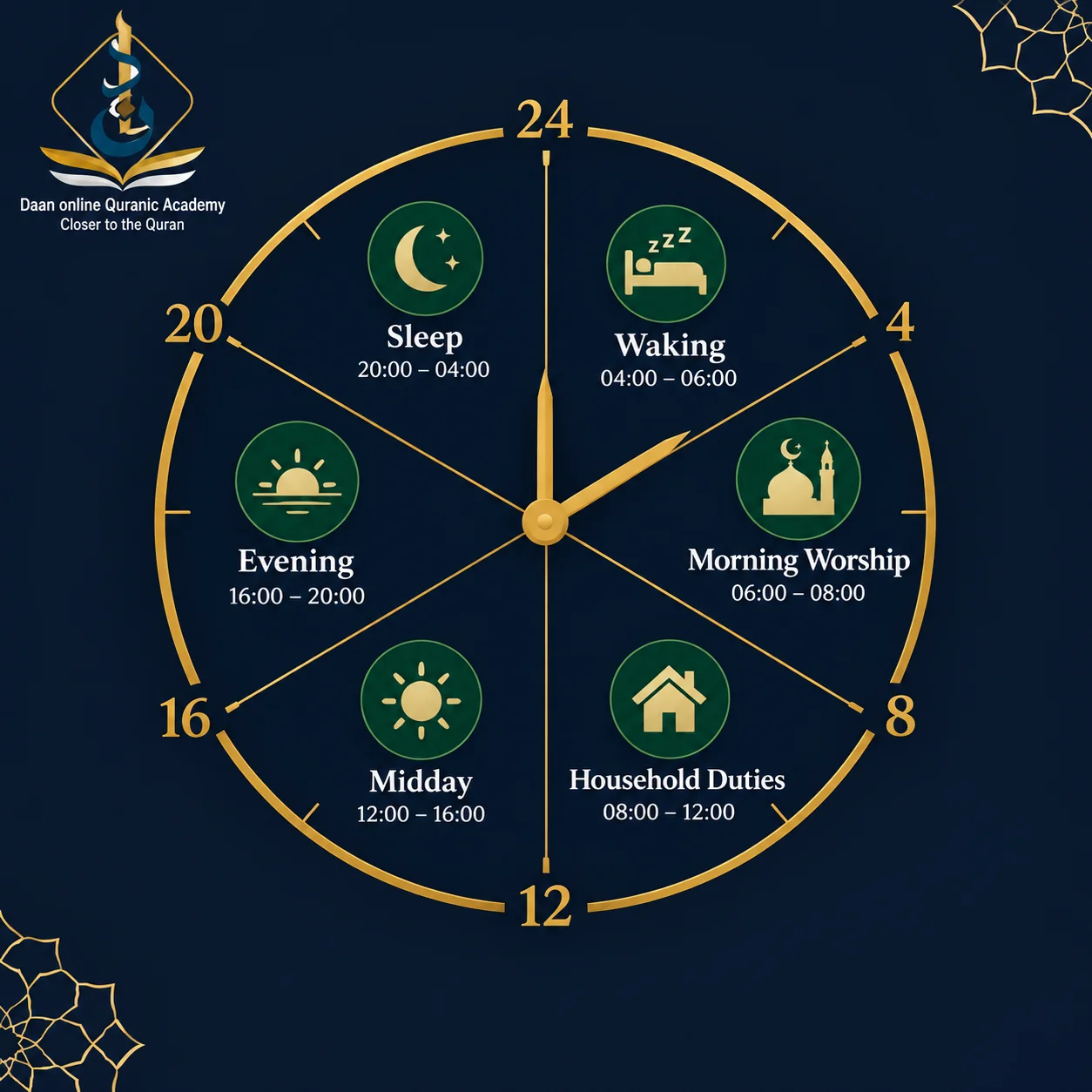
A workable Islamic daily routine is built one verified habit at a time, anchored to the five daily prayers, and checked by someone who can correct your mistakes — not copied wholesale from a list and abandoned after a week. Most people who try to overhaul their entire day in one go quit within a fortnight; the ones who stick with it add a single sunnah, hold it for two or three weeks, then add the next.
Anchor everything to the five prayers
Salah already breaks your day into five fixed points. Attach one new habit to each — the waking dua before Fajr, a few minutes of dhikr after Asr — instead of inventing a separate schedule from scratch.
Start with intention, not perfection
A short, sincere dua said imperfectly beats a long one memorized but never said. Begin with the version you can actually remember at 5 a.m.
Add one verified habit at a time
Pick a single authentic hadith-based act — the miswak, sleeping on the right side, saying salam first — and hold it for two to three weeks before adding another.
Learn the meaning behind the action
A habit sticks longer once you know why the Prophet ﷺ did it. This is where a short Islamic Studies or Quranic Arabic course pays off — the words stop being memorized sounds and start being understood language.
Have someone check your practice
Self-taught routines quietly drift over months. A native Egyptian tutor who reviews your recitation, dhikr, and understanding weekly catches mistakes before they become habits.
Daily Life Sunnah of Prophet Muhammad: From Fajr to Midday
The daily life sunnah of Prophet Muhammad between Fajr and midday centred on cleanliness, a light breakfast, and productive work — not a return to bed, and not idle scrolling through the day’s news, ancient or modern. After Fajr, he would often sit until sunrise engaged in remembrance, then move into the practical business of the day.
One habit that recurs across multiple authentic reports is his use of the siwak, a natural tooth-stick, which he treated almost as a reflex rather than an occasional grooming task.
“I asked Aisha: ‘What did the Prophet ﷺ use to start with when he entered his house?’ She said: ‘The tooth-stick.'”
Narrated by Shurayh ibn Hani — Sahih Muslim, 253
Notice what this hadith is really describing: not a single dramatic act of worship, but a small, repeated, almost invisible habit that Aisha only remembered because she was asked directly. That is the pattern behind most of the daily life sunnah of Prophet Muhammad — quiet consistency rather than occasional grand gestures. It’s also why so many people give up trying to learn it from scattered videos and short reels; the details live in full hadith collections, not sound-bites, and a native Egyptian tutor trained in these texts can walk you through the full chain and context in a single session rather than leaving you to piece it together yourself.
The Prophet ﷺ also set a clear standard for how much to eat during the day: “The son of Adam does not fill any vessel worse than his stomach. It is sufficient for him to eat a few bites to keep his back straight. If he must eat more, then a third for food, a third for drink, and a third for breath.” (Sunan al-Tirmidhi, 2380, graded Sahih). It’s one of the clearest daily-life sunnahs to apply immediately — no tutor required, just attention at your next meal.
Prophet Muhammad Daily Routine at Home: How He Treated His Family
The Prophet Muhammad daily routine at home involved him doing his own chores — mending his clothes, repairing his sandals, milking his own animal, and helping his family — right up until the call to prayer. This is one of the most repeated and well-documented details of his private life, narrated directly by Aisha, his wife.
“I asked Aisha what the Prophet ﷺ used to do at home. She said: ‘He used to keep himself busy serving his family, and when it was time for prayer, he would go out to pray.'”
Narrated by Al-Aswad — Sahih al-Bukhari, 676
There is no version of this hadith where the leader of a growing community expects to be waited on. He is described, in Aisha’s own words elsewhere, as “a man among men” who did what any man does in his own house. For English-speaking families trying to build an Islamic daily routine around dual careers, school runs, and long commutes, this detail matters more than it might first appear — it removes the excuse that “proper” religious practice requires servants, spare time, or a simpler century. He built it into an ordinary, busy life, which is exactly the life most students at Daan Quranic Academy are trying to organise their own routines around, across families in more than 15 countries.
Sunnahs Acts in Daily Life for Children: Teaching Kids the Prophetic Routine
Sunnahs acts in daily life for children work best when they’re taught as small, repeatable actions with a story attached — the dua before sleep, saying salam, eating with the right hand — rather than as a long list of rules. Children retain a habit far longer when they understand the “why” behind it in age-appropriate language, and when it’s reinforced consistently rather than mentioned once during Ramadan and forgotten by Shawwal.
This is exactly where a structured children’s program earns its place. At Daan Quranic Academy, young students learn the Prophet’s daily habits through 1-on-1 live sessions with a native Egyptian tutor, reinforced by a 600+ educational games library that turns a dua or a hadith into something a seven-year-old actually wants to repeat. Parents track exactly what was covered through the Smart Student Dashboard on the Daan LMS, so the Sunnah taught in class doesn’t stay locked inside the lesson — it comes home.
Consistency Over Intensity
A five-minute daily habit — reviewed weekly by a real tutor and tracked on a dashboard parents can actually see — outperforms a two-hour Sunday lecture nobody remembers by Wednesday. Every plan at Daan Academy, from Essential to Elite, is built around that principle rather than around cramming.
Reverts raising children without an extended family network nearby often feel this gap the most acutely — there’s no grandmother down the street modelling these habits daily. A dedicated tutor fills that role reliably, one session at a time, and every new family can test the fit with a free trial session before committing to anything.
Sunnahs Acts in Daily Life: Character, Speech, and Kindness
Sunnahs acts in daily life are not limited to prayer and prayer-adjacent rituals — a large portion of the Prophet’s ﷺ recorded conduct is about how he spoke to people, and even a smile was categorised as an act of charity. This is often the most overlooked category, because it can’t be checked off a list the way “prayed Fajr” can be.
Abu Dharr, one of the earliest converts to Islam, reported a long hadith listing everyday acts of charity that require no wealth at all: “Your smiling in the face of your brother is charity, commanding good and forbidding evil is charity, guiding a man lost on the road is charity for you.” (Sunan al-Tirmidhi, 1956, graded Sahih).
Read alongside the household chores hadith from the previous section, a clear picture forms: the daily-life Sunnah is less about visible ritual and more about how a person carries themselves through an ordinary Tuesday. Unlike programs that only teach recitation, a well-rounded Islamic Studies curriculum covers this character dimension explicitly, using Seerah and Hadith study side by side with Tajweed and memorisation — because reciting the Quran beautifully and living its instructions are meant to be the same project, not two separate ones.
For readers going deeper into the foundations this conduct rests on, our guide to the Five Pillars of Islam is a useful next stop.
Islamic Daily Routine and Structured Learning: Comparing Your Options
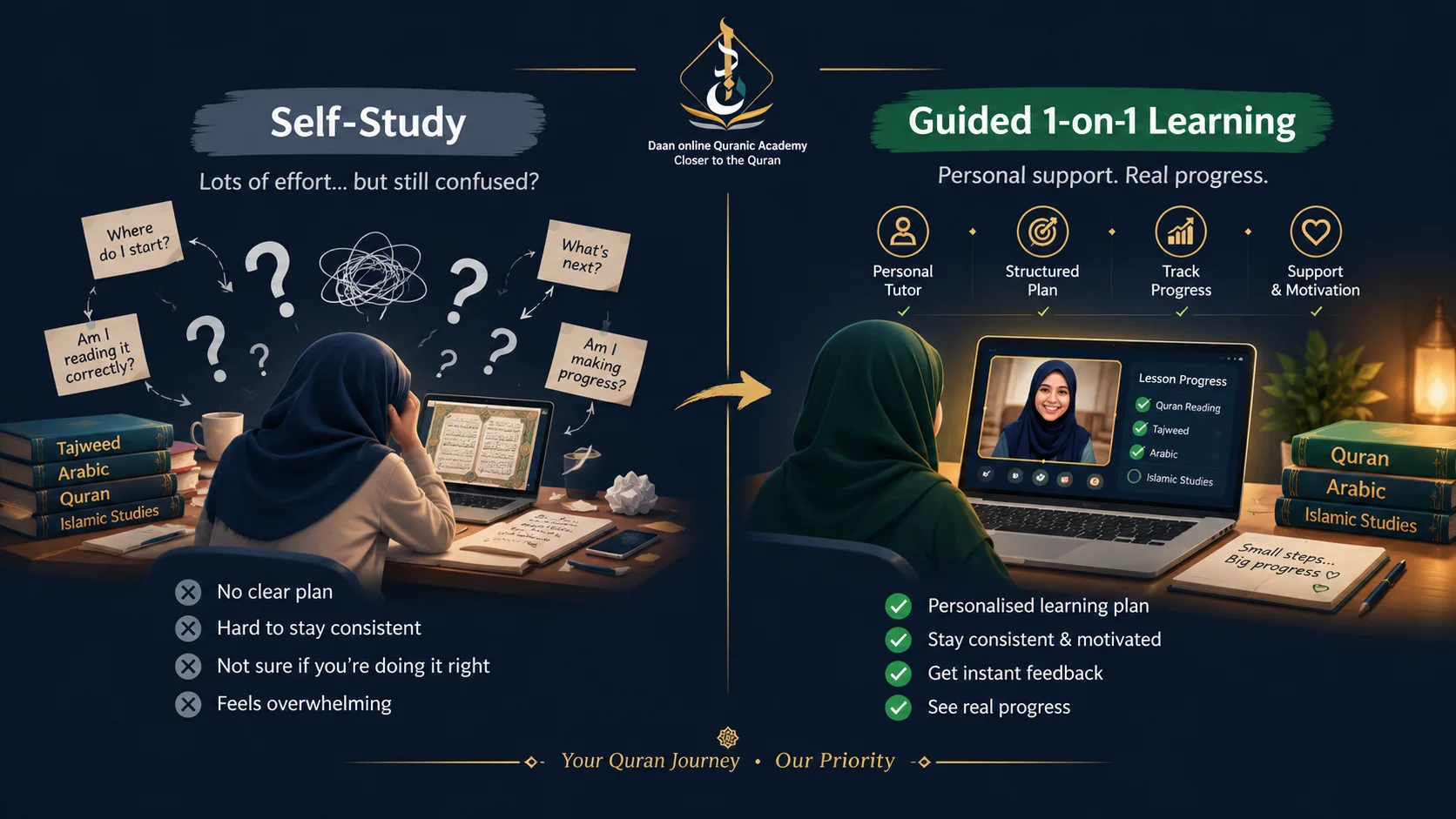
Building an Islamic daily routine from books and random videos is possible, but a guided 1-on-1 program with a certified tutor corrects mistakes in real time, tracks your progress, and keeps you accountable — three things self-study almost never provides. Where many platforms rely on pre-recorded content or group classes that dilute individual attention, Daan Academy’s model is built entirely around private sessions.
| What You Need | Self-Study (Books/Videos) | 1-on-1 Live Tutoring |
|---|---|---|
| Real-time correction | Not available | Every session |
| Native pronunciation model | Inconsistent | Native Egyptian tutors |
| Progress tracking | None | Smart Student Dashboard (Daan LMS) |
| Certification | None | Verified certificates per milestone |
| Accountability | Self-motivation only | Scheduled weekly sessions + reminders |
Some platforms lack transparency on pricing entirely — Daan’s three plans are clearly listed and start from just $9/hr, with Pro at $10.99/hr and Elite at $12.99/hr for families who want a discount across multiple children.
Plans start from just $9/hr with native Egyptian, Al-Azhar-trained tutors — many of them certified Ijazah holders with verified chains of transmission. Compare our three flexible pricing tiers — Essential, Pro, and Elite — each designed for different learning goals and budgets, with a family discount available on Elite.
Every tutor communicates in fluent English, so there’s no language barrier slowing down a lesson on Hadith terminology or Tajweed rules, and flexible scheduling means a session can happen before Fajr, during a lunch break, or after the kids are in bed — wherever the day actually allows. New families can see this in practice with a no-obligation free trial session before deciding on a plan.
People Also Ask: How Many Sunnahs Are There in a Day?
There is no single fixed number of daily sunnahs — scholars have compiled lists ranging from a dozen core habits to well over a hundred detailed acts — because the Sunnah covers an entire lived day, not a checklist with a finish line. What matters more than the total count is consistency with a manageable set you can actually sustain.
Most structured Islamic Studies courses, including the one taught at Daan Quranic Academy in 2026, group these into a handful of categories: waking and sleeping etiquette, purification and prayer, eating and drinking manners, speech and social conduct, and household duties. Learning them in categories, rather than as one long undifferentiated list, is what makes the daily life sunnah of Prophet Muhammad manageable for a beginner rather than overwhelming.
- Waking and sleeping: the dua on waking, sleeping on the right side, reciting before bed
- Purification: the miswak, wudu etiquette, cleanliness before prayer
- Eating and drinking: Bismillah, right hand, moderation, gratitude after
- Speech and character: salam first, smiling, honest speech, patience
- Household duties: serving family, punctuality to prayer, simple living

Frequently Asked Questions
How many sunnahs are there in a day for a Muslim to practice?
There’s no single official number — different scholarly compilations list anywhere from a dozen essential daily habits to well over a hundred detailed acts. Beginners are usually better served starting with five or six core habits covering waking, prayer, eating, and speech, then expanding gradually.
Can I learn the Prophet’s daily Sunnah through online classes?
Yes. Daan Academy’s Islamic Studies course covers Seerah, Hadith, and daily Sunnah practice in structured 1-on-1 sessions with native Egyptian tutors, so you’re learning from verified sources rather than piecing it together from short videos.
Is Daan Academy’s free trial really free, with no commitment?
Yes — the free trial session requires no payment details and no commitment. It’s a full 1-on-1 session so you can judge the tutor and teaching style before choosing a plan.
How much do online Quran and Sunnah classes cost?
Daan Academy’s plans start from $9/hr (Essential), with Pro at $10.99/hr and Elite at $12.99/hr, which adds a family discount for households enrolling more than one child. Full details are on the pricing plans page.
Are the tutors qualified to teach Hadith and Sunnah, not just recitation?
Yes — Daan’s tutors are native Egyptian Arabic speakers formally trained in Quranic sciences, and many hold Ijazah in multiple Qira’at with verified chains of transmission. You can read tutor backgrounds on the Our Tutors page.
Is it safe for my child to learn the Sunnah online?
Every class is private and 1-on-1, never group-based, with parents able to monitor sessions, progress reports, and session history through the Smart Student Dashboard at any time.
What’s included in a typical 1-on-1 session at Daan Academy?
A live video session with a native Egyptian tutor covering your chosen subject — Quran recitation, Tajweed, Hifz, Arabic, or Islamic Studies — followed by a written progress report on the Daan LMS and an automated reminder before your next session.
Turn Knowledge Into a Daily Habit
Reading about the Prophet’s daily routine is the first step — living it, correctly and consistently, is the part most people need real guidance for. A native Egyptian tutor can help you build these sunnahs acts in daily life one habit at a time, starting this week.
No commitment required. One free session to experience the Daan Academy difference.
Final Thoughts
The Prophet Muhammad daily routine was never meant to feel like a separate, extra layer bolted onto an already-full life — it was his ordinary life, prayer and chores and conversation all woven together with intention. Bringing sunnahs acts in daily life into your own week doesn’t require moving to a different century; it requires the same thing it required in 7th-century Madinah: consistency, sincerity, and someone who can show you the details correctly.
May Allah make it easy for all of us to live even a portion of this example well, and to raise children who carry it further than we did. Ameen.
Explore more guides like this one on the Daan Academy blog.