Prophet Yunus and the Whale Story in the Quran: Trials, Dua, and Forgiveness
The Prophet Yunus and the whale story is one of the Quran’s most moving lessons on repentance: a prophet who left his mission, was swallowed by a great fish, and was rescued by a single dua. Understanding it properly means reading the verses in Arabic, with accurate meaning and a teacher who can explain the context.
This guide walks through the Prophet Yunus and the whale story step by step, explains where he appears in the Quran, and teaches his famous dua. It also shows what to look for in a tutor if you or your child want to study Quranic stories in 2026, and how our Quran and Arabic courses at Daan Quranic Academy make that simple.
Key Takeaways
- The story: Yunus left his people in frustration, was swallowed by a great fish at sea, and was saved after calling on Allah in sincere repentance. It unfolds in six stages: the mission, the departure, the ship, the fish, the dua, and the return.
- Where he appears: The story appears mainly in Surah As-Saffat (37:139–148) and Surah Al-Anbiya (21:87–88). His people are mentioned in Surah Yunus (10:98), and the title “companion of the whale” appears in Surah Al-Qalam (68:48).
- The dua: “La ilaha illa Anta, subhanaka, inni kuntu minaz-zalimin” (Al-Anbiya 21:87) combines affirming Allah’s oneness, declaring His perfection, and admitting one’s own mistake. Allah answered him in the next verse (21:88).
- Hadith: The Prophet ﷺ taught that no Muslim ever supplicates with this dua for anything except that Allah answers him (Jami’ at-Tirmidhi, 3505, narrated by Sa’d ibn Abi Waqqas).
- The return and lessons: Yunus was cast onto a barren shore, was sent again to his people, and they believed, so Allah lifted the punishment (10:98). The main lessons are patience, sincere repentance, and trust that Allah answers those who turn to Him.
📑 Table of Contents
- Prophet Yunus and the Whale Story: What the Quran Says
- The Story of Yunus in Quran: A Step-by-Step Timeline
- Prophet Yunus Dua: Arabic, Meaning, and Hadith
- How to Study Quran Stories Online: What to Look For in 2026
- Lessons from the Prophet Yunus and the Whale Story for Families
- What Learning the Prophet Yunus and the Whale Story Costs
- Why Families Choose Daan Quranic Academy
- Frequently Asked Questions
Prophet Yunus and the Whale Story: What the Quran Says
The Prophet Yunus and the whale story tells of a messenger who left his people in frustration, was swallowed by a great fish at sea, and was saved after calling on Allah in sincere repentance. The Quran gives the core events in a few short passages, and each word carries a lesson. Classical commentators then add context that helps readers follow the sequence.

Yunus (peace be upon him) is a real prophet named in the Quran, and the story is not a fable. Allah calls him Dhun-Nun (“the man of the fish”) and Sahib al-Hut (“the companion of the whale”). Both titles point to the same event, and both are used with respect. For historical background you can also read the overview of Jonah in Islam on Wikipedia, though the Quran itself remains the primary source.
Prophet Yunus in Quran: Where He Appears
Prophet Yunus in Quran is mentioned by name in four places and referred to by title in two more. The verses are spread across several surahs, which is why many readers only know fragments of the story. Seeing them together gives the full picture.
| Surah | Reference | What it teaches |
|---|---|---|
| An-Nisa | 4:163 | Yunus is listed among the prophets who received revelation |
| Al-An’am | 6:86 | Allah favored him above the nations of his time |
| Yunus | 10:98 | His people believed, and the punishment was lifted |
| Al-Anbiya | 21:87–88 | His dua in the darkness and Allah’s answer |
| As-Saffat | 37:139–148 | The ship, the fish, the shore, and his return |
| Al-Qalam | 68:48–50 | A reminder to the Prophet Muhammad ﷺ to be patient |
Surah Yunus (the tenth surah) is named after him, even though it names him in only one verse. That naming tells us the lesson of hope is central. If you want to see how Quranic stories are taught alongside recitation, explore more guides on our blog.
The Story of Yunus in Quran: A Step-by-Step Timeline
The story of Yunus in Quran unfolds in six stages: the mission, the departure, the ship, the fish, the dua, and the return. The Quran states the main events, while tafsir (commentary) adds names and places, such as the city of Nineveh, so we separate the two below. Watching a tutor explain this sequence aloud makes it far easier to remember.
Real session recording: An adult learner studying Tafseer with a native Arab tutor, the same kind of one-on-one explanation used when teaching the story of Yunus in Quran. All videos are real, unedited screen-recordings from actual student sessions at Daan Academy, posted with student consent.
The Mission
Allah sent Yunus to a very large community. The Quran says he was sent “to a hundred thousand or more” (37:147). Tafsir scholars identify the city as Nineveh, in present-day Iraq.
The Departure
When his people did not respond, Yunus left “in anger” (21:87) before receiving permission to depart. He believed Allah would not restrict him, which scholars explain as a lapse in patience rather than a lack of faith.
The Ship
He boarded a loaded ship. In Surah As-Saffat, lots were cast and he was among those who lost (37:141), and he was thrown into the sea.
The Fish
A great fish swallowed him, and he was held in what the Quran calls “darknesses” (21:87). Commentators describe three layers: the night, the sea, and the belly of the fish.
The Dua
From inside the darkness he called out with a sentence of tawhid, praise, and humble confession. Allah answered him and rescued him from distress.
The Return
Yunus was cast onto a barren shore, weak and sick, and Allah caused a plant of the gourd family to grow over him (37:145–146). He was sent again to his people, and they believed.
The last stage is the part many readers forget. Allah tells us that the people of Yunus believed together, and He lifted the punishment from them.
فَلَوْلَا كَانَتْ قَرْيَةٌ آمَنَتْ فَنَفَعَهَا إِيمَانُهَا إِلَّا قَوْمَ يُونُسَ لَمَّا آمَنُوا كَشَفْنَا عَنْهُمْ عَذَابَ الْخِزْيِ فِي الْحَيَاةِ الدُّنْيَا وَمَتَّعْنَاهُمْ إِلَىٰ حِينٍ
“Was there ever a town that believed and benefited from its faith, except the people of Yunus? When they believed, We removed from them the punishment of disgrace in worldly life and let them enjoy life for a time.”
Prophet Yunus Dua: Arabic, Meaning, and Hadith
The Prophet Yunus dua is the supplication he made inside the whale: “La ilaha illa Anta, subhanaka, inni kuntu minaz-zalimin.” It means “There is no god but You, glory be to You, indeed I was among the wrongdoers.” It combines three things in one breath: affirming Allah’s oneness, declaring His perfection, and admitting one’s own mistake.
وَذَا النُّونِ إِذ ذَّهَبَ مُغَاضِبًا فَظَنَّ أَن لَّن نَّقْدِرَ عَلَيْهِ فَنَادَىٰ فِي الظُّلُمَاتِ أَن لَّا إِلَٰهَ إِلَّا أَنتَ سُبْحَانَكَ إِنِّي كُنتُ مِنَ الظَّالِمِينَ
“And remember the man of the whale, when he went off in anger and thought We would not constrain him. Then he called out in the depths of darkness: ‘There is no god but You, glory be to You! Truly, I have been among the wrongdoers.'”
Allah answers immediately in the next verse: “So We responded to him and saved him from distress, and thus We save the believers” (21:88). That final phrase makes the dua an open invitation, not a one-time miracle. The Prophet ﷺ confirmed this in a hadith recorded by at-Tirmidhi.
“The supplication of Dhun-Nun, when he called upon his Lord while in the belly of the whale: ‘There is no god but You, glory be to You, indeed I have been among the wrongdoers.’ No Muslim ever supplicates with it for anything, except that Allah answers him.”
Narrated by Sa’d ibn Abi Waqqas — Jami’ at-Tirmidhi, 3505
The dua is short, but its Arabic needs careful pronunciation. Letters like dhal in “Dhun-Nun”, the heavy zaa in “az-zalimin”, and the long madd in “Subhanaka” are where English speakers most often slip. A teacher who corrects these in real time will help you recite it correctly and with confidence. Our guide to the common Tajweed mistakes non-Arabic speakers make covers these errors in detail.
Break the dua into three parts: “La ilaha illa Anta”, “Subhanaka”, and “Inni kuntu minaz-zalimin”. Recite each part slowly ten times, then join them. A short practice with a tutor will catch pronunciation errors before they become habits.
How to Study Quran Stories Online: What to Look For in 2026
The best way to study Quranic stories online is with a certified tutor who teaches the Arabic text, the meaning, and the lessons together. The prophet Yunus whale story in Quran, for example, is spread across several surahs, so a good teacher has to connect verses from several surahs without adding anything the sources do not support. Here is what to look for when comparing options.
What to Look For: Native Arabic and Fluent English
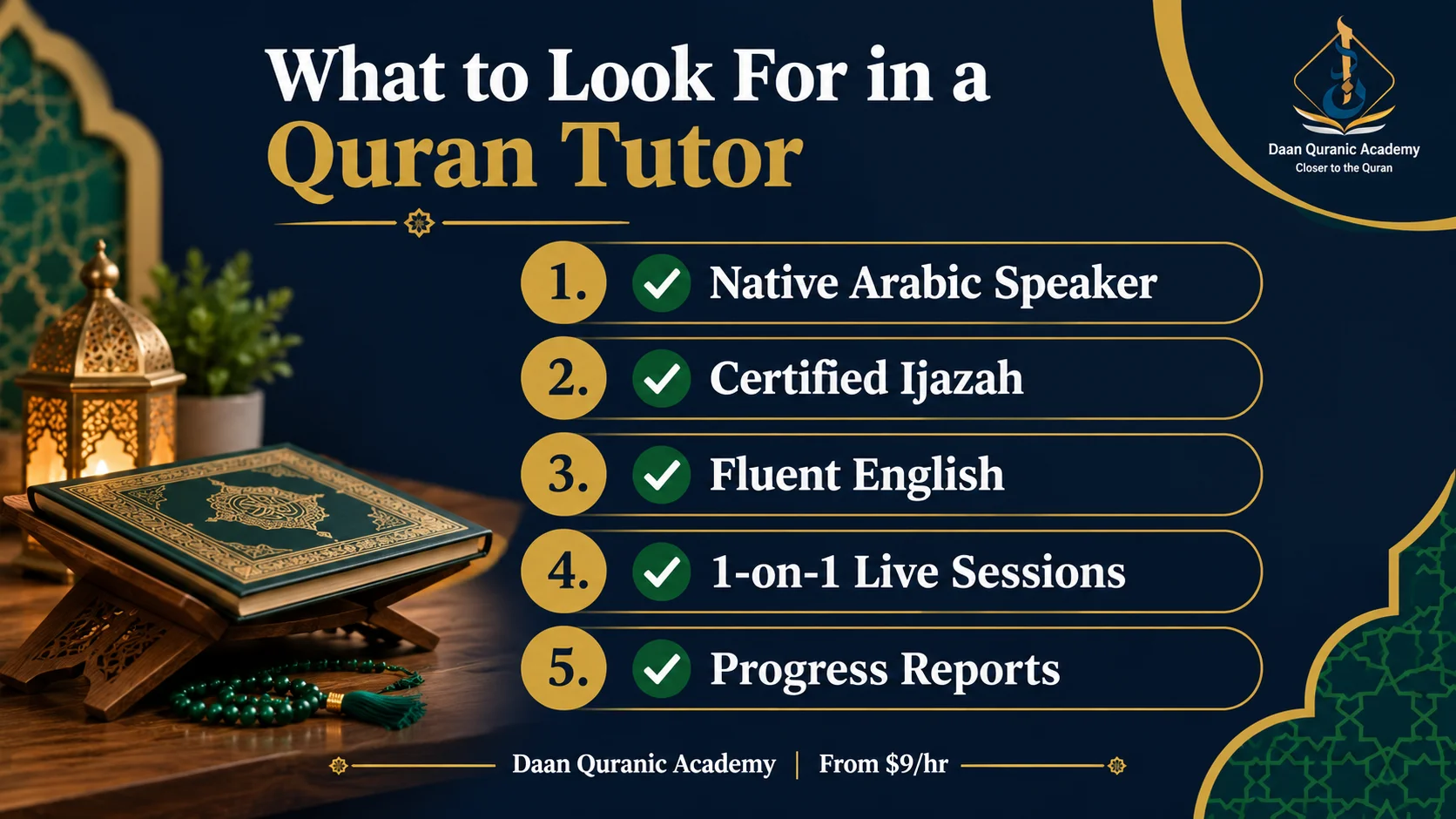
Many platforms use non-native speakers, which can affect both pronunciation and the explanation of meaning. At Daan Quranic Academy, every tutor is a native Arabic speaker from Egypt, formally trained in Quranic sciences, and speaks fluent English, so there is no language barrier. You can meet the team on our tutors page.
What to Look For: Verified Ijazah and a Chain of Transmission
Look for tutors who can show an Ijazah, which is a certified chain of recitation reaching back to the Prophet ﷺ. Many of our tutors hold Ijazah in multiple Qira’at. This matters when reciting the dua of Yunus, because the Arabic must be exactly right.
What to Look For: One-on-One Attention and Visible Progress
Unlike group classes that dilute attention, every Daan session is private and personalized. Students track sessions, balance, and progress reports through the Daan LMS dashboard, and families receive monthly progress updates. That transparency is what separates a serious academy from a casual one.
| Criterion | Typical online academy | Daan Quranic Academy |
|---|---|---|
| Tutors | Mixed backgrounds, often non-native | Native Egyptian Arabic speakers |
| Class format | Group or rotating teachers | 1-on-1 live sessions |
| Credentials | Often unverified | Certified Ijazah holders |
| Progress tracking | Verbal feedback only | Dashboard, session reports, monthly updates |
| Trial | Paid or limited | Free trial session |
If you also want to understand the Arabic behind each story, Quranic Arabic classes teach the vocabulary that appears in these verses.
Lessons from the Prophet Yunus and the Whale Story for Families
The main lessons of the Prophet Yunus and the whale story are patience, sincere repentance, and trust that Allah answers those who turn to Him. Children, adults, and reverts each connect with it differently, so a good tutor adapts the explanation to the learner.
The Prophet Yunus Whale Story in Quran: Teaching It to Children
Children remember stories better than rules. For the prophet Yunus whale story in Quran, a tutor can use simple language: Yunus made a mistake, he said sorry to Allah, and Allah forgave and helped him. Our library of 600+ educational games reinforces stories like this through play, and completion certificates mark each milestone. Parents who want a wider plan can read why the Quran is a gift for every child’s future.
For Adults and Reverts
New Muslims often meet the Prophet Yunus and the whale story through a friend or a lecture, with no clear way to verify the details. Reading Prophet Yunus in Quran with a qualified tutor lets you ask questions and see where the Quran ends and tafsir begins. Our guide on how to learn Quran for non-Arabic speakers shows how to build that foundation step by step.
- Patience: Allah told the Prophet Muhammad ﷺ not to be like the companion of the whale (68:48), which is a reminder to stay steady in hardship.
- Repentance: No sin is too great to return from, and no place is too dark for a dua to reach.
- Hope for others: His people believed after he left, which shows that a community can change.
- Humility: Even a prophet admitted his mistake, and that honesty is what Allah accepted.
What Learning the Prophet Yunus and the Whale Story Costs
Learning the Prophet Yunus and the whale story with a certified tutor starts from $9 per hour at Daan Quranic Academy. Some providers hide their rates until you sign up, whereas Daan’s three plans are clearly listed on our pricing page.
Essential starts at $9/hr, Pro at $10.99/hr, and Elite at $12.99/hr, all with native Egyptian tutors. The Elite plan includes a family discount, and our referral program gives both you and a friend a discount when they join.
Most families choose a plan by how often they want sessions and which course they follow. Whether you pick Noorani Qaida, Hifz, Tajweed, Islamic Studies, or Quranic Arabic, you can change your focus as you progress. Flexible scheduling means classes run at times that suit you anywhere in the world, with smart reminders sent before every session.
If you are unsure which plan fits, start with the free session. It costs nothing, carries no commitment, and gives you a real lesson with a real tutor.
Why Families Choose Daan Quranic Academy
Families choose Daan Quranic Academy for its native Egyptian tutors, its private lessons, and its transparency. We teach families across 15+ countries, including the UK, USA, Europe, and Australia, so our schedule works across time zones. For a full overview, see why families choose Daan Academy.
Safety is often the first question parents ask. Every class is one-on-one, support is available 24/7 for technical or academic issues, and parents can follow progress through the dashboard. Our tutors are trained to build respect, patience, and confidence in each learner.
If you are still comparing options, our guide to the best Quran academy online in 2026 explains the standards to measure any academy against.

Frequently Asked Questions
Where is the Prophet Yunus and the whale story in the Quran?
The Prophet Yunus and the whale story appears mainly in Surah As-Saffat (37:139–148) and Surah Al-Anbiya (21:87–88). His people are mentioned in Surah Yunus (10:98), and the title “companion of the whale” appears in Surah Al-Qalam (68:48).
How much do online Quran classes cost?
Plans at Daan Quranic Academy start at $9/hr (Essential), $10.99/hr (Pro), and $12.99/hr (Elite). You can compare all three on our pricing plans page.
Can I try a Quran class before committing?
Yes. You can book a free trial session with no commitment, meet a tutor, and see how a one-on-one lesson works.
Is it safe for my child to learn Quran online?
Yes. Every class is private and live, parents can monitor progress through the dashboard, and 24/7 support is available. Our tutors are trained and certified, and you can meet them on our tutors page.
What is the dua of Prophet Yunus?
It is “La ilaha illa Anta, subhanaka, inni kuntu minaz-zalimin” (Surah Al-Anbiya, 21:87). The Prophet ﷺ taught that no Muslim calls on Allah with it for a need except that Allah answers (Tirmidhi 3505).
Can reverts and non-Arabic speakers learn Quranic stories online?
Yes. Our tutors speak fluent English and teach from the very beginning, so reverts can start with the Arabic alphabet and move on to stories and Tafseer at their own pace.
Learn the Stories of the Quran with a Certified Tutor
Bring the Prophet Yunus and the whale story to life with a native Egyptian tutor who teaches the Arabic, the meaning, and the lessons. Your first session is free, so you can see the difference for yourself.
No commitment required. One free session to experience the Daan Academy difference.
Final Thoughts
The Prophet Yunus and the whale story reminds us that no darkness is deeper than Allah’s mercy. A single sincere sentence, spoken from the depths, was enough for him, and it remains open to every believer. Studying Prophet Yunus in Quran with proper Arabic and a qualified teacher turns a familiar story into lasting understanding, and the prophet Yunus whale story in Quran remains one of the most hopeful passages we can teach our children. Our online Islamic Studies classes for kids introduce young learners to the Prophets and their stories.
May Allah forgive our shortcomings, answer our duas as He answered Yunus, and make us among those He saves. Ameen.