
Best Dua for Forgiveness: Sayyid al-Istighfar and Supplications for Major Sins
The best dua for forgiveness is Sayyid al-Istighfar, the Master of Istighfar — an authentic supplication from Sahih al-Bukhari that Muslims recite every morning and evening to ask Allah ﷻ to pardon their sins. If you are looking for the best dua for forgiveness of all sins major and minor, this guide gives you the Arabic text, the transliteration, the meaning and the conditions that make your repentance sincere.
At Daan Quranic Academy, students across the UK, USA and Europe ask us the same question: how do I recite these duas correctly and understand what I am saying? In 2026, you can learn them in private 1-on-1 sessions with native Egyptian tutors, starting from just $9/hr.
Key Takeaways
- What makes it best: The best dua for forgiveness comes from a sincere heart, praises Allah, admits the sin honestly and asks for pardon by His beautiful names. Istighfar is asking Allah for forgiveness, while tawbah is turning back to Him with regret and a firm intention to change.
- Sayyid al-Istighfar: The Prophet ﷺ called it the master of istighfar (Sahih al-Bukhari 6306, narrated by Shaddad ibn Aws). It opens with “اللَّهُمَّ أَنْتَ رَبِّي لَا إِلَهَ إِلَّا أَنْتَ”, and the hadith attaches a promise of Paradise to saying it with firm faith.
- Five steps of tawbah: Stop the sin immediately, feel genuine regret, resolve not to return, restore the rights of others, then ask with istighfar and dua. Surah Az-Zumar 39:53 says Allah forgives all sins, so no one should despair.
- Short authentic duas: In sujud, the Prophet ﷺ asked Allah to forgive all his sins (Sahih Muslim 483): “اللَّهُمَّ اغْفِرْ لِي ذَنْبِي كُلَّهُ”. Also keep “اللَّهُمَّ إِنَّكَ عَفُوٌّ تُحِبُّ الْعَفْوَ فَاعْفُ عَنِّي” (Jami at-Tirmidhi 3513) and the dua of Prophet Yunus (Surah Al-Anbiya 21:87).
- Best times: The last third of the night, the time of sujud, between the adhan and iqamah, and Laylat al-Qadr. Learn the Arabic with a qualified teacher, since meaning can change with a mispronounced letter.
📑 Table of Contents
- Best Dua for Forgiveness: What Makes a Supplication Accepted?
- Sayyid al-Istighfar: The Master of Istighfar in Arabic and English
- Dua for Forgiveness of Major Sins: Conditions of Sincere Tawbah
- Dua for Forgiveness of All Sins Major and Minor: Authentic Supplications
- Best Dua for Forgiveness in the Quran: Verses of Hope and Mercy
- Best Dua for Forgiveness Times: When Is Dua Most Likely Accepted?
- Learn the Best Dua for Forgiveness Correctly: How to Choose a Quran Teacher in 2026
- Daan Quranic Academy Pricing, Free Trial and Student Results
- Frequently Asked Questions
- Final Thoughts: Make the Best Dua for Forgiveness a Daily Habit
Best Dua for Forgiveness: What Makes a Supplication Accepted?
The best dua for forgiveness is one that comes from a sincere heart, praises Allah ﷻ, admits the sin honestly, and asks for pardon by His beautiful names. Scholars consider Sayyid al-Istighfar the best dua for forgiveness because the Prophet Muhammad ﷺ himself called it the master of all seeking of forgiveness.
Istighfar means asking Allah for forgiveness, while tawbah means turning back to Him with regret and a firm intention to change. The two work together: the tongue asks, and the heart and actions follow. A dua recited without presence of heart is not the same as one recited with understanding, which is why learning the meaning matters as much as memorising the words.
Allah introduces Himself in the Quran as al-Ghafur (the Forgiving), al-Ghaffar (the Ever-Forgiving), at-Tawwab (the Accepter of Repentance) and al-Afuww (the Pardoner). When you choose the best dua for forgiveness, you are really choosing the words through which you call on these names. The most effective supplications below all do exactly that.
Many students and reverts tell us they feel unsure whether they are pronouncing the Arabic correctly. That concern is valid, because meaning can change with a mispronounced letter. A short session with a qualified teacher fixes this quickly, and you can start with our free trial session at no risk.
Sayyid al-Istighfar: The Master of Istighfar in Arabic and English
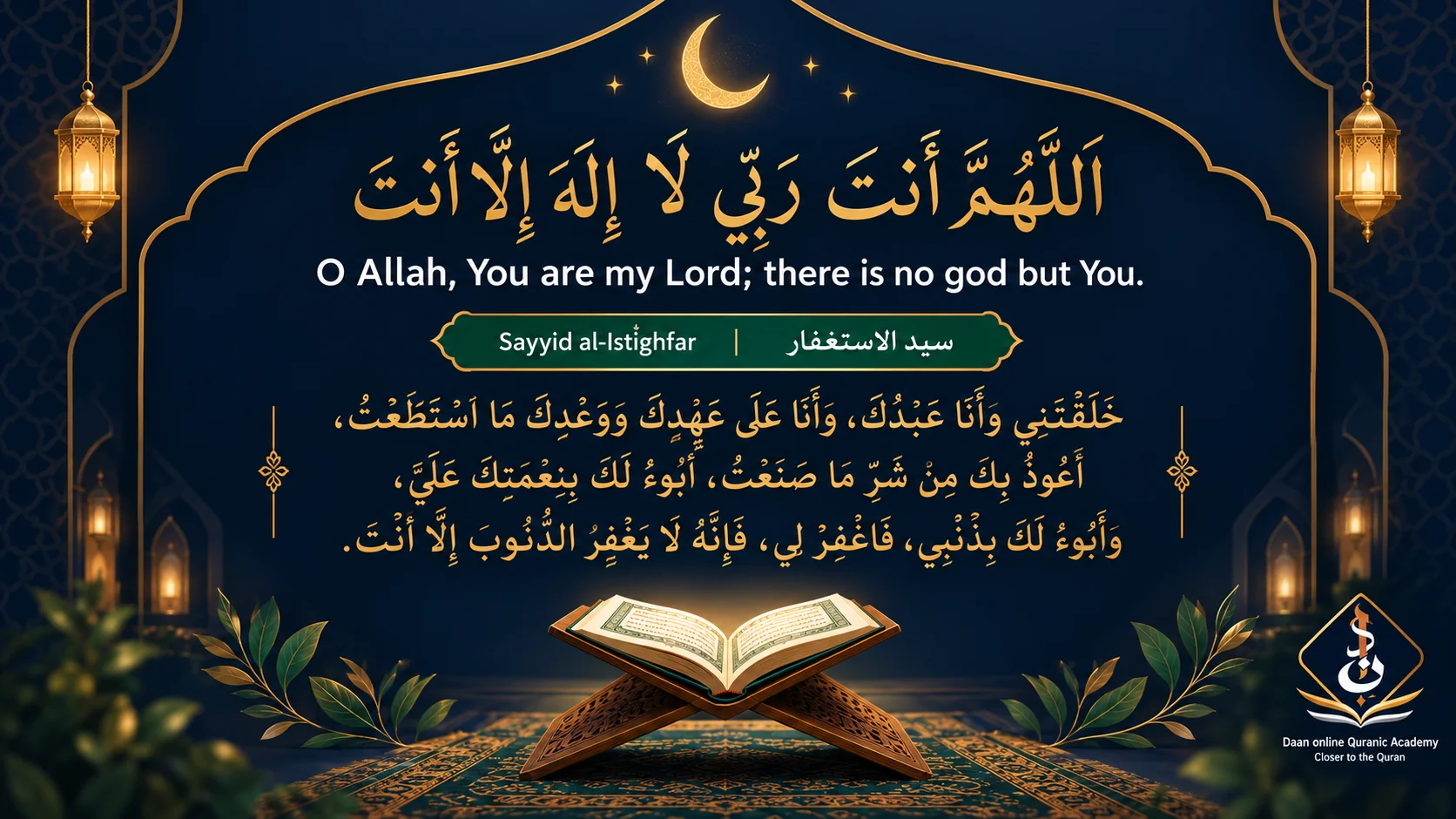
Sayyid al-Istighfar, also called the Master of Istighfar, is the Prophetic supplication that begins with acknowledging Allah as Lord and ends with admitting one’s sin and asking for pardon. It is recorded in Sahih al-Bukhari from the Companion Shaddad ibn Aws, and it carries one of the greatest promises in all the duas of the Sunnah.
Real session recording: A qualified tutor guiding an adult learner through a hadith in a live 1-on-1 Islamic Studies session, the same approach we use to teach authentic supplications such as the Master of Istighfar. All videos are real, unedited screen-recordings from actual student sessions at Daan Academy, posted with student consent.
“The master of istighfar is to say: ‘O Allah, You are my Lord, there is no god but You. You created me and I am Your servant, and I am upon Your covenant and promise as best I can. I seek refuge in You from the evil of what I have done. I acknowledge Your favour upon me and I acknowledge my sin, so forgive me, for none forgives sins except You.’ Whoever says it during the day with firm faith in it and dies that day before evening will be of the people of Paradise, and whoever says it at night with firm faith in it and dies before morning will be of the people of Paradise.”
Narrated by Shaddad ibn Aws — Sahih al-Bukhari, Hadith 6306
اللَّهُمَّ أَنْتَ رَبِّي لَا إِلَهَ إِلَّا أَنْتَ، خَلَقْتَنِي وَأَنَا عَبْدُكَ، وَأَنَا عَلَى عَهْدِكَ وَوَعْدِكَ مَا اسْتَطَعْتُ، أَعُوذُ بِكَ مِنْ شَرِّ مَا صَنَعْتُ، أَبُوءُ لَكَ بِنِعْمَتِكَ عَلَيَّ، وَأَبُوءُ بِذَنْبِي فَاغْفِرْ لِي، فَإِنَّهُ لَا يَغْفِرُ الذُّنُوبَ إِلَّا أَنْتَ
Allahumma anta rabbi la ilaha illa anta, khalaqtani wa ana abduka, wa ana ala ahdika wa wa’dika mastata’tu, a’udhu bika min sharri ma sana’tu, abu’u laka bi ni’matika alayya, wa abu’u bi dhanbi faghfir li, fa innahu la yaghfirudh-dhunuba illa anta.
O Allah, You are my Lord; there is no god but You. You created me and I am Your servant, and I keep Your covenant and promise as best I can. I seek refuge in You from the evil I have done. I acknowledge Your favour upon me, and I acknowledge my sin, so forgive me, for none forgives sins but You.
The Meaning of the Master of Istighfar, Line by Line
The dua opens with tawhid, then moves to humility and gratitude before it ever asks for anything. That order is itself a lesson: the strongest dua begins with Allah, not with ourselves. The Arabic word abu’u, meaning “I acknowledge,” appears twice, once for Allah’s blessings and once for our sin.
The promise attached to the Master of Istighfar depends on reciting it with firm faith and understanding its meaning. This is where learning with a teacher helps. Our native Egyptian tutors at Daan Academy correct the heavy letters such as the ع in abduka and the ء in abu’u in private 1-on-1 sessions, so you recite with confidence. You can see the full list of tutors and their Ijazah credentials before you book.
Dua for Forgiveness of Major Sins: Conditions of Sincere Tawbah
The dua for forgiveness of major sins is sincere istighfar joined with tawbah, because scholars explain that major sins require repentance and not only the passing of time or ordinary good deeds. The hadith in Sahih Muslim (233), narrated by Abu Hurayrah, teaches that the five daily prayers and other regular acts of worship expiate the sins between them as long as major sins are avoided.
That is why a sincere dua for forgiveness of major sins is always paired with action. Allah describes in Surah Al-Furqan (25:68–70) that even those who committed grave sins can be forgiven if they repent, believe and do righteous deeds. Despair is never the answer, and the door of tawbah stays open until death, as reported in Jami at-Tirmidhi (3537) from Ibn Umar.
5 Steps to Make Tawbah Before You Recite Your Dua
Stop the Sin Immediately
Repentance begins by leaving the sin, or by taking real steps to leave it if it is a habit. Asking for forgiveness while continuing the act empties the dua of its meaning.
Feel Genuine Regret
Regret is the heart of tawbah. You do not need dramatic emotion, only honest sorrow that you disobeyed the One who has been good to you.
Resolve Not to Return
Make a firm intention to avoid the sin in future. If you slip again, you renew your tawbah rather than abandon it.
Restore the Rights of Others
If the sin involved another person, such as stolen money or a broken trust, return the right or seek their pardon where it is safe and possible. Consult a qualified scholar if the situation is complicated.
Ask with Istighfar and Dua
Now recite the Master of Istighfar and the supplications in this guide, asking Allah directly. This final step is where learning correct Arabic and meaning turns a memorised phrase into real worship.
Sahih Muslim (121), narrated by Amr ibn al-As, teaches that Islam wipes out what came before it. Reverts who worry about their past can begin fresh, and our beginner-friendly courses help you build the knowledge to protect your new start.
Dua for Forgiveness of All Sins Major and Minor: Authentic Supplications
The dua for forgiveness of all sins major and minor most clearly taught in the Sunnah is the supplication the Prophet ﷺ made in sujud, asking Allah to forgive every sin, small and great, first and last, open and secret. It is recorded in Sahih Muslim (483), narrated by Abu Hurayrah, and it is one of the most complete duas you can memorise.
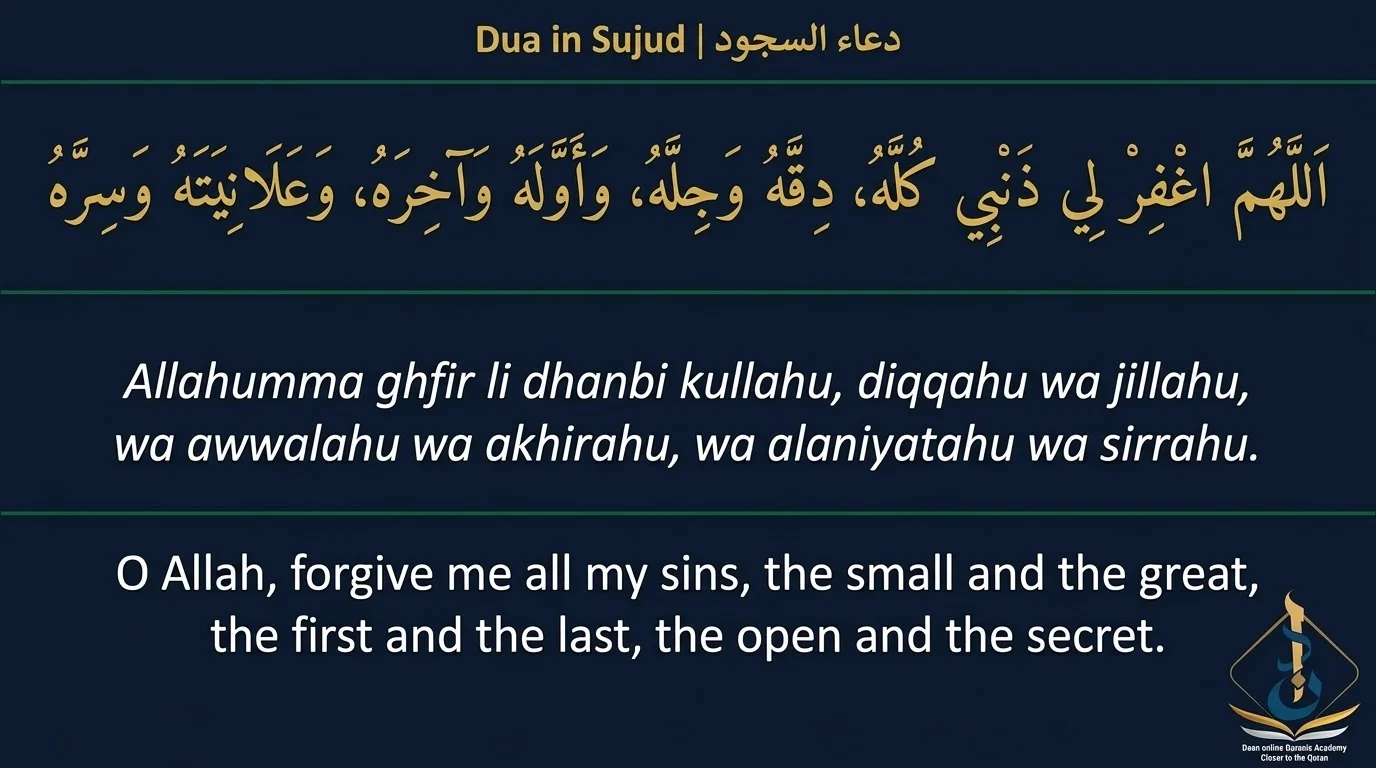
اللَّهُمَّ اغْفِرْ لِي ذَنْبِي كُلَّهُ، دِقَّهُ وَجِلَّهُ، وَأَوَّلَهُ وَآخِرَهُ، وَعَلَانِيَتَهُ وَسِرَّهُ
Allahumma ghfir li dhanbi kullahu, diqqahu wa jillahu, wa awwalahu wa akhirahu, wa alaniyatahu wa sirrahu.
O Allah, forgive me all my sins, the small and the great, the first and the last, the open and the secret. (Sahih Muslim 483, narrated by Abu Hurayrah)
The Prophet ﷺ made this dua in prostration, and Sahih Muslim (482), also narrated by Abu Hurayrah, teaches that a servant is closest to his Lord in sujud, so we should make abundant dua there. This makes the supplication easy to practise: you can add it to every prayer without changing your routine.
Other Short Duas to Keep on Your Tongue
Alongside the Master of Istighfar, several brief supplications are rooted in the Quran and Sunnah. Each takes only seconds, so they fit into a busy day.
قَالَا رَبَّنَا ظَلَمْنَا أَنفُسَنَا وَإِن لَّمْ تَغْفِرْ لَنَا وَتَرْحَمْنَا لَنَكُونَنَّ مِنَ الْخَاسِرِينَ
“They said, ‘Our Lord, we have wronged ourselves, and if You do not forgive us and have mercy upon us, we will surely be among the losers.'”
- Rabbi ighfir li wa tub alayya (رَبِّ اغْفِرْ لِي وَتُبْ عَلَيَّ إِنَّكَ أَنْتَ التَّوَّابُ الرَّحِيمُ): “My Lord, forgive me and accept my repentance; You are the Accepter of Repentance, the Merciful.” Reported in Jami at-Tirmidhi (3434), narrated by Ibn Umar, who said the Prophet ﷺ would repeat it about a hundred times in a single sitting.
- Allahumma innaka afuwwun tuhibbul-afwa fa’fu anni (اللَّهُمَّ إِنَّكَ عَفُوٌّ تُحِبُّ الْعَفْوَ فَاعْفُ عَنِّي): “O Allah, You are the Pardoner and You love to pardon, so pardon me.” Taught by the Prophet ﷺ to Aisha for Laylat al-Qadr in Jami at-Tirmidhi (3513).
- The dua of Prophet Yunus (لَا إِلَٰهَ إِلَّا أَنتَ سُبْحَانَكَ إِنِّي كُنتُ مِنَ الظَّالِمِينَ): “There is no god but You; exalted are You. Indeed, I have been of the wrongdoers.” Surah Al-Anbiya, 21:87.
Learning these in order, one new dua every week, is a realistic plan for busy adults. If you prefer structured guidance, our Quran, Tajweed and Islamic Studies courses include supplications as part of practical worship lessons.
Best Dua for Forgiveness in the Quran: Verses of Hope and Mercy
The best dua for forgiveness in the Quran is rooted in Allah’s promise that He forgives all sins for those who turn to Him, so no servant should ever despair. These verses are the foundation under every istighfar you recite.
قُلْ يَا عِبَادِيَ الَّذِينَ أَسْرَفُوا عَلَىٰ أَنفُسِهِمْ لَا تَقْنَطُوا مِن رَّحْمَةِ اللَّهِ ۚ إِنَّ اللَّهَ يَغْفِرُ الذُّنُوبَ جَمِيعًا ۚ إِنَّهُ هُوَ الْغَفُورُ الرَّحِيمُ
“Say, ‘O My servants who have transgressed against themselves, do not despair of the mercy of Allah. Indeed, Allah forgives all sins. Indeed, it is He who is the Forgiving, the Merciful.'”
This verse is the clearest answer for anyone searching for a dua for forgiveness of major sins. Allah addresses even those who have been excessive against themselves, and calls them His servants. The invitation comes before the sin is erased, not after.
وَالَّذِينَ إِذَا فَعَلُوا فَاحِشَةً أَوْ ظَلَمُوا أَنفُسَهُمْ ذَكَرُوا اللَّهَ فَاسْتَغْفَرُوا لِذُنُوبِهِمْ وَمَن يَغْفِرُ الذُّنُوبَ إِلَّا اللَّهُ وَلَمْ يُصِرُّوا عَلَىٰ مَا فَعَلُوا وَهُمْ يَعْلَمُونَ
“And those who, when they commit an immorality or wrong themselves, remember Allah and seek forgiveness for their sins — and who can forgive sins except Allah? — and do not persist in what they have done while they know.”
Surah Al-Imran gives the formula in one verse: remember Allah, ask forgiveness, and do not persist in the sin. It matches the steps of tawbah described earlier. The same reasoning appears in the Prophetic narration below.
“Allah the Exalted said: O son of Adam, as long as you call upon Me and hope in Me, I will forgive you for what you have done and I will not mind. O son of Adam, if your sins reach the clouds of the sky and then you ask My forgiveness, I will forgive you and I will not mind.”
Narrated by Anas ibn Malik — Jami at-Tirmidhi, Hadith 3540
Reading these verses in Arabic and understanding their meaning deepens every dua you make. Many learners find this much easier when they first master the basics of pronunciation, and our guide on common Tajweed mistakes and how to fix them is a good place to begin.
Best Dua for Forgiveness Times: When Is Dua Most Likely Accepted?
The best times to make the best dua for forgiveness are the last third of the night, the time of sujud, between the adhan and iqamah, and Laylat al-Qadr. These moments are highlighted in the Sunnah as times of special closeness and mercy.
Sahih al-Bukhari (1145) and Sahih Muslim (758), narrated by Abu Hurayrah, report that Allah descends to the lowest heaven in the last third of every night and asks who is seeking forgiveness so that He may forgive. Even five quiet minutes before Fajr, reciting the Master of Istighfar, can become a lasting habit that transforms your day.
Making Istighfar a Daily Routine
- Morning and evening: Recite Sayyid al-Istighfar once after Fajr and once after Asr or Maghrib.
- In every prayer: Add the sujud dua for forgiveness of all sins major and minor.
- After a slip: Make wudu, pray two rakahs and renew your tawbah. Our guide to the dua after wudu in Arabic and English pairs well with this habit.
- Throughout the day: Say “Astaghfirullah” in moments of waiting, travelling or walking. The Prophet ﷺ said in Sahih Muslim (2702), narrated by al-Agharr al-Muzani, that he sought forgiveness a hundred times each day.
Consistency is the real challenge for working parents and students. At Daan Quranic Academy, flexible scheduling at any time of day and smart notifications before every session help students build a steady practice without stress.
🎮 Try a game from more than 700 games on the Daan platform!
Learn the Best Dua for Forgiveness Correctly: How to Choose a Quran Teacher in 2026
The most reliable way to learn the best dua for forgiveness correctly is to study with a certified native Arabic tutor in private 1-on-1 sessions who can correct your pronunciation in real time. Apps and videos can introduce a dua, but they cannot hear you, correct you or adjust to your level.
When comparing options for online Quran learning, it helps to measure each provider against clear criteria. Many platforms rely on non-native speakers or group classes where individual correction is limited. Here is a simple comparison you can use to evaluate any academy, including ours.
| What to Look For | Typical Online Academies | Daan Quranic Academy |
|---|---|---|
| Tutor background | Mixed, often non-native speakers | Native Egyptian tutors trained in Quranic sciences |
| Qualifications | Often unclear | Many tutors hold Ijazah in multiple Qira’at |
| Class format | Frequently group-based | Private 1-on-1 live sessions |
| English communication | Varies | Every tutor speaks fluent English |
| Pricing clarity | Hidden or bundled fees | Three transparent plans from $9/hr |
| Progress tracking | Limited reports | Daan LMS dashboard with session reports and monthly updates |
| Trial | Paid or restricted | Free trial session, no commitment |
What a Good Tutor Does When Teaching a Dua
- Corrects each letter’s articulation point (makhraj) so the meaning stays intact.
- Explains the meaning of every phrase, not only the pronunciation.
- Connects the dua to its authentic source, with the narrator and the book of hadith.
- Sets a realistic memorisation plan based on your schedule and level.
These are exactly the standards behind our approach. If pronunciation is your main worry, our article on overcoming Arabic pronunciation challenges explains why a native tutor makes such a difference. You can also read why families choose Daan Academy for a deeper look at our teaching method.
Daan Quranic Academy Pricing, Free Trial and Student Results
Daan Quranic Academy offers three transparent plans starting from $9/hr, with a free trial session so you can meet your tutor before paying anything. Essential starts at $9/hr, Pro at $10.99/hr and Elite at $12.99/hr, and the Elite plan includes a family discount.
Plans start from just $9/hr with native Egyptian tutors. Compare our three flexible pricing tiers — Essential, Pro, and Elite — each designed for different learning goals and budgets.
Families across 15+ countries learn with us, and many arrive with exactly the questions this article answers: how to recite the Master of Istighfar properly, how to teach children to ask Allah for forgiveness, and how to build a daily dua habit. Each course milestone earns a verified certificate, and children stay motivated with a library of 600+ educational games.
The Smart Student Dashboard lets you track sessions, balance and progress reports in one place. Our team offers 24/7 dedicated support for technical or academic questions, and a referral programme gives both you and a friend a discount. Whether you want to improve your recitation, learn the Master of Istighfar by heart or study the meaning behind it, you can explore more guides on our blog and then take the next step.

Frequently Asked Questions
What is the best dua for forgiveness of major sins?
The best dua for forgiveness of major sins is sincere istighfar, such as Sayyid al-Istighfar, combined with the conditions of tawbah: stopping the sin, regretting it, resolving not to return and restoring any rights owed to others. If you are unsure about a specific situation, speak to a qualified scholar.
Can I recite the Master of Istighfar in English?
The supplication was taught in Arabic, so the best dua for forgiveness is recited in Arabic, while understanding its meaning in English. You may also ask Allah in your own language at any time. Our Noorani Qaida course for beginners and Tajweed classes online for beginners help you read and pronounce the Arabic with confidence.
How much do online Quran classes cost?
Plans at Daan Quranic Academy start from $9/hr (Essential), with Pro at $10.99/hr and Elite at $12.99/hr. You can compare each tier on our pricing plans page before you choose.
Can I try a Quran class before committing?
Yes. Daan Academy offers a risk-free trial session with no commitment, so you can meet a tutor and learn a dua such as the best dua for forgiveness before deciding. You can book your free trial in a few minutes.
Is it safe for my child to learn Quran and duas online?
Every class at Daan Academy is a private 1-on-1 live session with a vetted tutor, and parents can follow progress through session reports and monthly updates. Our team is also available 24/7 for any concern.
How do I know my tutor is qualified to teach duas and Tajweed?
Look for native Arabic speakers with formal training in Quranic sciences and verifiable Ijazah. At Daan Quranic Academy, tutors are native Egyptians and many hold Ijazah in multiple Qira’at. You can review them on our tutors page.
Learn Istighfar and Your Duas the Right Way
Reciting the Master of Istighfar with correct Arabic and real understanding is easier with a patient native tutor. Start with one free session at Daan Academy and see the difference.
No commitment required. One free session to experience the Daan Academy difference.
Final Thoughts: Make the Best Dua for Forgiveness a Daily Habit
The best dua for forgiveness is not a magic formula but a relationship: you acknowledge Allah, admit your fault, and return to Him again and again. Sayyid al-Istighfar, the sujud supplication for all sins major and minor, and the duas of the prophets give you everything you need to begin today. Choose one, learn it properly, and recite it with a present heart.
If you want guidance on pronunciation, meaning and memorisation, we would be honoured to help at Daan Quranic Academy. May Allah accept our repentance, forgive our major and minor sins, and make us among those who return to Him often. Ameen.