Introduction: Eid.. More Than Just a Day
In the heart of Western societies, where streets glitter and decorations fill every corner during non-Islamic festive seasons, Muslim parents face a profound challenge: How do we plant the love of Eid in our children’s hearts? In the West, Eid is not just a religious ritual; it is a “Battle of Identity.” If a child doesn’t feel that their Eid is “more beautiful” and “more joyful,” they may seek belonging in others’ celebrations. At our Academy, we believe that “Manufacturing Joy” is an act of worship, and making your home a beacon of happiness is the first step in connecting your child to their roots.
I. The Psychology of Celebration (Why Are Children Attracted to the ‘Other’?)
Children are inherently visual beings. They are drawn to colors, lights, and music. In the West, celebrations engage all five senses: the scent of cinnamon, the glowing street lights, and meticulously wrapped gifts. To compete with this momentum, we must do more than say “Eid Mubarak.” We must embody Eid. A child needs to see Eid, smell it, taste it, and touch it.
II. Transforming Your Home into an “Eid Kingdom”
Don’t wait for the streets to celebrate you; create your own festival within your home.
- The Corner of Light: Dedicate a large corner in the living room. Use LED string lights in the shapes of crescents and stars. Lighting is the magical element that instantly shifts the mood of a space.
- The Gift Tree (With an Islamic Twist): Instead of direct imitation, create a “Kaaba Model” or an “Eid Tent” where gifts are placed underneath.
- The Eid Scent: Dedicate a specific fragrance (like Oud or Bakhoor) for the home that only appears during Eids. The Pavlovian link between scent and memory is the strongest human connection.

III. Creating Exclusive “Family Rituals” (The Power of Traditions)
What makes a child anticipate Eid is the “ritual” that precedes it.
- The “Grand Baking” Night: Make the night before Eid a day for flour and sugar. Bake Kahk or cookies with your children and let them shape the dough. This “beautiful mess” is what they will remember when they grow up.
- The Eid Eve Bag: Place an “Eid Bag” by each child’s bed containing their new clothes, a small perfume, and candy. Make their morning awakening a moment of pure suspense.
- The Eid Countdown Calendar: Ten days before Eid, create a pocket board where the child opens a pocket daily to find a small piece of candy or a religious fun fact, raising their adrenaline for the big day.
IV. Gifts: The Art That Outshines the Material
In the West, wrapping is often as important as the gift itself.
- Luxurious Wrapping: Don’t present a gift in a plain plastic bag. Use colorful paper, satin ribbons, and cards with the child’s name written with words of pride in their Muslim identity.
- Multi-Gifting: Instead of one expensive gift, bring several smaller items wrapped separately. This allows the child to spend more time in the “joy of discovery.”
V. Community Connection and Pride in Identity
Do not let Eid be a time of isolation; let it be an opening with dignity.
- Gifts for Neighbors: Encourage your children to distribute elegantly wrapped plates of sweets to non-Muslim neighbors with a card explaining “Our Eid.” This act builds bridges of trust and makes the child feel like an “ambassador” of their faith.
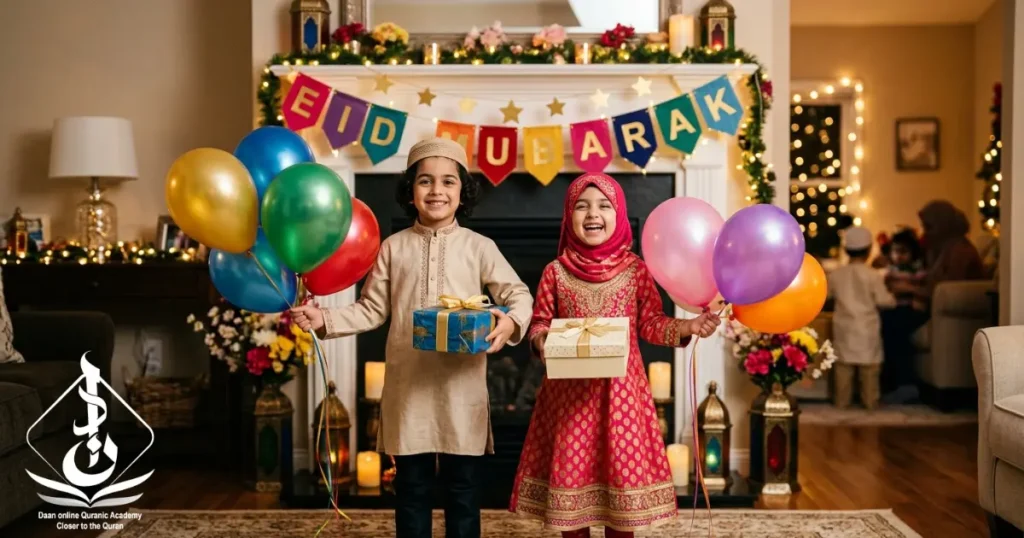
- Exterior Decorating: Place an “Eid Mubarak” wreath on your front door. When a child sees their home proudly displaying Eid to passersby, their sense of belonging is fortified.
- Eid Party for Peers: Invite your children’s friends (including non-Muslims) for an open day of games and stories about Eid.
VI. The Eid Prayer: The Grand Festival
Eid prayer in the West is often held in Islamic centers or rented halls.
- Make the Journey a Trip: Play Takbeerat loudly in the car, distribute balloons to children at the prayer hall, and take professional family photos. These photos are the “documentation” the child will return to over the years.
VII. The Academy’s Role in Reinforcing These Values
At Daan Quranic Academy, we don’t just teach letters and verses; we teach a “Lifestyle.” Through our courses, we focus on linking the Arabic language and Islamic upbringing to lived reality. Eid is the true laboratory where we see the fruits of what the child learns.
Conclusion: Eid is a Trust in Our Hands
Dear parents, Eid in the West is not a burden; it is a golden opportunity to show them the beauty of our faith. When you make the Muslim Eid an artistic masterpiece that surpasses what they see on screens, you aren’t just providing fun—you are protecting their faith and planting an unshakable pride in their souls.
Experience our unique approach first-hand. Book your free free trial sessions now with no strings attached.