
Cat Hadiths in Islam: Prophet Muhammad’s Teachings and Love for Cats
The cat hadith in Islam show that cats are pure, that Muslims must treat them with mercy, and that cruelty to a cat can carry a grave punishment. Every report in this guide comes from Sahih al-Bukhari, Sahih Muslim or the Sunan, with Arabic text, narrator and reference.
If you want to read these narrations in Arabic and understand them properly, this guide also shows how to study hadith with certified tutors at Daan Quranic Academy, from $9/hr, in 2026.
📑 Table of Contents
- Cat Hadith in Islam: What the Prophet ﷺ Taught
- Hadith on Cats Sahih Bukhari: The Woman and the Cat
- Prophet Muhammad Hadith About Cats: Purity and Mercy
- Hadith About Cats in Arabic: Text, Meaning and Pronunciation
- Cats in Islam: Rulings, Care and Common Myths
- How to Study the Cat Hadith in Islam: What to Look For
- Best Way to Learn Hadith in 2026: Online vs In-Person
- Why Families Choose Daan Academy for Islamic Studies
- Frequently Asked Questions
Cat Hadith in Islam: What the Prophet ﷺ Taught
The cat hadith in Islam are a small group of authentic narrations that establish three principles: cats are clean, animals have rights, and mercy toward them is rewarded. They are short, but they shaped how Muslim households have treated cats for fourteen centuries.

The Quran sets the foundation. Allah describes every animal as a community in its own right, which is why Islamic ethics treat animals as beings with dignity, not property to be used carelessly.
وَمَا مِن دَآبَّةٍ فِى ٱلْأَرْضِ وَلَا طَـٰٓئِرٍ يَطِيرُ بِجَنَاحَيْهِ إِلَّآ أُمَمٌ أَمْثَالُكُم
“There is no creature on earth, nor bird that flies with its wings, but they are communities like you.”
Students who study the cat hadith in Islam with a qualified teacher learn the Arabic wording, the chain of narrators and the scholarly rulings together. You can see how this fits into a full Islamic Studies and Arabic curriculum.
Hadith on Cats Sahih Bukhari: The Woman and the Cat
The most famous hadith on cats in Sahih Bukhari is the report of a woman who was punished in the Hellfire for imprisoning a cat until it died. It is also recorded in Sahih Muslim, which makes it one of the strongest evidences that cruelty to animals is a serious sin.
Real session recording: A qualified tutor teaching Hadith sciences to an adult learner in a live 1-on-1 Islamic Studies class. All videos are real, unedited screen-recordings from actual student sessions at Daan Academy, posted with student consent.
“A woman was punished because of a cat which she had tied up until it died. She entered the Fire because of it: she neither fed it nor gave it water when she confined it, nor did she let it eat from the creatures of the earth.”
Narrated by Abdullah ibn Umar — Sahih al-Bukhari, 3318; also Sahih Muslim, 2242
Scholars draw several lessons from this hadith on cats in Sahih Bukhari. An animal in your care is an amanah (trust), and its food, water and freedom to hunt are your responsibility. Neglect is not a small matter: the Prophet ﷺ linked it to the Fire.
Understanding such reports well means knowing who narrated them and how scholars graded them. That is the focus of a good Islamic education library and of one-to-one teaching.
Prophet Muhammad Hadith About Cats: Purity and Mercy
The key Prophet Muhammad hadith about cats on purity states that a cat is not impure; it is among those who move around among us. This ruling is why Muslims may live with cats and pray in homes where they roam.
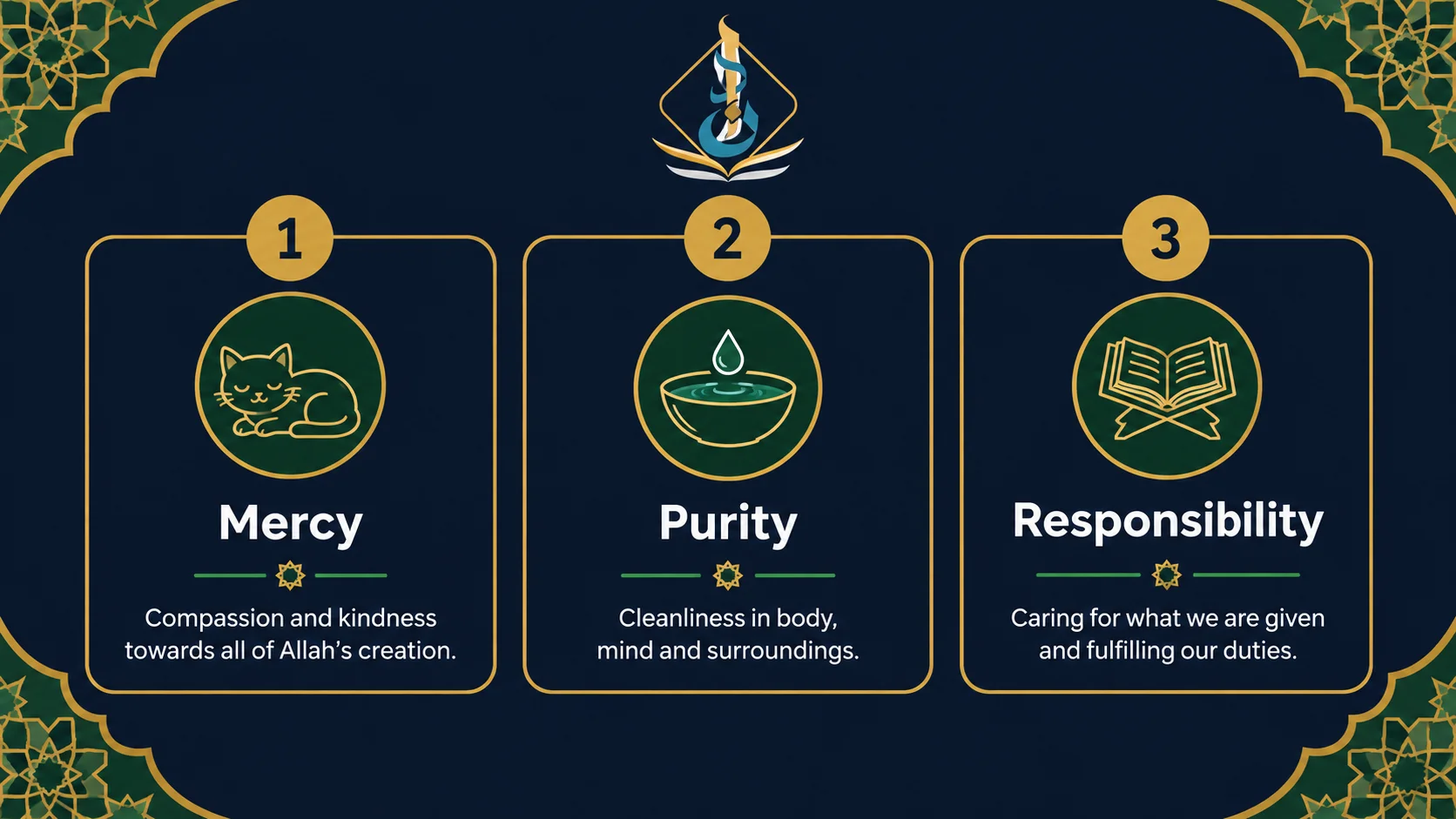
“Indeed, it is not impure. It is one of those who go around among you, male and female.”
Narrated by Abu Qatada — Sunan Abi Dawud, 75; also Jami’ at-Tirmidhi, 92
In the same narration, Abu Qatada tilted a vessel so a cat could drink from it. Most scholars conclude from this that a cat’s leftover water is pure and that its presence does not invalidate wudu. Some Hanafi scholars note a mild dislike in certain cases, so a teacher can explain the differences between schools.
This Prophet Muhammad hadith about cats also explains a rule of Islamic law: hardship removes strictness. Cats live in homes, so the Shariah does not burden people with treating them as impure.
You may have heard that the Prophet ﷺ cut his sleeve rather than disturb a sleeping cat named Muezza. This story is widely told but is not found in the authentic hadith collections. Always ask for the source before sharing a narration.
Hadith About Cats in Arabic: Text, Meaning and Pronunciation
A hadith about cats in Arabic uses the word هِرَّة (hirrah) for a cat, and هِرّ (hirr) for a tomcat. Reading the original wording protects you from mistranslation and reveals details that English drops.
دَخَلَتِ امْرَأَةٌ النَّارَ فِي هِرَّةٍ رَبَطَتْهَا، فَلَمْ تُطْعِمْهَا، وَلَمْ تَدَعْهَا تَأْكُلُ مِنْ خَشَاشِ الأَرْضِ
“A woman entered the Fire because of a cat she tied up: she did not feed it, nor let it eat from the creatures of the earth.” (Sahih al-Bukhari 3318)
إِنَّهَا لَيْسَتْ بِنَجَسٍ، إِنَّمَا هِيَ مِنَ الطَّوَّافِينَ عَلَيْكُمْ وَالطَّوَّافَاتِ
“Indeed, it is not impure; it is one of those who go around among you, males and females.” (Sunan Abi Dawud 75)
Notice the word khashash (خَشَاش), meaning the small creatures of the earth. It shows the Prophet ﷺ expected the cat to be fed or freed to hunt. Native speakers hear this nuance instantly, which is why a hadith about cats in Arabic is best learned with a native tutor.
At Daan Quranic Academy, all tutors are native Egyptian Arabic speakers who also speak fluent English. Learners who want to read texts like these can start with our online Quranic Arabic classes guide.
Cats in Islam: Rulings, Care and Common Myths
Cats in Islam are permitted pets, considered ritually pure, and protected by the Shariah from cruelty, hunger and neglect. Beyond the hadith, scholars have summarized the practical rulings clearly.
- Keeping a cat is permissible, provided you feed it, give it water and care for its health.
- A cat’s saliva and leftover water are considered pure by the majority of scholars.
- Praying near or around a cat does not invalidate salah.
- Harming, starving or abandoning a cat is sinful, as the Bukhari hadith establishes.
- Cats are not omens or spiritual threats. Such beliefs have no basis in the authentic sources.
A frequent question is whether Abu Hurairah’s name relates to cats. Historians report that his kunya, “father of the kitten,” is linked to a small cat he kept, though this comes from historical accounts rather than a hadith of legal ruling. For background on Islamic history, see the Wikipedia biography of Abu Hurairah.
Children often ask about animals in Islam, and families can use these narrations as an easy way in. Our Islamic Studies course guide for kids and adults shows how tutors turn such stories into lasting lessons.
How to Study the Cat Hadith in Islam: What to Look For
To study the cat hadith in Islam properly, follow five steps: read the Arabic, identify the narrator, check the grading, learn the ruling, then apply it. The same criteria apply when choosing a teacher.
Read the Arabic Text
Translations lose detail. Work from the original wording with a tutor who explains vocabulary and grammar.
Identify the Narrator and Source
Every authentic report names its narrator and collection, such as Abdullah ibn Umar in Bukhari 3318.
Check the Grading
Scholars grade narrations as sahih, hasan or da’if. Learn why a report is graded that way, not only the label.
Learn the Scholarly Rulings
Understand how the four schools derive rulings from the text, including areas of difference.
Apply It in Daily Life
Turn knowledge into character: feed the stray, be gentle with animals and teach your children the same.
What to Look For: Certified Tutors
Look for teachers with formal training and verified chains of transmission. Many tutors at Daan Academy hold Ijazah, are trained in Quranic sciences and teach in fluent English. You can review them on our native Egyptian tutors page.
Best Way to Learn Hadith in 2026: Online vs In-Person
The best way to learn hadith in 2026 is 1-on-1 online tuition with a qualified tutor, because it offers expert access, flexible scheduling and personal feedback. Here is how the main options compare.
| Criteria | Daan Academy 1-on-1 Online | Typical Group Class | Self-Study |
|---|---|---|---|
| Personal attention | Full, private session | Shared with the group | None |
| Native Arabic tutor | Yes, native Egyptian | Varies | No |
| Flexible scheduling | Any time, anywhere | Fixed timetable | Flexible |
| Progress tracking | Reports and dashboard | Limited | Self-managed |
| Price | From $9/hr | Varies | Free to low |
Unlike group classes that dilute attention, Daan provides private sessions built around your level. Compare the options on our transparent pricing plans: Essential from $9/hr, Pro at $10.99/hr and Elite at $12.99/hr, with a family discount on Elite.
Why Families Choose Daan Academy for Islamic Studies
Families choose Daan Academy for verified tutors, private lessons, clear pricing and visible progress. We teach students across 15+ countries, including the UK, USA and Europe, and offer Noorani Qaida, Hifz, Tajweed, Islamic Studies, Modern Standard Arabic, Quranic Arabic and Ijazah programs.
Students track sessions and progress reports in our Smart Student Dashboard, receive automatic reminders before each class and earn verified certificates at course milestones. Children stay engaged with our library of 600+ educational games. To see the standards we hold ourselves to, read why students choose Daan Academy.
Plans start from just $9/hr with native Egyptian tutors. Compare our three flexible pricing tiers — Essential, Pro and Elite — each designed for different learning goals and budgets. Referral rewards and 24/7 support are included.
Want to see it before you commit? Book a free trial session and meet a tutor with no obligation.

Frequently Asked Questions
Is there a cat hadith in Islam that says cats are clean?
Yes. Abu Qatada narrated that the Prophet ﷺ said a cat is not impure and is among those who move around among us (Sunan Abi Dawud 75, Tirmidhi 92).
Is the hadith on cats in Sahih Bukhari authentic?
Yes. The report of the woman punished over a cat is in Sahih al-Bukhari (3318) and Sahih Muslim (2242), the two most authentic collections.
Did the Prophet Muhammad ﷺ have a cat named Muezza?
The story is popular, but it is not found in the authentic hadith collections. The authenticated narrations only establish mercy toward cats and their purity.
How much do online hadith and Islamic Studies classes cost?
Daan Academy plans start from $9/hr. See the Essential, Pro and Elite plans for full details.
Can I try a class before committing?
Yes. Our free trial session is risk-free with no commitment, so you can meet a tutor and experience a live 1-on-1 lesson.
Are your tutors qualified to teach hadith and Arabic?
Yes. All tutors are native Egyptian Arabic speakers trained in Quranic sciences, and many hold Ijazah. Meet them on the tutors page.
Learn the Hadith of the Prophet ﷺ in Its Original Arabic
Move from reading translations to understanding the sources. Study hadith, Arabic and Islamic Studies with a certified native tutor at Daan Quranic Academy.
No commitment required. One free session to experience the Daan Academy difference.
Final Thoughts
The cat hadith in Islam are brief but powerful. They tell us that cats are pure, that a small animal’s hunger matters, and that mercy is rewarded by Allah. Studying the cat hadith in Islam with authentic sources and a qualified teacher turns that knowledge into character.
May Allah make us among those who are merciful to His creation, and grant us understanding of the words of His Messenger ﷺ. Allahumma inni as’aluka ‘ilman nafi’a. O Allah, I ask You for beneficial knowledge. Ameen.