The Best of People Are Those Most Beneficial to People: Complete Hadith Guide
One hadith. Eight words in Arabic. A complete blueprint for how a Muslim should live. The statement of the Prophet Muhammad ﷺ — “the best of people are those most beneficial to people” — ranks among the most comprehensive and transformative in all of prophetic literature. In an age of self-promotion and personal branding, this guidance stands as a timeless counter-culture: your worth before Allah is not measured by what you accumulate, but by what you give. This guide unpacks the linguistic depth, Quranic foundation, and six life-changing lessons embedded in this single, luminous hadith on being the best of people.
خَيْرُ النَّاسِ أَنْفَعُهُمْ لِلنَّاسِ — “The best of people are those who are most beneficial to people.”
📑 Table of Contents
- Understanding the Arabic: The Weight of “Anfa’uhum”
- The Quranic Foundation
- Six Transformative Lessons
- The Narrator: Jabir ibn Abdillah (RA)
- The Prophet ﷺ: Greatest Embodiment
- Practical Ways to Live This Hadith
- Teaching This Hadith to Your Children
- A Message for Reverts
- The Echo Across Fourteen Centuries
- Frequently Asked Questions
- Final Thoughts
This blessed hadith — the best of people are those most beneficial to people — has been a foundation of Islamic civilisation for fourteen centuries. From the scholars who devoted their lives to teaching, to the traders who acted with ethics and generosity, to the mothers who raised righteous generations — the Muslims who left the deepest legacies were those who lived this principle. In what follows, we explore the hadith’s linguistic depth, its Quranic support, the life of its narrator, the supreme example of the Prophet ﷺ, and six actionable lessons you can begin implementing today.
Understanding the Arabic: The Weight of “Anfa’uhum”
Before exploring the lessons of the best of people hadith, it is worth pausing on the Arabic — because the Prophet ﷺ spoke a language of extraordinary precision, and every word carries intentional weight.
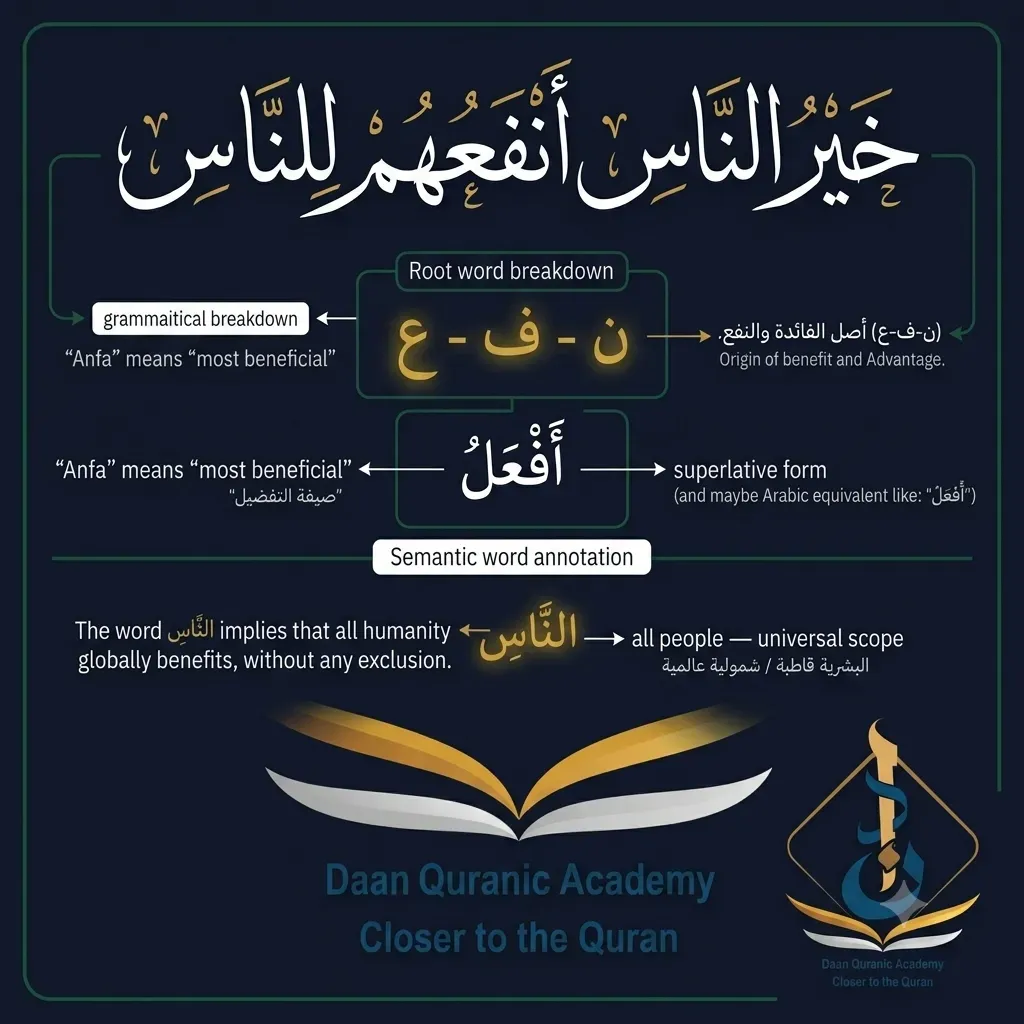
The key word is أَنْفَعُهُمْ (anfa’uhum — “the most beneficial of them”). It comes from the root ن-ف-ع (n-f-‘), meaning to benefit, to be of use, to bring genuine goodness to another. What makes the Prophet’s ﷺ choice of words remarkable is the grammatical form: أَفْعَل (af’al) — the superlative in Arabic grammar. He did not say “a person who benefits others is good.” He used the superlative: the best of people are those who benefit most.
This reveals something profound about Islamic ethics: goodness is not static — it is measured in degrees of benefit. A Muslim is always encouraged to stretch further, give more, and reach higher in the service of others. The standard is not “good enough” but “the best.” This is not a call to burnout or self-neglect, but to intentional, sincere, and consistent investment in the wellbeing of those around you.
The word النَّاسِ (al-naas — “the people”) is equally significant. The Prophet ﷺ did not restrict this hadith to Muslims or to one’s immediate family. He said “people” — a universal scope of benefit that includes neighbours of different faiths, strangers in need, colleagues, and communities near and far. This is why the best of people hadith is among the most universally applicable of all prophetic statements.
The Quranic Foundation: A Life of Cooperation and Sincere Giving
The best of people hadith does not stand alone. The entire Quran breathes the spirit of benefit, service, and generosity toward others. Two passages in particular illuminate and ground the prophetic statement about the best of people being those most beneficial.
Allah commands believers to make cooperation in goodness a defining feature of their community life. The verb تَعَاوَنُوا (ta’awanu — “cooperate with one another”) is a form of mutual action: you benefit others and they benefit you. This verse establishes that benefiting others is not optional generosity — it is a divine command embedded in the architecture of an Islamic community.
Allah describes the people of Jannah with this picture: they gave to others while they themselves loved and needed the very thing they gave. And they did so purely for Allah’s sake, expecting nothing in return — no recognition, no social capital, no reward from the one they served. This is the defining quality of the best of people as described in the hadith: benefit that flows from deep sincerity, not from social obligation or the quiet hunger for applause.
Six Transformative Lessons from the Best of People Hadith
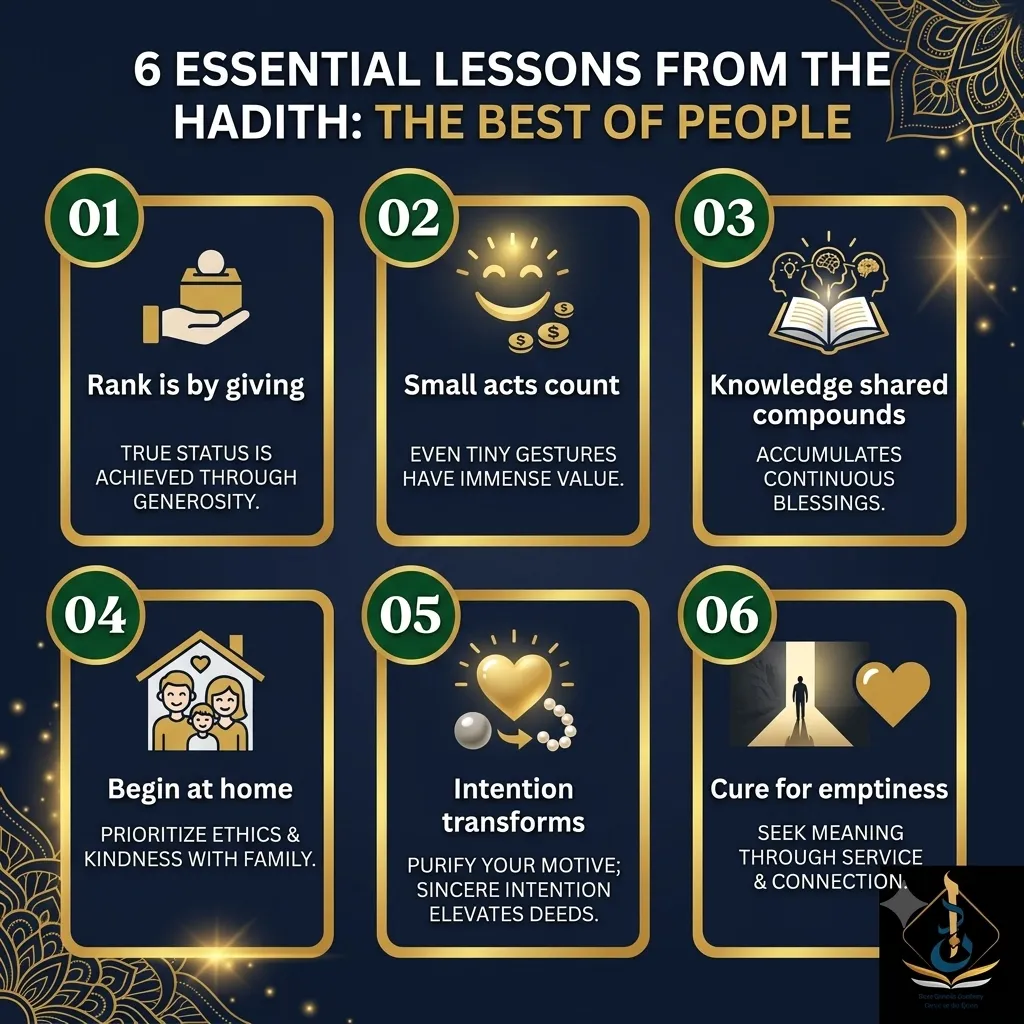
This brief prophetic statement about the best of people being those most beneficial to people contains a universe of guidance. Below are six practical lessons drawn from its text, its context, and its echoes across the Quran and Sunnah — lessons that apply to every Muslim, whether scholar or student, parent or child, professional or revert.
Your Rank Before Allah Is Determined by What You Give, Not What You Own
Islam does not measure a person’s worth by wealth, nationality, social standing, or physical appearance. The best of people hadith establishes a clear and democratic criterion: the best person is the most beneficial person. This fundamentally reorients the Muslim’s relationship with success. A person of vast wealth who benefits no one ranks lower on this scale than a person of modest means who consistently lifts those around them. This principle is profoundly liberating — it places spiritual excellence within the reach of every Muslim, regardless of material circumstance. Begin with this question today: who in my life benefits directly from my presence?
The Smallest Act Can Be the Most Powerful Form of Benefit
The Prophet ﷺ also taught us: “Every good deed is an act of charity” (Sahih al-Bukhari, no. 6021; Sahih Muslim, no. 1005 | Narrated by Jabir ibn Abdillah (RA)). The removal of a harmful object from a pathway is charity. A warm smile given to a grieving believer is charity (Sunan al-Tirmidhi, no. 1956 | Narrated by Abu Dharr (RA)). A patient explanation offered to a confused student is charity. The best of people hadith’s use of أَنْفَعُهُمْ is deliberately broad and unrestricted — any form of genuine benefit counts. Even the busiest parent, the most exhausted worker, or the newest revert can be among the best of people by consistently offering sincere, small acts of service to those around them.
Knowledge Shared Is Among the Highest and Most Lasting Forms of Benefit
Of all the things a Muslim can give, knowledge stands apart — because its benefit compounds across time and generations. The Prophet ﷺ taught us that when a person dies, all deeds cease except three, one of which is عِلْمٌ يُنْتَفَعُ بِهِ (ilmun yuntafa’u bihi — “knowledge from which benefit continues to flow”) (Sahih Muslim, no. 1631 | Narrated by Abu Hurayrah (RA)). Teaching the Quran, Arabic, or Islamic knowledge is therefore one of the most powerful expressions of the best of people hadith — because your reward flows long after you are gone. Every student you teach becomes a living extension of your benefit in this world and a stream of reward for you in the Hereafter.
Begin with Those Closest to You — True Benefit Starts at Home
Islam’s model of responsibility places the family at the centre. The Prophet ﷺ clarified this directly: “The best of you is the one who is best to his family, and I am the best of you to my family” (Sunan Ibn Majah, no. 1977 | Narrated by Aisha (RA)). Outward community service built on a neglected household is not the Prophetic model. The best of people hadith begins at home — the patient father who reads Quran with his children, the mother who creates an environment of peace and learning, the spouse who genuinely listens. These are the bedrock upon which civilisations of benefit are built, one family at a time.
Sincere Intention Transforms Every Ordinary Act into Eternal Worship
Allah describes the people of Jannah as those who say: إِنَّمَا نُطْعِمُكُمْ لِوَجْهِ اللَّهِ (Innama nut’imukum li-wajhillah — “We feed you only for the sake of Allah”). The act of giving food is entirely ordinary — but the intention transforms it into something eternal. The Arabic term نِيَّة (niyyah — “intention”) is the alchemy of Islamic action: it turns the ordinary into the everlasting. A Muslim who teaches Quran to a neighbour’s child solely for Allah’s pleasure is accumulating rewards that no worldly accounting can calculate — and is living the best of people hadith in its truest sense.
A Life Rooted in Benefit Is the Prophetic Cure for Spiritual Emptiness
One of the defining crises of modern life is meaninglessness — a pervasive purposelessness that fuels anxiety, disconnection, and spiritual drift. The Prophet ﷺ, through the best of people hadith, prescribes the cure: root your identity in genuine service to others. When your daily intention is to be useful to at least one person, your life gains a structure of meaning that no material comfort can replicate. The most spiritually alive people are those who live outward-facing lives — whose concern extends beyond themselves to their families, communities, and ummah. The best of people hadith is not merely moral instruction; it is a prescription for a profoundly fulfilled life.
The Narrator: Jabir ibn Abdillah (RA) — A Man Who Lived What He Transmitted
The best of people hadith is narrated by Jabir ibn Abdillah al-Ansari (RA) — one of the most prolific and trusted transmitters of hadith among the Companions, with over 1,500 narrated reports attributed to him. He was from the Ansar of Madinah — the tribe whose very name means “the Helpers.” When the Muhajireen (migrants from Makkah) arrived in Madinah having left behind their homes, livelihoods, and families, the Ansar shared their homes, divided their wealth, and opened their hearts without hesitation or resentment. That a man of the Ansar narrates the best of people hadith is perhaps no coincidence: he embodied the principle before he ever transmitted it.
Jabir ibn Abdillah (RA) participated in nineteen military expeditions alongside the Prophet ﷺ, devoted himself to transmitting the Sunnah well into old age, and was known throughout Madinah for his generosity and tireless service to others. He is not simply a transmitter of the best of people hadith — he is a human embodiment of it. When we study the lives of the narrators of prophetic statements, we receive the message twice: once in words, once in a lived example.
The Prophet ﷺ: The Greatest Living Embodiment of the Best of People Hadith
No reflection on the best of people hadith is complete without returning to the one who spoke it — for the Prophet Muhammad ﷺ was not only the teacher of this principle but its most complete and perfect embodiment in human history.
He was a husband who helped with household chores when the culture of his time expected otherwise. A teacher who patiently repeated lessons until each student truly understood. A leader who visited the sick without being asked, comforted the grieving without being summoned, and played with children in the streets of Madinah. He freed enslaved people, championed the rights of women and orphans, and cared for those on the margins of society — at a time when none of these were expected of a man of his standing. He was, in the fullest and truest sense, the most beneficial human being who ever lived — the living definition of the best of people hadith. And Allah Himself confirmed it:
The Prophet ﷺ was Allah’s mercy made manifest for all of creation — and mercy is the most encompassing form of benefit there is. To love the Prophet ﷺ is to aspire to his example; to aspire to his example is to strive, each day, to be genuinely and sincerely beneficial to those around you. This is the heart of the best of people hadith.
Practical Ways to Live the Best of People Hadith in the Modern World
Understanding the best of people hadith intellectually is the first step. Living it requires daily, deliberate choices. Here are five concrete, Islam-rooted ways to embody the principle of being most beneficial to people in your life as a Muslim in the UK, USA, Europe, or Australia:
- Teach what you already know. Do you know a few surahs with correct Tajweed? Teach them to a family member or friend. Have you recently understood an Islamic concept that moved you? Share it with someone who needs to hear it. Knowledge shared is a form of ongoing charity that outlasts your life — the deepest expression of the best of people hadith.
- Make du’a for specific people by name. Sincerely praying for a fellow believer in their absence is a profound act of benefit. The Prophet ﷺ confirmed that when a Muslim makes du’a for their brother in his absence, an angel says: “Ameen, and the same for you” (Sahih Muslim, no. 2732 | Narrated by Abu al-Darda (RA)). Your du’a for others becomes a gift returned to you.
- Give of your time before your money. Time is often more precious — and more needed — than wealth. Sitting with an elderly parent, listening deeply to a friend in difficulty, or helping a child with their Quran memorisation are gifts of immeasurable value. The best of people hadith measures benefit in deeds, not in wealth.
- Commit to one consistent act of community service. The Prophet ﷺ loved consistent deeds, even if small. Choose one weekly or monthly act of benefit — volunteering at a mosque, supporting a new revert, mentoring a student of knowledge — and make it a sustainable, non-negotiable habit. A small stream of benefit flowing consistently becomes a river.
- Renew your intention before every interaction. Before a conversation, a message, or an act of giving, pause and set your intention inwardly: “I am doing this for Allah’s sake.” This single act transforms ordinary social interaction into worship — ensuring that your benefit is spiritually anchored, as the best of people hadith demands.
Teaching the Best of People Hadith to Your Children
If you are raising children in the UK, USA, Europe, or Australia, the best of people hadith is one of the most valuable Islamic seeds you can plant in your child’s heart from an early age — because it gives them an Islamic identity rooted in giving rather than taking, in service rather than status.
Create a simple “Weekly Benefit Chart” at home. Each Friday, sit with your child and identify three ways they were beneficial to someone that week — helping a sibling, sharing food with a friend, offering a kind word to someone who was sad. Connect each example to the best of people hadith by name. Over time, your child will internalise that being “most beneficial” is what makes a person the “best” in the eyes of Allah — the most powerful definition of success they can carry into adulthood.
Children who grow up understanding that service is a form of worship develop a fundamentally different relationship with their deen. They experience Islam not as a list of restrictions, but as a framework for becoming the finest version of themselves. They enter adulthood with a sense of purpose rooted in the eternal, not in the shifting approval of social media or peer culture.
One of the most enduring acts of benefit a parent can give their child is a Quran education. Every letter recited correctly, every surah memorised, every rule of Tajweed internalised — these are seeds of benefit that bloom throughout your child’s lifetime and, by Allah’s grace, long beyond it. For more on raising children in the Quran, read our guide on The Quran: A Guiding Light and a Gift for Every Child’s Future.
A Message for Reverts: You Are Already Living the Best of People Hadith
For Muslims who have recently embraced Islam — welcome. The best of people hadith speaks to you in a particular and tender way. The journey of reverting is itself one of the most beneficial acts a person can undertake — not only for themselves, but for those around them. Your Islam becomes a living witness to the beauty of this deen. Your sincere questions inspire deeper reflection in those who were born Muslim.
If you are still learning the basics — the Arabic letters, your first surahs, the pillars of Iman — know that every step of your learning journey is a step toward becoming more beneficial. The following hadith speaks directly to the support you are owed — and that every Muslim should offer you:
“Whoever relieves a believer’s distress of the distressful aspects of this world, Allah will rescue him from a difficulty of the difficulties of the Hereafter. Whoever makes things easy for the one who is in difficulty, Allah will make things easy for him in this world and in the Hereafter. And Allah helps His slave as long as His slave is helping his brother.”
Every person who supports your learning, answers your questions, and shares their Quranic knowledge with you is living the best of people hadith. And as you grow in your faith and begin sharing what you have learned with others — a surah with a friend, a ruling with a neighbour, a du’a with your child — so will you. For guidance on navigating Muslim identity in the West, read our article on Preserving Islamic Identity in the West: A Guide for Muslim Families.
The Echo of the Best of People Hadith Across Fourteen Centuries
The best of people hadith was not merely recited across the centuries — it was institutionalised. The great achievements of Islamic civilisation were collective expressions of the prophetic drive to be genuinely beneficial to others, outlasting the individual lives that produced them.
- The great libraries and academies of the Islamic Golden Age — from the House of Wisdom (Bayt al-Hikmah) in Baghdad to al-Azhar in Cairo — were founded on the conviction that knowledge shared freely is the highest form of benefit to humanity. These were not private institutions; they were endowments for all who sought learning — living embodiments of the best of people hadith.
- The waqf (Islamic endowment) system funded hospitals, schools, mosques, water channels, and shelters for centuries — a direct institutional expression of the Muslim desire to remain beneficial even after death. The waqf is sadaqah jariyah on a civilisational scale.
- The scholars who refused payment for teaching and devoted entire lifetimes to writing books designed to outlast them — from Imam al-Nawawi to Ibn Kathir to al-Bukhari — were each striving to become أَنْفَعَ النَّاسِ (anfa’ al-naas — “the most beneficial of people”) in the eyes of Allah.
- The Muslim traders of the medieval world who carried Islamic ethics, knowledge, and justice alongside their goods into Africa, Central Asia, and Southeast Asia were merchants of benefit as much as of commerce. Where they went, communities became Muslim — through character, not compulsion.
The Muslim ummah has always risen to its greatest heights when it lived the best of people hadith — and has struggled when it turned inward and forgot it. The invitation to return to this principle, beginning with one’s own heart and home, is an invitation to personal and communal revival. For more on this, read our guide on How to Build a Strong Muslim Identity in Western Societies.
What legacy of benefit do I want to leave? This question is not reserved for scholars or community leaders. Every Muslim can answer it meaningfully. Identify one sustainable way to benefit others — through your family, your profession, your knowledge, or your local community — and commit to it for the long term. Even the smallest stream of benefit, flowing consistently and sincerely over a lifetime, becomes a river that nourishes generations you may never meet.
Frequently Asked Questions
What is the hadith “the best of people are those most beneficial to people”?
The best of people hadith — خَيْرُ النَّاسِ أَنْفَعُهُمْ لِلنَّاسِ — is a prophetic statement attributed to Prophet Muhammad ﷺ, narrated by Jabir ibn Abdillah (RA), and recorded in al-Tabarani’s al-Mu’jam al-Awsat (no. 5787). It was graded Hasan (Good) by Imam al-Albani in al-Silsilah al-Sahihah (no. 426). It establishes that a Muslim’s rank before Allah is measured by how genuinely beneficial they are to others.
Is the “best of people are those most beneficial to people” hadith authentic?
Yes. The best of people hadith is graded Hasan (Good/Acceptable) by the renowned hadith scholar Imam al-Albani in his al-Silsilah al-Sahihah (no. 426). While it is not found in the two primary collections of Sahih al-Bukhari or Sahih Muslim, its chain of narration is acceptable and it is widely cited by scholars of hadith sciences. Its meaning is also firmly supported by multiple authentic hadiths and Quranic verses.
Who narrated the “best of people” hadith?
The best of people hadith is narrated by Jabir ibn Abdillah al-Ansari (RA), one of the most prolific Companions and narrators of prophetic traditions. He was from the Ansar of Madinah — the tribe known as “the Helpers” — and participated in nineteen military expeditions alongside the Prophet ﷺ. His life was itself a living embodiment of the principle he transmitted.
What does “most beneficial to people” mean in the context of Islam?
In the best of people hadith, “most beneficial” comes from the Arabic root ن-ف-ع (n-f-‘) in the superlative form أَنْفَعُهُمْ (anfa’uhum). It means any genuine act of goodness that benefits another person — from sharing knowledge and giving charity to offering a kind word, removing harm from a path, or raising righteous children. The word al-naas (“the people”) is universal — it includes Muslims and non-Muslims alike.
How can a Muslim apply the best of people hadith in daily life?
Living the best of people hadith daily means beginning each morning with the intention to benefit at least one person — through teaching, du’a, time, patience, or giving. Start with your family, then your neighbours, then your wider community. Even small, consistent acts — a shared surah, a listened-to problem, a patient answer — accumulate into a life of genuine benefit that earns lasting reward.
What Quran verses support the best of people hadith?
Several Quranic verses directly support the best of people hadith. Surah Al-Ma’idah (5:2) commands Muslims to cooperate in righteousness and benefit. Surah Al-Insan (76:8–9) describes the people of Jannah as those who give to others sincerely for Allah’s sake alone. Surah Al-Anbiya (21:107) confirms that the Prophet ﷺ himself was sent as a mercy — the ultimate embodiment of being most beneficial to people.
Become More Beneficial — Begin with the Quran
One of the most powerful ways to live the best of people hadith is to deepen your knowledge of the Quran — and then pass that gift on to your family. At Daan Quranic Academy, our certified native Egyptian tutors help you and your children build a real, lasting foundation in Quran recitation, Tajweed, and Arabic through live, personalised online sessions, from wherever you are in the world.
No commitment required. One free session to experience the Daan Academy difference.
Final Thoughts: Choosing Every Day to Be the Best of People
The best of people hadith — “the best of people are those most beneficial to people” — is not a call to exhaustion or to self-erasure. It is an invitation to a life of deep meaning, grounded in the understanding that you were created to be of service, and that every act of genuine benefit you offer to another human being is an act of worship that Allah witnesses, records, and rewards far beyond what we can imagine.
You do not need to be a scholar, a wealthy philanthropist, or a prominent community leader to embody the best of people hadith. You need only to wake each morning with the sincere intention to be genuinely useful — to your spouse, your children, your neighbour, your colleague, your student, your community, your ummah. Each day is a fresh invitation to rise to this standard, however imperfectly.
The Prophet ﷺ gave us the criterion. The Quran gave us the framework. The Companions showed us the living model. Now it falls to each of us — in our homes in London and New York, in Manchester and Houston, in Paris and Riyadh and beyond — to choose, day by day, act by act, to embody this luminous prophetic principle. May we all be counted among the best of people.
May Allah make us of خَيْرِ النَّاسِ (khayr al-naas — “the best of people”) — those most beneficial to those around them. May He purify our intentions, bless our efforts, and accept from us every act of benefit we offer, however small, in His noble name. May He make our knowledge a source of flowing good, our families gardens of righteous giving, and our communities bright lights for those still searching. Ameen.
اَللّٰهُمَّ اجْعَلْنَا مِنْ خَيْرِ النَّاسِ، وَاغْفِرْ لَنَا ذُنُوبَنَا، وَعَلِّمْنَا الْحَقّ
(O Allah, make us of the best of people, forgive our sins, and teach us the truth.)