
Understanding Madd Munfasil: Tajweed Rules and Clear Examples from the Quran
Madd muttasil and madd munfasil are the two hamzah-linked elongation rules in Tajweed: madd muttasil is obligatory when a madd letter meets a hamzah inside one word, while madd munfasil is permissible when the hamzah begins the next word. Getting both lengths right is what separates a hesitant reciter from a confident one.
This guide gives you a clear definition, exact counts, madd munfasil examples from Quran verses and a practice plan. It also shows how to choose a Tajweed teacher. If the basics of elongation are new to you, start with our guide to the madd rules in Tajweed first. At Daan Quranic Academy, native Egyptian tutors teach these rules 1-on-1 from $9/hr, and you can start with a free trial.
Key Takeaways
- The key difference is position: in madd muttasil the madd letter and the hamzah are in the same word and the lengthening is obligatory (wajib). In madd munfasil the madd letter ends one word and the hamzah begins the next, and the lengthening is permissible (ja’iz).
- Examples: madd muttasil in جَاءَ and السَّمَاءِ. Madd munfasil in يَا أَيُّهَا النَّاسُ, إِنَّا أَعْطَيْنَاكَ and قُوا أَنفُسَكُمْ.
- Length: in Hafs ‘an Asim both are read at 4 or 5 counts when you continue reading, compared with 2 counts for a natural madd. Keep your choice consistent, and keep madd muttasil at least as long as madd munfasil.
- If you stop on the madd word: madd muttasil stays long (a longer stop length is allowed), while madd munfasil returns to a natural 2 counts.
- How to practise: identify the madd letter, check where the hamzah sits, choose one length, then drill short verses with feedback. Elongation lengths can only be corrected by ear, so live 1-on-1 sessions with a certified native Arabic tutor are the best way to learn them.
📑 Table of Contents
- What Is Madd Munfasil? A Clear Definition Next to Madd Muttasil
- Madd Muttasil vs Madd Munfasil: Key Differences at a Glance
- Madd Munfasil Examples from Quran: Verses and Reading Guide
- Madd Munfasil Examples Tajweed Rules: Counts, Length and Mistakes
- Madd Muttasil and Madd Munfasil: A Step-by-Step Practice Plan
- Best Way to Learn Madd Muttasil and Madd Munfasil Online in 2026
- Frequently Asked Questions
- Final Thoughts: Read Madd Muttasil and Madd Munfasil with Confidence
What Is Madd Munfasil? A Clear Definition Next to Madd Muttasil
Madd munfasil (the “separated” elongation) occurs when a madd letter, either alif, waw or ya, ends one word and a hamzah begins the very next word. In the standard Hafs ‘an Asim recitation, the reader stretches that letter for 4 or 5 counts. The ruling is permissible rather than obligatory.
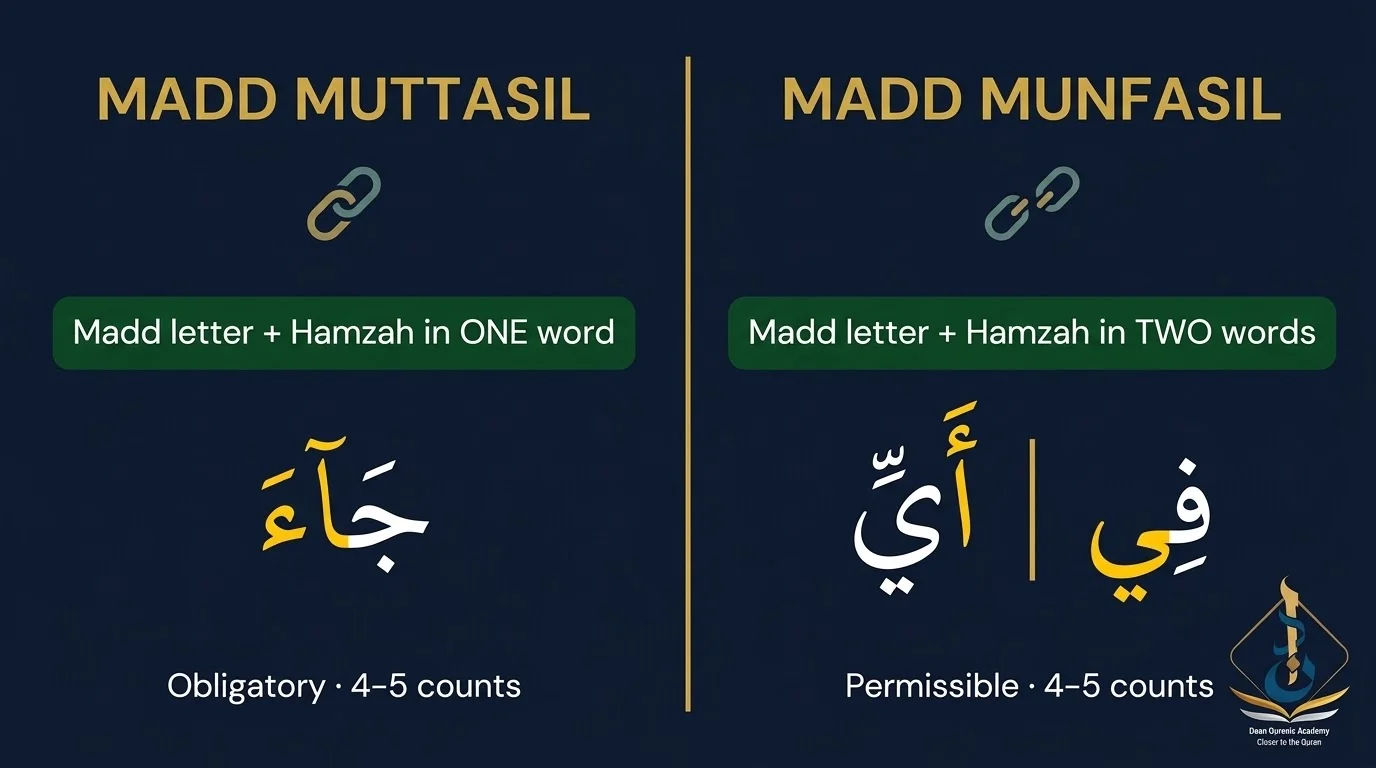
To see why it is called “separated”, compare it with its sibling. In madd muttasil, the madd letter and the hamzah sit together inside one word, such as جَاءَ. In madd munfasil, a word boundary separates them, such as قُوا أَنفُسَكُمْ. Most students find the separated rule easier once they have mastered madd muttasil first.
Three conditions make the rule apply. First, a madd letter (alif after a fathah, waw sakinah after a dammah, or ya sakinah after a kasrah) must end a word. Second, a hamzah must begin the next word. Third, you must read the two words continuously. If you stop on the first word, the extra stretch disappears and it returns to a natural 2-count madd.
This rule is a core part of the Tajweed lessons in our Quran and Tajweed courses, where the madd munfasil examples tajweed rules are taught step by step from the basics. Adults can study it in our Tajweed classes online for adults, and children in our Tajweed classes online for kids.
Madd Muttasil vs Madd Munfasil: Key Differences at a Glance
The key difference is position: madd muttasil keeps the madd letter and hamzah in one word and is obligatory, while madd munfasil splits them across two words and is permissible. Both are lengthened to 4 or 5 counts in Hafs ‘an Asim, but they differ in ruling, examples and behaviour when you stop.
Real session recording: An adult learner practising madd rules in a live Tajweed session while a certified native Egyptian tutor corrects the length and flow of the recitation. All videos are real, unedited screen-recordings from actual student sessions at Daan Academy, posted with student consent.
| Feature | Madd Muttasil | Madd Munfasil |
|---|---|---|
| Hamzah position | Same word as the madd letter | First letter of the next word |
| Ruling | Obligatory (wajib) | Permissible (ja’iz) |
| Length in Hafs ‘an Asim | 4 or 5 counts when continuing | 4 or 5 counts when continuing |
| Examples | جَاءَ، السَّمَاءِ | إِنَّا أَعْطَيْنَاكَ، قُوا أَنفُسَكُمْ |
| If you stop on the madd word | Stays long (a longer stop length is allowed) | Returns to a natural 2 counts |
One practical rule: keep madd muttasil at least as long as madd munfasil, and keep each length consistent throughout your recitation. Using 2 counts in one verse and 5 in the next is among the most common madd muttasil and madd munfasil mistakes our tutors correct.
If you want to avoid other habits that creep into recitation, read our guide on 5 Common Tajweed Mistakes Non-Arabic Speakers Make and How to Fix Them.
Madd Munfasil Examples from Quran: Verses and Reading Guide
The most famous madd munfasil example is يَا أَيُّهَا النَّاسُ, where the alif of “yā” meets the hamzah of “ayyuhā” across two words. Other classic madd munfasil examples include إِنَّا أَعْطَيْنَاكَ, قُوا أَنفُسَكُمْ and وَفِي أَنفُسِكُمْ.
In this verse, the alif ending إِنَّا is followed by the hamzah that begins أَعْطَيْنَاكَ. You stretch the alif for 4 or 5 counts, then continue smoothly without breaking the hamzah. Notice that this is madd munfasil and not madd muttasil, because the two letters belong to different words.
- يَا أَيُّهَا النَّاسُ — Al-Baqarah, 2:21 (alif then hamzah)
- قُوا أَنفُسَكُمْ — At-Tahrim, 66:6 (waw then hamzah)
- وَفِي أَنفُسِكُمْ — Adh-Dhariyat, 51:21 (ya then hamzah)
- بِمَا أُنزِلَ إِلَيْكَ — Al-Baqarah, 2:4 (alif then hamzah)
- إِنَّا أَنزَلْنَاهُ — Al-Qadr, 97:1 (alif then hamzah)
Read each example slowly, then at normal pace, and always at the same count. Keep this list of madd munfasil examples from Quran verses on your phone and revisit it with your tutor during revision.
Madd Munfasil Examples Tajweed Rules: Counts, Length and Mistakes
The standard length for madd munfasil in Hafs ‘an Asim is 4 or 5 counts (harakat), compared with 2 counts for a natural madd. One count is roughly the time it takes to raise or lower a finger at a steady, unhurried pace.
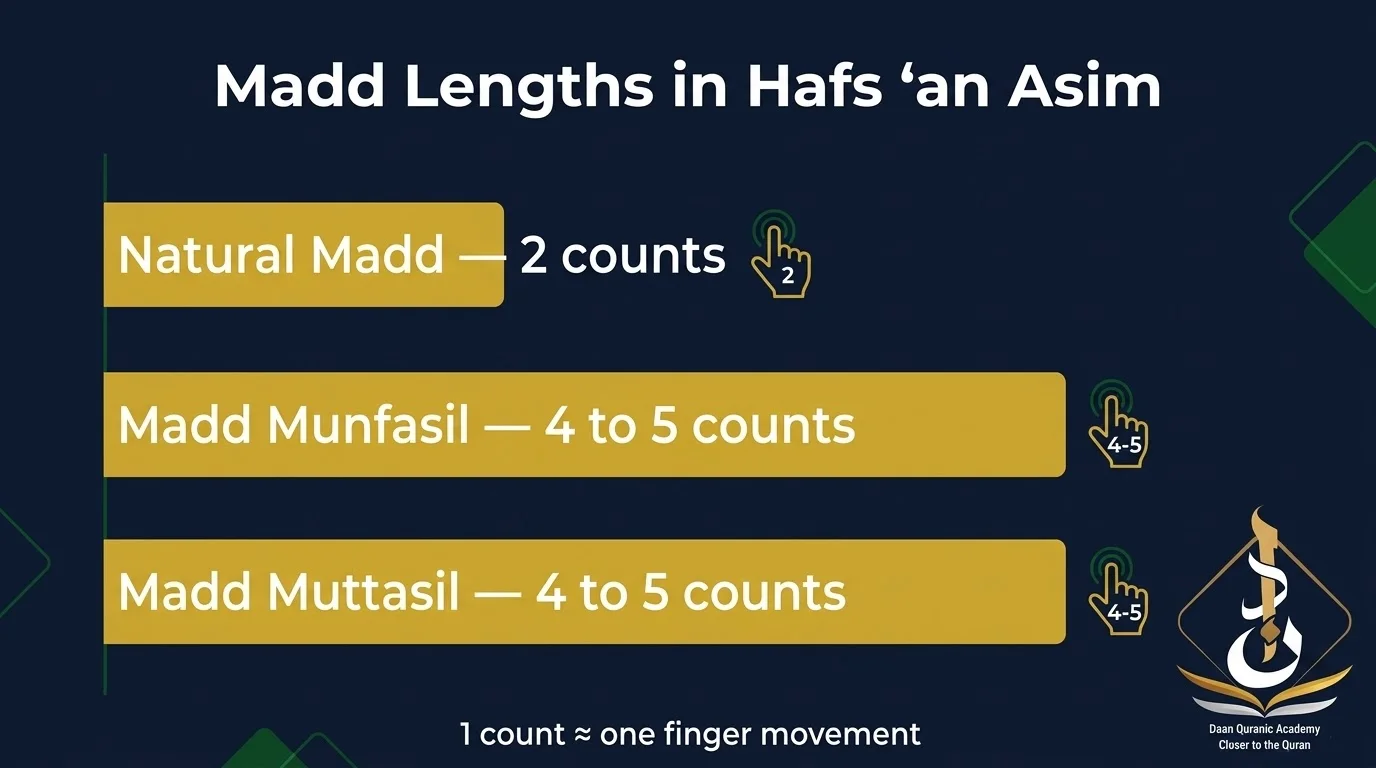
These madd munfasil examples tajweed rules refer to the Hafs ‘an Asim reading, the most widely taught around the world. Some other Qira’at allow shorter lengths for madd munfasil, so always follow the riwayah your teacher is certified in. Many Daan Academy tutors hold Ijazah in multiple Qira’at with verified chains, so they can explain those differences with authority.
Watch out for these frequent errors:
- Shortening to 2 counts and treating madd munfasil as a natural madd.
- Inconsistent length, such as 4 counts in one verse and 5 in the next.
- Stretching after stopping on the first word, where the rule no longer applies.
- Breaking the hamzah with a pause or breath between the two words.
- Treating madd munfasil as obligatory like madd muttasil, which wrongly stops learners from flowing.
Tap a steady beat on your desk while you recite. Choose 4 or 5 counts and keep that tempo for every madd munfasil in the same recitation.
Madd Muttasil and Madd Munfasil: A Step-by-Step Practice Plan
To practise madd muttasil and madd munfasil, identify the madd letter, check where the hamzah sits, choose one length, then drill short verses with feedback. Follow these five steps in order.
Spot the Madd Letter
Look for an alif after a fathah, a waw sakinah after a dammah, or a ya sakinah after a kasrah. These are the only letters that can carry the rule.
Check Where the Hamzah Sits
If the hamzah is in the same word, it is madd muttasil. If it begins the next word, it is madd munfasil.
Choose One Length
Pick 4 or 5 counts, and keep madd muttasil at least as long as madd munfasil. Confirm the choice with your tutor.
Drill with Short Verses
Start with madd muttasil in إِذَا جَاءَ نَصْرُ اللَّهِ (Surah An-Nasr, 110:1), then move to the madd munfasil examples from Quran verses listed above.
Record and Get Corrected
Record yourself, listen back, then recite live with a qualified tutor. Ear training is the fastest way to fix length errors.
If you are not sure where your level sits, book a free trial session and your tutor will assess your recitation in the first lesson.
Try one of 700+ games on the Daan platform 🎮
Best Way to Learn Madd Muttasil and Madd Munfasil Online in 2026
The best way to learn madd muttasil and madd munfasil online is with a certified native Arabic tutor in live 1-on-1 sessions, because elongation lengths can only be corrected by ear. Apps and videos cannot hear your 4 versus 5 counts, so look for these criteria before you enrol.
What to Look For: Certified Native Tutors
Many platforms use non-native speakers. At Daan Academy, all tutors are native Arabic speakers from Egypt, formally trained in Quranic sciences, and many hold Ijazah in multiple Qira’at with chains back to the Prophet ﷺ. You can meet the team on our certified Quran tutors page.
What to Look For: Private Sessions in Fluent English
Unlike group classes that dilute attention, Daan provides 1-on-1 live sessions. Every tutor also speaks fluent English, so a revert or a child can ask “why 4 counts?” and receive an answer they understand. Classes run at flexible times from anywhere, with smart reminders before every session.
What to Look For: Progress You Can See
The Smart Student Dashboard (Daan LMS) lets students track sessions, balance and progress reports in one place. Detailed session reports, monthly updates and verified certificates for each milestone show whether your madd lengths are improving. For children, our library of 600+ educational games keeps practice fun, and 24/7 dedicated support is always on hand.
“The best among you are those who learn the Quran and teach it.”
Narrated by Uthman ibn Affan — Sahih al-Bukhari 5027
Families across 15+ countries trust Daan Quranic Academy for Tajweed, from first-time readers to advanced reciters. See what sets the academy apart on our Why Choose Us page.
Plans start from just $9/hr (Essential), then $10.99/hr (Pro) and $12.99/hr (Elite). Compare our three transparent pricing plans. The Elite plan includes a family discount, and our referral program gives both you and a friend a discount.

Frequently Asked Questions
What is the difference between madd muttasil and madd munfasil?
In madd muttasil, the madd letter and hamzah are in the same word, and the lengthening is obligatory. In madd munfasil, the hamzah starts the next word, and the lengthening is permissible. Both are read at 4 or 5 counts in Hafs ‘an Asim.
How many counts is madd muttasil and madd munfasil?
In the standard Hafs ‘an Asim recitation, both are read at 4 or 5 counts when you continue reading. Keep your choice consistent, and keep madd muttasil at least as long as madd munfasil.
Can I try a Tajweed class before committing?
Yes. Daan Academy offers a risk-free session with no commitment, where your tutor assesses your recitation and explains rules like madd munfasil. You can claim your free trial class in minutes.
How much do online Tajweed classes cost?
Daan Academy plans start from $9/hr (Essential), $10.99/hr (Pro) and $12.99/hr (Elite), all with 1-on-1 live sessions. You can compare every feature on the pricing plans page.
How do I know if my Tajweed tutor is qualified?
Look for native Arabic speakers who are formally trained in Quranic sciences and hold an Ijazah with a verified chain. At Daan Academy, all tutors are native Egyptian Arabs, and many hold Ijazah in multiple Qira’at.
Can my child learn madd rules online safely?
Yes. Every session is private and 1-on-1, parents can follow session reports on the Daan LMS dashboard, and games make practice enjoyable. Browse our children’s Quran and Tajweed courses to find the right level.
Master Madd Rules with a Certified Native Tutor
Reading madd muttasil and madd munfasil correctly takes a trained ear. Book a free session and hear the difference a certified Egyptian tutor makes.
No commitment required. One free session to experience the Daan Academy difference.
Final Thoughts: Read Madd Muttasil and Madd Munfasil with Confidence
Madd munfasil is simple once you remember the pattern: a madd letter at the end of a word, a hamzah at the start of the next, and a steady 4 or 5 counts. Compare it with madd muttasil, practise with the madd munfasil examples tajweed rules above, and ask a qualified tutor to check your lengths.
Whenever you are ready to refine your recitation, explore more guides on our Tajweed and Quran learning blog. We ask Allah to make us among those who recite His Book with excellence, and to increase us in knowledge:
رَبِّ زِدْنِي عِلْمًا — “My Lord, increase me in knowledge.” May Allah bless your journey to mastering madd muttasil and madd munfasil.