Islamic Parenting: Quranic Verses and Hadiths on Child Upbringing
What does the Quran say about raising a child? The Quran and the authentic Sunnah set out a complete, practical framework for child upbringing — grounding a child in tawheed, establishing the habit of prayer, modelling good character, and treating every child with justice and mercy. These aren’t abstract ideals. Every Muslim parent can put them into daily practice, and doing so becomes far easier with **qualified, native Arabic-speaking guidance** rather than guesswork alone.
📑 Table of Contents
- What Does the Quran Say About Raising a Child?
- Quranic Verses on Child Upbringing Every Muslim Parent Should Know
- Hadith on Child Upbringing: What the Prophet ﷺ Taught Us
- What to Look For When Teaching Islamic Parenting Values
- Quranic Verses on the Responsibilities of Parents in Raising Children
- Islamic Responsibilities of Parents: A Practical Guide
- Online vs Traditional: Reinforcing Islamic Values at Home
- What Age Should Parents Start Teaching Islamic Values?
- How Much Does It Cost — and Why Families Trust This Approach
- Frequently Asked Questions
What Does the Quran Say About Raising a Child?
The Quran teaches that raising a child means grounding them in tawheed (belief in the Oneness of Allah), establishing the habit of prayer, modelling good character, and treating them with justice and mercy — a framework drawn most directly from Luqman’s counsel to his son in Surah Luqman, and reinforced throughout the authentic Sunnah of the Prophet ﷺ.
When parents search for what does the Quran say about raising a child, they’re usually looking for something more than inspiration — they want a workable framework. The Quran describes children as a trust (amanah) and a comfort to the eyes (Surah Al-Furqan 25:74), but a trust still has to be actively fulfilled through daily teaching, correction, and example.
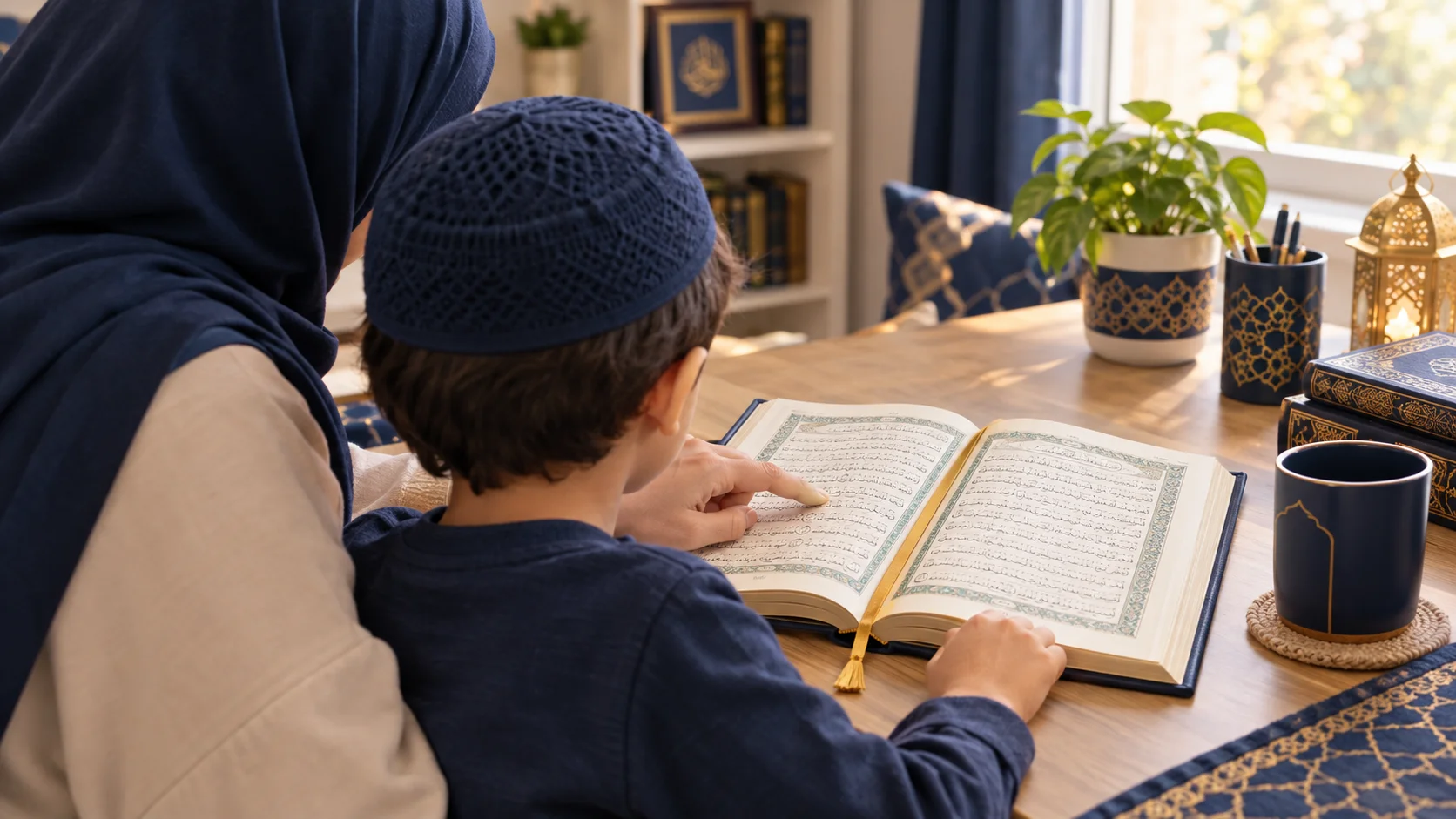
In 2026, Muslim families across the UK, USA, Europe, and Australia are raising children in environments that don’t always reinforce these values by default, which is exactly why turning Quranic principles into consistent routines matters so much. That’s where structured support — such as the specialized Quran, Tajweed, and Islamic Studies courses offered at Daan Quranic Academy — helps parents translate scripture into a real weekly rhythm for their children.
Quranic Verses on Child Upbringing Every Muslim Parent Should Know
The most frequently cited Quranic verses on child upbringing come from Surah Luqman, chapter 31, where a wise, believing father counsels his son on faith, worship, and character in a passage scholars regard as the Quran’s clearest blueprint for parenting.
يَا بُنَيَّ لَا تُشْرِكْ بِاللَّهِ ۖ إِنَّ الشِّرْكَ لَظُلْمٌ عَظِيمٌ
“O my son, do not associate anything with Allah. Indeed, association with Him is a tremendous wrong.”
This is the very first lesson Luqman gives his son, and it sets the order of priorities for the rest of a child’s upbringing: aqeedah (belief) comes before rituals, and rituals come before everything else. A child who understands who Allah is will carry that foundation into every later lesson about prayer, honesty, and kindness.
Real session recording: A native Egyptian tutor walking a student through the sciences of hadith, the same discipline that preserves the sayings of the Prophet ﷺ referenced throughout this guide. All videos are real, unedited screen-recordings from actual student sessions at Daan Academy, posted with student consent.
A few verses later, Luqman’s advice turns from belief to action:
يَا بُنَيَّ أَقِمِ الصَّلَاةَ وَأْمُرْ بِالْمَعْرُوفِ وَانْهَ عَنِ الْمُنكَرِ وَاصْبِرْ عَلَىٰ مَا أَصَابَكَ ۖ إِنَّ ذَٰلِكَ مِنْ عَزْمِ الْأُمُورِ
“O my son, establish prayer, enjoin what is right, forbid what is wrong, and be patient with whatever befalls you. Indeed, that takes real resolve.”
Notice the order again: prayer first, then character, then patience — because a parent who can’t model patience will struggle to teach it. For a deeper look at putting the prayer instruction into practice at home, see our guide on building a plan for teaching salah to non-Arabic-speaking children.
Hadith on Child Upbringing: What the Prophet ﷺ Taught Us
The clearest hadith on child upbringing describes every parent as a shepherd who will be questioned about how they cared for their flock — a responsibility the Prophet ﷺ placed squarely on both mothers and fathers, not on the wider community or the school system.
“Each of you is a shepherd, and each of you is responsible for his flock. A man is a shepherd over the people of his household, and a woman is a shepherd over her husband’s house and children — every one of you will be asked about those in your care.”
Narrated by Abdullah ibn Umar — Sahih al-Bukhari 7138 & Sahih Muslim 1829
This hadith on child upbringing is why Islamic scholarship treats parenting as worship, not just biology. A second, very practical hadith gives an actual timeline for building the habit of prayer:
“Instruct your children to pray when they reach the age of seven, and if they still neglect it by the age of ten, discipline them gently for it — and from that age, keep their beds separate.”
Narrated by Abdullah ibn Amr — Sunan Abi Dawud 495
Scholars are clear that the discipline mentioned here is meant to be mild and non-harmful — a last resort after years of gentle instruction, not a first response. What matters for parents today is the staged structure: introduce prayer around seven, take it seriously by ten. Turning that staged structure into a real weekly habit is much easier with a dedicated tutor who tracks a child’s progress — every tutor at Daan Quranic Academy is a native Egyptian, formally trained in the Quranic sciences, with many holding Ijazah certification in multiple Qira’at.
What to Look For When Teaching Islamic Parenting Values
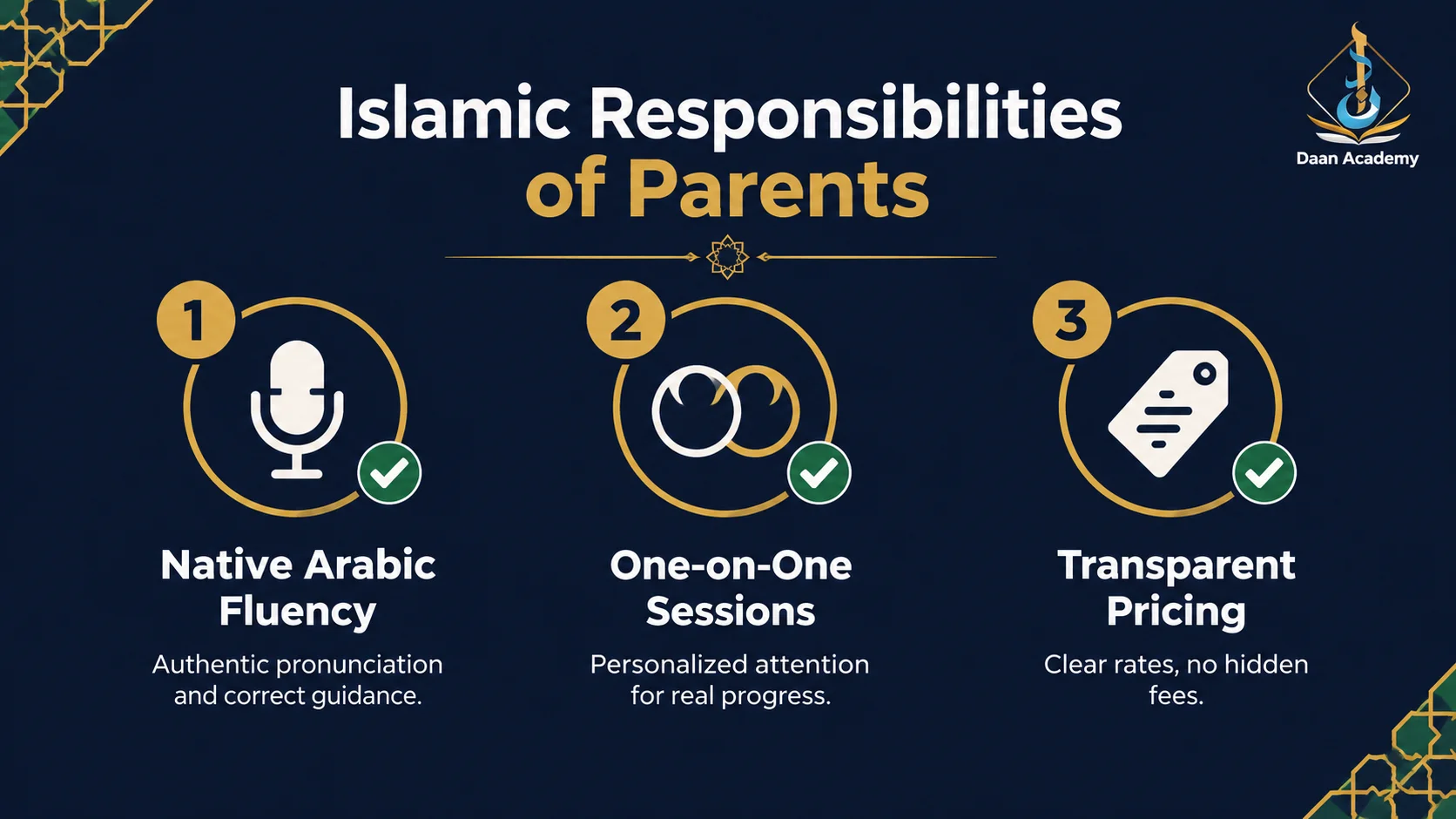
The right support for Islamic parenting combines a fluent, qualified native Arabic speaker, genuinely one-on-one attention, and transparent pricing — three criteria that separate a program that actually builds a child’s understanding from one that only keeps them occupied for an hour a week.
Native Arabic Fluency, Not Just Recitation
A tutor who speaks Arabic as a first language catches pronunciation and Tajweed errors an English-speaking teacher may miss entirely. At Daan Academy, every tutor is a native Egyptian, and every tutor also communicates fluently in English, so nothing gets lost between correcting your child and explaining why the correction matters.
Genuinely One-on-One Sessions
Unlike group classes that dilute attention across six or eight children at once, a private session means the tutor adjusts pace, tone, and examples to your specific child. This matters even more for character-building than for recitation, since a shy or distracted child rarely opens up in a crowd.
Transparent, Family-Friendly Pricing
Some platforms lack clarity on what you’ll actually pay month to month. Daan Academy’s three plans are clearly listed starting from just $9/hr, so parents can budget with confidence instead of guessing at hidden fees.
Quranic Verses on the Responsibilities of Parents in Raising Children
The clearest Quranic verses on the responsibilities of parents describe protecting the family from harm as a direct command, not a suggestion — a responsibility the Quran places on believers before it places it on any institution.
يَا أَيُّهَا الَّذِينَ آمَنُوا قُوا أَنفُسَكُمْ وَأَهْلِيكُمْ نَارًا وَقُودُهَا النَّاسُ وَالْحِجَارَةُ عَلَيْهَا مَلَائِكَةٌ غِلَاظٌ شِدَادٌ لَا يَعْصُونَ اللَّهَ مَا أَمَرَهُمْ وَيَفْعَلُونَ مَا يُؤْمَرُونَ
“O you who believe, protect yourselves and your families from a Fire whose fuel is people and stones, watched over by angels who are stern and severe — they never disobey what Allah commands them, and they do exactly as they are told.”
Classical commentators, including Ibn Abbas, explain this protection as teaching your family religion and good conduct — not physical safety alone. Responsibility also means fairness between children, something the Prophet ﷺ addressed directly:
“Fear Allah, and be just and fair among your children.”
Narrated by An-Nu’man ibn Bashir — Sahih al-Bukhari 2587 & Sahih Muslim 1623
The occasion for this hadith was a father giving one son a gift without giving the others the same, and the Prophet ﷺ refused to witness it until it was corrected. Fairness in attention, time, and even in gifts is not optional — it’s part of the responsibilities of parents in Islam.
| Responsibility | Quranic or Prophetic Basis | What It Looks Like Day-to-Day |
|---|---|---|
| Protecting their faith (tawheed) | Surah Luqman 31:13 | Teaching the names and oneness of Allah before anything else |
| Establishing worship | Surah Luqman 31:17; Abu Dawud 495 | Modelling salah, then commanding it from around age seven |
| Guarding them from harm | Surah At-Tahrim 66:6 | Teaching halal and haram, online safety, good company |
| Practicing justice and fairness | Sahih al-Bukhari 2587 | Equal love, time, and gifts shared between siblings |
Islamic Responsibilities of Parents: A Practical Guide
Putting the Islamic responsibilities of parents into practice comes down to five repeatable habits — none of which require perfection, only consistency over years rather than weeks.
Start With Tawheed, Not Just Rituals
Before drilling recitation, talk about who Allah is in simple, age-appropriate language. A child who understands the “why” behind prayer holds onto it far longer than one who only memorizes the “how.”
Establish the Habit of Salah Early
Following the Prophetic timeline, introduce prayer gently around age seven and treat it seriously by ten. Praying alongside your child, rather than only instructing from the sidelines, makes the habit stick.
Model the Character You Want to See
Children absorb adab (manners) by watching, not by being lectured. Patience, honesty, and gentle speech at home teach more than any single lesson ever could.
Give Them Ownership of the Quran and Arabic
A child who can read Arabic and understand basic Quranic vocabulary builds a personal relationship with the text rather than a dependent one. Structured Noorani Qaida and Quranic Arabic courses are designed for exactly this stage.
Make Dua for Them Consistently
Surah Al-Furqan 25:74 records believers asking Allah for offspring who are “a comfort to the eyes” — a reminder that raising righteous children is ultimately a partnership between effort and dua, not effort alone.
Online vs Traditional: Reinforcing Islamic Values at Home
Structured one-on-one online instruction reinforces Islamic values more consistently than occasional weekend classes, simply because consistency — not intensity — is what turns a Quranic principle into a lasting habit.
A once-a-week mosque class is valuable for community, but it rarely offers the personalized correction a child needs to progress in Tajweed or memorization. Where many platforms use non-native speakers or rotate tutors frequently, Daan Academy pairs each child with a consistent native Egyptian tutor, so progress compounds instead of restarting every term.
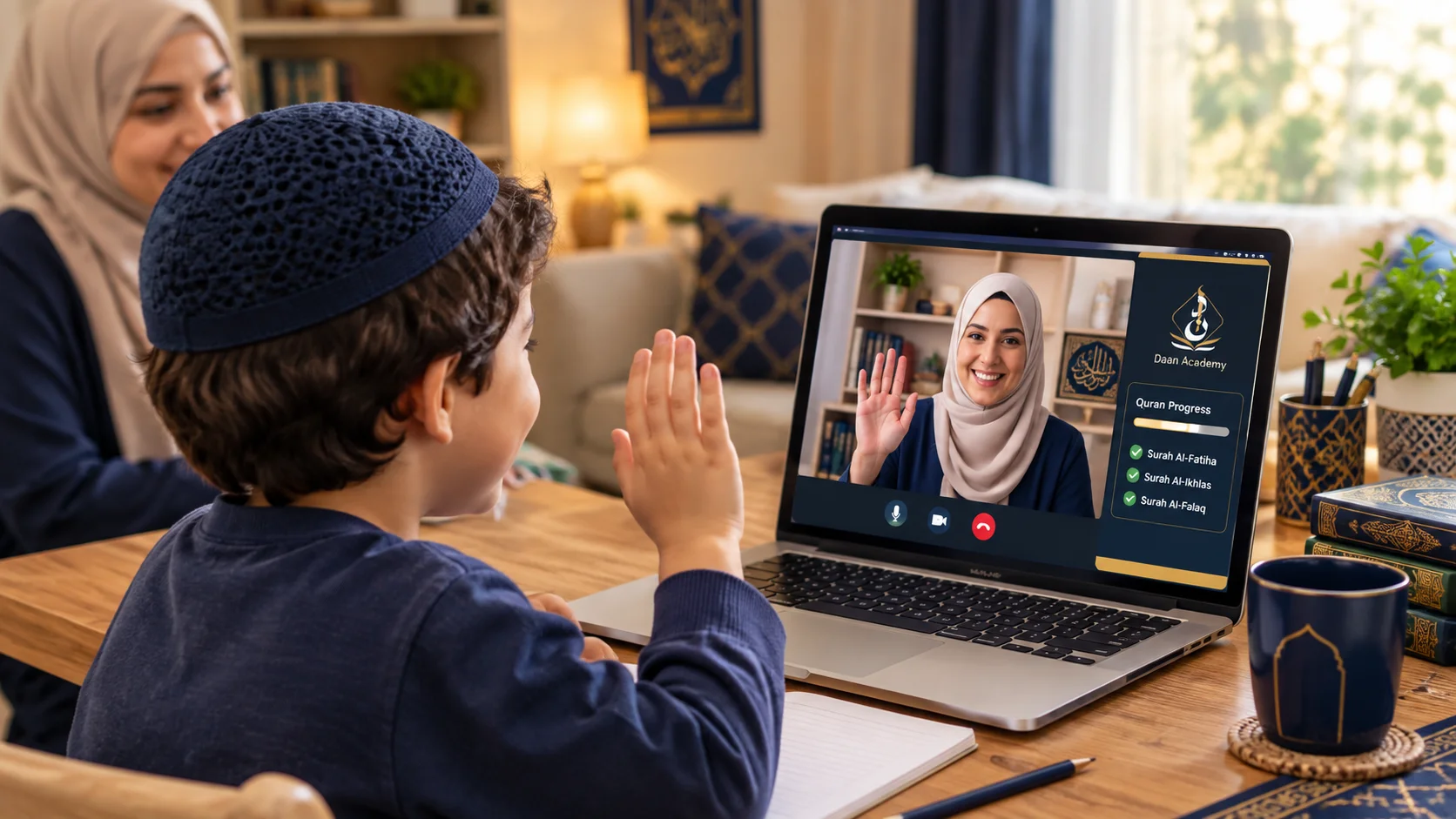
Engagement matters just as much as instruction. Daan’s 600+ educational games library keeps younger children motivated between lessons, while the Smart Student Dashboard (Daan LMS) gives parents a transparent, real-time view of sessions completed, balance, and progress reports — so you’re never guessing how your child is actually doing.
None of this replaces the values you teach at home; it reinforces them. If you’d like to see how a real session runs before deciding, Daan Academy offers a free trial session with no commitment required.
What Age Should Parents Start Teaching Islamic Values?
Most Islamic educators recommend introducing basic concepts — like the names of Allah and short surahs — from around age three or four, formal Quran reading from five or six, and structured Tajweed from around seven, which lines up closely with the Prophetic instruction to command prayer at that same age.
Every child develops differently, so these ages are a guide rather than a rule. What matters more than the exact starting age is starting with the right foundation — Noorani Qaida before fluent recitation, and fluent recitation before Tajweed rules. For a closer look at getting this sequencing right, see our guide on the best age to start teaching your child Noorani Qaida.
How Much Does It Cost — and Why Families Trust This Approach
Structured Quran and Islamic Studies guidance at Daan Academy starts from $9/hr on the Essential plan, with Pro and Elite tiers available for families who want additional features like family discounts and expanded course access.
Plans start from just $9/hr with native Egyptian tutors. Compare the three flexible pricing tiers — Essential, Pro, and Elite — each designed around different learning goals and family budgets, with a family discount available on Elite.
Trusted by Families Across the UK, USA, Europe & Australia
At Daan Quranic Academy, families across 15+ countries rely on the same core promise: certified, native Egyptian tutors — many holding Ijazah with verified chains — teaching one child at a time, with verified certificates marking each course milestone and 24/7 support for anything technical or academic. You can read more about the academy’s approach on the Why Choose Us page.
Frequently Asked Questions
What does the Quran say about raising a child?
The Quran, especially through Luqman’s advice to his son in Surah Luqman, emphasizes teaching tawheed first, then establishing prayer, then building good character and patience. You can explore how Daan Academy structures these stages in its Quran and Islamic Studies courses.
How much do online Quran and Islamic Studies classes for children cost?
At Daan Academy, plans start from $9/hr on the Essential tier, with Pro and Elite options for families wanting more. Full details are on the pricing plans page.
Can I try a class before committing to a plan?
Yes — Daan Academy offers a free trial session with no commitment required, so you can see how a live one-on-one session runs before choosing a plan.
What age should I start teaching my child Quran and Islamic values?
Most educators suggest simple concepts from age three or four, formal reading from five or six, and structured Tajweed around seven — matching the Prophetic guidance to introduce prayer at that same age.
Are online tutors qualified to teach Islamic parenting values, not just recitation?
At Daan Academy, every tutor is a native Egyptian trained in the Quranic sciences, and many hold Ijazah certification. Meet the team on the Our Tutors page.
Is online Quran education safe and effective for young children?
Sessions are one-on-one and supervised throughout, with progress visible to parents via the Smart Student Dashboard. Learn more about the academy’s approach on the Why Choose Us page.
What’s included in the free trial session?
A full live one-on-one session with a native Egyptian tutor, including an informal assessment of your child’s current level — with no obligation to continue afterward.
Turn These Verses Into a Weekly Habit for Your Child
Reading about Islamic parenting is the easy part — building the routine is where most families need support. A free trial session with a native Egyptian tutor is the simplest way to start.
No commitment required. One free session to experience the Daan Academy difference.
Final Thoughts
What does the Quran say about raising a child, in the end? It says start with belief, build the habit of prayer, model good character, and be fair — and it says to keep asking Allah for help along the way, just as the believers do in Surah Al-Furqan when they ask for children who are “a comfort to the eyes.”
Rabbana hab lana min azwajina wa dhurriyyatina qurrata a’yunin waj’alna lil-muttaqina imama — “Our Lord, grant us from among our spouses and offspring comfort to our eyes, and make us leaders for the righteous.” Ameen.