
Madd Rules in Tajweed Explained: Types & Letters
Madd rules in Tajweed govern exactly how long you must stretch certain letters when reciting the Qur’an — and getting the count wrong doesn’t just sound off, it can genuinely change the meaning or grammatical structure of a word. This guide walks through every madd letter, every category of madd, and the exact counts scholars have preserved for each — then shows you how a qualified, native-speaking tutor can help you apply them correctly from your very first session.
📑 Table of Contents
- What Are Madd Rules in Tajweed?
- The Madd Letters in Tajweed
- Types of Madd in Tajweed: The Complete Breakdown
- Madd Far’i Explained: Muttasil, Munfasil, and Lazim
- How to Choose the Best Place to Learn Madd Rules in Tajweed
- Online vs In-Person Tajweed Classes: Which Helps You Master Madd Faster?
- Common Mistakes When Applying Madd in Arabic Tajweed
- What Does Learning Madd Rules in Tajweed Cost?
- How Many Types of Madd Are There in Tajweed?
- Frequently Asked Questions
What Are Madd Rules in Tajweed? A Complete Definition
Madd rules in Tajweed are the set of guidelines that determine how long a reciter must elongate specific letters in the Qur’an — usually the letters Alif, Waw, and Yaa when they appear without a vowel directly after a matching short vowel. Each rule specifies an exact duration, measured in units called harakat (counts), so that recitation stays faithful to how the Prophet ﷺ himself recited and taught the Qur’an.
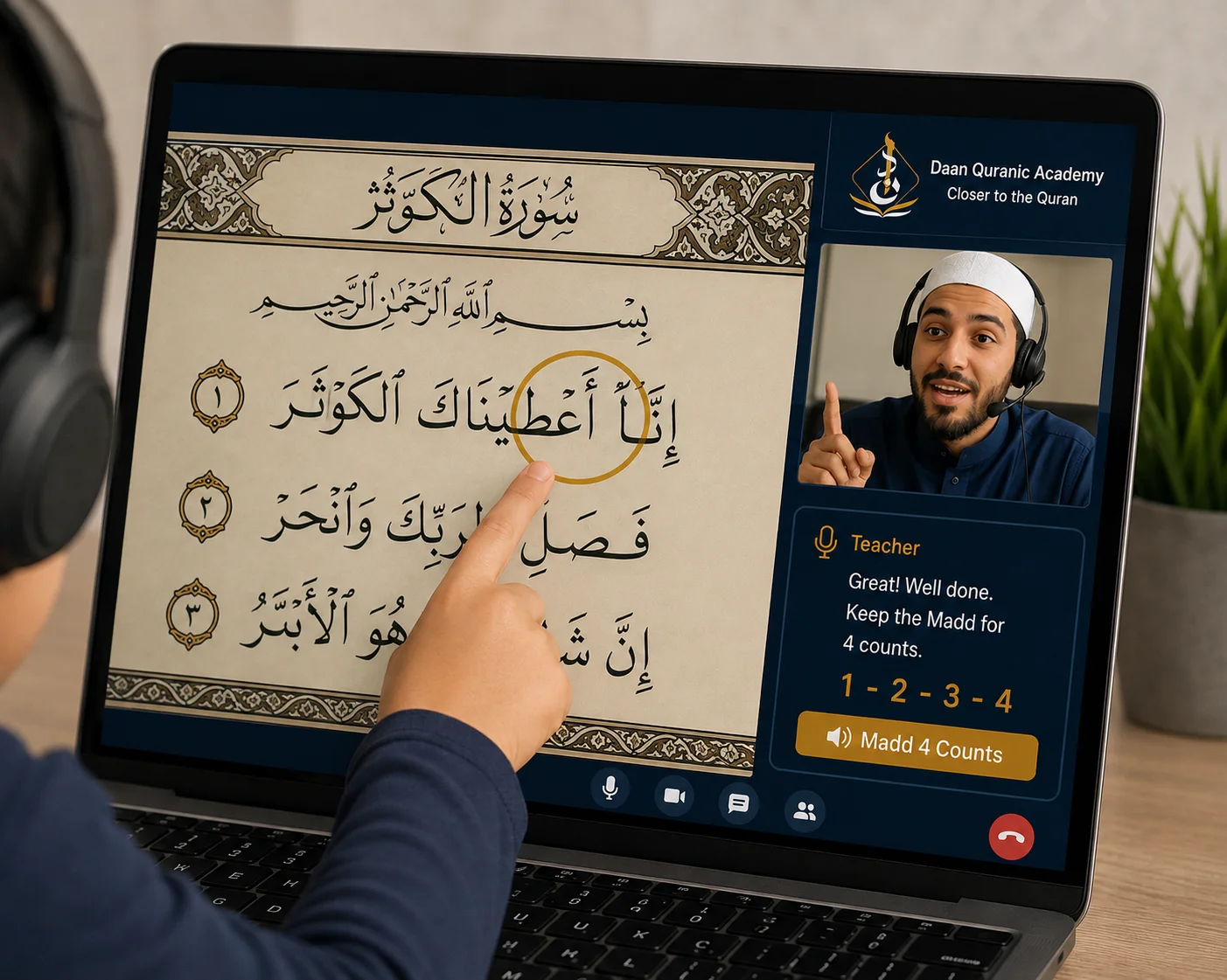
Why does this matter beyond ritual precision? Because Arabic is a language where vowel length can be grammatically meaningful. Shortening a madd that should be six counts, or stretching one that should only be two, can distort the rhythm of the ayah and, in some cases, obscure the word being recited. This is precisely why madd rules in Tajweed are taught as a distinct, structured topic rather than picked up casually.
At Daan Quranic Academy, madd rules are woven into the Tajweed Rules Mastery course from the very first lessons, because they form the backbone of accurate recitation. The Prophet ﷺ was praised for the beauty and precision of his Qur’an recitation, and the science of Tajweed — including madd — exists to help every reciter, however far removed in time, approach that same standard.
Consider this hadith on the reward tied to learning and teaching the Qur’an correctly:
“The best among you are those who learn the Qur’an and teach it.”
Narrated by Uthman ibn Affan — Sahih al-Bukhari, Hadith 5027
Learning the correct application of madd is part of learning the Qur’an properly — not a separate, optional skill. It is one of the clearest, most teachable entry points into Tajweed, which is exactly why it’s usually one of the first structured topics covered in a serious Quran recitation course.
The Madd Letters in Tajweed: The Three Letters of Elongation
There are three madd letters in Tajweed: Alif (ا), Waw (و), and Yaa (ي) — each one triggers elongation only when it is sakin (carries no vowel of its own) and is immediately preceded by a matching short vowel: a fatha before Alif, a dammah before Waw, and a kasrah before Yaa.
Real session recording: An adult student practices applying madd rules in Tajweed while a certified native Egyptian tutor listens for the correct count and corrects the elongation in real time. All videos are real, unedited screen-recordings from actual student sessions at Daan Academy, posted with student consent.
These three madd letters Tajweed recognizes are easiest to spot in common words: قَالَ (qaala, “he said”) carries the Alif madd, يَقُولُ (yaqoolu, “he says”) carries the Waw madd, and قِيلَ (qeela, “it was said”) carries the Yaa madd. In each case, the base elongation is two counts — this baseline is called Madd Asli, and every other type of madd builds on top of it.
Why the Vowel-Letter Pairing Matters
If the vowel before the letter doesn’t match — for example, a kasrah before a Waw — the letter is not functioning as a madd letter at all, and no elongation applies. This is one of the most common early mistakes learners make, and it’s exactly the kind of detail a live tutor catches instantly, but a self-study app or recording usually cannot.
Types of Madd in Tajweed: The Complete Breakdown
There are two main categories of madd in Tajweed: Madd Asli (natural madd) and Madd Far’i (secondary or branching madd) — Madd Asli is the baseline two-count elongation, while Madd Far’i covers several additional rules that extend the duration further whenever a hamzah or a sukoon follows the madd letter.
- Madd Asli (Tabee’i) — Natural Madd: The default two-count elongation with no hamzah or sukoon following. Every other madd is measured against this baseline.
- Madd Muttasil — Connected Madd: A madd letter followed by a hamzah within the same word, extended to four or five counts.
- Madd Munfasil — Separated Madd: A madd letter at the end of one word followed by a hamzah at the start of the next word, typically four or five counts.
- Madd Lazim — Obligatory Madd: A madd letter followed by a permanent sukoon or a shaddah, always held for six counts.
- Madd ‘Aridh Lissukoon — Temporary Madd: Occurs only when pausing at the end of a word that would otherwise end in a short vowel after a madd letter; held for two, four, or six counts depending on the reciter’s choice.
- Madd Badal — Substitute Madd: A hamzah immediately followed by a madd letter (the reverse of the usual pattern), held for two counts.
- Madd Silah — Connecting Madd: Applies to the pronoun “hu/hi” (ه) when it connects two vowelled letters, in either a minor or major form.
- Madd Leen — Soft Madd: A Waw or Yaa sakinah preceded by a fatha, elongated only when pausing on the following letter.
Every one of these types of madd in Tajweed is taught with worked examples inside Daan Academy’s Tajweed and Quran Recitation courses, so learners move from theory to correct, audible application within the same session rather than memorizing rules in the abstract.
Madd Far’i Explained: Muttasil, Munfasil, and Lazim in Detail
Madd Far’i rules extend the standard two-count madd to four, five, or six counts depending on what follows the madd letter — a hamzah in the same word, a hamzah in the next word, or a permanent sukoon or shaddah.
| Type of Madd | What Triggers It | Duration (Counts) | Example |
|---|---|---|---|
| Madd Asli | No hamzah or sukoon follows | 2 | قَالَ |
| Madd Muttasil | Hamzah in the same word | 4–5 | جَاءَ |
| Madd Munfasil | Hamzah at the start of the next word | 2–5 (varies by qira’ah) | إِنَّا أَعْطَيْنَاكَ |
| Madd Lazim | Permanent sukoon or shaddah | 6 | الْحَاقَّةُ |
| Madd ‘Aridh Lissukoon | Pausing on a word ending after a madd letter | 2, 4, or 6 | نَسْتَعِينُ (at a pause) |
| Madd Badal | Hamzah immediately before the madd letter | 2 | آمَنُوا |
Madd Lazim is worth pausing on, because it also appears at the very start of several Surahs, in the disconnected letters known as the muqatta’at. Surah Al-Baqarah opens with exactly this pattern:
الٓمٓ ﴿١﴾ ذَٰلِكَ الْكِتَابُ لَا رَيْبَ ۛ فِيهِ هُدًى لِّلْمُتَّقِينَ ﴿٢﴾
“Alif, Lam, Meem. This is the Book about which there is no doubt, a guidance for those conscious of Allah.”
In “الٓمٓ”, the letter Meem is held for six counts under Madd Lazim Harfi — a rule most self-taught reciters get wrong on their first attempt, because nothing about the written text signals the six-count duration on its own. This is exactly the kind of rule where working with a tutor who holds a verified Ijazah makes the difference between guessing and reciting with certainty.
How to Choose the Best Place to Learn Madd Rules in Tajweed
The best place to learn madd rules in Tajweed is a program that pairs certified, native Arabic-speaking tutors with live, 1-on-1 correction — because madd counts are audible errors, and a self-study app or pre-recorded video simply cannot catch them the moment they happen.

Here’s what actually separates a program that will get your madd rules right from one that leaves you guessing:
Certified, Native Tutors
Look for tutors trained in Quranic sciences, ideally with roots in institutions like Al-Azhar. At Daan Quranic Academy, every tutor is a native Egyptian Arabic speaker, and many hold Ijazah in multiple Qira’at with verified chains of transmission back to the Prophet ﷺ.
1-on-1 Live Correction, Not Group Classes
Unlike group classes that dilute individual attention, Daan Academy provides 1-on-1 live sessions for every student, so a mispronounced Madd Muttasil gets corrected the second it happens — not lost in a crowd of students.
A Curriculum That Covers Every Madd Type
Where many platforms offer a generic overview, Daan’s Tajweed Rules Mastery course walks through every category — Asli, Muttasil, Munfasil, Lazim, ‘Aridh Lissukoon, Badal, Silah, and Leen — with guided practice on real ayahs.
Transparent Progress Tracking
The Daan Smart Student Dashboard logs every session, tracks which madd rules a student has mastered, and shares monthly progress reports — so parents and adult learners alike can see real, measurable improvement rather than a vague sense of “getting better.”
A Real Track Record
Daan Quranic Academy has taught students across 15+ countries, from complete beginners to reverts refining advanced recitation — proof that the same structured approach to madd rules in Tajweed works across ages and starting levels.
If you’d like to see how these criteria translate into an actual curriculum, the Why Choose Us page breaks down tutor credentials and teaching methodology in full.
Online vs In-Person Tajweed Classes: Which Helps You Master Madd Faster?
Online Tajweed classes with a native tutor generally help students master madd rules faster than in-person classes, simply because they remove the geography constraint that limits most families to whichever local teacher happens to be available, qualified or not.
In-person classes can work well when a genuinely qualified, native-speaking Tajweed teacher lives nearby — but for the vast majority of English-speaking Muslims in the UK, USA, and Europe, that’s not realistic. Where most local options offer generic, one-size-fits-all instruction, online platforms let you match with a tutor whose qualifications actually fit what you’re trying to learn.
Flexible scheduling is the other major advantage: Daan Academy’s classes run at any time, from anywhere in the world, with automated smart notifications before every session so nothing gets missed between work, school, and family commitments. You can start with a free trial session to feel the difference for yourself before deciding anything.
Common Mistakes When Applying Madd in Arabic Tajweed
The most common mistake when applying madd in Arabic Tajweed is cutting Madd Lazim short — reciters who are used to the default two-count elongation often stop at two or three counts on a Madd Lazim, when six is required.
- Shortening Madd Lazim: Treating a six-count obligatory madd like a standard two-count natural madd.
- Confusing Muttasil and Munfasil: Applying the wrong duration because the hamzah’s position (same word vs. next word) wasn’t identified correctly.
- Dropping Madd ‘Aridh Lissukoon at a pause: Reciting a word at full speed even when stopping, instead of extending the madd letter before the pause.
- Inconsistent counts between sessions: Without a tutor to correct in real time, self-taught reciters often drift, holding the same madd type for different lengths on different days.
- Missing Madd Silah on the pronoun “hu/hi”: Overlooking this rule entirely, since it’s easy to mistake the pronoun letter for a non-madd sound.
These are exactly the kind of pattern errors covered in our related guide on 5 Common Tajweed Mistakes Non-Arabic Speakers Make and How to Fix Them, and they connect closely to the broader pronunciation issues discussed in Top Arabic Pronunciation Challenges for English Speakers.
What Does Learning Madd Rules in Tajweed Cost?
Learning madd rules in Tajweed with a certified native tutor at Daan Quranic Academy starts from just $9 per hour, with no group-class markup and no hidden fees — every session is private, 1-on-1, and fully personalized to the student’s current level.
Plans start from just $9/hr with native Egyptian tutors. Compare our three flexible pricing tiers — Essential, Pro, and Elite — each designed for different learning goals and budgets.
The Elite plan also includes a family discount, making it practical for households learning together, and the referral program means both an existing student and the friend they invite receive a discount when they sign up. For families weighing cost against quality, the real comparison isn’t price alone — it’s price against what you actually get: a native, Ijazah-holding tutor, transparent progress tracking, and a free trial session with zero commitment required.
How Many Types of Madd Are There in Tajweed?
Scholars of Tajweed typically identify around 15 to 20 distinct sub-types of madd, though nearly all of them fall under two broad umbrellas — Madd Asli and Madd Far’i — and a structured course usually condenses them into six to eight core rules that cover well over 95% of what you’ll encounter in real recitation.
This is good news for beginners: you don’t need to memorize every scholarly sub-classification to recite correctly. You need consistent, corrected practice on the core rules — Asli, Muttasil, Munfasil, Lazim, ‘Aridh Lissukoon, Badal, Silah, and Leen — until applying them becomes automatic.

Frequently Asked Questions
How long does it take to learn madd rules in Tajweed?
Most students grasp the core madd rules within 4–8 weeks of consistent, 1-on-1 practice, though fluent, automatic application takes longer. You can see the pace for yourself with a free trial session before committing to a full course.
Is Madd Lazim always held for six counts?
Yes. Madd Lazim, whether Kalimi (within a word) or Harfi (in the disconnected letters at the start of certain Surahs), is always six counts by scholarly consensus — the longest of all madd durations.
Can I learn madd rules in Tajweed online with a native tutor?
Yes. Every tutor at Daan Quranic Academy is a native Egyptian Arabic speaker who teaches fluently in English, so you get authentic pronunciation and clear explanation in the same session. Meet the team on our Our Tutors page.
How much do Tajweed classes covering madd rules cost?
Plans start from $9/hr for the Essential tier, up to $12.99/hr for the Elite tier, which includes a family discount. Full details are on our Pricing Plans page.
Do I need to know Arabic before learning madd rules in Tajweed?
No. Many students start with little to no Arabic background. Tutors typically begin with Noorani Qaida or basic letter recognition before moving into madd and other Tajweed rules, all explained in fluent English.
Can I try a class before committing to a Tajweed program?
Yes — every new student gets one free trial session with no obligation, so you can experience the teaching style and see how madd corrections work in real time before paying anything.
Is Daan Academy suitable for kids learning madd rules too?
Yes. Alongside adult courses, Daan Academy runs dedicated children’s programs with a 600+ educational games library that reinforces madd letters and counts in an engaging, age-appropriate way.
Master Every Madd Rule with a Real Native Tutor
Reading about madd rules in Tajweed only goes so far — real progress happens when a certified tutor listens to your recitation and corrects your counts live. Book your free trial and experience the Daan Academy difference for yourself.
No commitment required. One free session to experience the Daan Academy difference.
Final Thoughts
Madd rules in Tajweed can feel technical at first, but they follow a logic that becomes second nature with the right guidance: three letters, a baseline of two counts, and a handful of clear conditions that extend that count when a hamzah or sukoon appears. What separates confident reciters from hesitant ones isn’t memorizing definitions — it’s consistent, corrected practice with someone who can hear the difference between four counts and six.
Whether you’re a revert building your recitation from the ground up, a parent guiding a child through their first Surahs, or someone simply looking to refine years of self-taught habits, structured 1-on-1 instruction remains the fastest, most reliable path forward. Explore more guides like this one on our blog, and may Allah make the recitation of His Book easy for you, and reward you for every letter perfected. Ameen.