Dua After Wudu (Ablution): What to Say in Arabic & English
The dua after wudu is the short declaration of faith the Prophet Muhammad ﷺ taught his companions to say the moment ablution is complete, and getting the Arabic wording, pronunciation, and timing right matters more than most people realise. Search online and you’ll find a dozen versions, half of them missing a hadith reference. Below is the authentic wording, its source in Sahih Muslim, the common mistakes people make when reciting it, and — since pronunciation only really improves with a real teacher correcting you in real time — how a live tutor at Daan Quranic Academy can help you say it with confidence from your very first session.
📑 Table of Contents
- What Is the Dua After Wudu?
- The Dua After Ablution in Arabic, Transliteration & English
- The Hadith Evidence Behind the Dua After Wudu
- Is There a Dua While Making Wudu?
- What Dua to Say After Wudu — And How to Memorise It
- Common Mistakes When Reciting the Dua After Wudu
- Learning Duas Online vs. Memorising From an App
- What Does It Cost to Learn Duas and Tajweed Properly?
- Why Tutor Qualifications Matter
- Dua After Wudu in English: Can You Say It in Your Own Language?
- Frequently Asked Questions
What Is the Dua After Wudu?
The dua after wudu is the shahada — the declaration that there is no god but Allah and that Muhammad ﷺ is His servant and Messenger — recited immediately after completing ablution. It takes about five seconds to say and is recorded in Sahih Muslim as one of the most rewarded short supplications in daily worship. Reciting it consistently, and correctly, is a confirmed sunnah practised by Muslims of every background, including reverts still learning their first Arabic phrases.
Unlike longer adhkar, this dua doesn’t require memorising a paragraph. It requires memorising twelve words precisely, and that precision — the exact letters, the pauses, the elongations — is exactly where self-taught learners tend to drift without realising it. This is one of the reasons live, corrected practice with a qualified tutor changes how quickly someone actually retains it, something we cover in our Islamic Studies and Tajweed courses.

The Dua After Ablution in Arabic, Transliteration & English
Here is the exact wording of the dua after ablution, as narrated in the authentic hadith literature. Say it while facing the direction you finished washing in, ideally raising your gaze slightly, though this last detail is a matter of adab (etiquette) rather than a strict condition.
Transliteration: Ash-hadu an lā ilāha illā Allāhu waḥdahu lā sharīka lahu, wa ash-hadu anna Muḥammadan ‘abduhu wa rasūluh.
Real session recording: An adult student working through the fiqh of worship and correct dua pronunciation with a native Egyptian tutor in a live 1-on-1 lesson. All videos are real, unedited screen-recordings from actual student sessions at Daan Academy, posted with student consent.
Some students also learn a second, longer version that adds a line asking Allah to count them among “those who constantly repent” and “those who purify themselves.” This addition is reported in Jami’ at-Tirmidhi, but its chain was graded weak by hadith scholars such as Ibn Hajar al-‘Asqalani, while others accepted it as a permissible general supplication. The safest approach — and the one we teach at Daan Quranic Academy — is to treat the shahada as the confirmed sunnah and the addition as optional, rather than presenting it as equally authenticated.
Live 1-on-1 correction for short adhkar like this one starts from just $9/hr. Compare our three flexible pricing tiers — Essential, Pro, and Elite — each built around a different pace and budget.
The Hadith Evidence Behind the Dua After Wudu
The dua after wudu is not a custom passed down by tradition alone — it comes directly from an authentic hadith in Sahih Muslim, one of the two most trusted hadith collections in Islam. Knowing the source matters, because it’s what separates a confirmed sunnah from a well-meaning guess.
It was narrated that ‘Umar ibn al-Khattab (may Allah be pleased with him) reported that the Messenger of Allah ﷺ taught: whoever completes their wudu carefully and then bears witness that there is no god but Allah alone, without partner, and that Muhammad is His servant and Messenger, will have all eight gates of Paradise opened for them, free to enter through whichever one they choose.
Source: Sahih Muslim 234, also narrated in Sunan an-Nasa’i 148 and Sunan Ibn Majah — read the full hadith on Sunnah.com.
Wudu itself is commanded directly in the Quran: “O you who have believed, when you rise to perform prayer, wash your faces and your forearms to the elbows and wipe over your heads and wash your feet to the ankles” (Surah Al-Ma’idah, 5:6). The dua afterward is the spiritual seal on a physical act — which is exactly the kind of detail that gets lost when someone learns Tajweed rules and adhkar from disconnected videos instead of a structured course. If mispronunciation is a recurring worry for you, our post on common Tajweed mistakes non-Arabic speakers make is worth reading alongside this one.
Is There a Dua While Making Wudu?
Yes — there is a short phrase to say before wudu begins, but there is no authenticated dua to recite between each limb, despite what many “step-by-step wudu dua” charts online suggest. Separating what’s actually sunnah from what has simply become popular practice is one of the more valuable things a qualified tutor will do for you.
Before starting, it is recommended to say “Bismillah” (in the name of Allah). This is based on a hadith narrated by Abu Hurairah: “The prayer of a person who does not perform ablution is not valid, and the ablution of a person who does not mention the name of Allah is not valid” (Sunan Abi Dawud 101, graded hasan by Al-Albani). Scholars differ on whether this makes Bismillah obligatory or strongly recommended, but either way, it is worth building into the habit.
The lists of individual duas “for washing the hands,” “for rinsing the mouth,” and so on that circulate on social media are not traced back to an authentic hadith from the Prophet ﷺ specifically for wudu. It’s fine to make sincere personal dua silently while washing — that is always encouraged — but presenting those specific phrases as sunnah is inaccurate, and it’s exactly the kind of detail a certified tutor will correct rather than let slide. If a student asks us about a dua while making wudu that they saw on social media, we’ll usually walk them through which parts are authenticated and which are simply popular custom.
What Dua to Say After Wudu — And How to Memorise It
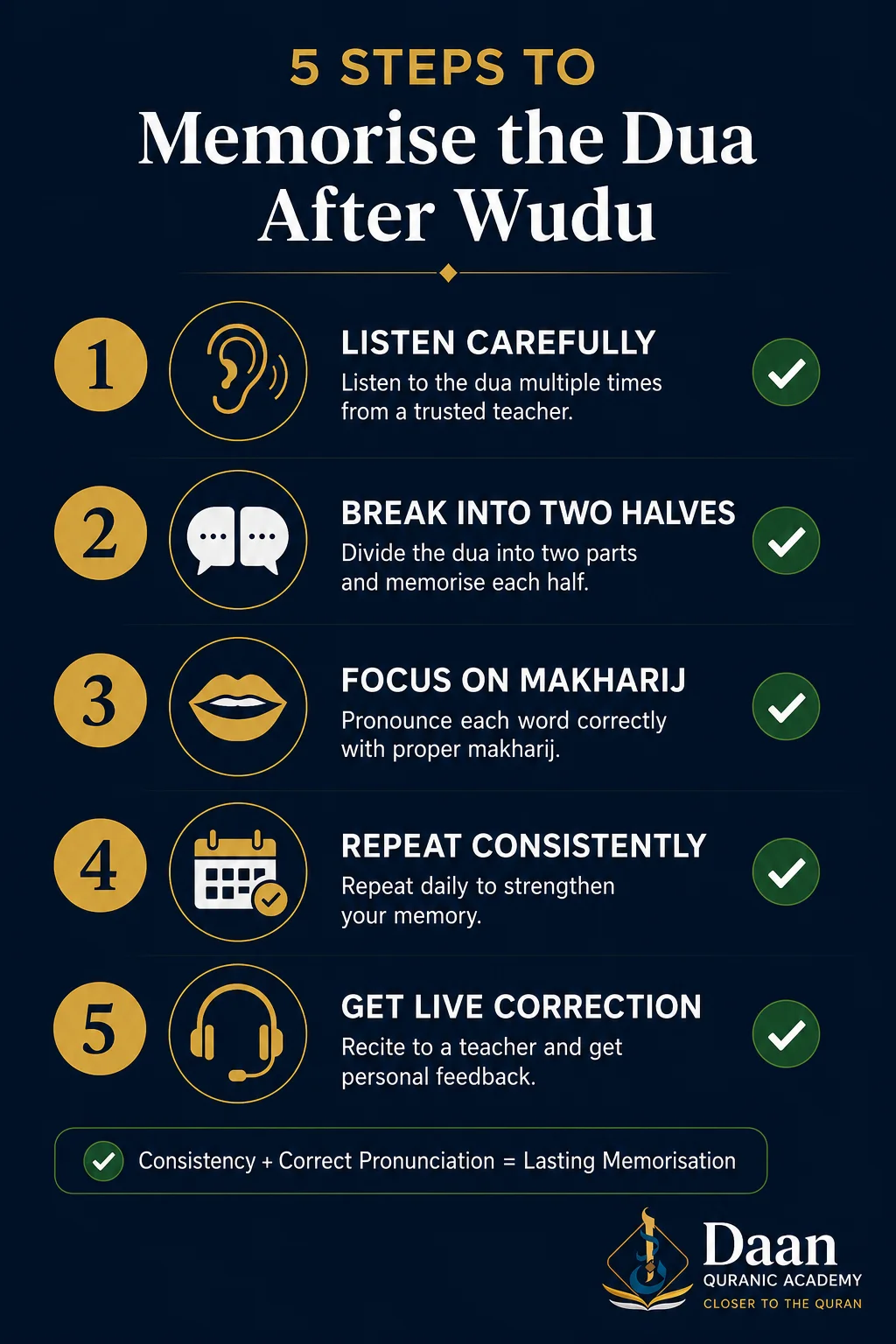
The dua to say after wudu is only twelve Arabic words, but memorising it correctly — not just approximately — usually takes a structured, guided approach rather than passive repetition. Here is the process we walk students through at Daan Quranic Academy.
- Hear it correctly first. Listen to a native Arabic speaker say it slowly, several times, before attempting it yourself — this is where a live tutor beats a recorded video, since they can repeat and adjust pacing to you.
- Break it into two halves. The shahada naturally splits at “wa ash-hadu” — master the first half before adding the second.
- Practise the makharij (letter articulation points). Letters like the ح in “ilaha” and ش in “sharika” are commonly flattened by English speakers without correction.
- Say it aloud after every wudu for a week. Repetition tied to an existing habit (ablution before each prayer) cements it faster than isolated study sessions.
- Get corrected in real time. A tutor who can hear your recitation live — not a self-check against a video — is what actually catches errors before they become habits.
This is exactly what a 1-on-1 session with a Daan Academy tutor is built for: no group class to dilute attention, no waiting your turn — just live correction of your own voice, tracked afterward in your Smart Student Dashboard so you can see your progress session by session. You can test this approach with a free trial session before deciding on anything further.
Common Mistakes When Reciting the Dua After Wudu
The most common mistake isn’t forgetting the words — it’s mispronouncing them confidently for years without anyone correcting it. A few patterns come up again and again with new students.
- Merging “la ilaha” into one rushed sound instead of clearly separating the negation from the affirmation.
- Softening the ح in “ilaha” into an English “h,” which changes the letter’s articulation point entirely.
- Treating the tawwabin addition as compulsory when it is, at best, an optional supplement to the confirmed shahada.
- Saying it silently in one’s head — the sunnah is to say it audibly, even if quietly.
- Skipping it out of embarrassment about pronunciation — which is precisely the problem a private, judgment-free 1-on-1 class solves.
If pronunciation anxiety is holding you back generally — not just with this one dua — it’s worth reading our breakdown of the top Arabic pronunciation challenges for English speakers, since the same handful of letters trip people up across almost every dua and surah.
Learning Duas Online vs. Memorising From an App
Apps and YouTube videos are fine for hearing a dua once, but they cannot tell you when you’ve said it wrong, which is the entire point of learning correct recitation. Where an app plays a fixed recording, a live tutor listens to your specific voice and adjusts on the spot.
| What You Need | App / Self-Study | 1-on-1 Live Tutor |
|---|---|---|
| Hears your actual pronunciation | No | Yes, in real time |
| Corrects makharij mistakes | No | Yes |
| Explains hadith source & grading | Rarely | Yes |
| Adapts pace to the learner | No | Yes |
| Tracks progress over time | Sometimes | Yes — via Daan LMS dashboard |
Where many platforms rely on pre-recorded content or large group classes that dilute individual attention, Daan Academy keeps every session private and one-on-one. It’s a small structural difference that has an outsized effect on how quickly pronunciation actually improves — you can see the full breakdown of what sets our approach apart on our Why Choose Us page.
What Does It Cost to Learn Duas and Tajweed Properly?
Learning to recite duas and Quran correctly with a certified native tutor starts from $9/hr at Daan Academy — considerably less than many people assume private, native-speaker instruction costs. Some platforms keep pricing vague until checkout; ours is published in full upfront.
| Plan | Price | Best For |
|---|---|---|
| Essential | From $9/hr | Beginners, single learners, casual pace |
| Pro | From $10.99/hr | Consistent weekly progress, Hifz & Tajweed focus |
| Elite | From $12.99/hr | Families (with family discount), Ijazah track |
Every plan includes fluent-English-speaking, native Egyptian tutors, session reports, and access to our 600+ educational games library for younger learners. Families enrolling more than one child typically find the Elite plan’s family discount brings the effective per-child rate down further. See the full breakdown, including what’s included at each tier, on our Pricing Plans page.
Why Tutor Qualifications Matter
When evaluating who teaches you Quranic Arabic and duas, look for native fluency, formal training in Tajweed and Qira’at, and — ideally — a documented Ijazah, since these are the credentials that separate a casual reciter from a qualified teacher. This is the single biggest differentiator between academies, more than app features or marketing.
At Daan Quranic Academy, tutors are native Egyptian Arabic speakers, many trained through Al-Azhar-linked institutions and holding certified Ijazah in multiple Qira’at with verified chains of transmission. All communicate fluently in English, which removes the language barrier that slows down so many self-taught learners. Families across more than 15 countries currently study with us, from complete beginners to students working toward a full Ijazah.
If your goal extends beyond a single dua to genuinely understanding Quranic Arabic — vocabulary, grammar, meaning — our guide on how to learn Quran for non-Arabic speakers lays out a realistic 2026 roadmap.
Dua After Wudu in English: Can You Say It in Your Own Language?
The dua after wudu in English can be understood and reflected on in your own language, but the majority of scholars recommend reciting the actual words in Arabic, since the specific reward described in the hadith is tied to the wording the Prophet ﷺ taught. This is a common and completely reasonable question for reverts and new learners.
The practical approach most teachers recommend: understand the English translation fully first, so you know what you’re affirming, then transition to the Arabic as soon as you can pronounce it — even imperfectly. Perfection is not the bar; sincere, audible recitation in Arabic is. This is exactly the transition a structured beginner course is designed to shorten, sometimes to a matter of days rather than months.

Frequently Asked Questions
What is the dua after wudu in Arabic and English?
It is the shahada: “Ash-hadu an lā ilāha illā Allāhu waḥdahu lā sharīka lahu, wa ash-hadu anna Muḥammadan ‘abduhu wa rasūluh” — “I bear witness that there is no god worthy of worship except Allah alone, and I bear witness that Muhammad is His servant and Messenger.” It is recorded in Sahih Muslim 234.
How much do online Quran and dua classes cost?
At Daan Academy, private 1-on-1 sessions start from $9/hr on the Essential plan, with Pro and Elite tiers available for more intensive study. Full details are on our pricing plans page.
Is it safe for my child to learn Quran and duas online?
Yes — every class is private, one-on-one, and conducted by a verified, native Egyptian tutor with fluent English. Sessions are never group-based, and parents can monitor progress directly through the student dashboard.
Can I try a class before committing to a plan?
Yes. Daan Academy offers a completely free trial session with no commitment required, so you can experience a live 1-on-1 class before choosing a plan. Book your free trial here.
Do I have to say the tawwabin addition after the shahada?
No. The core dua — the shahada — is the confirmed sunnah from Sahih Muslim. The additional line asking to be counted among “those who repent” comes from a narration with a disputed chain, so it is optional rather than required.
Can beginners and reverts join with no prior Arabic knowledge?
Yes — most new students start with zero Arabic reading ability. Tutors begin with Noorani Qaida and basic pronunciation before moving into duas, Tajweed, and recitation at a pace suited to the individual student.
How long does it take to learn the dua after wudu correctly?
Most students memorise the wording within one or two guided sessions, though refining pronunciation of specific letters can take a few weeks of consistent practice with correction.
Say It With Confidence — Not Just From Memory
A dua is only fully realised when it’s said correctly. Book a free trial session and let a native Egyptian tutor listen, correct, and guide your recitation of the dua after wudu — and everything you learn after it.
No commitment required. One free session to experience the Daan Academy difference.
Final Thoughts
The dua after wudu is short, but it carries weight — it is the seal placed on an act of purification, said the same way the Prophet ﷺ taught it more than fourteen centuries ago. Learning the exact wording, understanding its hadith source, and having someone correct your pronunciation turns a habit into worship done with real presence.
May Allah accept our wudu, our prayers, and the small daily words we say between them. If you’d like guided help getting the pronunciation right, explore more free guides on our Daan Academy blog, or start with a live session today.