How to Learn Quran for Non-Arabic Speakers: The Ultimate 2026 Guide
You can learn Quran for non-Arabic speakers — fluently, beautifully, and with full Tajweed — regardless of your age, background, or how little Arabic you currently know. The Quran is not reserved for those born into Arabic-speaking households. In 2026, with the right structured approach, certified native tutors available online, and proven phonetic methods built specifically for English-speaking learners, the path from complete beginner to confident Quranic reciter is clearer than it has ever been. This guide gives you the complete, step-by-step framework — from the Arabic alphabet to mastering Tajweed — designed for Muslims in the UK, USA, Europe, and Australia who are ready to answer this divine invitation.
This ayah — repeated four times in the same surah — is Allah’s personal promise to every person who sincerely wants to connect with His Book. “Easy for remembrance” is not a poetic metaphor; it is a divine guarantee. When you learn Quran for non-Arabic speakers, the journey begins not with a language barrier but with a decision: to respond to this invitation with consistency, the right method, and sincere intention. The phonetics, the rules, and the beautiful recitation all follow from that single act of turning toward the Quran with a willing heart.
📑 Table of Contents
- The Myth of the Arabic Barrier
- Phase 1 — Building Your Phonetic Foundation
- Phase 2 — Mastering Tajweed: The Art of Beautiful Recitation
- Phase 3 — Consistency Over Intensity: Daily Practice That Works
- Why a Native Tutor Is Irreplaceable When You Learn Quran for Non-Arabic Speakers
- Tools and Resources for Non-Arabic Speakers in 2026
- Frequently Asked Questions
The Myth of the Arabic Barrier: Can You Really Learn Quran for Non-Arabic Speakers?
The single most common misconception stopping non-Arabic speakers from beginning their Quranic journey is the belief that you must be fluent in conversational Arabic before you can recite the Quran. This belief is not only incorrect — it actively delays people from beginning a practice that could transform their spiritual lives immediately. Quranic recitation (Tilawah) is a phonetic science, not a linguistic one. These are two entirely distinct disciplines, and confusing them is the source of years of unnecessary hesitation for millions of English-speaking Muslims worldwide.
Consider the evidence: many of the most celebrated Qaris (reciters) in the Muslim world come from Indonesia, Pakistan, Bosnia, and West Africa — countries where Arabic is not the native language. They mastered the vocal mechanics of Quranic recitation — the precise articulation of each letter, the correct application of Tajweed rules, and the disciplined repetition that produces accurate and beautiful recitation. Every one of these skills is fully accessible to any English-speaking Muslim. The barrier is not linguistic. It is methodological. With the right structured method and the right teacher, you can learn Quran for non-Arabic speakers at any age, from any starting point.
When you begin to learn Quran as a non-Arabic speaker, it helps to be clear about your immediate goal. Recitation — reading the Quran correctly with Tajweed — and comprehension — understanding the Arabic text — are both valuable, but they are sequential, not simultaneous goals for a beginner. Start with recitation: learn the alphabet, master the phonetics, apply the Tajweed rules. Once you can read fluently, adding meaning and grammatical understanding produces an entirely new layer of spiritual depth. Attempting both simultaneously as an absolute beginner typically results in slow progress in both. Our Quran and Arabic courses are structured with exactly this sequential approach — giving you the right foundation before adding the next layer.
Phase 1: Building Your Phonetic Foundation — The Step You Cannot Skip
Every person who has successfully learned to recite the Quran as a non-native speaker began in the same place: the Arabic alphabet and its sounds. The phonetic foundation is not optional, not a preliminary formality, and not something you can shortcut. It is the architecture on which everything else — Tajweed, fluency, and eventually Hifz — is built. Rushing this phase produces a reciter who makes persistent pronunciation errors that become increasingly difficult to correct over time. Taking it seriously produces a reciter whose foundation is strong enough to support years of continued improvement.
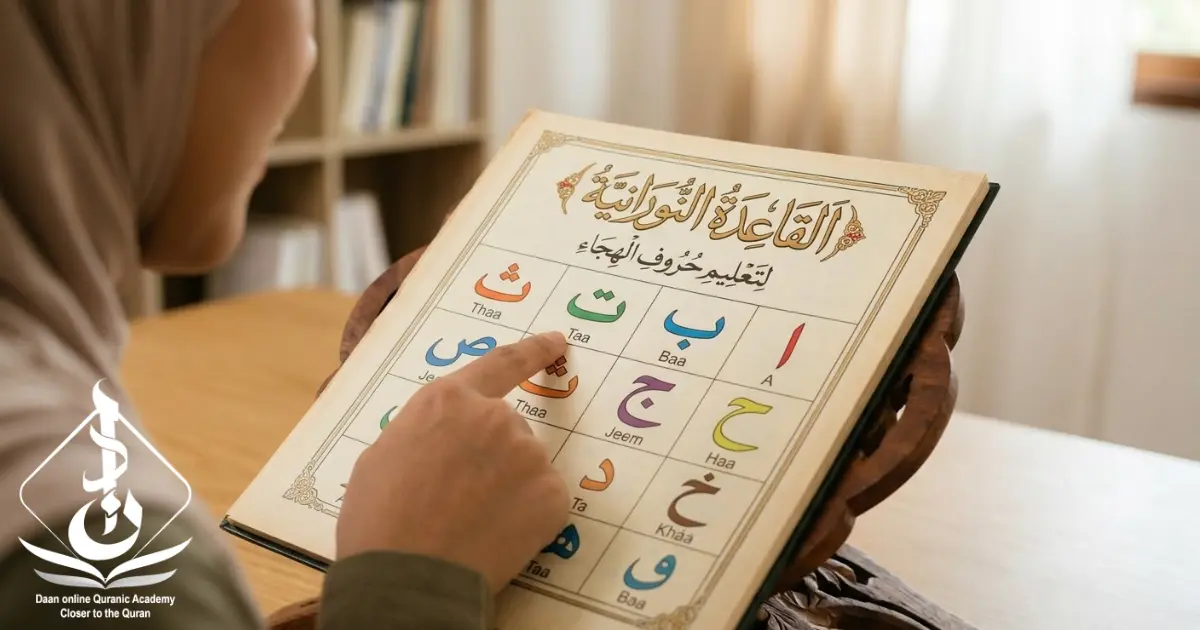
1. The Noorani Qaida: The Universal Starting Point
You would not build a house without a solid foundation. In Quranic studies, that foundation is Noorani Qaida — a structured phonetic methodology developed specifically to teach Arabic letters and Quranic reading to non-native learners in a systematic, step-by-step sequence.
The Building-Block Method
Noorani Qaida introduces the Arabic alphabet in all its forms — isolated, at the beginning of a word, in the middle, and at the end. It teaches each letter’s sound individually before combining sounds into syllables, syllables into words, and words into Quranic text. By the time a student completes the Qaida, they can phonetically read any word in the Quran — even words whose meaning they do not yet know. This is the first and most critical milestone for anyone who wants to learn Quran for non-Arabic speakers: the ability to decode the text accurately and independently, without guessing or approximating.
The Cognitive Science Behind the Method
The Noorani Qaida works because it respects how the human brain acquires a new phonetic system: through graduated exposure, active repetition, and immediate reinforcement. Each step introduces only what the learner is ready to handle, building confidence at every stage. For English-speaking adults encountering Arabic script for the first time, this methodical approach prevents the overwhelm that causes most self-taught learners to quit within weeks. A qualified teacher guiding you through the Qaida in 1-on-1 sessions accelerates this dramatically — you receive immediate correction of errors that self-study cannot catch, and you benefit from your teacher’s experience with precisely the mistakes non-native learners consistently make.
2. Training the Makharij: Articulation Points for Non-Native Tongues
Arabic is known as لُغَةُ الضَّاد (Lughat al-Daad — the language of the letter Daad) because of its unique sounds, several of which have no equivalent in English or any other Western language. As a non-native learner, your tongue, throat, and lip muscles are not conditioned to produce these sounds automatically. This is not a flaw — it is a physiological reality that every non-Arabic speaker faces, and that every non-Arabic speaker can overcome with targeted, supervised practice.
The Throat Letters: ‘Ayn and Haa
The letters ع (‘Ayn) and ح (Haa) are produced deep in the throat at articulation points with no English equivalent. Most non-native learners initially substitute these with a glottal stop or a simple ‘h’ sound — errors that fundamentally alter both meaning and recitation validity. These letters require dedicated, patient practice: begin by learning to feel the correct constriction in the throat, then practice the sound in isolation before attempting it within words. A native Arabic teacher is indispensable here — they can hear immediately whether you are producing the correct articulation or a plausible approximation, and in Tajweed the difference is not subtle.
The Heavy Letters: Qaf, Saad, Daad, and Taa
The emphatic letters — ق (Qaf), ص (Saad), ض (Daad), and ط (Taa) — require the back of the tongue to elevate toward the back of the throat while surrounding vowels adopt a fuller, deeper quality. These letters “darken” the sounds around them. Non-native learners who miss this distinction produce a recitation that sounds consistently flat and loses much of the acoustic richness that makes Quranic Arabic so distinctively beautiful. The contrast between the light س (seen) and the heavy ص (saad) alone will dramatically change the quality of your recitation once mastered.
The Interdental Letters: Thaa and Dhaal
The letters ث (Thaa) and ذ (Dhaal) are produced with the tongue lightly touching the edge of the upper teeth — similar to the English “th” in “think” and “the” respectively, though not identical. Many non-native learners substitute these with ‘s’ and ‘z’ — a common colloquial error that is not acceptable in Quranic recitation. These are actually among the more accessible challenges for English speakers, since the “th” sounds exist in English; the work is precision and consistency in applying them to every occurrence in the Quranic text. For a deeper dive into the full range of pronunciation challenges facing English-speaking learners, see our dedicated guide on Arabic Pronunciation Challenges for Non-Native Learners.
Practice your Arabic letter articulation in front of a mirror daily. Watch how your mouth, lips, and tongue move — then compare your articulation with your teacher’s. This visual feedback complements the auditory feedback from lessons and significantly accelerates the physical conditioning of the muscles involved in Arabic pronunciation. Even five minutes of mirror practice after each lesson produces measurable improvement in articulation accuracy within weeks.
Phase 2: Mastering Tajweed — The Art of Beautiful Quranic Recitation
Tajweed is the science that governs the correct pronunciation, elongation, merging, and stopping in Quranic recitation. The word تَجْوِيد (Tajweed — from the root meaning “to perfect” or “to make beautiful”) describes precisely what it accomplishes: it transforms phonetically accurate reading into the distinctive, spiritually resonant recitation style in which the Quran has been transmitted since it was first revealed. For a non-Arabic speaker working to learn Quran, Tajweed is not an advanced add-on — it is the standard to which recitation has always been held, and it is both learnable and fully achievable with proper instruction.
“Beautify the Quran with your voices.”
Ghunnah — The Nasalisation
Ghunnah (غُنَّة) is the nasalisation applied to the letters Noon (ن) and Meem (م) under specific conditions — most commonly when they carry a Shaddah (doubling mark). It is held for two counts and produces the distinctive humming resonance through the nose that characterises much Quranic recitation. For non-native speakers, Ghunnah is one of the most immediately accessible and satisfying Tajweed rules to master — once learned, it is consistently applicable and instantly audible in the quality of your recitation.
Qalqalah — The Echoing Bounce
Qalqalah (قَلْقَلَة) is the slight vibrational “bounce” added to five specific letters — ق ط ب ج د — when they carry a Sukoon (rest mark) or appear at the end of a verse. This rule adds the rhythmic, percussive quality that gives Quranic recitation much of its distinctive acoustic texture. Learning Qalqalah is among the earlier Tajweed milestones for most students because it is a positive addition rather than a subtle distinction — you are adding something audible, which is easier to practice and monitor than refining an existing sound.
Madd — The Elongation Rules
Madd (مَدّ — elongation) governs the extension of vowel sounds in specific phonetic contexts. The Natural Madd (Madd Tabee’i) extends a vowel for two counts; various conditional Madds extend it for four or six counts depending on following letters. Correct Madd application is one of the most audibly significant aspects of Tajweed — a recitation with correct elongation sounds measured, dignified, and melodic; one without it sounds rushed and flat. For a non-Arabic speaker, Madd rules are relatively straightforward to understand intellectually; the challenge is applying them consistently in live recitation, which requires sustained practice and regular teacher feedback.
Idghaam — The Merging Rule
Idghaam (إِدْغَام — merging) occurs when a Noon Sakinah or Tanween is followed by certain letters, causing the two sounds to merge into a single elongated sound. This rule reflects the natural flow of Arabic speech and produces one of the most characteristic features of fluid Quranic recitation — the seamless way words link and flow into one another. Learning Idghaam is particularly important for non-native learners because English speakers naturally tend to give each letter equal, separate weight. Correct Idghaam application produces a qualitatively different, more natural, and more musical recitation that immediately signals genuine Tajweed training to any listener.
The Role of Al-Mushaf Al-Muallim for Independent Practice
In 2026, digital recitation resources are abundant — but quality varies enormously. For non-Arabic speakers practising Tajweed between lessons, we strongly recommend Al-Mushaf Al-Muallim (The Teaching Quran) by Sheikh Mahmoud Khalil Al-Husary. In this recording, Sheikh Al-Husary recites each ayah with exceptional clarity, then pauses for the student to repeat. This “listen and repeat” method is the closest available approximation to having a certified teacher present during independent practice and has produced accurately pronouncing Quran students across the non-Arabic-speaking world for decades.
Phase 3: Consistency Over Intensity — The Daily Practice Framework That Works
The most common mistake among motivated students who want to learn Quran is studying intensively for several hours on weekends while neglecting practice during the week. This pattern is counterproductive for phonetic and recitation learning in a way it is not for many other subjects. The Arabic phonetic system — the letters, Makharij, Tajweed rules — is retained through short, frequent, repeated exposure, not occasional long sessions. The brain consolidates new motor patterns and phonetic memories during sleep and rest between practice sessions; a week without practice effectively erases a significant portion of the previous session’s gains.
“The one who is proficient in the Quran will be with the honourable and obedient scribes (angels), and the one who recites the Quran and finds it difficult, stammering through it, will have a double reward.”
This hadith contains a truth every non-Arabic speaker needs to hear clearly: the struggle itself is rewarded. You are not penalised for finding Arabic difficult. You receive a double reward — one for the recitation, and one for the effort. The imperfect recitation of a sincerely trying non-native speaker is not a lesser act of worship than the effortless recitation of a native Arabic speaker. In the sight of Allah, it is potentially a greater one. Begin with that confidence.
The 15-Minute Daily Minimum
Fifteen minutes of focused Quranic practice every single day produces dramatically better results than two hours once a week. At 15 minutes daily you accumulate 105 minutes per week — more than most once-weekly learners — while also benefiting from the daily repetition that consolidates phonetic memory. On the hardest days, when life leaves you only five minutes before bed, do not skip entirely: read even one ayah with full focus and correct Tajweed. The unbroken practice streak is itself a spiritual and psychological asset that compounds over months into genuine fluency that no amount of sporadic intensive study can replicate.
The Fajr Advantage
Practise your Quranic recitation immediately after Fajr prayer whenever possible. The mind after Fajr is physiologically at its clearest — the brain has fully consolidated the previous day’s learning during sleep, the distractions of daily life have not yet accumulated, and the spiritual energy of the pre-dawn hours creates a focus and receptivity that is genuinely different from any other time of day. The Companions of the Prophet ﷺ were famous for this practice, and modern neuroscience aligns completely with what Islamic tradition has always affirmed: the first hours after sleep are optimal for memorisation, phonetic learning, and deep retention. Even 15 minutes after Fajr will outperform 30 minutes in the afternoon.
The Integration Strategy: Recite What You Learn in Salah
One of the most powerful and often overlooked strategies for non-Arabic learners is integrating the surahs currently being studied directly into daily prayers. When you recite in Salah a surah you have been practising in your lessons, two things happen simultaneously: your practice becomes an act of worship rather than a study exercise, and your daily prayer deepens into a more conscious, engaged encounter with the Quran. Begin with the short surahs of Juz’ Amma — Al-Ikhlas, Al-Falaq, Al-Nas, Al-Kawthar — focusing on correct Tajweed in every prayer. This integration is one of the most motivating developments on the entire journey to learn Quran for non-Arabic speakers, because every Salah becomes evidence of real progress.
Why a Native Tutor Is Irreplaceable When You Learn Quran for Non-Arabic Speakers
Apps, YouTube videos, digital Mushafs, and AI pronunciation tools are genuinely useful supplements to Quranic learning. But they share one fundamental limitation that no technological advancement in 2026 has overcome: they cannot hear you. They cannot detect the subtle flattening of a heavy letter you are producing. They cannot notice that your ‘Ayn sounds like a glottal stop. They cannot catch that your Madd elongation is consistently one count too short. Only a human teacher — specifically, a native Arabic speaker with formal Tajweed training — can provide the real-time, personalised, error-specific feedback that actually corrects your recitation rather than simply allowing you to practise your mistakes with increasing confidence.
Detecting and Correcting Hidden Errors
The most dangerous errors in Quranic recitation are not the ones you know you are making — they are the ones you cannot hear in yourself. A non-native speaker who has been pronouncing ز (Zayn) slightly like ذ (Dhaal) for three months has reinforced that error with every repetition. Without a teacher, this error will persist and deepen indefinitely. A qualified native tutor detects such errors immediately — often within the first few lines of recitation — and provides targeted correction before the pattern solidifies. This correction function alone justifies the investment in private instruction; the alternative is spending years building proficiency on a foundation of undetected errors.
The Isnad: Joining an Unbroken Chain of Transmission
Learning Quran from a qualified teacher is not simply a pedagogical preference — it is how the Quran has been transmitted across every generation since its revelation. The إِسْنَاد (Isnad — chain of transmission) connects every Quran student through their teacher, and their teacher’s teacher, in an unbroken chain reaching back to the Companions of the Prophet ﷺ and ultimately to the Prophet himself. When you learn from a certified teacher, you are not merely acquiring a skill — you are joining a living tradition of transmission that is one of the most remarkable intellectual inheritances in human history. This dimension is available only through a human teacher, and it provides a spiritual motivation that no app can replicate. Discover why our certified native Egyptian tutors are at the foundation of the Daan Academy approach.
Personalised Pace and Curriculum
Every non-Arabic speaker who decides to learn Quran brings a different starting point, a different set of pronunciation challenges, a different learning pace, and a different life schedule. The throat letters may come naturally to one student while the emphatic letters are their persistent challenge. Another student may master the Makharij quickly but struggle with the Madd elongations. A third may have Arabic heritage without formal reading instruction, producing fluent but Tajweed-deficient recitation. A private tutor with experience in teaching non-native learners adapts the curriculum, the pace, and the emphasis to each individual’s actual profile — an optimisation that is simply impossible in a group class or a self-study programme.
Tools and Resources for Non-Arabic Speakers in 2026
The landscape of resources available to those who want to learn Quran for non-Arabic speakers has been transformed in recent years. In 2026, a dedicated student anywhere in the English-speaking world has access to a quality and variety of supporting tools that simply did not exist for previous generations. Used correctly — as supplements to, not replacements for, qualified human instruction — these tools can significantly accelerate your progress.
| Tool / Resource | Best Use | Key Limitation |
|---|---|---|
| Al-Mushaf Al-Muallim (Al-Husary) | Listen-and-repeat Tajweed practice between lessons | Cannot correct your specific errors |
| Quran.com / Ayat App | Verse-by-verse audio reference with transliteration | No feedback on your recitation quality |
| Colour-coded Tajweed Mushaf | Visual identification of Tajweed rules in live text | Requires teacher guidance to interpret correctly |
| Noorani Qaida (printed or digital) | Structured phonetic foundation for absolute beginners | Most effective when paced by a qualified teacher |
| Habit-tracking apps | Maintaining daily practice streaks and consistency | Cannot improve what you are practising |
| Private online tutoring | Real-time error correction, personalised curriculum, Isnad | None — this is the essential component |
For English-speaking Muslims across the UK, USA, Europe, and Australia, the most significant development of the past five years is the availability of certified native Arabic Quran tutors for private 1-on-1 online sessions — eliminating the geographical barrier that previously meant access to qualified Quran instruction depended entirely on where you happened to live. Our flexible learning plans starting from $9/hr are designed specifically for the reality of Western Muslim life: varying schedules, different time zones, children and adults side by side, all served by the same certified native Egyptian tutors who have been teaching non-native speakers to recite Quran beautifully for years.
For a detailed comparison of the best online platforms available in 2026, see our comprehensive review of the Best Online Tajweed Courses of 2026.
Frequently Asked Questions: Learn Quran for Non-Arabic Speakers
How long does it take to read the Quran fluently as a non-Arabic speaker?
For most dedicated beginners studying consistently with a qualified teacher, 6 to 12 months of daily practice (15–30 minutes per day) is sufficient to read the Quran fluently with basic Tajweed. Students with some prior Arabic exposure or who study more intensively can reach this milestone in 3 to 6 months. Mastering Tajweed to a high standard typically takes 1 to 2 years of consistent study. The most important variable in all of these timelines is not intelligence or natural ability — it is daily consistency. A student practising 15 minutes every day will outperform one studying 3 hours once a week in both retention and overall speed of progress.
I am an adult. Is it too late for me to learn Quran as a non-Arabic speaker?
Absolutely not — and this may be the most important misconception to correct. Adults often progress faster than children in terms of intellectual understanding and motivational discipline, even if children have a slight advantage in phonetic acquisition. Many of the Prophet’s ﷺ Companions were adults when they first learned to recite the Quran. The hadith in Sahih Muslim specifically promises a double reward to those who find recitation difficult — a promise directed precisely at people who are struggling rather than finding it effortless. At Daan Quranic Academy, a significant proportion of our students are adults learning for the first time, and most of them reach confident, accurate recitation within their first year of study.
Should I learn Arabic grammar at the same time as Quran recitation?
For a complete beginner, focus on recitation first. Attempting to learn Arabic grammar (Nahw) simultaneously as an absolute beginner typically divides attention between two demanding disciplines and slows progress in both. Once you can read the Quran comfortably and consistently, adding grammatical study opens a new dimension of understanding that transforms the experience of recitation entirely. At that stage, understanding the Arabic of the Quran rather than simply pronouncing it correctly is one of the most spiritually and intellectually rewarding developments on the entire learning journey. For a guided introduction to the Arabic vocabulary that prepares you for this stage, see our guide on Arabic Phrases Every Muslim Should Know.
Can I learn Quran online or do I need in-person lessons?
Online 1-on-1 Quran lessons with a qualified native teacher are equally effective as in-person lessons for the vast majority of students — and often more practical, because they eliminate travel, scheduling constraints, and geographical limitations on access to qualified teachers. The critical factor is the quality and certification of the teacher, not the medium of delivery. Video-based sessions allow the teacher to hear your recitation in real time, provide immediate correction, and demonstrate articulation visually — everything available in a physical classroom. At Daan Quranic Academy, all our sessions are delivered online and serve students across the UK, USA, Europe, and Australia with the same certified native Egyptian tutors.
What is the best starting point for a complete beginner with no Arabic at all?
The Noorani Qaida — ideally studied with a qualified teacher in private sessions. Begin with the Arabic alphabet: learn each letter’s sound, its various written forms, and its correct articulation point. Do not rush to read Quranic text before this foundation is solid. Most dedicated beginners complete the Noorani Qaida in 2 to 4 months of consistent study, after which they can phonetically read any word in the Quran independently. This foundation makes everything that follows — Tajweed, fluency, and eventually Hifz — dramatically more accessible. Book a free trial class at Daan Academy for a structured assessment of your current level and a personalised learning plan.
Is Tajweed obligatory or just recommended for non-Arabic speakers?
The majority of Islamic scholars hold that applying Tajweed to the degree that prevents distortion of meaning is obligatory (Fard) for every Muslim who recites Quran — not optional and not restricted to scholars or native Arabic speakers. The obligation scales with ability: you are held to the standard of correct recitation that is within your current capacity. A beginner sincerely applying what they have learned is fulfilling the obligation; a capable person who recites carelessly when they know better is not. The practical conclusion: begin learning Tajweed from the earliest stage of your Quranic studies, not as an advanced topic to be deferred until your recitation is already fluent.
How much does it cost to learn Quran online as a non-Arabic speaker?
Quality private Quran instruction with a certified native Arabic teacher is available for significantly less than most people expect. At Daan Quranic Academy, private 1-on-1 online sessions with certified native Egyptian tutors start from $9 per hour — with flexible plans designed for different schedules, ages, and learning goals. This makes consistent, expert Quranic education accessible for Muslim families and individuals across the UK, USA, Europe, and Australia regardless of budget. A free trial session is available with no commitment whatsoever, so you can experience the teaching approach before making any decision. View our full pricing and course plans to find the option that fits your needs.
Ready to Learn Quran for Non-Arabic Speakers — With a Certified Native Teacher?
The right structured approach with a qualified native teacher is the single most important factor in whether you successfully learn Quran as a non-Arabic speaker. At Daan Quranic Academy, our certified native Egyptian tutors have guided hundreds of English-speaking Muslims from complete beginners to confident, beautiful Quranic reciters — and they are ready to do the same for you.
No commitment required. One free session to experience the Daan Academy difference.
Final Thoughts: Your Double Reward Is Already Being Written
The road to learn Quran for non-Arabic speakers is real, it requires patience, and it is — in the truest sense — a journey worth every step. Every stammered letter, every repeated ayah, every hour spent conditioning your tongue to produce sounds your language never required of you before: all of it is being recorded. The Prophet ﷺ told us so directly. You are not simply learning a language. You are answering a call from your Creator, joining an unbroken chain of transmission that stretches across fourteen centuries, and building the most intimate relationship available to a human being: the relationship between a soul and the words of Allah. There is no better time to begin than now. Explore more guides on Quranic education on our Islamic education blog.
May Allah make the Quran easy on your tongue, light in your heart, a companion in your solitude, and an intercessor for you on the Day you stand before Him. Ameen.