
The holy month of Ramadan serves as the “greatest station” in the life of a Muslim family. It is not merely a chronological period for abstaining from food and drink; rather, it is a comprehensive “educational and social ecosystem” that redefines familial bonds and renews the love between its members. In an era where the frantic pace of modern life and the pressures of work and study often scatter the family unit throughout the year, Ramadan arrives to impose a calm, unified rhythm that gathers everyone under one roof. In this article, we will delve deep into how Ramadan acts as a bridge to strengthen family ties and how its rituals contribute to building the character of children and deepening the affection of parents.
1. The Iftar Table: More Than Just a Meal
The moment of Iftar in Ramadan is one of the most precious times that families often miss during ordinary days. In the “pre-Ramadan world,” a father might eat at work, and children might eat in their rooms in front of screens. However, in Ramadan, everyone gathers around a single table at a unified time.
This “temporal and spatial unity” has a massive psychological impact; it reinforces a sense of “belonging” within the individual. Sitting together while waiting for the Adhan (call to prayer) creates a state of “emotional sharing” in patience and anticipation. From an educational perspective, these minutes should be utilized for calm dialogue, away from criticism or disputes. The Iftar table is the ideal place to exchange stories, check on the well-being of children, and instill values of gratitude and appreciation to God for His blessings.
2. Crafting “Ramadan Memories” in Children’s Hearts
Adults always remember the scent of incense in their grandparents’ homes, the sound of the old lantern, and the family gathering around the “Mesaharati” (the dawn caller). These memories are what form an individual’s cultural and religious identity. Therefore, it is the parents’ responsibility to “engineer beauty” within the home during Ramadan.
Families can join together in decorating the house and designating a special corner for prayer and reading, often called the “Family Mihrab.” Involving children in these details makes them look forward to the month with joy and passion, linking worship in their minds with happiness rather than effort and fatigue. Furthermore, introducing children to fasting should be done through “gradualism and motivation,” not through coercion, with the necessity of celebrating their “first fast” as a great achievement that boosts their self-confidence.
3. Collective Worship: Spirituality That Unites Hearts
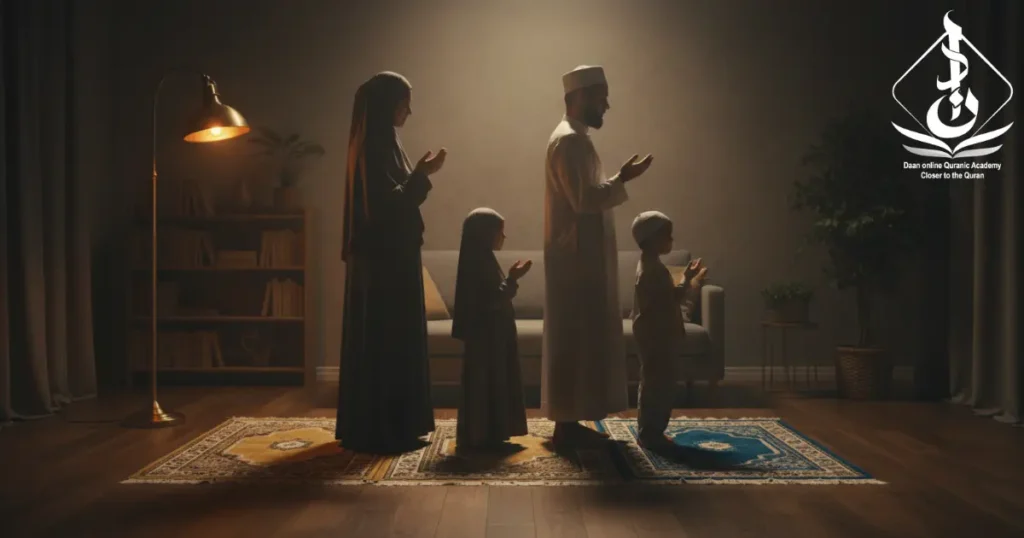
When a son sees his father reading the Quran, and a daughter finds her mother diligent in performing the night prayer (Qiyam), it establishes a “silent role model” that exceeds the impact of thousands of verbal sermons. Ramadan provides families with the opportunity for “collective worship,” such as performing Tarawih prayers at home or in the mosque and sharing a daily portion (Wird) of the Quran.
This type of activity strengthens the “spiritual bond” between family members. The collective supplication (Dua) before Iftar, where the father leads his family in prayers for their well-being and prosperity, creates a feeling of emotional security and tranquility. Ramadan teaches the family that “success” is not just material; it is a success in elevating the soul together toward the Creator.
4. The Mother’s Role: Balancing Worship and Service
One cannot speak about Ramadan and the family without paying a tribute of respect to the mother, who often exerts double the effort to provide comfort for everyone. Here, an important ethical value emerges: “Family Cooperation.” It is unjust for the mother to spend most of her time in the kitchen while the rest of the family rests. Therefore, tasks should be distributed among everyone—setting the table, cleaning, and organizing the prayer area.
The assistance of the father and children to the mother is not just “burden-lifting”; it is a practical application of the character of the Prophet (Peace Be Upon Him), who used to be “in the service of his family.” This cooperation breaks down psychological barriers and teaches children to take responsibility and appreciate the effort made for them.

5. Digital Detox: Reclaiming Lost Time
One of the greatest challenges for the modern family is “digital isolation,” where each individual is drowned in their own phone. Ramadan is a golden opportunity to impose a “digital truce,” where the use of phones is prohibited during Iftar, Suhoor, or family gathering times.
Reclaiming time from screens in favor of “eye contact” and direct conversation repairs many of the gaps caused by technology. During this time, the family can engage in mental games, discuss a book, or even enjoy a “beautiful silence” filled with remembrance and reflection.
6. Family and Society: Instilling Values of Giving
Ramadan takes the family out of the boundaries of the “I” and into the “We.” Training children to prepare “Iftar meals” for neighbors or the needy, and involving them in choosing Eid clothes to donate, transforms the family into a “unit of goodness.”
These practices plant “social intelligence” and mercy toward others in the hearts of the youth. A child who sees their parents keen on maintaining kinship ties (Silat al-Rahim) and visiting relatives in Ramadan grows up realizing the value of the “extended family” and the importance of social compassion, protecting them from self-absorption or isolation.
7. Suhoor: Blessing in Food and Connection
The Prophet (PBUH) described Suhoor as a “blessing.” This blessing is not limited to physical strength for fasting but extends to the blessing of gathering during the time of “Sahar” (the pre-dawn period), a time when mercy descends. The quiet Suhoor session, away from the noise of the day, opens a space for “transparency and honesty” between spouses and between parents and children. It is a time for exchanging gentle advice and sincere prayers that leave an indelible mark on the soul.
8. Sustaining Ramadan’s Gains After Eid
The true challenge for the family is how not to let this gathering disperse once the month departs. The family should emerge from Ramadan with a “new family constitution,” such as maintaining at least one daily meal where everyone gathers, or dedicating one day a week for a shared spiritual or social meeting. Ramadan is the “seed” which, if nurtured well, yields stability and affection throughout the year.
Conclusion
Ramadan is the annual “Family Eid”; in it, cracks are repaired, intentions are renewed, and emotions are recharged. A smart family is one that does not get preoccupied with the “husks” of the month—such as types of food and exaggerated decorations—but rather focuses on the “essence” of connection and education. Let us make our homes during this month mosques for worship, schools for ethics, and oases for affection, to emerge from Ramadan as a “single entity,” stronger and closer to God and to each other.
Experience our unique approach first-hand. Book your free free trial sessions now with no strings attached.