“And We have indeed made the Quran easy to understand and remember, then is there any that will remember?” (Surah Al-Qamar, 17)
Introduction: A Divine Invitation
For many non-Arabic speakers, the desire to connect with the Holy Quran often comes with a sense of hesitation. You might ask yourself: “How can I recite a book in a language I don’t speak?” or “Is it too late for me to start?” The truth is, the Quran is not just a book for Arabs; it is a divine message for all of humanity. In 2026, with the advancement of educational technology and online learning, the barriers to entry have vanished. Whether you are a convert, a busy professional in the West, or a parent wanting the best for your children, this ultimate guide will take you from the basics of the alphabet to the beauty of Tajweed.
The Myth of the “Arabic Barrier”
One of the biggest misconceptions is that you must be fluent in conversational Arabic to read the Quran. While understanding the language is beneficial, recitation (Tilawah) is a distinct science. It is a phonetic discipline.
Many of the world’s greatest Qaris (reciters) come from Indonesia, Pakistan, or Bosnia and did not grow up speaking Arabic. They mastered the vocal mechanics of the language. This guide focuses on how you can do the same.
Phase 1: The Foundation – Building Your Phonetic Base
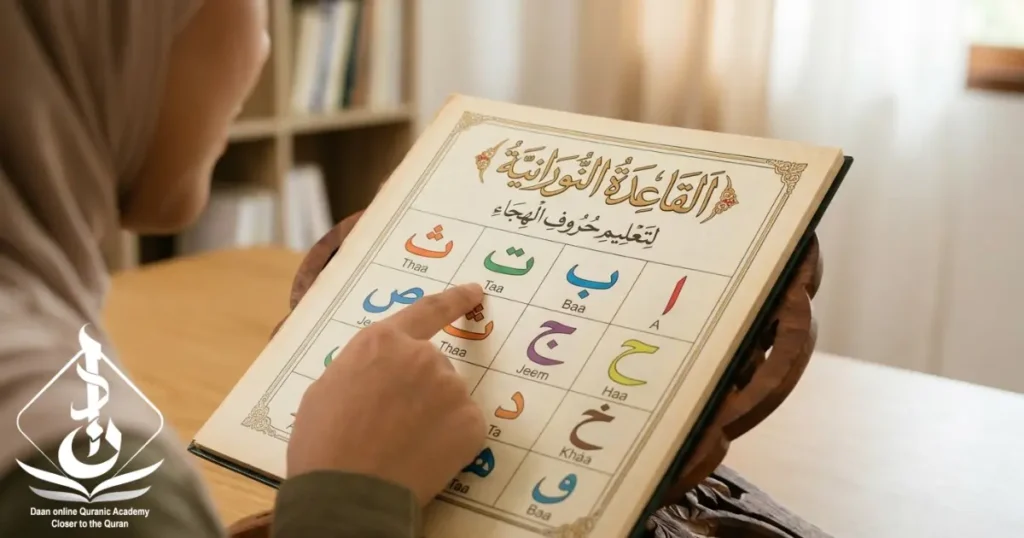
1. The Power of Noorani Qaida
You wouldn’t build a house without a solid foundation. In Quranic studies, that foundation is Noorani Qaida.
- What is it? It is a simplified methodology that introduces the Arabic alphabet in its various forms (isolated, beginning, middle, and end of a word).
- Why it works: It uses a “building block” approach. You learn a sound, then a syllable, then a word. By the time you finish the Qaida, you will be able to read any word in the Quran, even if you don’t know its meaning yet.
2. Training the “Makharij” (Articulation Points)
Arabic is known as the “Language of Dad” ($\text{ض}$) because of its unique sounds. As a non-native, your tongue and throat muscles aren’t used to these positions.
- The Throat Letters: Spend extra time on letters like ‘Ayn ($\text{ع}$) and Haa ($\tau$).
- The Heavy Letters: Learn to elevate the back of the tongue for letters like Qaf ($\text{ق}$) and Saad ($\text{ص}$).
- Pro Tip: Practice in front of a mirror. Watch how your mouth moves compared to your teacher’s.
Phase 2: Mastering Tajweed – The Art of Beautiful Recitation
Tajweed is the science that gives every letter its right. For a non-native speaker, mastering Tajweed is what transforms a “mechanical” reading into a “spiritual” one.
1. Understanding the Rules of Silence and Sound
- Ghunnah (Nasalization): Learning how to hum through the nose for two beats during specific letters.
- Qalqalah (Echoing): Adding a slight “bounce” to certain letters when they have a Sukoon. This adds a rhythmic quality to your recitation.
2. The Role of “Mushaaf Al-Muallim”
In 2026, digital resources are everywhere. We recommend using the “Teaching Quran” (Al-Mushaf Al-Muallim) by Sheikh Al-Husary. He recites with extreme clarity, leaving a gap for the student to repeat after him. This “Listen and Repeat” method is the fastest way to fix your accent.
Phase 3: Consistency Over Intensity
The secret to learning the Quran isn’t studying for 5 hours once a week; it’s studying for 15 minutes every single day.
- The “Morning Barakah” Slot: Try to practice right after Fajr. The mind is fresh, and the spiritual energy is at its peak.
- Use Apps for Tracking: Use habit-tracking apps to ensure you don’t break your streak. Even on busy days, read just one line.
Why a Native Arabic Tutor is Irreplaceable
While apps and YouTube videos are great supplements, they cannot hear you.
- Correcting Hidden Mistakes: A native tutor can detect if your “Zay” sounds too much like a “Thal.”
- The Spiritual Connection: Learning the Quran is a tradition passed down from teacher to student (Ijazah). This bond keeps you motivated when the lessons get challenging.
- Tailored Pace: Everyone learns at a different speed. A private tutor adjusts the curriculum to fit your struggles, not a generic classroom pace.
FAQ: Common Questions from Non-Arabic Students
Q: How long does it take to read the Quran fluently? A: For most dedicated beginners, it takes 6 to 12 months of consistent study to read comfortably. Memorization (Hifz) takes longer, depending on your goals.
Q: I am an adult; is it too late for me to learn? A: Absolutely not. In fact, many adults find they have more discipline than children. Remember, the Sahaba (companions of the Prophet) were adults when they began learning the Quran.
Q: Should I learn Arabic grammar (Nahw) at the same time? A: Focus on reading first. Once you can glide through the verses comfortably, adding grammar will help you understand the meaning, which adds a new layer of beauty to your prayers.
Conclusion: Your Double Reward
The road may seem long, but every struggle you face is being recorded as a good deed. The Prophet Muhammad (PBUH) gave the ultimate encouragement to non-Arabs when he said:
“The one who recites the Quran and stammers over it, finding it difficult, will have a double reward.” (Sahih Muslim)
One reward for the recitation, and another for the effort. You are not just learning a book; you are responding to a call from your Creator.
Start Your Journey Today!
Don’t let another year pass by wishing you could read the Quran. Our academy specializes in bridging the gap for non-Arabic speakers. With certified native tutors and a curriculum designed for the Western lifestyle, we make your dream a reality.
Experience our unique approach first-hand. Book your free free trial sessions now with no strings attached.