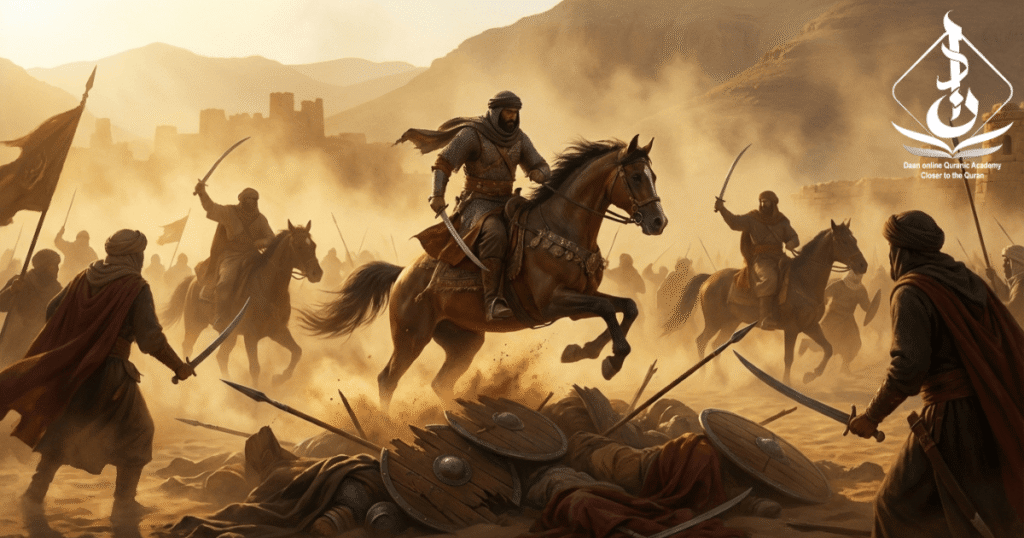
On the morning of the 17th of Ramadan, in the second year of the Hijra, the desert sands were destined for an event that was not merely a military confrontation between two armies, but a seismic shift that altered the course of human history. This was The Great Battle of Badr, which the Holy Quran named “The Day of Criterion” (Yawm al-Furqan), for it distinguished between an era of weakness and an era of empowerment, and between the age of paganism and the age of monotheism.
1. Precursors and Historical Context: Reclaiming Rights, Not Aggression
The story of Badr did not begin solely in Ramadan; its roots stretched back to the moment the Muslims migrated from Makkah to Madinah, leaving behind their homes and wealth, which the Quraysh confiscated unjustly. In Madinah, the Muslims sought a means of economic pressure on Quraysh to force them to recognize the new state and cease their harassment.
In the month of Ramadan, news reached the Prophet (peace be upon him) that a major trade caravan of the Quraysh, coming from the Levant and carrying a thousand camels with goods valued at fifty thousand gold dinars, led by “Abu Sufyan ibn Harb,” would pass near Madinah. The Prophetic objective was clear: intercept the caravan to reclaim part of the looted wealth and weaken the economic power of Quraysh.
The Prophet (PBUH) set out with a small number (313 men), unprepared for a full-scale war. They had only two horses and seventy camels, which they took turns riding.
2. Abu Sufyan’s Intelligence and the Change of Course
Abu Sufyan was a shrewd leader; he sensed danger and sent scouts to monitor the road. Upon learning of the Muslims’ departure, he cleverly changed his route toward the Red Sea coast, away from the usual caravan path. Simultaneously, he sent a cry for help to Makkah with “Damdam ibn ‘Amr al-Ghifari,” who entered Makkah with his shirt torn and his camel’s nose cut, shouting: “The caravan! The caravan! Your wealth with Abu Sufyan has been intercepted by Muhammad and his companions!”
3. Abu Jahl’s Arrogance and Quraysh’s Insistence on War
Quraysh was enraged and marched out with a massive army of approximately $1,000$ fighters, including the elite knights of Arabia and the leaders of Makkah. Despite receiving a later message from Abu Sufyan informing them that the caravan was safe and asking them to return, “Abu Jahl” arrogantly insisted on moving forward, famously saying: “By Allah, we will not return until we reach Badr. We will stay there for three days, slaughter camels, feed people, drink wine, and the singers will perform for us. The Arabs will hear of our march and our gathering, and they will hold us in awe forever.”
4. The School of Shura: Decision-Making in Crises
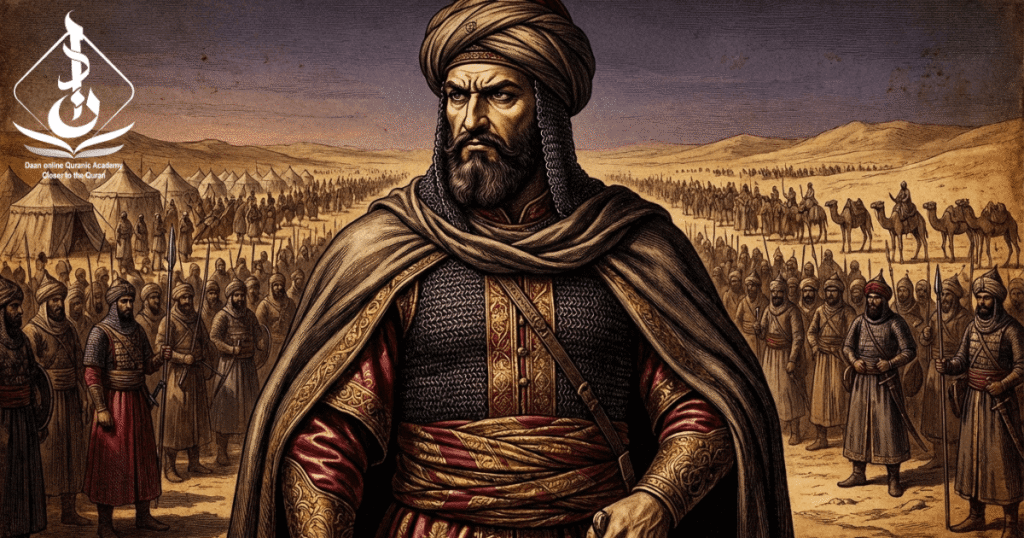
When the Prophet (PBUH) learned of the Makkan army’s departure, he faced a new reality: either return to Madinah with a military and moral defeat, or face an army three times his size. Here, the magnificence of Prophetic Shura (consultation) was manifested:
- The Position of the Muhajirun: Al-Miqdad ibn ‘Amr stood up and spoke eternal words: “O Messenger of Allah, proceed to what Allah has shown you, for we are with you. By Allah, we will not say to you as the Children of Israel said to Moses: {Go you and your Lord and fight, we are sitting here}, but we say: Go you and your Lord and fight, we are fighting with you.”
- The Position of the Ansar: The Prophet (PBUH) wanted to know the opinion of the Ansar because the Pledge of Aqaba required them to defend him within their territory. Sa’d ibn Mu’adh understood this and said: “Perhaps you fear that the Ansar do not see it as their duty to support you except in their homes… By Him who sent you with the truth, if you were to cross this sea, we would cross it with you.”
With this spirit, the army transformed from a group intercepting a caravan into an ideological army ready to die for a principle.
5. Military Genius and Field Tactics
The Muslims reached Badr, and the Prophet (PBUH) began organizing his ranks. Here, the importance of field expertise emerged:
- Al-Hubab ibn al-Mundhir’s Plan: Al-Hubab suggested changing the army’s position to be at the well closest to the enemy at Badr, then filling the other wells and creating a basin for water. Thus, the Muslims would control the only water source in the area.
- The Rank System: The Prophet (PBUH) innovated the system of ranks in fighting instead of the “hit and run” system common among the Arabs, giving his army high cohesion.
- Building the Arish (Tent): A tent was built for the Prophet (PBUH) on an elevated spot to oversee the battle and manage operations, which is considered the first “operations room” in Islamic military history.
6. The Night of the Battle: Tranquility and Divine Support
On the night of the 17th of Ramadan, “slumber” overcame the Muslims as a sign of security and tranquility from Allah, resting their bodies and calming their fears. Rain also fell, which was a purification for the Muslims and a means to firm the ground under their feet, while for the polytheists, it was a heavy downpour that hindered their movement. The Prophet (PBUH) spent his night in supplication and prayer to his Lord until his cloak fell from his shoulders, saying: “O Allah, if this small band is destroyed today, You will not be worshipped on earth.”
7. The Epic Events: From Duels to Full Victory
The battle began with the traditional Arab style of “individual duels”:
- From Quraysh came Utbah ibn Rabi’ah, his brother Shaybah, and his son Al-Walid.
- Three young Ansar men came out from the Muslims, but the Qurayshis refused, saying: “O Muhammad, send out our equals from our own people.”
- The Prophet (PBUH) then ordered Hamza ibn Abdul-Muttalib, Ali ibn Abi Talib, and Ubaydah ibn al-Harith to step forward.
- In minutes, Hamza killed Shaybah, Ali killed Al-Walid, and they both joined to finish Utbah after he had wounded Ubaydah. This beginning was a massive psychological shock to the polytheist army.
Then the general attack began. The Prophet (PBUH) shouted to his companions: “Rise to a Paradise as wide as the heavens and the earth.” He threw a handful of pebbles toward the Quraysh, saying: “May these faces be deformed,” and there was not one of them whose eyes or nostrils were not struck by it. At that moment, divine support descended with thousands of angels fighting alongside the Muslims and firming their hearts.
8. Outcomes that Shook the Arabian Peninsula
The battle ended in a resounding victory for the Muslims, with the following results:
- Casualties: 70 of the polytheists were killed, most of them leaders and thinkers of Quraysh, including “Abu Jahl” and “Umayyah ibn Khalaf.”
- Prisoners: Another 70 prominent men of Quraysh were captured.
- Martyrs: Only 14 Muslims were martyred (6 from the Muhajirun and 8 from the Ansar).
9. Treatment of Prisoners: Noble Islamic Ethics
The greatness of Islam was evident in the treatment of prisoners. The Prophet (PBUH) ordered that they be treated kindly, and the Muslims would prioritize the prisoners’ food over their own. Ransom was also implemented in innovative ways; those who were wealthy paid in money, while those who were poor but literate ransomed themselves by teaching ten Muslim children to read and write, confirming that Islam is a religion that celebrates knowledge even in the heart of war.
10. Lessons of Badr for Future Generations
The Battle of Badr is not just a historical story; it is a constitution for success:
- Victory through Quality, Not Quantity: The lesson is not in numerical superiority, but in the sincerity of belief and strength of organization.
- The Importance of Psychological Stability: Tranquility and trust in Allah are the keys to steadfastness in crises.
- Social Justice: Where the leader and the followers stood in one line, sharing food, transport, and risks.
- Ramadan is a Month of Action: Badr proved that fasting does not mean laziness; rather, it is a charging of the soul to achieve the greatest victories.
Experience our unique approach first-hand. Book your free free trial sessions now with no strings attached.