
Fruits in the Quran: Complete List, Arabic Names, and Fruits of Jannah
Fruits in Quran are named across dozens of verses, and the 6 fruits mentioned in Quran most often are dates, grapes, figs, olives, pomegranates, and bananas (talh). This guide gives you the complete list of fruits in Quran with their Arabic names, verse references, the fruits of Jannah in Quran, and an honest answer on the total count.
Reading these verses correctly takes more than a list, though. At Daan Quranic Academy, certified native Egyptian tutors teach live 1-on-1 classes from $9/hr, so you can learn the words, the meanings, and the recitation together.
Key Takeaways
- The main fruits: Dates (nakhl, rutab), grapes (a’nab), figs (teen), olives (zaytun), pomegranates (rumman) and bananas (talh), plus the general word fakihah, meaning fruit.
- Key verse: Surah Al-An’am 6:99 names four of these fruits together: the palm, grapes, olives and pomegranates. The Quran uses nakhl and rutab for dates, not the everyday word tamr.
- Talh is debated: It appears once, in the description of the people of the right hand in Jannah (56:29). Many commentators render it as banana trees, while others identify it as a tall thorny tree, so the difference of opinion should be noted.
- How many fruits: There is no single agreed number. Six are named most clearly, and counts differ because scholars disagree on talh and on whether trees such as the lote tree (sidr) are included.
- Fruits of Jannah: They are abundant, neither cut off nor forbidden (56:32-33), chosen by the believers (56:20), and come in two kinds of every fruit (55:52). Surah Ar-Rahman 55:68 names fruit, palm trees and pomegranates.
📑 Table of Contents
- Fruits in Quran: The Complete List at a Glance
- 6 Fruits Mentioned in Quran, Explained One by One
- Fruits Mentioned in Quran in Arabic: Names and Pronunciation
- How Many Fruits Are Mentioned in Quran? The Honest Answer
- Fruits of Jannah in Quran: What Allah Promises the Believers
- How to Learn Fruits in Quran Online: What to Look For
- Online vs In-Person Quran Classes: Daan Academy vs Typical Platforms in 2026
- Why Families Choose Daan to Learn Fruits in Quran: Credentials and a Free Trial
- Frequently Asked Questions
Fruits in Quran: The Complete List at a Glance
Fruits in Quran include dates, grapes, figs, olives, pomegranates, and bananas (talh), plus the general word fakihah, meaning fruit. Each of the fruits in Quran appears as a sign of Allah’s provision, a food of this world, or a reward in Jannah. Below you will find the Arabic name, the verse reference, and the lesson behind every one.
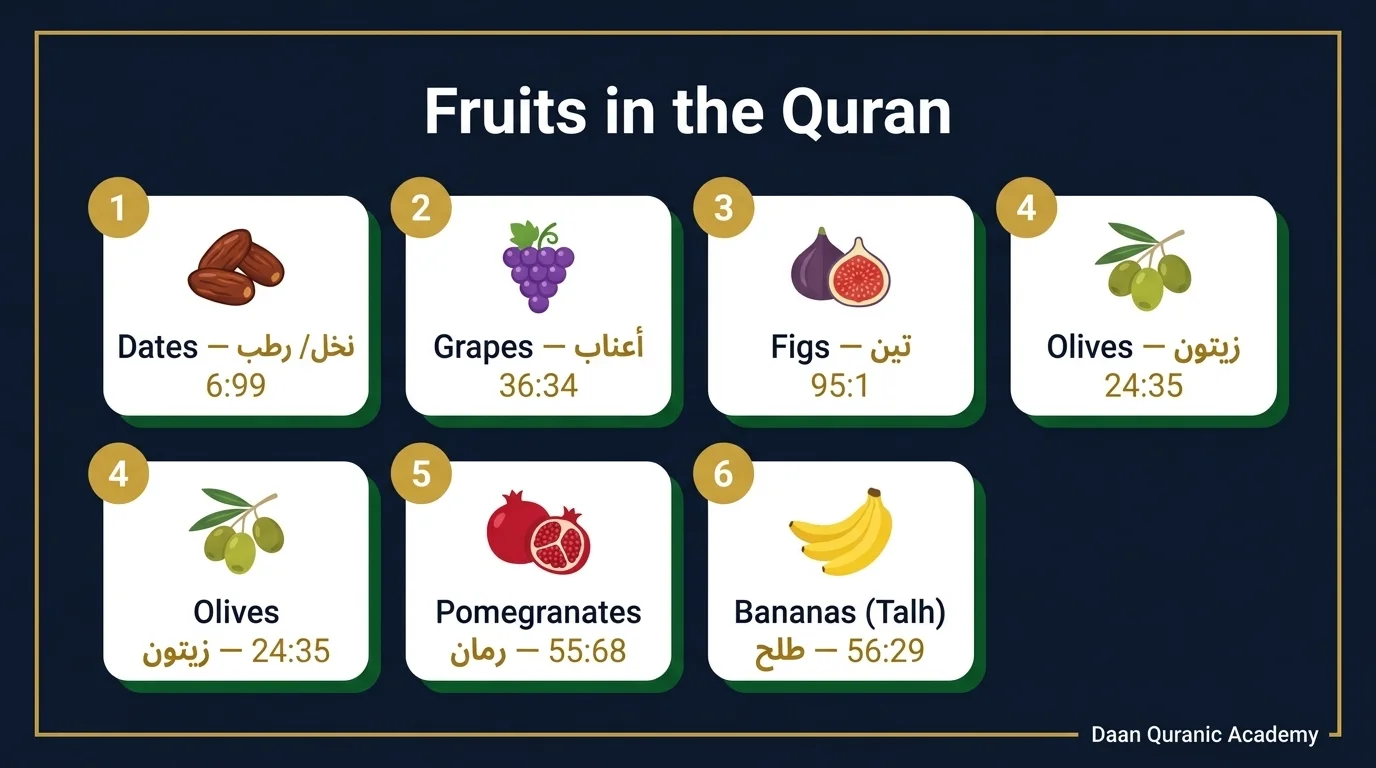
Anyone searching for fruits in Quran usually wants three things: a clear list, correct Arabic spelling, and references they can check. This page gives all three for the fruits in Quran, and each reference can be verified verse by verse in the Quran itself. The names below are the ones the Quran actually uses, which is not always the word used in everyday Arabic today.
- Dates — nakhl (palm) and rutab (fresh dates), the most repeated of all fruits in Quran
- Grapes — a’nab, often paired with gardens and palm trees
- Figs — teen, sworn by in Surah At-Tin
- Olives — zaytun, a blessed tree and a source of oil
- Pomegranates — rumman, named in this world and in Jannah
- Bananas — talh, understood this way by many commentators
- Fruit in general — fakihah, used for the fruits of Jannah
Learning to read and understand the fruits in Quran is a natural first step into Quranic vocabulary. The Quran, Tajweed, and Quranic Arabic courses at Daan Academy build exactly this skill, from letters to meaning.
6 Fruits Mentioned in Quran, Explained One by One
The 6 fruits mentioned in Quran that readers ask about most are dates, grapes, figs, olives, pomegranates, and bananas. Five of them are named without much debate, while talh is read as banana trees by many commentators and as a thorny acacia-type tree by others. Here is each fruit in turn.
Real session recording: A native Egyptian tutor at Daan Academy teaches Quranic Arabic vocabulary one-on-one, breaking each word down so the learner can read and understand it. All videos are real, unedited screen-recordings from actual student sessions at Daan Academy, posted with student consent.
One verse names four of these fruits together, and it is the best place to begin.
وَهُوَ الَّذِي أَنزَلَ مِنَ السَّمَاءِ مَاءً فَأَخْرَجْنَا بِهِ نَبَاتَ كُلِّ شَيْءٍ فَأَخْرَجْنَا مِنْهُ خَضِرًا نُّخْرِجُ مِنْهُ حَبًّا مُّتَرَاكِبًا وَمِنَ النَّخْلِ مِن طَلْعِهَا قِنْوَانٌ دَانِيَةٌ وَجَنَّاتٍ مِّنْ أَعْنَابٍ وَالزَّيْتُونَ وَالرُّمَّانَ مُشْتَبِهًا وَغَيْرَ مُتَشَابِهٍ ۗ انظُرُوا إِلَىٰ ثَمَرِهِ إِذَا أَثْمَرَ وَيَنْعِهِ ۚ إِنَّ فِي ذَٰلِكُمْ لَآيَاتٍ لِّقَوْمٍ يُؤْمِنُونَ
“And it is He who sends down rain from the sky, and We produce thereby the growth of all things. We produce from it greenery from which We produce grains arranged in layers. And from the palm trees – of its emerging fruit are clusters hanging low. And [We produce] gardens of grapevines and olives and pomegranates, similar and dissimilar. Look at [each of] its fruit when it yields and [at] its ripening. Indeed in that are signs for a people who believe.”
Dates: Nakhl and Rutab (نَخْل / رُطَب)
Dates and the palm tree are the most frequently mentioned of all fruits in Quran. The palm appears in 6:99 above and again in 55:68, while the word rutab, meaning ripe fresh dates, is used in the story of Maryam in Surah Maryam (19:25). Among all fruits in Quran, dates also carry a strong Prophetic legacy of blessing and nourishment.
“Whoever eats seven ‘Ajwa dates every morning will not be harmed by poison or magic that day.”
Narrated by Sa’d ibn Abi Waqqas — Sahih al-Bukhari, 5445
Grapes: A’nab (أَعْنَاب)
Among the fruits in Quran, grapes are named repeatedly as gardens of grapevines, for example in 2:266, 6:99, 36:34, and 78:32. The Quran uses them as a picture of fertile land that Allah brings back to life. They also appear among the blessings of Jannah.
Figs: Teen (تِين)
The fig is mentioned once by name, yet it gives its name to an entire chapter, Surah At-Tin. Allah begins that surah with an oath by the fig and the olive.
Olives: Zaytun (زَيْتُون)
The olive is among the most blessed fruits in Quran, a tree of oil and light. It is named in 6:99, 23:20, 24:35, 80:29, and 95:1, and it is the centre of the famous Verse of Light. Surah Al-Mu’minun describes it as a tree growing from Mount Sinai that gives oil and a condiment for those who eat.
Pomegranates: Rumman (رُمَّان)
Pomegranates appear in 6:99, 6:141, and 55:68. The last of these places the pomegranate in Jannah beside fruit and palm trees, so it is one of the few fruits in Quran named both in this world and in the next.
Bananas: Talh (طَلْح)
Among the fruits in Quran, talh appears once, in the description of the people of the right hand in Jannah (56:29). Many commentators and several well-known English translations render it as banana trees with fruit layered one above another. Others identify it as a tall thorny tree, so it is wise to note the difference of opinion rather than state it as settled.
Fruits Mentioned in Quran in Arabic: Names and Pronunciation
Fruits mentioned in Quran in Arabic use short, root-based words that are easy to recognise once you can read the letters. The table below lists the exact wording the Quran uses, with transliteration and verse references.
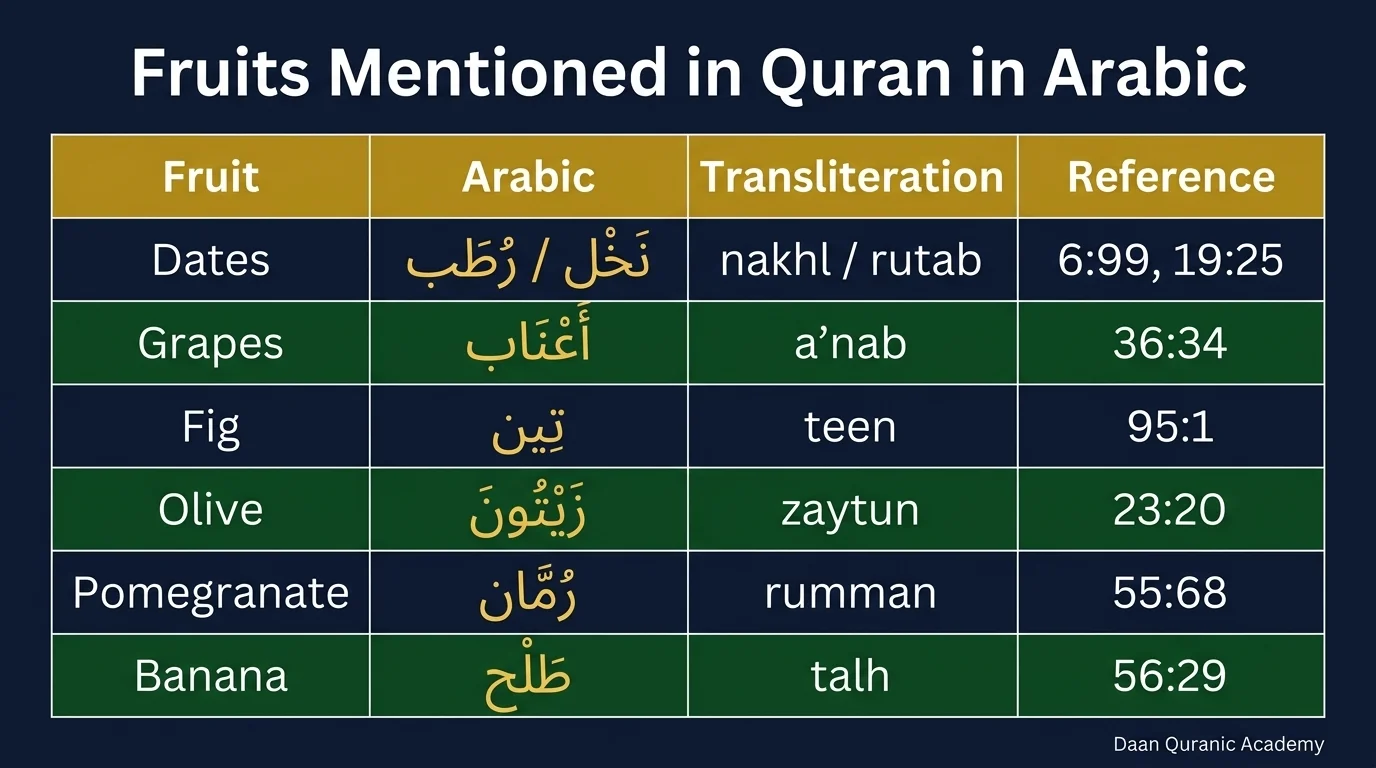
| Fruit | Arabic | Transliteration | Example References |
|---|---|---|---|
| Dates / palm | نَخْل / رُطَب | nakhl / rutab | 6:99, 19:25, 55:68 |
| Grapes | أَعْنَاب | a’nab | 2:266, 6:99, 36:34, 78:32 |
| Fig | تِين | teen | 95:1 |
| Olive | زَيْتُون | zaytun | 6:99, 23:20, 24:35, 80:29 |
| Pomegranate | رُمَّان | rumman | 6:99, 6:141, 55:68 |
| Banana (as understood by many) | طَلْح | talh | 56:29 |
| Fruit (general) | فَاكِهَة | fakihah | 55:52, 56:20, 56:32 |
Notice that the everyday word for dates, tamr, is not the form used in these verses. The Quran speaks of the palm (nakhl) and of fresh dates (rutab) instead. Small details like this are why reading fruits mentioned in Quran in Arabic is better done with a tutor than from a word list alone.
Pronunciation matters too. The shaddah on the meem in rumman, the long vowel in a’nab, and the heavy letter in talh each change the sound. If you want to build this skill step by step, our guide to the best online Quranic Arabic classes explains how vocabulary, grammar, and recitation fit together.
How Many Fruits Are Mentioned in Quran? The Honest Answer
There is no single agreed number of fruits mentioned in Quran. Commonly shared lists name six or seven specific fruits, while the general word fakihah covers every fruit of this world and of Jannah. Counts of fruits in Quran differ because scholars disagree on talh and on whether trees such as the lote tree (sidr) should be included.
So, how many fruits are mentioned in Quran? The safest answer is that six are named most clearly: dates, grapes, figs, olives, pomegranates, and bananas. Anyone who gives one fixed total for fruits in Quran without explaining their counting method is simplifying the question. When you ask how many fruits are mentioned in Quran, always check what the source includes.
Some lists add foods such as lentils, onions, garlic, and cucumbers from 2:61, but those are vegetables and crops rather than tree fruits. Others add the lote tree. Decide what you are counting first, then count.
If you enjoy questions like this one, you may also like our breakdown of how many surahs are in the Quran, which uses the same careful approach to counting.
Fruits of Jannah in Quran: What Allah Promises the Believers
The fruits of Jannah in Quran are described as abundant, never cut off, never forbidden, and chosen by the believers themselves. Surah Al-Waqi’ah says they will have fruit of what they select (56:20) and fruit in abundance, neither cut off nor forbidden (56:32-33).
فِيهِمَا فَاكِهَةٌ وَنَخْلٌ وَرُمَّانٌ
“In both of them are fruit and palm trees and pomegranates.”
The fruits of Jannah in Quran are not a copy of this world’s fruit. Surah Ar-Rahman says that in both gardens there are two kinds of every fruit (55:52), and Surah Muhammad says the believers will have every kind of fruit there (47:15). Surah Al-Mursalat adds fruits from whatever they desire (77:42).
فِي سِدْرٍ مَّخْضُودٍ وَطَلْحٍ مَّنضُودٍ
“Among lote trees without thorns, and banana trees (talh) layered with fruit.”
- Abundant: fruit “in abundance” with no shortage (56:32)
- Always available: neither cut off nor forbidden (56:33)
- Chosen: the believers select what they want (56:20)
- Varied: two kinds of every fruit (55:52)
- Named: fruit, palm trees, and pomegranates (55:68), and talh (56:29)
These verses are best understood with the right recitation and meaning. Our certified native Egyptian tutors, many holding Ijazah in multiple Qira’at, teach students to read passages like these accurately and to reflect on them.
How to Learn Fruits in Quran Online: What to Look For
The best way to learn fruits in Quran online is with a certified tutor, in a private lesson, following a structured plan. Searching for Quran classes near me often leads to a limited local choice, while online learning lets families in the UK, USA, and Europe study with the same qualified teacher. Use these criteria to judge any provider.
Check Tutor Qualifications
Look for tutors trained in Quranic sciences who hold an Ijazah with a verifiable chain. At Daan Academy, many tutors hold Ijazah in multiple Qira’at with chains back to the Prophet ﷺ.
Insist on 1-on-1 Lessons
Group classes dilute attention, and vocabulary needs correction in the moment. Every class at Daan Academy is a private live session.
Confirm Native Arabic and Fluent English
You need a teacher who pronounces Arabic naturally and explains clearly in English. All Daan tutors are native Egyptian Arabs who speak fluent English.
Ask for a Personal Learning Plan
Generic curricula rarely suit a beginner who wants to study fruits in Quran, a revert, a revert, or a child equally well. A good plan starts with reading, adds Tajweed, then builds Quranic vocabulary.
Look for Transparent Progress Tracking
Students should see sessions, balance, and reports in one place. The Daan student dashboard (Daan LMS) shows session records and monthly progress updates.
Try Before You Commit
A free trial removes the risk. You can book a free trial session and judge the teaching for yourself.
For children, engagement is just as important. Daan’s library of 600+ educational games turns practice with fruits in Quran vocabulary into play, and our guide to the best online Quran classes for kids explains what to expect.
Online vs In-Person Quran Classes: Daan Academy vs Typical Platforms in 2026
Online Quran classes now match or beat in-person learning when the lessons are private, live, and taught by qualified native speakers. In 2026, flexible scheduling and screen-sharing make it easy to study fruits in Quran, recite, and review mistakes in real time, from any country.
| What to Compare | Typical Online Academies | Daan Quranic Academy |
|---|---|---|
| Class format | Often group sessions | Private 1-on-1 live sessions |
| Tutors | Mixed backgrounds | Native Egyptian Arabic speakers, fluent in English |
| Credentials | Rarely verified | Many tutors hold Ijazah in multiple Qira’at |
| Pricing | Sometimes unclear | Three clear plans from $9/hr |
| Progress | Informal feedback | Session reports and monthly updates in Daan LMS |
| Support | Office hours | 24/7 dedicated support |
| Trial | Varies | Free trial session, no commitment |
When choosing, look for providers who can show these standards. For anyone comparing providers of fruits in Quran lessons, our overview of the best Quran academy online in 2026 explains the full checklist in more detail.
Plans start from just $9/hr with native Egyptian tutors. Compare our three flexible pricing plans — Essential ($9/hr), Pro ($10.99/hr), and Elite ($12.99/hr) — each designed for different learning goals and budgets. The Elite plan includes a family discount.
Why Families Choose Daan to Learn Fruits in Quran: Credentials and a Free Trial
Daan Quranic Academy serves families across 15+ countries with qualified native Egyptian tutors, verified certificates for each course milestone, and a free trial for new students. These are the trust signals worth checking before you enrol anywhere.
Parents often ask whether learning the fruits in Quran online is safe and effective for their child. Private 1-on-1 lessons, smart reminders before every session, and 24/7 dedicated support help families stay consistent. You can read why families choose Daan Academy to see how we address these concerns.
Adults and reverts benefit from the same structure. A revert can begin with letters, move into Tajweed, and then study the vocabulary of verses like those on fruits in Quran at a comfortable pace. Our referral program also rewards you and a friend with discounts when you invite them.
For more articles on Quran study and Arabic, explore the Daan Academy blog.

Frequently Asked Questions
How many fruits are mentioned in Quran?
There is no single agreed number. Six fruits are named most clearly: dates, grapes, figs, olives, pomegranates, and bananas (talh). The general word fakihah covers all other fruit.
What are the 6 fruits mentioned in Quran?
The 6 fruits mentioned in Quran most often are dates (nakhl, rutab), grapes (a’nab), figs (teen), olives (zaytun), pomegranates (rumman), and bananas (talh). Our Quranic Arabic courses teach the vocabulary behind them.
What are the fruits of Jannah in Quran?
The Quran names fruit, palm trees, and pomegranates (55:68), and describes abundant fruit that is never cut off or forbidden (56:32-33). It also mentions two kinds of every fruit (55:52).
How much do online Quran classes cost?
At Daan Academy, plans start at $9/hr (Essential), $10.99/hr (Pro), and $12.99/hr (Elite). See the full details on our pricing plans page.
Can I try a Quran class before committing?
Yes. You can book a free trial session with no commitment and experience a live 1-on-1 class first.
How do I know the tutor is qualified?
Ask about training and Ijazah. Daan tutors are native Egyptian Arabic speakers formally trained in Quranic sciences, and many hold Ijazah in multiple Qira’at.
Is it safe for my child to learn Quran online?
Every class is a private live session, with automatic reminders and dedicated support available at any time. You can read more about how Daan Academy works.
Learn the Quran’s Words, Meanings, and Recitation With a Certified Tutor
Understanding the fruits in Quran starts with reading the Arabic correctly. Book a free session and meet a native Egyptian tutor who will guide you at your level.
No commitment required. One free session to experience the Daan Academy difference.
Final Thoughts
The fruits in Quran are reminders of Allah’s mercy: dates, grapes, figs, olives, and pomegranates in this world, and endless fruit in Jannah for the believers. Knowing the 6 fruits mentioned in Quran, their Arabic names, and the fruits of Jannah in Quran gives these verses real depth when you recite them.
If you want to study the fruits in Quran and recite with confidence, Daan Quranic Academy is ready to guide you. May Allah make us among those who recite His Book, reflect on His signs, and are rewarded with the gardens of Jannah. Ameen.