5 Common Tajweed Mistakes Non-Arabic Speakers Make and How to Fix Them

“The best among you are those who learn the Quran and teach it.” > — Prophet Muhammad (PBUH) [Sahih Al-Bukhari] The journey of reciting the Holy Quran is one of the most rewarding spiritual paths a Muslim can take. This beautiful citation reminds us that every effort we make to perfect our recitation is a step toward excellence. However, for non-Arabic speakers, the Arabic language presents unique phonetic challenges. The science of Tajweed (the rules governing the pronunciation of the Quran) is essential because a slight change in a letter’s sound can alter the entire meaning of a Divine Verse. In this comprehensive guide, we will explore the 5 most common Tajweed mistakes made by non-native speakers and provide practical, step-by-step solutions to fix them. Why Tajweed Matters for Non-Arabic Speakers Before diving into the mistakes, it is crucial to understand that Tajweed is not just about “sounding beautiful.” It is about precision. Arabic contains sounds that do not exist in English, French, or Urdu. If you replace a “Haa” ($\tau$) with a “Ha” ($\text{هـ}$), you might change a word from “Praised” to “Perished.” Learning Tajweed online with a native Arabic tutor is the most effective way to identify these subtle errors that your own ears might not catch. Mixing Up Heavy and Light Letters (Tafkheem vs. Tarqeeq) One of the most frequent errors is failing to distinguish between Tafkheem (heavy/thick letters) and Tarqeeq (light/thin letters). The Mistake: Many students pronounce the heavy letter Saad {ص} like the light letter Seen t{س}, or the heavy Taa {ط} like the light Taa {ت}. For example, in Surah Al-Fatiha, pronouncing “Mustaqeem” with a heavy “Taa” changes the phonetic integrity of the word. How to Fix It: Mispronouncing the Throat Letters (Al-Halq) The Arabic alphabet has six letters that originate from the throat. For non-natives, the middle and deep throat sounds are particularly difficult. The Mistake: The most common struggle is with the letter ‘Ayn and Haa How to Fix It: Neglecting or Overextending Madd (Elongation) The Madd rules determine how long a vowel sound should be held (2, 4, or 6 counts). The Mistake: Non-Arabic speakers often either “clip” the vowels too short (making a long vowel short) or extend short vowels into long ones. This is a Lahn Jali (clear mistake) because it changes the grammar of the sentence. How to Fix It: Incorrect Application of Ghunnah (Nasalization) Ghunnah is the nasal sound produced through the nose, primarily with the letters Noon ($\text{ن}$) and Meem ($\text{م}$). The Mistake: Students often forget to apply Ghunnah during Idgham (merging) or Ikhfa (hiding). Conversely, some students add a nasal sound to every letter, making their recitation sound “stuffy.” How to Fix It: Confusion Between the Two “Z” and “T” Sounds English speakers tend to group several Arabic letters into one English equivalent. The Mistake: How to Fix It: Conclusion: How to Perfect Your Recitation Correcting Tajweed mistakes is a marathon, not a sprint. The goal is not just to read fast, but to read as the Prophet (PBUH) received the revelation. As mentioned in our opening citation, learning the Quran places you among the best of people—so keep going! Steps to take now: Ready to Master Tajweed? At Daan Quranic Academy , we specialize in helping non-Arabic speakers overcome these 5 mistakes and more. Our native tutors use proven linguistic methods to perfect your Makharij and Tajweed from the comfort of your home. Experience our unique approach first-hand. Book your free free trial sessions now with no strings attached.
“The Best of You Are Those Who Learn the Qur’an and Teach It”
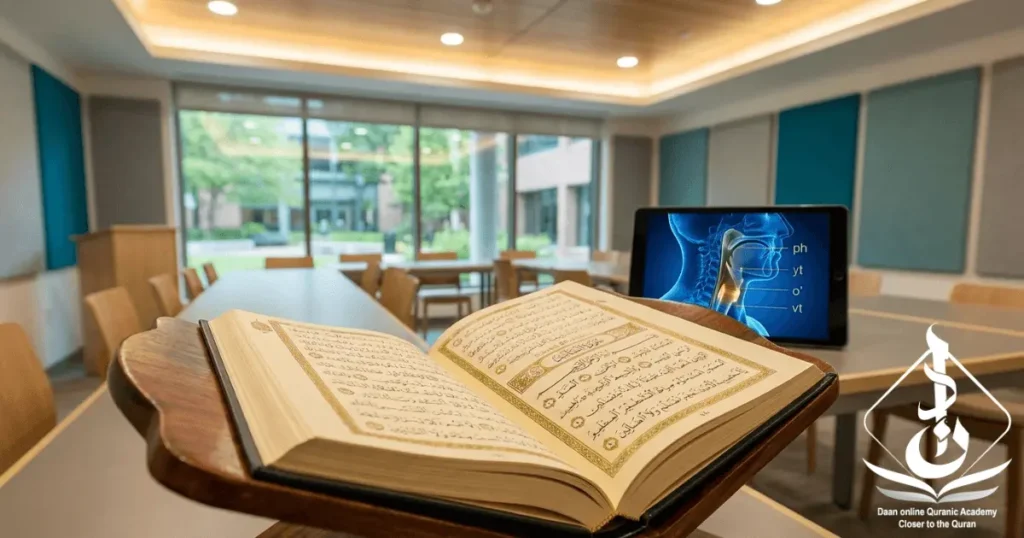
The Journey of Mastery: Overcoming Arabic Pronunciation Challenges for Non-Native Speakers The Arabic language is the language of “Bayan” (eloquence) and miracles. It is the language of the Holy Qur’an, chosen by Allah to be the vessel for His revelation. For non-native speakers, Arabic represents a fascinating world of intricate details, yet it simultaneously presents unique phonetic challenges. “Correct pronunciation” is not merely a linguistic luxury; it is the foundation for understanding meaning—especially when reciting the Qur’an, where shifting the articulation point of a single letter can entirely alter the verse’s meaning. In this comprehensive guide, we dive deep into the human vocal apparatus to explore how to tame difficult Arabic letters such as (Ḍād, ‘Ayn, Ghayn, Khā’, Ḥā’, Hā’, and Hamzah), providing practical and scientific strategies to help students achieve mastery. First: The Philosophy of the Arabic Sound System Arabic is distinguished by what are known as “Guttural sounds” and “Emphatic articulation”—qualities often lacking in many European and Asian languages. English, for instance, focuses most of its sounds at the front of the mouth and lips, while Arabic extends to the deepest parts of the throat. Therefore, the first step in treatment is “Retraining the speech muscles” and expanding the student’s vocal range. Second: The Guttural Letters (Hamzah, Hā’, ‘Ayn, Ḥā’, Ghayn, Khā’) 1. The Hamzah (أ) and Hā’ (هـ): Deepest Throat These two letters originate from the furthest point in the throat. 2. The ‘Ayn (ع) and Ḥā’ (ح): Middle Throat This area is the most difficult as it requires control over the “epiglottis.” 3. The Ghayn (غ) and Khā’ (خ): Upper Throat This region is closest to the mouth (the root of the tongue with the soft palate). Third: The Language of Ḍād.. The Mystery of the Letter (Ḍād) Arabic is famously called “The Language of Ḍād” because of this unique sound. Fourth: Educational Strategies for Academies (The Remedial Approach) Explaining the articulation point theoretically is not enough; practical steps must be followed: 1. Phonological Awareness Before a student speaks, they must hear. 2. Utilizing Technology and Visual Aids 3. The “Static to Dynamic” Rule A “Sākin” (vowel-less) letter shows the articulation point more clearly. Fifth: The Psychological and Motivational Aspect Learning Arabic articulation points can be frustrating initially. The teacher’s role is: Sixth: The Importance of Face-to-Face Transmission (Mushafahah) Articulation points cannot be learned from books alone. “Mushafahah” (direct interaction) is the backbone of teaching Arabic. Conclusion Arabic pronunciation challenges are not impossible barriers; they are “thresholds of mastery” that increase a student’s ability to taste the beauty of this language. Through a scientific understanding of articulation, consistent practice, and the help of modern tools, any student—regardless of their mother tongue—can speak Arabic with an eloquent tongue. In our academy, we believe every student has the potential to excel. We are here to take your hand through every letter, from Hamzah to Yā’, making you an ambassador for the language of the Qur’an everywhere. Experience our unique approach first-hand. Book your free free trial sessions now with no strings attached.