The Journey of Mastery: Overcoming Arabic Pronunciation Challenges for Non-Native Speakers
The Arabic language is the language of “Bayan” (eloquence) and miracles. It is the language of the Holy Qur’an, chosen by Allah to be the vessel for His revelation. For non-native speakers, Arabic represents a fascinating world of intricate details, yet it simultaneously presents unique phonetic challenges. “Correct pronunciation” is not merely a linguistic luxury; it is the foundation for understanding meaning—especially when reciting the Qur’an, where shifting the articulation point of a single letter can entirely alter the verse’s meaning.
In this comprehensive guide, we dive deep into the human vocal apparatus to explore how to tame difficult Arabic letters such as (Ḍād, ‘Ayn, Ghayn, Khā’, Ḥā’, Hā’, and Hamzah), providing practical and scientific strategies to help students achieve mastery.
First: The Philosophy of the Arabic Sound System
Arabic is distinguished by what are known as “Guttural sounds” and “Emphatic articulation”—qualities often lacking in many European and Asian languages. English, for instance, focuses most of its sounds at the front of the mouth and lips, while Arabic extends to the deepest parts of the throat. Therefore, the first step in treatment is “Retraining the speech muscles” and expanding the student’s vocal range.
Second: The Guttural Letters (Hamzah, Hā’, ‘Ayn, Ḥā’, Ghayn, Khā’)
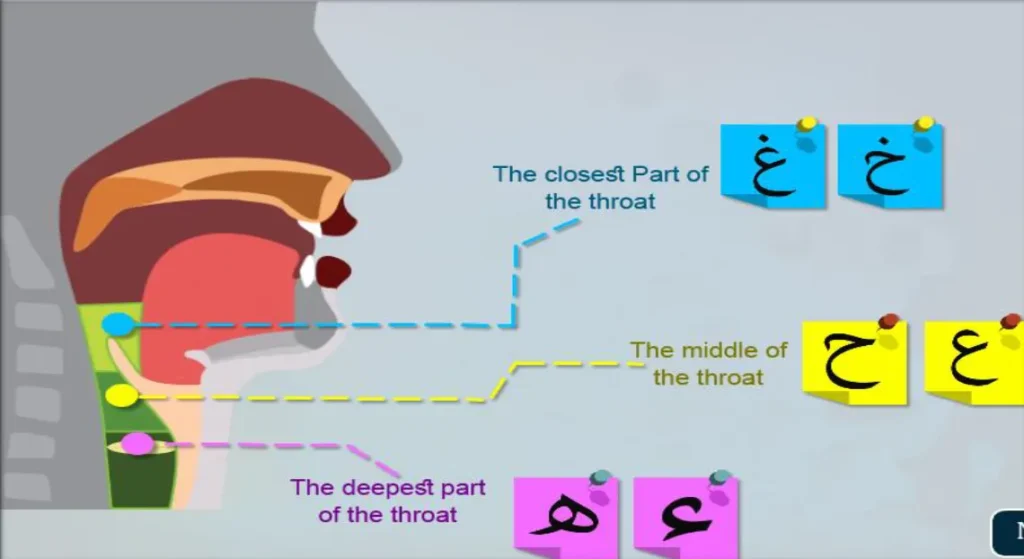
1. The Hamzah (أ) and Hā’ (هـ): Deepest Throat
These two letters originate from the furthest point in the throat.
- The Challenge: Students often make the Hamzah “floaty” or weak, and the Hā’ may come out as a simple breath without a defined exit point.
- The Remedy:
- For Hamzah: Train the student to “hold their breath” and then release it suddenly. Imagine a slight cough; the movement in the larynx is the beginning of the Hamzah’s exit point.
- For Hā’: The “Sigh of Relief” exercise. Ask the student to sigh deeply (Haaaa), ensuring the sound comes from the larynx rather than just the chest or mouth.
2. The ‘Ayn (ع) and Ḥā’ (ح): Middle Throat
This area is the most difficult as it requires control over the “epiglottis.”
- The Challenge: English-speaking students often substitute ‘Ayn with Hamzah, and Ḥā’ with Hā’.
- The Remedy (‘Ayn): * Labeling it as the “Squeezed Letter.” Ask the student to imagine they are swallowing something; that pressure in the middle of the throat is the ‘Ayn’s exit point.
- “Dry Gargle” exercise: Attempting to produce a sound while narrowing the middle throat.
- The Remedy (Ḥā’):
- Describing it as a “clean, sharp sound.” Ask the student to blow on glasses to clean them; that hot, forceful air is the Ḥā’. It must be distinguished from the weak Hā’ and the rough Khā’.
3. The Ghayn (غ) and Khā’ (خ): Upper Throat
This region is closest to the mouth (the root of the tongue with the soft palate).
- The Challenge: Confusing Ghayn with the “J” sound (in some languages) or pronouncing Khā’ as a soft “K.”
- The Remedy (Ghayn):
- The “Water Gargling” exercise: The sound produced when gargling is exactly the exit point for Ghayn.
- Clarifying that Ghayn is a “voiced” sound (involving vocal cord vibration).
- The Remedy (Khā’):
- Describing it as a gentle “snore” or a “frictional” sound. Ensure there is no moisture (saliva) so it doesn’t turn into a Ghayn. It is a “voiceless” sound relying on airflow.
Third: The Language of Ḍād.. The Mystery of the Letter (Ḍād)
Arabic is famously called “The Language of Ḍād” because of this unique sound.
- The Challenge: Most students pronounce it as an “emphatic D” or confuse it with the letter Ẓā’.
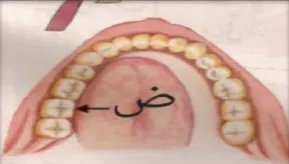
- Correct Articulation: It comes from one or both sides of the tongue pressing against the upper molars.
- The Remedy:
- The “Cushion” Theory: Teach the student that the tip of the tongue does not press against the front teeth (as in Dāl), but “elongates” so the edges of the tongue stick to the molars.
- Elongation Exercise: Training the student to push the tongue forward slowly inside the mouth while maintaining contact with the upper palate until the tip touches the Dāl exit point without pressing on it.
Fourth: Educational Strategies for Academies (The Remedial Approach)
Explaining the articulation point theoretically is not enough; practical steps must be followed:
1. Phonological Awareness
Before a student speaks, they must hear.
- Discrimination Test: Pronounce similar words (Ḥām – Hām), (‘Ālim – Alam), and ask the student to identify the letter. If the ear cannot distinguish the difference, the tongue cannot produce it.
2. Utilizing Technology and Visual Aids
- Cross-section Diagrams: Displaying side-profile images of the face showing where the tongue rises and where the throat constricts.
- Frequency Measurement Apps: Using software that visualizes sound waves so students can visually see the difference between thin (Muraqqaq) and thick (Mufakhkham) letters.
3. The “Static to Dynamic” Rule
A “Sākin” (vowel-less) letter shows the articulation point more clearly.
- Start with (Aḥ, Agh, A‘).
- Then move to vowels (Ḥa, Ḥi, Ḥu).
- Finally, practice simple words containing the letter in different positions.
Fifth: The Psychological and Motivational Aspect
Learning Arabic articulation points can be frustrating initially. The teacher’s role is:
- Beautiful Patience: Reminding students that many of the Prophet’s companions were non-Arabs (like Bilal from Abyssinia and Suhaib the Roman) and mastered the language through practice.
- Praising the Effort: Every attempt to pronounce the “‘Ayn” is a step toward perfecting the recitation of Allah’s book. As the Prophet (PBUH) said: “The one who recites the Qur’an and stutters over it, finding it difficult, will have a double reward.”
Sixth: The Importance of Face-to-Face Transmission (Mushafahah)
Articulation points cannot be learned from books alone. “Mushafahah” (direct interaction) is the backbone of teaching Arabic.
- The student must see the teacher’s lip movements and the tension in the neck muscles when pronouncing guttural letters.
- Voice Recording: Ask the student to record themselves, listen, and compare it to the teacher’s voice. This “self-feedback” accelerates learning by 200%.
Conclusion
Arabic pronunciation challenges are not impossible barriers; they are “thresholds of mastery” that increase a student’s ability to taste the beauty of this language. Through a scientific understanding of articulation, consistent practice, and the help of modern tools, any student—regardless of their mother tongue—can speak Arabic with an eloquent tongue.
In our academy, we believe every student has the potential to excel. We are here to take your hand through every letter, from Hamzah to Yā’, making you an ambassador for the language of the Qur’an everywhere.
Experience our unique approach first-hand. Book your free free trial sessions now with no strings attached.