
Types of Tanween in Arabic: Rules, Symbols, and Quranic Examples
The types of tanween in Arabic are three — tanween fath, tanween damm, and tanween kasr — and learning them correctly is the fastest way to clean up the endings of your Quran recitation. Whether you are comparing tutors or choosing your first Tajweed course, this guide explains every rule, sound, and Quranic example in plain English.
You will see exactly what is tanween in Quran recitation, what is tanween in Tajweed, how to read every tanween symbol, and how to practise tanween examples with a certified tutor. At Daan Quranic Academy, native Egyptian teachers help English-speaking students master these sounds one-on-one, with plans from $9/hr.
Key Takeaways
- Three types: The three types of tanween in Arabic are tanween fath (ـً, “-an”), tanween damm (ـٌ, “-un”) and tanween kasr (ـٍ, “-in”). Tanween is an extra noon sound added to the end of an indefinite noun, pronounced but never written as a letter.
- Where it appears: Only on nouns and adjectives, never on verbs or particles. Tanween damm usually marks the subject, tanween fath the object, and tanween kasr appears after a preposition or in a possessive structure.
- When you stop: Tanween fath becomes a long “ā”, so عَلِيمًا is read ʿalīmā. Tanween damm and kasr disappear, so عَلِيمٌ and عَلِيمٍ are both read ʿalīm. Words ending in ta marbuta change to a soft “h”: رَحْمَةً is read raḥmah.
- Five rules: The next letter decides the rule. Izhar before ء ه ع ح غ خ; Idgham with ghunnah before ي ن م و; Idgham without ghunnah before ل ر; Iqlab before ب; Ikhfa’ before the remaining fifteen letters.
- Versus noon sakinah: Tanween is a vowel mark on the end of an indefinite noun, while noon sakinah is a real letter ن carrying a sukoon. They follow the same five rules.
📑 Table of Contents
- Types of Tanween in Arabic: A Complete Guide for 2026
- What Is Tanween in Quran Recitation? Meaning and Purpose
- Tanween Symbol: How to Read and Write the Three Marks
- Types of Tanween in Arabic vs Noon Sakinah: Key Differences
- What Is Tanween in Tajweed? The Five Rules Every Reciter Needs
- Tanween Examples from the Quran with Meanings
- Learn the Types of Tanween in Arabic with Native Egyptian Tutors
- Affordable Tajweed Classes: Pricing and Value in 2026
- Why Families Choose Daan Quranic Academy
- Frequently Asked Questions
Types of Tanween in Arabic: A Complete Guide for 2026
The types of tanween in Arabic are three: tanween fath (ـً, sounds “-an”), tanween damm (ـٌ, sounds “-un”), and tanween kasr (ـٍ, sounds “-in”). Tanween is an extra noon sound added to the end of an indefinite noun. It is pronounced but never written as a letter, and it tells the reader that the word is indefinite.
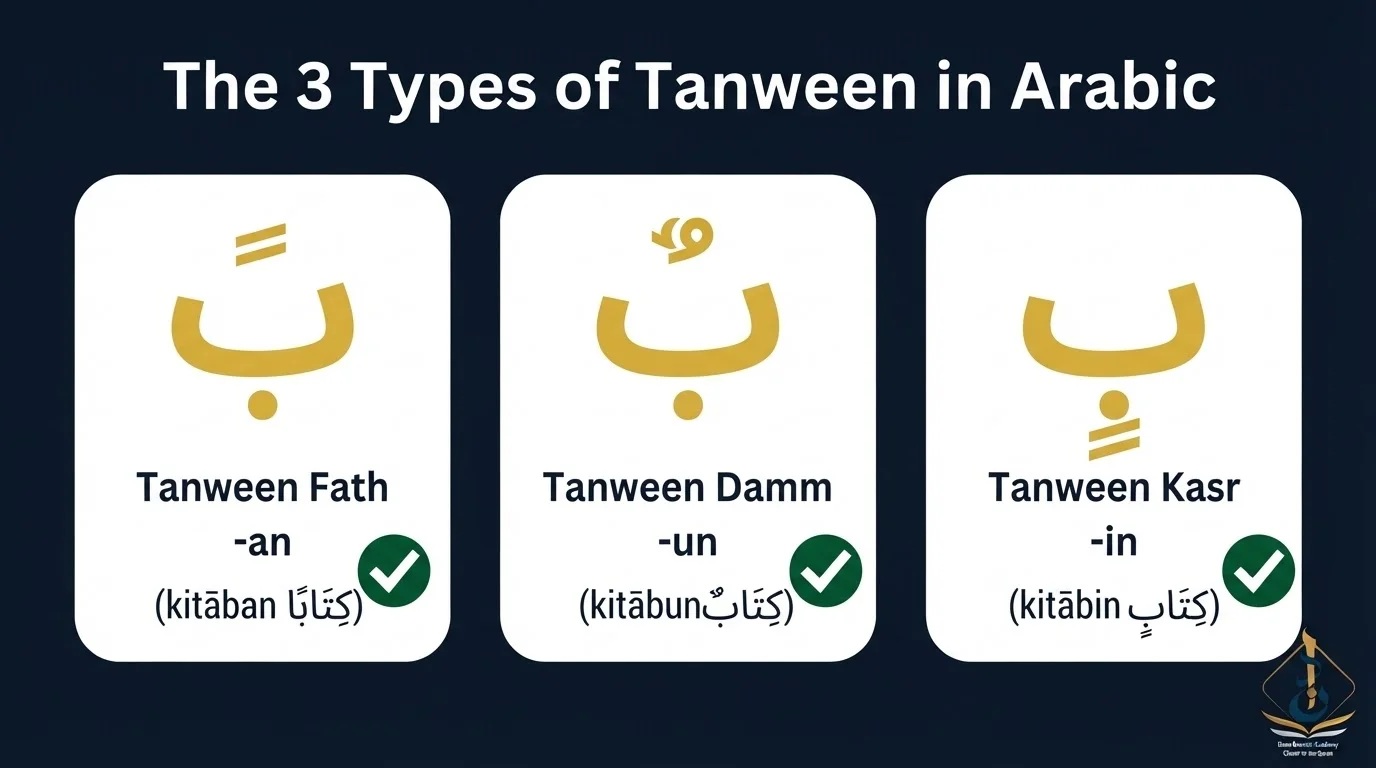
Think of tanween as a doubled short vowel. A single fatha, damma, or kasra gives a short vowel; the doubled mark adds a light “n” sound after it. The word tanween (تَنْوِين) itself carries the idea of “adding a noon.”
Learning the types of tanween in Arabic matters because tanween ends a very large number of Quranic words and decides how the next letter is pronounced. Students who skip it often repeat the same ending mistakes in every surah, which is why it features in our guide to common Tajweed mistakes non-Arabic speakers make and how to fix them.
Tanween Fath, Damm, and Kasr at a Glance
- Tanween fath (fathatan): pronounced “-an” and usually written on an alif, as in كِتَابًا (kitāban), “a book.”
- Tanween damm (dammatan): pronounced “-un,” as in كِتَابٌ (kitābun), “a book” as a subject.
- Tanween kasr (kasratan): pronounced “-in,” as in كِتَابٍ (kitābin), “of a book.”
Not sure which of these sounds you pronounce correctly today? A short free trial session with a native tutor shows you exactly which endings need work.
What Is Tanween in Quran Recitation? Meaning and Purpose
What is tanween in Quran recitation? It is a doubled vowel mark on the last letter of an indefinite noun that adds a noon (ن) sound that is pronounced but not written: “-an,” “-un,” or “-in.” The reciter pronounces this ending, then applies the correct Tajweed rule to the letter that follows.
Real session recording: A native Egyptian tutor guides a student through the application of Noon Sakinah and Tanween rules during a live 1-on-1 Tajweed lesson. All videos are real, unedited screen-recordings from actual student sessions at Daan Academy, posted with student consent.
When students ask what is tanween in Quran reading, the first thing to know is that it never appears on verbs or particles. It sits only on nouns and adjectives, such as أَحَدٌ (aḥadun, “One”) in Surah Al-Ikhlas or تَرْتِيلًا (tartīlan, “measured recitation”) in Surah Al-Muzzammil.
Tanween Also Carries Grammar
Beyond sound, tanween carries grammatical information. Tanween damm usually marks a noun as the subject (nominative), tanween fath marks it as the object (accusative), and tanween kasr appears after a preposition or in a possessive structure (genitive). Learners who also study Quranic Arabic quickly see the types of tanween in Arabic as a built-in grammar signal, not only a pronunciation rule.
You can study both sides in one programme: our Tajweed classes online for beginners and Quranic Arabic classes for beginners, part of our wider course range, pair recitation rules with meaning, so tanween never feels like an isolated chore.
Tanween Symbol: How to Read and Write the Three Marks
The tanween symbol is a doubled short-vowel mark placed on the final letter of an indefinite noun. There are three: fathatan (ً), dammatan (ٌ), and kasratan (ٍ), and each one produces a different ending sound.
| Type | Tanween Symbol (on ب) | Sound | Example |
|---|---|---|---|
| Tanween fath (fathatan) | بً | -an | كِتَابًا (kitāban) |
| Tanween damm (dammatan) | بٌ | -un | كِتَابٌ (kitābun) |
| Tanween kasr (kasratan) | بٍ | -in | كِتَابٍ (kitābin) |
Tanween fath is usually written over a supporting alif, as in كِتَابًا. The exceptions are words ending in ta marbuta (رَحْمَةً) or alif maqsura (هُدًى), where the fathatan sits on the final letter itself.
In many Uthmani-script printings, such as the Madinah Mushaf, the position of the two marks hints at the Tajweed rule: stacked marks usually signal Izhar, while offset marks signal Idgham, Iqlab, or Ikhfa’. Knowing this turns every tanween symbol on the page into a visual Tajweed cue.
Reading the Tanween Symbol When You Stop (Waqf)
All three types of tanween in Arabic behave differently when you pause on a word. Tanween fath becomes a long “ā” sound, so عَلِيمًا is read ʿalīmā. Tanween damm and tanween kasr simply disappear, so عَلِيمٌ and عَلِيمٍ are both read ʿalīm. Words ending in ta marbuta change to a soft “h”: رَحْمَةً is read raḥmah.
Say the vowel first, then add a quick “n”: ba + n = ban, bun, bin. Before you move on, always check the next letter, because it decides how that “n” is pronounced.
Types of Tanween in Arabic vs Noon Sakinah: Key Differences
Tanween and noon sakinah sound alike in Tajweed, but they are not the same: tanween is a vowel mark on the end of an indefinite noun, while noon sakinah is a real letter ن carrying a sukoon. Understanding this difference stops beginners from mixing the two up.
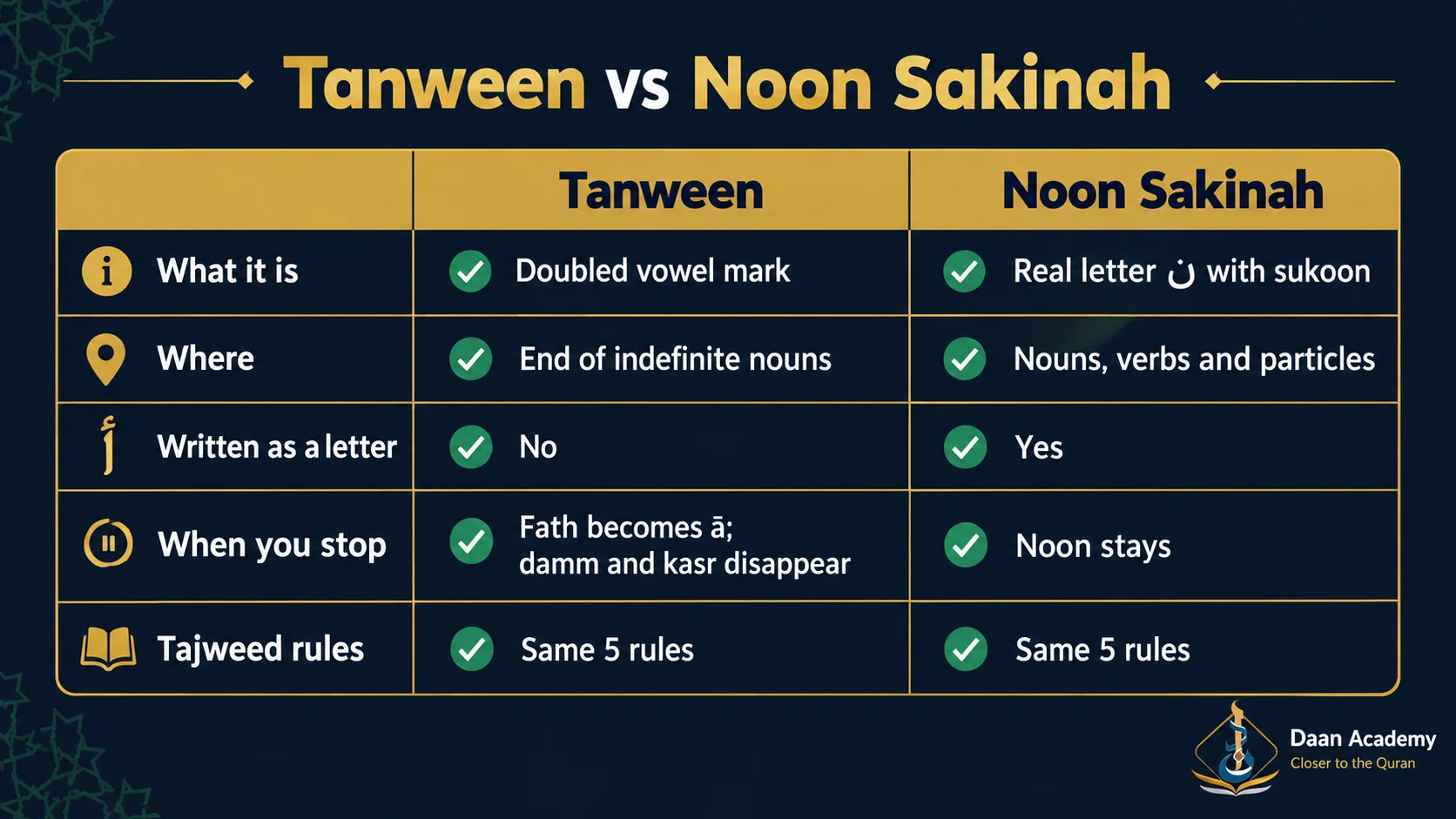
| Feature | Tanween | Noon Sakinah |
|---|---|---|
| What it is | A doubled vowel mark (ً ٌ ٍ) | A real letter ن with a sukoon |
| Where it appears | End of indefinite nouns only | Inside or at the end of nouns, verbs, and particles |
| Written as a letter? | No — only pronounced | Yes |
| When you stop on the word | Fath becomes “ā”; damm and kasr disappear | The noon stays |
| Tajweed rules | Izhar, two types of Idgham, Iqlab, Ikhfa’ | The same five rules |
| Example | أَحَدٌ (aḥadun) | مِنْ (min) |
Once you understand what is tanween in Tajweed, the good news is that noon sakinah follows the same five rules. Once you master the types of tanween in Arabic, you already know most of the noon sakinah system. If you still struggle to read Arabic letters fluently, start with our comprehensive guide to learning Noorani Qaida before moving on to these rules.
What Is Tanween in Tajweed? The Five Rules Every Reciter Needs
What is tanween in Tajweed? It is the noon sound at the end of an indefinite noun, and it follows the same five rules as noon sakinah: Izhar, Idgham with ghunnah, Idgham without ghunnah, Iqlab, and Ikhfa’. The rule you apply depends only on the Arabic letter that comes right after the tanween.
Izhar (Clear Pronunciation)
Applied before the six throat letters: ء ه ع ح غ خ. Pronounce the tanween clearly without ghunnah, as in سَمِيعٌ عَلِيمٌ (Surah Al-Baqarah, 2:227).
Idgham with Ghunnah (Merging with Nasal Sound)
Applied before ي ن م و. Merge the tanween into the next letter while holding a nasal ghunnah for about two counts, as in وُجُوهٌ يَوْمَئِذٍ نَّاعِمَةٌ (Surah Al-Ghashiyah, 88:8).
Idgham without Ghunnah (Merging without Nasal Sound)
Applied before ل and ر. The tanween blends fully into the next letter with no nasal sound, as in غَفُورٌ رَّحِيمٌ (Surah Al-Baqarah, 2:173) and هُدًى لِّلْمُتَّقِينَ (2:2).
Iqlab (Converting to Meem)
Applied before ب only. Turn the tanween into a hidden meem with ghunnah and lightly close the lips, as in سَمِيعٌۢ بَصِيرٌ (Surah Al-Hajj, 22:61).
Ikhfa’ (Hiding)
Applied before the remaining fifteen letters: ت ث ج د ذ ز س ش ص ض ط ظ ف ق ك. Hide the tanween with a light ghunnah, keeping the tongue off the mouth’s roof, as in جَنَّٰتٍ تَجْرِى (Surah Al-Baqarah, 2:25).
To read more about the science behind these rules, see the overview of Tajweed on Wikipedia. Every one of the types of tanween in Arabic follows these five rules, and you can practise them with the tanween examples in the next section. Rules on paper are only the start, though: ghunnah length and mouth position are learned by ear, which is where live correction makes the difference.
If you are comparing programmes, our review of the best online Tajweed course in 2026 explains what a complete curriculum should include.
Tanween Examples from the Quran with Meanings
The best way to learn the types of tanween in Arabic is to see them inside real verses. These tanween examples show one verse for each type, with the exact Surah and Ayah reference.
Tanween Damm Example: Surah Al-Ikhlas
In أَحَدٌ (aḥadun), tanween damm gives the “-un” ending. Because this is the end of the verse, a reciter who stops reads it as aḥad, with the tanween dropped.
Tanween Fath Example: Surah Al-Muzzammil
أَوْ زِدْ عَلَيْهِ وَرَتِّلِ ٱلْقُرْءَانَ تَرْتِيلًا
“Or add to it, and recite the Quran with measured recitation.”
The word تَرْتِيلًا (tartīlan) carries tanween fath. When you stop at the end of the verse, it is read tartīlā with a long alif sound. This verse is also a reminder that careful, measured recitation is itself a command.
Tanween Kasr Example: Surah Al-Asr
In خُسْرٍ (khusrin), tanween kasr appears after the preposition فِى. Stopping on it gives khusr, because tanween kasr disappears when you pause.
More Tanween Examples to Practise
| Word | Tanween Type | Reading | Meaning | Reference |
|---|---|---|---|---|
| غَفُورٌ | Damm | ghafūrun | Forgiving | 2:173 |
| يُسْرًا | Fath | yusran | ease | 94:6 |
| هُدًى | Fath | hudan | guidance | 2:2 |
| رَحْمَةً | Fath | raḥmatan | mercy | 21:107 |
| جَنَّٰتٍ | Kasr | jannātin | gardens | 2:25 |
Practise the types of tanween in Arabic by reading each word aloud twice: once with the tanween and once as if you were stopping. A live tutor hears whether your “-an” is clean or stretched, which is why 1-on-1 correction beats recorded lessons alone.
Try it yourself: Tap the tiles to match each tanween symbol with its example and sound. This is one of 600+ interactive games children and adults use inside Daan Academy lessons.
Learn the Types of Tanween in Arabic with Native Egyptian Tutors
Where you study matters as much as what you study. When you want to learn the types of tanween in Arabic properly, look for these four qualities, because each one addresses a common weakness in typical online academies. A good tutor should also explain what is tanween in Quran terms and what is tanween in Tajweed practice, not just hand you a chart.
What to Look For: Native Arabic Pronunciation
Tanween endings are subtle, and only a trained native ear catches the gap between a clean “-an” and a flat one. While many platforms use non-native speakers, all tutors at Daan Academy are native Egyptian Arabs, and you can meet our native Egyptian tutors before you book.
What to Look For: Verified Ijazah Credentials
Ask every academy whether its teachers hold an Ijazah. At Daan Quranic Academy, many tutors hold Ijazah in multiple Qira’at with chains back to the Prophet ﷺ, supported by formal training in Quranic sciences and Al-Azhar-trained teachers. See why students choose Daan Academy for the full picture.
What to Look For: Private 1-on-1 Correction
Unlike group classes that dilute attention, every Daan session is private and personalised. Your tutor stops you the moment a tanween is dropped or over-stretched, and because every tutor speaks fluent English, explanations stay clear for reverts and children alike.
What to Look For: Transparent Progress Tracking
Progress should be visible, not guessed. The Daan LMS student dashboard shows sessions, balance, and progress reports in one place, while monthly updates, smart reminders before every session, and verified completion certificates keep you motivated at each milestone.
The Prophet ﷺ highlighted the value of this journey of learning and teaching the Quran:
“The best among you are those who learn the Quran and teach it.”
Narrated by Uthman ibn Affan — Sahih al-Bukhari, 5027
Affordable Tajweed Classes: Pricing and Value in 2026
Affordable Tajweed classes at Daan Academy start from $9/hr, with three transparent plans: Essential ($9/hr), Pro ($10.99/hr), and Elite ($12.99/hr). Every plan includes private lessons with a native Egyptian tutor, so learning the types of tanween in Arabic does not have to be expensive.
Cost is the first worry for many parents and adult learners. Some providers hide their prices until you book, whereas Daan lists all three plans openly. Because every lesson is 1-on-1, you pay for focused attention, not for a seat in a crowded virtual room.
Plans start from just $9/hr with native Egyptian tutors. Compare our three flexible pricing tiers — Essential, Pro, and Elite — each designed for different learning goals and budgets.
- Essential: $9/hr, an accessible way to start learning the types of tanween in Arabic one-on-one.
- Pro: $10.99/hr, for students who want a deeper Tajweed programme.
- Elite: $12.99/hr, with a family discount for households learning together.
Online vs In-Person: Which Delivers Better Value?
Online lessons remove the commute and fit around work, school, and time zones, with flexible scheduling at any hour from anywhere in the world. They also give families in the UK, USA, Europe, and Australia access to native Arabic tutors that a local class may not offer. If you bring a friend, the referral program gives both of you a discount.
Why Families Choose Daan Quranic Academy
Families choose Daan Quranic Academy for native Egyptian tutors, certified Ijazah credentials, and private 1-on-1 lessons that fix the types of tanween in Arabic and other pronunciation points in real time. Students join from more than 15 countries, from reverts taking their first steps to parents enrolling children.
For children, the library of 600+ educational games keeps tanween practice playful and improves retention, while parents follow progress through the dashboard and detailed session reports. Dedicated support is available around the clock for any technical or academic question, so a missed login never means a missed lesson.
Trust is built on transparency: clear pricing, verified certificates, and a free trial with no commitment. If you are still weighing your options, explore more beginner-friendly Tajweed guides on the Daan Academy blog.
When you are ready, book a free trial class and hear your own tanween endings corrected by a native tutor, risk-free.

Frequently Asked Questions
How many types of tanween in Arabic are there?
There are three types of tanween in Arabic: tanween fath (-an), tanween damm (-un), and tanween kasr (-in). Each is a doubled short-vowel mark on the end of an indefinite noun. The extra noon sound is the same in all three, and only the vowel before it changes.
What is the difference between tanween and noon sakinah?
Tanween is a doubled vowel mark at the end of an indefinite noun, pronounced but not written as a letter. Noon sakinah is a real letter ن with a sukoon that can appear inside or at the end of words. Both follow the same five Tajweed rules.
How much do online Tajweed classes cost?
Plans at Daan Academy start from $9/hr (Essential), with Pro at $10.99/hr and Elite at $12.99/hr, which includes a family discount. You can compare every option on our pricing plans page.
Can I try a Tajweed class before committing?
Yes. Daan Academy offers a free trial session with no commitment, so you can meet a tutor and experience a private lesson first. Book your free trial and choose a time that suits your time zone.
How do I know a tutor is qualified to teach tanween and Tajweed rules?
Look for native Arabic pronunciation, a verifiable Ijazah, and fluent English for clear explanations. At Daan Academy, all tutors are native Egyptians formally trained in Quranic sciences, and many hold Ijazah in multiple Qira’at.
Can kids and adult reverts learn tanween online?
Yes. Lessons are private and adapted to each learner, so beginners start from the basics and progress at their own pace. Children also benefit from interactive games, while adult reverts get patient explanations in fluent English.
Master Tanween with a Native Egyptian Tutor
Stop guessing how word endings should sound. Learn the types of tanween in Arabic with a certified native tutor who corrects you live, one-on-one.
No commitment required. One free session to experience the Daan Academy difference.
Final Thoughts
Mastering the types of tanween in Arabic is a small step that transforms the way you recite: clean endings, correct Tajweed rules, and growing confidence in every verse. Start with the three symbols, practise the five rules, and let a qualified teacher guide your ear.
May Allah make us among those who learn the Quran and teach it. We ask Him as He taught us: رَّبِّ زِدْنِى عِلْمًا — “My Lord, increase me in knowledge” (Quran, 20:114). Ameen.