Revelation of the Quran: The 3 Stages, Types, and Story of First Revelation
The revelation of the Quran is the process by which Allah communicated His final scripture to Prophet Muhammad ﷺ through the Angel Jibreel (Gabriel), across three distinct stages and over roughly 23 years — beginning in the Cave of Hira in 610 CE. Understanding this story is not just a matter of Islamic history; it is the foundation for reading, reciting, and reflecting on the Quran with real meaning. Whether you are a revert taking your first steps into the deen, a parent hoping your child grows up understanding where the Quran truly came from, or simply someone comparing options for online Quran and Islamic Studies classes, this guide walks through exactly how the revelation of the Quran unfolded — and how to find a tutor qualified enough to teach it properly.
📑 Table of Contents
- What Is the Revelation of the Quran?
- The Story of the First Revelation of the Quran to the Prophet Muhammad ﷺ
- The 3 Stages of Revelation of the Quran Explained
- Types of Revelation of the Quran: How Allah Spoke to His Messengers
- What to Look For When Choosing Where to Learn the Revelation of the Quran
- Online vs In-Person: Comparing How to Learn Quran and Tajweed Today
- Affordable Quran & Tajweed Classes in 2026: What Does It Cost?
- Real Outcomes: How Daan Academy Students Learn the Quran and Its Revelation
- When Was the Quran Revealed to Prophet Muhammad ﷺ?
- Frequently Asked Questions
What Is the Revelation of the Quran?
The revelation of the Quran refers to the transmission of Allah’s final message to humanity, delivered to Prophet Muhammad ﷺ in Arabic through the Angel Jibreel over approximately 23 years, from 610 CE until shortly before his death in 632 CE. Muslims call this process wahy. Unlike a book written by a human author, the Quran is understood as the literal word of Allah, preserved word-for-word from the moment it was first sent down to the Prophet ﷺ in the Cave of Hira near Makkah.
This is more than a historical footnote — it is the reason Tajweed, memorisation, and correct pronunciation matter so much in Islamic education. If every letter of the Quran was revealed with precision, then learning to recite it with precision is not optional extra credit; it is the point. That is exactly what a structured Quran, Tajweed, and Arabic curriculum is built around, and you can see how our full range of courses covers this from the very first Arabic letter through to advanced Tajweed rules.

The Story of the First Revelation of the Quran to the Prophet Muhammad ﷺ
By the time he was forty years old, Prophet Muhammad ﷺ had developed a habit of withdrawing to the Cave of Hira for days at a time, away from the noise of Makkah, to reflect and worship in solitude. It was during one of these retreats, in the month of Ramadan, that the story of the first revelation of the Quran to Muhammad ﷺ began — a moment that changed the course of human history.
Real session recording: A native Egyptian tutor walking an adult student through the Seerah of Prophet Muhammad ﷺ, the same kind of lesson used to teach the story of revelation at Daan Academy. All videos are real, unedited screen-recordings from actual student sessions at Daan Academy, posted with student consent.
According to the well-known narration of Aisha (may Allah be pleased with her), the Angel Jibreel appeared to the Prophet ﷺ in the cave and commanded him to recite, even though he had never learned to read:
“The Angel came to him and said, ‘Read!’ The Prophet ﷺ replied, ‘I do not know how to read.’ The Prophet ﷺ added, ‘The angel caught me and pressed me so hard that I could not bear it any more. He then released me and again asked me to read, and I replied, “I do not know how to read,” so he caught me again and pressed me a second time until I could not bear it any more. He then released me and again asked me to read, but again I replied, “I do not know how to read (or what shall I read?).” Thereupon he caught me for the third time and pressed me, and then released me and said, “Read in the name of your Lord who has created (all that exists), created man from a clot. Read! And your Lord is the Most Generous.”‘”
Narrated by Aisha — Sahih al-Bukhari, Hadith 3
These first five verses revealed to the Prophet ﷺ became the opening of Surah Al-Alaq, and they remain the earliest words of the Quran ever sent down:
اقْرَأْ بِاسْمِ رَبِّكَ الَّذِي خَلَقَ ﴿١﴾ خَلَقَ الْإِنْسَانَ مِنْ عَلَقٍ ﴿٢﴾ اقْرَأْ وَرَبُّكَ الْأَكْرَمُ ﴿٣﴾ الَّذِي عَلَّمَ بِالْقَلَمِ ﴿٤﴾ عَلَّمَ الْإِنْسَانَ مَا لَمْ يَعْلَمْ ﴿٥﴾
“Recite in the name of your Lord who created — created man from a clinging substance. Recite, and your Lord is the most Generous — who taught by the pen — taught man that which he knew not.”
Terrified and shaking, the Prophet ﷺ returned home to his wife Khadijah (may Allah be pleased with her) and asked her to cover him. She reassured him with words that are still quoted in Islamic Studies classes today, and later took him to her cousin Waraqah ibn Nawfal, a Christian scholar familiar with earlier scripture, who confirmed that what had come to him was the same kind of revelation sent to Musa (Moses) — the beginning of prophethood. For families who want their children to know this story properly, not as a bedtime tale but as documented history, our in-depth guide to the story of revelation traces the full Seerah timeline in more detail.
This is exactly the kind of narrative that a qualified tutor brings to life. At Daan Quranic Academy, Seerah and the story of revelation are taught by native Egyptian tutors trained in the Islamic sciences, so children and adults alike hear it with the correct context, correct Arabic terminology, and correct Tajweed for the verses involved — not a simplified paraphrase. You can review tutor backgrounds on our Our Tutors page before booking a single class.
The 3 Stages of Revelation of the Quran Explained
Islamic scholars describe the revelation of the Quran as unfolding in three stages: first its placement in the Preserved Tablet, second its descent all at once to the lowest heaven on Laylat al-Qadr, and third its gradual revelation to Prophet Muhammad ﷺ over 23 years. This scholarly framework, most famously attributed to Ibn Abbas, resolves an apparent contradiction: the Quran describes itself as being sent down “in Ramadan” and “on the Night of Decree,” yet history shows it was revealed piece by piece over more than two decades. Both are true — they simply refer to different stages.
Stage 1: Recorded in Al-Lawh Al-Mahfooz (The Preserved Tablet)
Before it ever reached the earth, the entire Quran existed in its complete form in Al-Lawh Al-Mahfooz, the Preserved Tablet — a record of Allah’s decree that Islamic theology describes as eternal and unalterable.
Stage 2: Descent to Bayt Al-Izzah in the Lowest Heaven
On Laylat al-Qadr (the Night of Decree) in the month of Ramadan, the Quran was sent down in its entirety from the Preserved Tablet to Bayt Al-Izzah (“The House of Might”) in the nearest heaven to earth — a single, complete transmission, according to the view held by the majority of classical scholars including Ibn Abbas.
Stage 3: Gradual Revelation to Prophet Muhammad ﷺ Over 23 Years
From Bayt Al-Izzah, the Angel Jibreel brought the Quran down to Prophet Muhammad ﷺ piece by piece, verse by verse and surah by surah, in response to real events, questions, and circumstances the early Muslim community faced — a process that continued until shortly before the Prophet’s ﷺ death in 632 CE.
Allah references this second stage directly in the Quran itself:
إِنَّا أَنْزَلْنَاهُ فِي لَيْلَةِ الْقَدْرِ
“Indeed, We sent the Quran down during the Night of Decree.”
Understanding the 3 stages of revelation of the Quran is one of those topics that separates a generic Quran app from an actual teacher. It requires someone trained in Uloom al-Quran (the sciences of the Quran) to explain accurately, which is why our approach at Daan Academy leans on tutors with formal training, not just fluent Arabic.
Types of Revelation of the Quran: How Allah Spoke to His Messengers
The Quran itself outlines three types of revelation through which Allah communicates with His messengers: direct inspiration placed into the heart, speech from behind a veil, and revelation sent through an angel — with the Quran specifically revealed through the third method, via the Angel Jibreel. This is laid out clearly in Surah Ash-Shura:
وَمَا كَانَ لِبَشَرٍ أَنْ يُكَلِّمَهُ اللَّهُ إِلَّا وَحْيًا أَوْ مِنْ وَرَاءِ حِجَابٍ أَوْ يُرْسِلَ رَسُولًا فَيُوحِيَ بِإِذْنِهِ مَا يَشَاءُ ۚ إِنَّهُ عَلِيٌّ حَكِيمٌ
“It is not for any human being that Allah should speak to him except by revelation or from behind a partition or that He sends a messenger to reveal, by His permission, what He wills. Indeed, He is Most High and Wise.”
In practice, the Quran was delivered through the third type: Jibreel bringing Allah’s exact words to Prophet Muhammad ﷺ. Authentic narrations describe this happening in more than one form — sometimes the Prophet ﷺ said it felt like the reverberation of a bell before the words became clear, and at other times Jibreel appeared to him in the form of a man. Both forms are documented in the same hadith collection that records the story of the first revelation, and this level of detail is exactly what a proper Islamic Studies curriculum should cover — not just “an angel brought the Quran,” but how, when, and in what forms, sourced correctly. This is the kind of depth covered in our Islamic Studies course, taught 1-on-1 rather than in a diluted group setting.
What to Look For When Choosing Where to Learn the Revelation of the Quran
The best place to learn about the revelation of the Quran combines certified, native Arabic-speaking tutors, one-on-one sessions, a structured Seerah and Tajweed curriculum, and a transparent, risk-free way to try before you commit. Here is what that looks like in practice, and what to check before signing up anywhere.

Certified, Native Arabic-Speaking Tutors
Look for tutors who are native Arabic speakers, formally trained in Quranic sciences rather than simply fluent conversationally. At Daan Academy, every tutor is a native Egyptian tutor, and many hold certified Ijazah in multiple Qira’at with a verified chain of transmission back to the Prophet ﷺ.
1-on-1 Sessions, Not Group Classes
Unlike group classes that dilute attention across several students, Daan Academy provides fully private, 1-on-1 sessions, so pronunciation, Tajweed corrections, and questions about the revelation of the Quran get addressed individually, every single class.
Fluent English Communication
While many platforms use tutors who struggle to explain concepts in English, every tutor at Daan Academy speaks fluent English, which matters enormously when explaining a nuanced topic like the three stages of revelation to a child or a revert learning the deen from the ground up.
A Real, No-Commitment Trial
Where most academies offer generic marketing promises, Daan Academy offers an actual free trial session with no card required and no obligation to continue — so you can judge tutor quality for yourself before spending anything.
Online vs In-Person: Comparing How to Learn Quran and Tajweed Today
Online Quran classes with a certified native tutor now match or exceed the quality of in-person lessons, while adding scheduling flexibility, progress tracking, and typically lower cost. The table below breaks down the practical differences families and adult learners actually care about.
| Criteria | Daan Academy (Online, 1-on-1) | Typical In-Person / Group Class |
|---|---|---|
| Tutor background | Native Egyptian, Ijazah-certified | Varies, often unverified |
| Class format | Private 1-on-1 | Group, shared attention |
| Scheduling | Any time, anywhere, from a phone | Fixed local timetable |
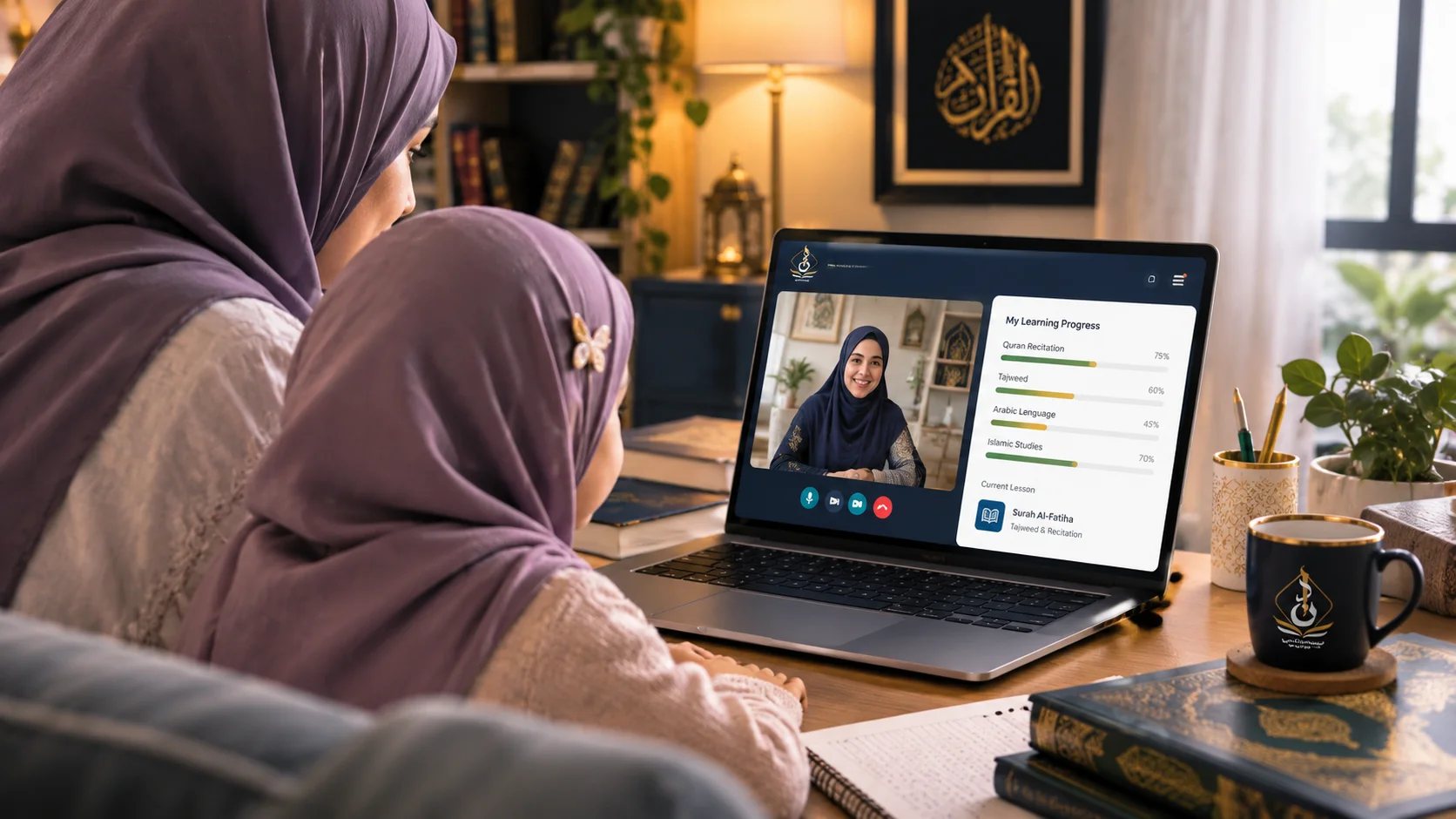
| Progress tracking | Smart Student Dashboard with session reports | Rarely formalised |
| Trial before paying | Free trial session | Rarely offered |
| Starting cost | From $9/hr | Varies, often higher with travel time |
None of this means in-person classes are a bad option where they exist and fit your schedule — it simply means online Quran classes no longer require a trade-off in quality, which is why families across the UK, USA, and Europe increasingly choose a structured online programme instead. You can compare course formats on our Our Courses page.
Affordable Quran & Tajweed Classes in 2026: What Does It Cost?
Affordable Quran and Tajweed classes in 2026 start from around $9 per hour for private, 1-on-1 sessions with a certified native tutor — considerably less than most local in-person tuition once travel time is factored in. Cost is usually the first objection families raise, and it is a fair one to raise.
Daan Academy runs three flexible pricing plans — Essential from $9/hr, Pro from $10.99/hr, and Elite from $12.99/hr — each with the same 1-on-1 native-tutor standard, just scaled to different learning goals and budgets. The Elite plan also includes a family discount for households enrolling more than one child, and every student can invite a friend through our referral program for a discount on both sides.
What you are actually paying for is not just class time. It includes access to the Smart Student Dashboard (Daan LMS) where sessions, balance, and progress reports live in one place, a library of over 600 educational games for younger learners to keep engagement high, automated smart notifications before every session, and 24/7 dedicated support if anything technical or academic comes up. When you compare that full package against the hourly rate, $9/hr for private, certified instruction is genuinely competitive.
Real Outcomes: How Daan Academy Students Learn the Quran and Its Revelation
Daan Quranic Academy has taught students across 15+ countries, with tutors trained in Al-Azhar-aligned Quranic sciences and many holding certified Ijazah with a verified chain of transmission. These are not abstract claims — they show up in how a class is actually run.
- Students receive a verified completion certificate at each course milestone, from finishing Noorani Qaida through to completing a full Hifz stage.
- Every session generates a transparent progress report inside the Smart Student Dashboard, so parents can see exactly what was covered — including topics like the story of revelation, not just recitation drills.
- Families comparing an academy for the first time can start with a single, no-obligation free trial session before deciding on a plan.
This combination of certified tutors, documented progress, and transparent pricing is what a serious commitment to Islamic education looks like — and it’s covered in more depth on our Why Choose Us page. For learners who want to go further into Islamic history after mastering the story of revelation, our Islamic Studies course online continues the journey through Seerah, Fiqh, and Aqeedah.
When Was the Quran Revealed to Prophet Muhammad ﷺ?
The Quran was first revealed to Prophet Muhammad ﷺ in 610 CE, when he was forty years old, in the Cave of Hira during the month of Ramadan, and its revelation continued in stages for approximately 23 years until shortly before his death in 632 CE. That 23-year window is exactly why the Quran contains guidance for such a wide range of real-life situations — each verse responded to something happening in the early Muslim community at the time.
For readers who want the wider historical picture — not just the moment of first revelation but everything that followed — our blog covers the full Seerah timeline, the Sunnahs of the Prophet ﷺ, and the historical battles and milestones that shaped early Islam.
Frequently Asked Questions
How much do online Quran classes cost?
At Daan Quranic Academy, private 1-on-1 classes start from $9/hr on the Essential plan, with Pro and Elite tiers available for more comprehensive learning goals. Full details are on our pricing plans page.
Is it safe for my child to learn Quran and Islamic Studies online?
Yes — every class is a private, 1-on-1 session with a vetted, native Egyptian tutor, and parents can monitor every session and progress report through the Smart Student Dashboard rather than relying on secondhand updates.
Can I try a class before committing to a plan?
Yes. Daan Academy offers a completely free trial session with no commitment required, so you can experience a real class on the story of revelation, Tajweed, or any other course before choosing a plan. Book your free trial here.
What’s included in the Daan Academy free trial?
The free trial is a full-length, private 1-on-1 session with a real native Egyptian tutor, matched to your (or your child’s) current level, so you can assess teaching quality firsthand before paying anything.
How do I know if a tutor teaching Islamic history and Seerah is actually qualified?
Check for formal training in the Islamic sciences and, where relevant, certified Ijazah credentials with a documented chain of transmission — not just conversational Arabic fluency. Tutor backgrounds at Daan Academy are listed on our Our Tutors page.
Do I need to already know Arabic before learning about the revelation of the Quran?
No. Classes are taught in fluent English by native Arabic-speaking tutors, so complete beginners, reverts, and non-Arabic-speaking parents can follow along from day one.
How long does it take to complete an Islamic Studies or Seerah course online?
This depends on the student’s pace and prior knowledge, but most learners progress through a structured curriculum over several months of consistent weekly sessions, with milestones marked by verified certificates along the way.
Learn the Full Story of the Quran’s Revelation, One-on-One
Reading about the revelation of the Quran is one thing — learning it properly, with correct Tajweed, sourced Seerah, and a tutor who can answer your questions, is another. Book a free trial with Daan Quranic Academy and see the difference for yourself.
No commitment required. One free session to experience the Daan Academy difference.
Final Thoughts
The revelation of the Quran is not a single event frozen in the past — it is a living story that shapes how Muslims read, recite, and relate to scripture today. From the terrified young Prophet ﷺ in the Cave of Hira to the completed Quran preserved word-for-word fourteen centuries later, the three stages and types of revelation give that story its structure, and understanding them properly changes how the Quran is experienced, not just studied.
Whether you are a parent choosing a first Quran teacher for your child, a revert learning the foundations of the deen, or simply someone who wants to understand the Quran’s origins with accuracy rather than assumption, the right tutor makes all the difference. We ask Allah to make the Quran a light in every home that seeks it, and a means of guidance for every student who commits to learning it.