What is Tashahhud in Salah & What to Say After it (Complete Guide) | Daan Quranic Academy
What to say after Tashahhud is one of the most searched questions among new Muslims, reverts, and parents teaching their children Salah — and getting it right matters, because Tashahhud sits at the heart of every single prayer, five times a day, for a lifetime.
In this 2026 guide, you’ll learn exactly what Tashahhud in Salah means, the authentic hadith behind it, what to read word-for-word, and what to say after Tashahhud in both Arabic and English. You’ll also see how a certified, native Egyptian tutor at Daan Quranic Academy can listen live and correct your pronunciation in real time — starting with a completely free trial session.
📑 Table of Contents
- What Is Tashahhud in Salah?
- What Is Tashahhud in Islam? The Hadith Behind It
- What to Read in Tashahhud: Full Text & Meaning
- How to Choose the Best Way to Learn Salah Online
- What to Say After Tashahhud: The Salawat Ibrahimiyyah
- What Is Tashahud in Prayer? The Final Dua Before Salam
- Common Mistakes: What to Say After Tashahhud If You Forget
- Is Learning Tashahhud and Salah Online Worth the Cost?
- Frequently Asked Questions
What Is Tashahhud in Salah? A Quick Definition
Tashahhud in Salah is the sitting position performed after every two rak’ahs, in which the worshipper recites specific words testifying to Allah’s oneness and the Prophethood of Muhammad ﷺ. It occurs at least once in every prayer, and twice in prayers of three or four rak’ahs — making it one of the most repeated acts of worship in a Muslim’s day.

The word “Tashahhud” comes from the Arabic root shahada, meaning “to testify” or “to bear witness.” Every time you sit for Tashahhud, you renew your testimony of faith — which is exactly why the wording, meaning, and pronunciation matter so much, whether you are a lifelong Muslim, a new revert, or a parent teaching a child their first Salah.
Many students preparing for this milestone work through a structured Salah and Tajweed course with a tutor who can watch their sitting position and listen to their pronunciation in real time — something a book or app alone simply cannot do.
What Is Tashahhud in Islam? The Hadith Behind Every Prayer
Tashahhud in Islam is not a man-made phrase — its exact wording was taught by the Prophet Muhammad ﷺ himself to his companion Abdullah ibn Mas’ud, hand-in-hand, the same way he taught a chapter of the Qur’an.
Ibn Mas’ud reported that the Prophet ﷺ took his hand between his own two hands and taught him the words directly, then said this was to be recited by every believer in every prayer. This narration is recorded as authentic (sahih) in one of the two most trusted hadith collections in Islam.
Real session recording: A certified native Egyptian tutor walking an adult student through the fiqh of worship, including the correct wording and timing of Tashahhud in Salah. All videos are real, unedited screen-recordings from actual student sessions at Daan Academy, posted with student consent.
A handful of authentically transmitted wordings exist — most notably the version from Ibn Mas’ud used widely across the Muslim world, alongside a slightly different version narrated by Ibn Abbas in Sahih Muslim. The meaning in every version is identical: testimony to Allah’s oneness, praise, and peace upon the Prophet ﷺ. At Daan Quranic Academy, tutors teach the standard Ibn Mas’ud wording first, since it is the version most Islamic schools of thought and most Quran academies teach beginners.
Understanding what is tashahhud in islam also means understanding its place in the wider structure of Salah — a subject covered in more depth in our guide on teaching Salah to non-Arabic speaking children.
What to Read in Tashahhud: The Full Text, Transliteration & Meaning
What to read in Tashahhud is a fixed set of Arabic words of testimony, praise, and peace — recited silently or quietly during the sitting position of Salah. Below is the most widely taught version, narrated by Ibn Mas’ud.
“The Messenger of Allah ﷺ taught me the Tashahhud, my hand held between his two hands, exactly as he taught me a surah from the Qur’an.”
Narrated by Abdullah ibn Mas’ud — Sahih al-Bukhari 831
التَّحِيَّاتُ لِلَّهِ وَالصَّلَوَاتُ وَالطَّيِّبَاتُ، السَّلَامُ عَلَيْكَ أَيُّهَا النَّبِيُّ وَرَحْمَةُ اللَّهِ وَبَرَكَاتُهُ، السَّلَامُ عَلَيْنَا وَعَلَى عِبَادِ اللَّهِ الصَّالِحِينَ، أَشْهَدُ أَنْ لَا إِلَهَ إِلَّا اللَّهُ وَأَشْهَدُ أَنَّ مُحَمَّدًا عَبْدُهُ وَرَسُولُهُ
“All greetings, prayers, and good deeds belong to Allah. Peace be upon you, O Prophet, along with the mercy of Allah and His blessings. Peace be upon us and upon the righteous servants of Allah. I bear witness that there is no god but Allah, and I bear witness that Muhammad is His servant and Messenger.”
Reciting this correctly is a skill built through repetition and correction, not memorisation alone. Non-Arabic speakers commonly stumble on the same handful of sounds — a topic we cover in detail in 5 Common Tajweed Mistakes Non-Arabic Speakers Make. A native Egyptian tutor who is also fluent in English can point out exactly which letter is being softened or dropped, in a language the student actually understands.
Break the Tashahhud into three parts — testimony of peace, testimony of Islam, and testimony of faith — and practise each part separately before joining them together. This is exactly how tutors structure lessons inside the Daan Academy Salah curriculum.
How to Choose the Best Way to Learn Salah and Tashahhud Online
The best way to learn Salah and Tashahhud online is through live, 1-on-1 sessions with a qualified, native Arabic-speaking tutor who can hear your pronunciation and watch your sitting position in real time — not a static app or a pre-recorded video course.

Unlike group classes that dilute individual correction time, Daan Academy provides 1-on-1 sessions only. While many platforms rely on non-native speakers reading from a script, Daan’s tutors are all native Egyptian Arabs, formally trained in Quranic sciences, with many holding certified Ijazah credentials in multiple Qira’at tracing back through an authenticated chain of transmission.
| What to Look For | Why It Matters | Daan Quranic Academy |
|---|---|---|
| Native Arabic-speaking tutors | Correct pronunciation points (makharij) can only be modelled by a trained native ear | All tutors are native Egyptian Arabs |
| 1-on-1 live sessions | Group classes reduce individual speaking and correction time | Every class is private and personalised |
| Certified Ijazah credentials | Confirms an authenticated, unbroken chain of transmission | Many tutors hold Ijazah in multiple Qira’at |
| Transparent, affordable pricing | Avoids hidden fees or long lock-in contracts | Three clear plans, from $9/hr |
| Risk-free trial session | Lets you judge tutor fit before paying anything | One free trial, no commitment |
What to Look For: A Real Human, Not Just an App
Apps can play a recording of Tashahhud, but they cannot hear whether you’re pronouncing the letter ع correctly or notice that you’re rushing the sitting position. At Daan Quranic Academy, every session is a live video call with a certified tutor who corrects mistakes the moment they happen, then logs progress inside the Daan LMS so parents and adult students can track improvement session by session.
Where most academies offer a generic, one-size-fits-all curriculum, Daan builds a personalised learning plan around each student’s age, current level, and goals — whether that’s simply mastering the daily Tashahhud or working toward a full Hifz or Ijazah program.
What to Say After Tashahhud: The Salawat Ibrahimiyyah (Darood)
What to say after Tashahhud, in the final sitting of Salah, is the Salawat Ibrahimiyyah — a specific blessing upon the Prophet Muhammad ﷺ and his family. This is recited immediately after the testimony portion of Tashahhud, before ending the prayer with the taslim (turning the head right and left to say “As-salamu alaykum”).
إِنَّ اللَّهَ وَمَلَائِكَتَهُ يُصَلُّونَ عَلَى النَّبِيِّ ۚ يَا أَيُّهَا الَّذِينَ آمَنُوا صَلُّوا عَلَيْهِ وَسَلِّمُوا تَسْلِيمًا
“Truly, Allah and His angels send blessings upon the Prophet. O you who believe, invoke blessings upon him and greet him with peace.”
This verse is the reason Muslims send blessings upon the Prophet ﷺ both inside and outside of Salah, and it explains why the Salawat Ibrahimiyyah was taught directly by the Prophet ﷺ when his companion Ka’b ibn ‘Ujrah asked him how to fulfil this command.
اللَّهُمَّ صَلِّ عَلَى مُحَمَّدٍ وَعَلَى آلِ مُحَمَّدٍ كَمَا صَلَّيْتَ عَلَى آلِ إِبْرَاهِيمَ إِنَّكَ حَمِيدٌ مَجِيدٌ، اللَّهُمَّ بَارِكْ عَلَى مُحَمَّدٍ وَعَلَى آلِ مُحَمَّدٍ كَمَا بَارَكْتَ عَلَى آلِ إِبْرَاهِيمَ إِنَّكَ حَمِيدٌ مَجِيدٌ
“O Allah, send blessings upon Muhammad and the family of Muhammad, as You sent blessings upon the family of Ibrahim — You are truly Praiseworthy and Glorious. O Allah, bless Muhammad and the family of Muhammad, as You blessed the family of Ibrahim — You are truly Praiseworthy and Glorious.”
This wording is recorded by two of the most authenticated chains in Sunni hadith literature. If you’re wondering exactly what to say after Tashahhud word-for-word, this Salawat is the correct and most widely taught answer, referenced in Sahih al-Bukhari 6357 and Sahih Muslim 406.
What Is Tashahud in Prayer? The Final Dua Before Salam
What is Tashahud in prayer’s final stage is completed with a short protective dua, recited after the Salawat and just before turning to give the taslim. While scholars differ on whether this dua is obligatory or highly recommended, it was taught directly by the Prophet ﷺ and is a core part of a complete final Tashahhud.
اللَّهُمَّ إِنِّي أَعُوذُ بِكَ مِنْ عَذَابِ جَهَنَّمَ، وَمِنْ عَذَابِ الْقَبْرِ، وَمِنْ فِتْنَةِ الْمَحْيَا وَالْمَمَاتِ، وَمِنْ شَرِّ فِتْنَةِ الْمَسِيحِ الدَّجَّالِ
“O Allah, I seek refuge in You from the punishment of Hell, from the punishment of the grave, from the trials of life and death, and from the evil of the trial of the False Messiah (Dajjal).”
This supplication is recorded in Sahih Muslim 588, where the Prophet ﷺ instructed his companions to seek refuge from these four specific trials at the close of every prayer. Many students then add personal du’a in any language before completing the taslim — a practice widely permitted by scholars once the obligatory wording has been recited.
Recite the Tashahhud
Say the testimony of peace and faith, beginning with “At-tahiyyatu lillahi…”
Send the Salawat Ibrahimiyyah
Invoke blessings upon the Prophet ﷺ and his family with “Allahumma salli ‘ala Muhammad…”
Seek Refuge from the Four Trials
Recite the protective dua against the punishment of Hell, the grave, and the trials of life, death, and Dajjal.
Add Personal Du’a (Optional)
Ask Allah for anything permissible, in Arabic or your own language, before ending the prayer.
Complete the Taslim
Turn your head to the right, then the left, saying “As-salamu alaykum wa rahmatullah” to end the Salah.
Common Mistakes: What to Say After Tashahhud If You Forget the Words
What to say after Tashahhud if you forget the words is simple — continue from the last part you remember, or move on and complete the Salah, since a sincere but imperfect recitation is still valid while you continue learning. This is one of the most common concerns among reverts and busy adults returning to regular prayer.
The most frequent pronunciation errors non-Arabic speakers make in Tashahhud involve softening the emphatic letters (like ص and ط), dropping the glottal stop in “أَشْهَدُ”, and rushing through the peace greeting instead of pausing between phrases. These are exactly the kinds of habits a native tutor catches instantly on a live call but a solo learner can repeat for years without noticing.
Families across 15+ countries now use Daan Quranic Academy specifically to fix these long-standing habits, working with tutors who are fluent in English and trained to explain Arabic sounds using comparisons the student already understands. For a deeper breakdown of pronunciation-specific fixes, see our guide on choosing the right tutor for sisters and children and our related piece on Islamic Studies courses online for building broader fiqh knowledge alongside Salah.
Is Learning Tashahhud and Salah Online Worth the Cost in 2026?
Learning Tashahhud and Salah online is worth the cost when sessions are private, taught by certified native tutors, and priced transparently — which is exactly the standard a family or adult learner should hold any academy to before paying for a single class.
Plans at Daan Quranic Academy start from just $9/hr with native Egyptian tutors. Compare our three flexible pricing tiers — Essential, Pro, and Elite — each built for different learning goals and budgets, with a family discount available on the Elite plan and a referral program that gives both you and a friend a discount when you sign up together.
Some platforms keep pricing vague until after a sales call. Daan’s three plans are listed clearly on the pricing page, starting from $9/hr for the Essential plan up to $12.99/hr for the Elite plan — which includes priority scheduling and the family discount. Every plan includes access to the Smart Student Dashboard, where students and parents can track session history, remaining balance, and monthly progress reports in one place.
For children specifically, the 600+ educational games library keeps lessons on Tashahhud, Tajweed, and Arabic vocabulary engaging rather than repetitive, while smart notifications remind families before every scheduled session so nothing gets missed. Combined with 24/7 dedicated support for any technical or academic question, the value proposition holds up against the ongoing cost — especially with a completely free trial session available before you commit a cent.
Frequently Asked Questions
What is Tashahhud in Salah and why is it important?
Tashahhud in Salah is the sitting portion of prayer in which a Muslim testifies to Allah’s oneness and Muhammad’s Prophethood. It is important because it occurs in every single prayer, making it one of the most repeated declarations of faith in daily life.
What do you say after Tashahhud in every prayer?
After Tashahhud, you recite the Salawat Ibrahimiyyah — a blessing upon the Prophet Muhammad ﷺ and his family — followed, in the final sitting, by a short dua seeking refuge from the punishment of Hell, the grave, and the trials of life, death, and Dajjal.
What to read in Tashahhud if I’m a beginner or a revert?
Beginners should start with the Ibn Mas’ud version of Tashahhud, the most widely taught wording across Islamic schools of thought. Our Salah and Tajweed course breaks this down phrase by phrase with a live tutor.
Is Tashahhud recited only in Arabic?
The obligatory wording of Tashahhud, the Salawat, and the protective dua are recited in Arabic, since this is the exact wording taught by the Prophet ﷺ. Understanding the English meaning alongside the Arabic helps deepen concentration (khushu) without changing what is actually recited.
How can I get corrected if I keep mispronouncing the Tashahhud words?
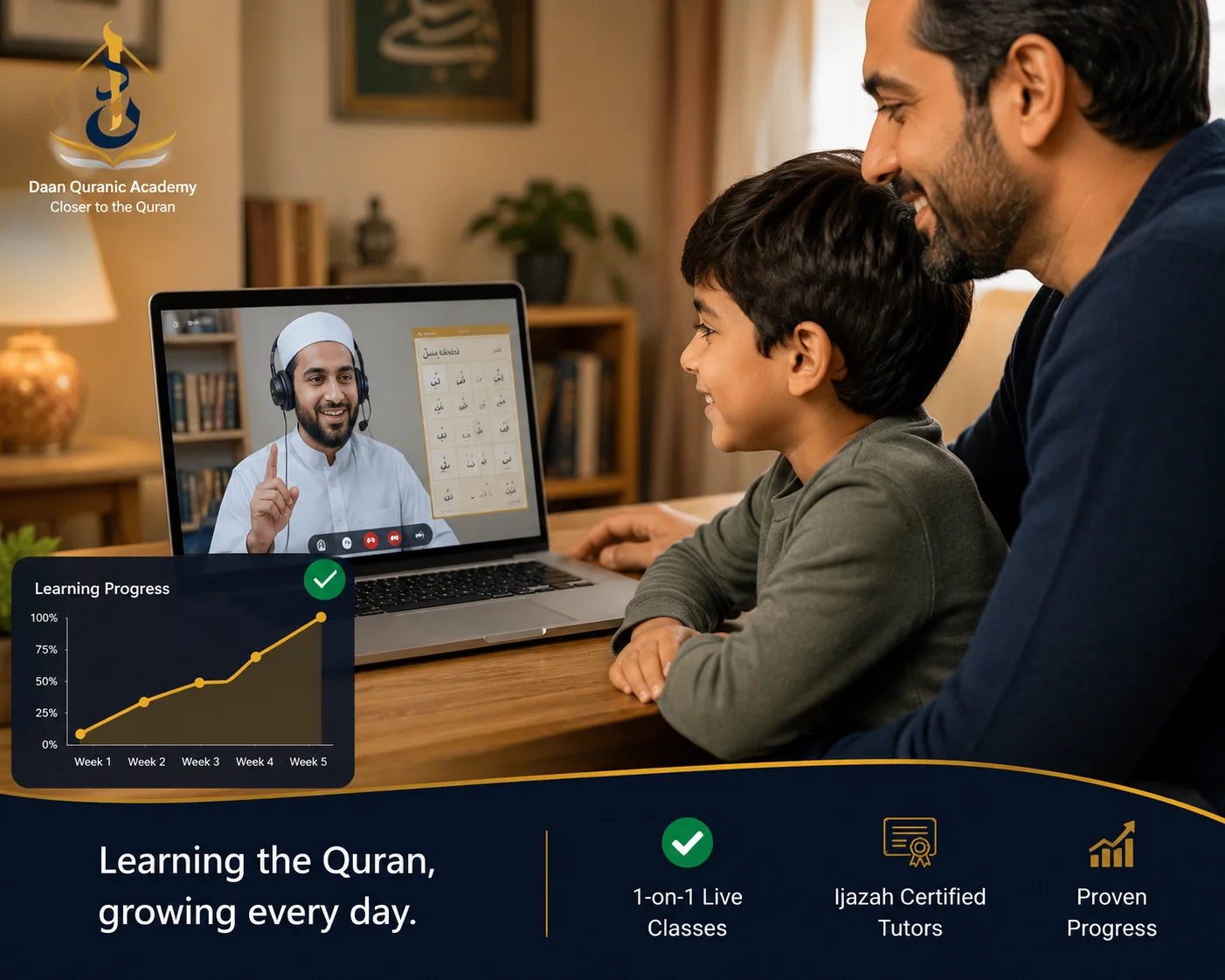
The fastest way is live correction from a native Arabic-speaking tutor during a real recitation, rather than repeating a recording alone. Every session at Daan Quranic Academy is 1-on-1 for exactly this reason.
Can I try an online class before committing to learn Tashahhud and Salah?
Yes. Daan Quranic Academy offers a free trial session with no commitment required, so you can experience a live class before choosing a plan.
How much does it cost to learn Salah and Tashahhud with a private tutor?
Plans at Daan Quranic Academy start from $9/hr for the Essential tier, up to $12.99/hr for the Elite tier, which includes a family discount. Full details are on the pricing plans page.
Learn What to Say After Tashahhud — With a Tutor Who Can Hear You
Reading about Tashahhud is a start, but nothing replaces live correction from a native Arabic-speaking tutor. Book your free session and find out exactly what you’re getting right, and what a quick correction could fix.
No commitment required. One free session to experience the Daan Academy difference.
Final Thoughts
Tashahhud is short in length but immense in meaning — a moment, repeated many times a day, where a Muslim renews their testimony of faith and sends blessings upon the final Messenger ﷺ. Whether you already know what to say after Tashahhud and simply want to refine your pronunciation, or you’re a revert learning it for the very first time, the goal is the same: reciting it with understanding, not just memorisation.
May Allah accept our prayers and grant us understanding of every word we recite in His presence. If you’d like guided, 1-on-1 practice with a native Egyptian tutor, you can explore more free guides like this one on our blog, or start with a free trial session today.