Is the “Fast and Be Healthy” Hadith Authentic? A Complete Guide to Fasting Hadith Authenticity
The “fast and be healthy” hadith — صوموا تصحوا — is one of the most widely shared Islamic phrases about fasting, yet its authenticity as a Prophetic statement is disputed among hadith scholars. This complete guide examines the fast and be healthy hadith authenticity in detail: the Arabic phrase’s origins and scholarly verdicts, the difference between authentic and weak hadiths, what the Quran and rigorously authenticated Prophetic teachings actually say about fasting, and practical guidance for teachers, parents, and English-speaking Muslims seeking reliable, evidence-based answers about fasting hadith authenticity in 2026.
“Whoever fasts Ramadan out of faith and in the hope of reward, his previous sins will be forgiven.”
These two sources — a clear Quranic command and an authenticated Prophetic statement — represent the bedrock of Islamic fasting teaching. They stand in sharp contrast to the widely circulated fast and be healthy hadith, whose status is far less certain. Understanding the difference between them is the essence of fasting hadith authenticity — and this guide provides that understanding step by step.
📑 Table of Contents
- Understanding the “Fast and Be Healthy” Hadith
- What Islamic Scholars Say About Fast and Be Healthy Hadith Authenticity
- What the Quran and Authentic Prophetic Teachings Say About Fasting
- Fasting, Health Claims, and Balancing Faith with Evidence
- How to Teach Fasting Hadith Authenticity to Students and Families
- Common Questions About the Fast and Be Healthy Hadith
- Practical Classroom and Lesson Ideas
- Frequently Asked Questions
Understanding the “Fast and Be Healthy” Hadith: Origins and Circulation
The Arabic phrase صوموا تصحوا — commonly translated as “Fast and be healthy” or “Fast and you will be sound” — is widely shared on social media, wellness blogs, and motivational Islamic content, but its status as an authenticated Prophetic hadith is the central question of fasting hadith authenticity.
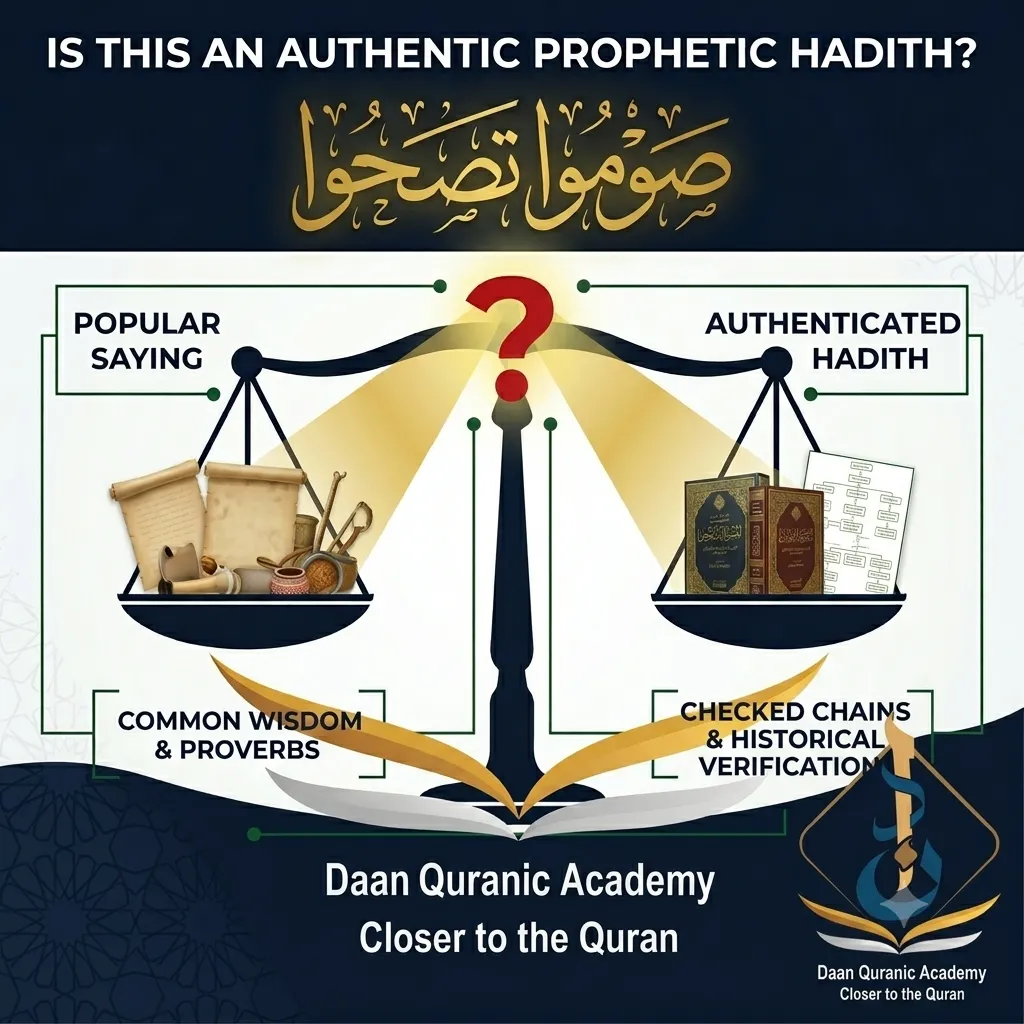
In everyday circulation, the fast and be healthy hadith is used to suggest a direct link between fasting and improved physical wellbeing. That translation captures the literal Arabic meaning, but the religious question is entirely separate: is صوموا تصحوا an authenticated Prophetic statement that may be reliably cited as Islamic evidence in teaching, personal practice, or juristic discussion? Fasting hadith authenticity demands we answer this question honestly, not simply because it is appealing.
It is entirely reasonable to note that fasting often benefits health — that is a separate discussion. The core question of fasting hadith authenticity is whether this specific phrase is a reliably authenticated Prophetic statement that Islamic scholars accept as religious proof. A beautiful meaning does not equal a sound chain of narration.
What Islamic Scholars Say About Fast and Be Healthy Hadith Authenticity
When examining the fast and be healthy hadith authenticity, Islamic hadith scholars follow a rigorous three-step method: examine the chain of narrators (isnād), compare the wording against known authentic reports, and review the verdicts of classical and modern hadith critics. The scholarly verdict on صوموا تصحوا is cautious at best.
The phrase does not appear in the two most rigorously authenticated collections — Sahih al-Bukhari or Sahih Muslim — as a standalone, properly authenticated hadith with a sound, continuous chain of narrators. It circulates in later compilations and in reports with broken or unverified chains. This is why classical and contemporary hadith scholars treat the fast and be healthy hadith with significant caution when assessing its fasting hadith authenticity.
Popular Circulation Does Not Equal Scholarly Authentication
Short, memorable sayings spread quickly — especially online and in Muslim communities. But fasting hadith authenticity demands a continuous, sound chain of narrators (isnād) tracing back to the Prophet ﷺ. Without this chain being verified, a saying remains weak (ضَعِيف) for use as Islamic religious proof — regardless of how widely it circulates or how appealing its meaning is.
How to Use Weak Hadiths Responsibly
Classical hadith scholars permit mentioning weak hadiths only for general moral encouragement — not for establishing legal rulings or doctrinal positions — and only when the hadith is not fabricated and does not contradict stronger evidence. For fasting hadith authenticity specifically: the fast and be healthy phrase is best treated conservatively. Acknowledge it as a popular saying, but anchor all teaching on fasting in Quranic verses and rigorously authenticated hadith.
The Levels of Hadith Authenticity Every Muslim Should Know
Understanding fasting hadith authenticity requires knowing the hierarchy: (1) Sahih (authentic) — the highest level, e.g., hadiths in Bukhari and Muslim; (2) Hasan (good) — slightly weaker chains but still acceptable for legal evidence; (3) Da’if (weak) — insufficient for legal or doctrinal proof; (4) Mawdu’ (fabricated) — rejected entirely. The fast and be healthy phrase falls in the weak category — not fabricated, but insufficient as religious proof.
What the Quran and Authentic Prophetic Teachings Actually Say About Fasting
The religious foundation for fasting in Islam is not the fast and be healthy hadith — it is the explicit Quranic command in Surah Al-Baqarah, which frames fasting primarily as a means toward taqwa (God-consciousness and piety) rather than a health guarantee. This theological framing is essential: Islamic fasting is primarily a spiritual practice. Any secondary benefits — physical, mental, social — are bonuses, not the primary purpose.
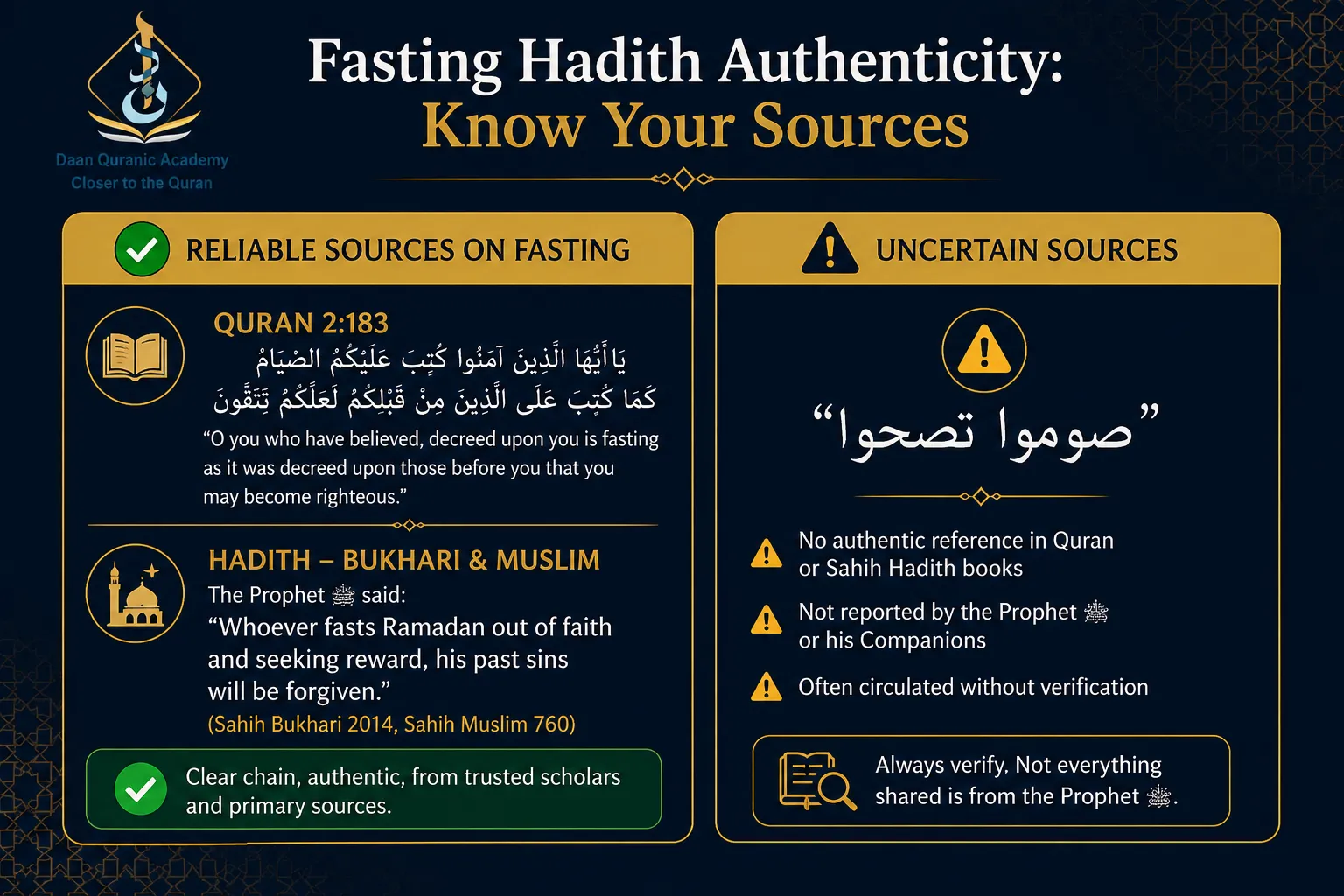
Alongside the Quran, the Prophet’s authenticated statements provide both spiritual encouragement and practical guidance on fasting. The hadith cited at the top of this article — narrated by Abu Hurayrah (RA) through an authenticated chain in both Sahih al-Bukhari and Sahih Muslim — promises spiritual forgiveness for sincere Ramadan fasting. This is the kind of robust, authenticated Prophetic teaching that genuinely establishes the religious significance and promised reward of fasting.
Two additional authenticated teachings deepen our understanding:
“Fasting is a shield. So when one of you is fasting, let him not speak obscenely or shout, and if someone insults him or fights with him, let him say: ‘I am fasting.'”
This authenticated hadith frames fasting as a shield — a spiritual protection, not a health prescription. The Prophet ﷺ consistently linked fasting to character refinement, self-discipline, and God-consciousness. Understanding authentic fasting hadith authenticity means recognizing that the most robust Prophetic teachings on fasting are overwhelmingly spiritual in emphasis, not physical. For a comprehensive exploration of this topic, read our complete guide on The Fiqh of Fasting in Islam.
When teaching children or new Muslims about fasting: present the Quranic purpose first (spiritual growth and God-consciousness), then mention authenticated Prophetic promises, and finally note that some people also experience physical benefits — with medical advice for those with health concerns. This is the correct sequence for fasting hadith authenticity in practice.
Fasting, Health Claims, and Balancing Faith with Evidence
Modern scientific research on intermittent fasting and Ramadan fasting has identified real benefits for many people — but scientific support for fasting health benefits does not elevate a weakly authenticated hadith into a reliable religious proof. These are two entirely separate questions, and understanding fasting hadith authenticity requires keeping them separate.
Research has identified improvements in weight management, blood sugar regulation, inflammation markers, and cardiovascular health indicators in certain populations during structured fasting periods. These findings are genuinely interesting and support the intuition that fasting periods can contribute to better physical markers for some individuals. However, scientific outcomes vary widely based on age, baseline health status, existing medical conditions, and fasting method. For a deep dive into this area, read our article on Fasting in the Balance of Science: Benefits and Biological Transformations.
Separating Scientific Observation from Prophetic Authentication
Never conflate scientific findings about fasting health benefits with fasting hadith authenticity. Encourage learners to consult a qualified clinician for health advice and a knowledgeable Islamic scholar for religious proof — and never let one substitute for the other. Scientific evidence that fasting benefits health does not change the scholarly verdict on the fast and be healthy hadith; and scholarly doubts about that hadith do not diminish the real health experiences of those who fast.
Important Medical Safety Note
If a student or family member has diabetes, pregnancy, hypertension, heart conditions, eating disorders, or other health concerns, fasting plans must always be developed with medical guidance. Islamic Sharia law fully recognizes this reality and provides clear, honorable allowances — such as permitted breaks and compensations — precisely because health situations vary from person to person. Islamic fasting authenticity never means endangering health.
How to Teach Fasting Hadith Authenticity to Students and Families
When explaining fasting hadith authenticity to students — whether adults or children — use a clear, step-by-step approach that builds critical thinking skills alongside religious knowledge. The goal is not to create doubt, but to build confidence in authentic sources.
- Start with the primary source: The Quranic command to fast (Al-Baqarah 2:183) — explain its spiritual purpose of taqwa. This is the unquestionable foundation that no discussion of fasting hadith authenticity can overshadow.
- Introduce authentic Prophetic teachings: Share the hadith on Ramadan’s forgiveness (from Sahih al-Bukhari and Sahih Muslim) as the central Prophetic evidence. These are the reliable anchors of fasting hadith authenticity.
- Address popular sayings carefully: Explain that “fast and be healthy,” while appealing, is not an authenticated hadith in the major collections. This is not about discouragement — it is about precision.
- Teach critical thinking: Show learners how to recognize the difference between: (a) Quranic commands, (b) authenticated Sahih hadiths, (c) weak reports, and (d) popular aphorisms. Fasting hadith authenticity becomes intuitive once this hierarchy is understood.
- Integrate health wisdom responsibly: Confirm that fasting often benefits health, while always involving doctors for individual medical situations. Religious and medical discussions serve different purposes.
Use age-appropriate language: for young children, emphasize gratitude, self-discipline, empathy for the hungry, and obedience to Allah’s command. Save detailed hadith criticism and health nuances for older students and adults. Introducing fasting hadith authenticity concepts gradually produces genuine understanding rather than confusion.
Common Questions About the Fast and Be Healthy Hadith Answered
Is the “Fast and Be Healthy” Hadith in Sahih al-Bukhari or Sahih Muslim?
No. The phrase صوموا تصحوا does not appear in either major collection as an authenticated, standalone hadith with a continuous sound chain. It circulates in later sources, but fasting hadith authenticity requires more than circulation — it requires a verified, continuous chain of narrators. Islamic scholars do not rank this among the most reliable Prophetic reports.
Can I Mention It When Encouraging Healthy Fasting Habits?
Yes — but only as an informal aphorism or popular saying, never as an Islamic proof. If you quote it, clarify: “There is a popular saying that…” rather than “The Prophet ﷺ said…” Always prefer to cite the Quran and authenticated hadith when teaching Islam. Responsible fasting hadith authenticity practice means being precise about the source level of every quote.
What Authenticated Sources Should I Teach Instead?
Teach the Quranic command (Al-Baqarah 2:183), the authentic hadith on Ramadan forgiveness (Sahih al-Bukhari 1901, Sahih Muslim 760 — narrated by Abu Hurayrah RA), and the hadith on fasting as a shield (Sahih al-Bukhari 1904). These authenticated sources represent the true foundation of Islamic fasting teaching — and they more than replace any need for the weakly-authenticated fast and be healthy hadith.
Practical Classroom and Lesson Ideas for Teaching Fasting Hadith Authenticity
- Begin each lesson with Al-Baqarah 2:183: recite the Arabic, provide the translation, and discuss why Allah connects fasting to piety (taqwa) — not health. This frames fasting hadith authenticity discussions correctly from the start.
- Introduce the authenticated hadith on Ramadan’s forgiveness; compare it side-by-side with the fast and be healthy hadith and have students identify the differences in authentication levels and scholarly authority.
- Role-play: students practice explaining to classmates why some sayings are attractive but not recognized by Islamic scholars as proof — a critical skill for fasting hadith authenticity literacy.
- Create a visual “Levels of Islamic Evidence” poster: Quran → Authenticated Hadith (Sahih) → Acceptable Hadith (Hasan) → Weak Hadith (Da’if) → Popular Sayings. Help students see exactly where the fast and be healthy phrase fits.
- Invite a local doctor or nutritionist familiar with Islamic fasting for a Q&A on safely fasting for students with health concerns — keeping medical and religious discussions appropriately separate.
Create a one-page printable handout: left column contains Quranic verses and authenticated hadith on fasting; right column lists common sayings with brief notes on their source status and authenticity level. This visual tool makes fasting hadith authenticity tangible and memorable for students of all ages.
For a broader spiritual context for these fasting discussions, our article on Ramadan: A Spiritual Oasis for Positive Change provides excellent supplementary reading for students and families. To understand how to guide students through the Fiqh dimensions, our Complete Beginner’s Guide to Ramadan Fiqh covers the legal foundations in accessible terms.

Frequently Asked Questions
Is the “fast and be healthy” hadith authentic in Islam?
The fast and be healthy hadith — صوموا تصحوا — is classified as weak (da’if) by hadith scholars. It does not appear in Sahih al-Bukhari or Sahih Muslim with a sound, continuous chain of narrators, and classical and contemporary scholars do not rank it among authenticated Prophetic proof. It may be mentioned as a popular saying for encouragement but should never be cited as religious evidence or attributed definitively to the Prophet ﷺ.
What does صوموا تصحوا mean in English?
The Arabic phrase صوموا تصحوا translates as “Fast and be healthy” or “Fast and you will be sound.” The meaning is linguistically clear — the question of fasting hadith authenticity is not about what it means but whether it is an authenticated statement of the Prophet Muhammad ﷺ with a verified chain of narrators. Hadith scholarship says it is not sufficiently established for that purpose.
What are the authentic hadiths about fasting in Islam?
The most rigorously authenticated hadiths about fasting include: (1) “Whoever fasts Ramadan out of faith and in hope of reward, his previous sins will be forgiven” (Sahih al-Bukhari 1901, Sahih Muslim 760); (2) “Fasting is a shield…” (Sahih al-Bukhari 1904, Sahih Muslim 1151); and (3) the complete verse of Surah Al-Baqarah (2:183) commanding fasting for the purpose of attaining taqwa. These authenticated sources are the genuine foundation of fasting hadith authenticity in Islamic teaching.
Can I quote a weak hadith about fasting?
Classical scholars permit mentioning weak hadiths only for general moral encouragement — never for establishing legal rulings, doctrinal positions, or as religious proof. When quoting the fast and be healthy hadith, say “there is a popular saying…” rather than “the Prophet said.” Always anchor Islamic fasting teaching in the Quran and Sahih hadiths first. For structured Islamic studies guidance, explore Daan Academy’s Islamic Studies course.
Why does fasting hadith authenticity matter for Muslims?
Fasting hadith authenticity matters because Islamic teaching is a matter of religious trust — quoting an unauthenticated statement as the Prophet’s ﷺ words is a serious responsibility. The Prophet ﷺ warned: “Whoever attributes to me a statement I did not make should expect his seat in the Hellfire” (Sahih al-Bukhari 110). Teaching accurate fasting hadith authenticity protects the integrity of the deen and builds a generation that knows how to verify Islamic knowledge rather than simply repeat what circulates.
Does Islam say fasting is good for health?
Islam’s primary teaching about fasting is that it builds taqwa (God-consciousness and piety), as stated explicitly in the Quran (2:183). Many Muslims also experience physical health benefits during fasting, and modern research supports potential benefits for certain populations. However, from a fasting hadith authenticity perspective, the religious obligation to fast is Quranic — not based on health outcomes. Muslims with health conditions should always consult a doctor, as Islamic law provides full accommodations for those unable to fast.
Where can I learn more about authentic Islamic knowledge online?
At Daan Quranic Academy, our Islamic Studies course covers Quranic sciences, hadith foundations, and Fiqh alongside Quran recitation, Tajweed, and Arabic — all in private 1-on-1 sessions with certified native Egyptian tutors. Book a free trial session with no commitment, and see our tutor credentials and methodology before you start.
Master Quranic Knowledge with Confidence
Understanding fasting hadith authenticity is one part of the broader skill of reading and interpreting primary Islamic texts with accuracy. At Daan Quranic Academy, our certified native Egyptian tutors guide learners through Quran recitation, Tajweed, Arabic language, and Islamic Studies — so you can teach and practice with genuine, authenticated confidence. Private 1-on-1 sessions available from anywhere in the world.
No commitment required. One free session to experience the Daan Academy difference.
Final Thoughts: Fasting Hadith Authenticity, Teaching, and Practice
The question of fasting hadith authenticity — and specifically whether the fast and be healthy hadith is an authentic Prophetic statement — is not merely academic. It matters deeply for how we teach, what we quote, and how we guide others in Islamic practice. The Quranic command to fast (Al-Baqarah 2:183) remains the primary source; authenticated Prophetic reports (like the hadith on Ramadan’s forgiveness in Sahih al-Bukhari and Sahih Muslim) provide the Prophetic context and promised reward.
As for the fast and be healthy hadith: treat it as a community aphorism and popular saying unless a reliable chain of narrators is presented. A Muslim who knows the difference between a Sahih hadith and a weak one — who can say confidently “this is from the Quran” or “this is from Sahih al-Bukhari” or “this is a popular saying with uncertain authentication” — carries the deen with accuracy and honour. Explore more Islamic guides on our blog, and view our flexible learning plans starting from $9/hr for structured Islamic Studies with certified native tutors.
May Allah grant us deep understanding of His revelation, protect us from error and fabrication, and make our fasting and our teaching a means of spiritual growth, obedience, and wellbeing.
اَللّٰهُمَّ اجْعَلْنَا مِنَ الْمُتَقِينَ وَاغْفِرْ لَنَا ذُنُوبَنَا وَعَلِّمْنَا الْحَقّ
(O Allah, make us among the God-conscious, forgive our sins, and teach us the truth.)