
The Sunnahs of Eid: A Comprehensive Guide to Following the Prophet’s ﷺ Traditions
The Sunnahs of Eid are not merely cultural traditions — they are precisely transmitted acts of worship through which every Muslim transforms the celebration of Eid into an extension of their devotion to Allah and love for the Prophet ﷺ. Both Eid Al-Fitr and Eid Al-Adha carry a rich set of Prophetic practices that govern everything from the night before Eid to the prayer itself, from how you eat on the morning of Eid to how you greet your Muslim brothers and sisters. This comprehensive guide covers every authenticated Sunnah of Eid for both celebrations — with their precise Islamic evidence, linguistic depth, and practical guidance for Muslims across the UK, USA, Europe, and Australia who want to celebrate Eid the way the Prophet ﷺ celebrated it.
The Sunnahs of Eid are among the most beautiful of all Islamic symbols (شَعَائِر — Sha’air). Honouring them — learning them, reviving them, and teaching them to your children — is itself an act of Taqwa. This guide gives you everything you need to do exactly that.
📑 Table of Contents
- Why Reviving the Sunnahs of Eid Transforms Your Celebration
- Sunnahs of Eid Eve and Preparation: Takbeer, Ghusl, and Best Clothes
- Sunnahs on the Morning of Eid: The Key Distinction Between the Two Eids
- The Etiquette of the Eid Prayer Ground (Musalla)
- The Method of Eid Prayer: Takbeerat, Recitation, and Khutbah
- Social Sunnahs of Eid: Greetings, Family Ties, and Community Joy
- Common Mistakes to Avoid on Eid
- Frequently Asked Questions
Why Reviving the Sunnahs of Eid Transforms Your Celebration
Eid in Islam is not simply a cultural festival that follows a period of worship — it is itself a form of worship, legislated by Allah and shaped in its every detail by the Prophet ﷺ. The word عِيد (Eid) comes from the root ع-و-د (to return) — suggesting a recurring joy, a regularly returning gift from Allah to His servants. Following the Sunnahs of Eid is what ensures that this joy is not merely emotional but spiritually complete and Prophetically grounded.
There are two Eids in Islam, each with its own character, its own distinct Sunnahs, and its own spiritual significance:
- Eid Al-Fitr (عِيدُ الفِطْر) — the celebration that concludes Ramadan, marking the completion of a month of fasting and the spiritual elevation it produces. Its Sunnahs of Eid are oriented around gratitude, purification, and shared joy.
- Eid Al-Adha (عِيدُ الأَضْحَى) — the celebration of sacrifice that coincides with the Hajj season and commemorates the obedience of Ibrahim (AS). Its Sunnahs of Eid are oriented around devotion, sacrifice, and the legacy of Prophetic submission.
The key insight about the Sunnahs of Eid is that following them transforms what could be a social celebration into a complete act of ibadah. Every practice — from the Takbeer that begins the night before Eid to the route you take home from the prayer — was modelled by the Prophet ﷺ and transmitted through authenticated narrations precisely so that Muslims across every generation and every country can celebrate Eid the same way he did. For a comprehensive exploration of the Sunnahs specific to Eid Al-Adha, read our dedicated guide on The Most Important Sunnahs of Eid Al Adha Every Muslim Should Know.
The Quran’s use of the word شَعَائِر (Sha’air — symbols/rites of Allah) in Surah Al-Hajj (22:32) places Eid practices in the same category as the rites of Hajj — divinely legislated expressions of God-consciousness. Honouring the Sunnahs of Eid is not an optional cultural add-on but a direct expression of the Taqwa of the heart. Understanding this elevates every Sunnah in this guide from a habit into a heartfelt act of worship.
Sunnahs of Eid Eve and Preparation: Takbeer, Ghusl, and Best Clothes
The Sunnahs of Eid begin not on the morning of the celebration but from the sunset of the night before — a beautiful detail of the Islamic tradition that extends the spiritual experience of Eid across a full day and night cycle. Every preparation made on Eid eve is an act of worship when done with intention and knowledge of its Prophetic basis.
The Takbeer: The Anthem of Eid — The Most Neglected Sunnah
Among all the Sunnahs of Eid, the Takbeer is simultaneously the most distinctive and the most neglected — particularly in Western Muslim communities where its public declaration feels unfamiliar. The Takbeer is the sustained, joyful declaration of Allah’s greatness that should fill the homes, streets, and mosques during Eid, just as it did in the time of the Prophet ﷺ and the Companions (RA).
The timing differs between the two Eids:
- Eid Al-Fitr Takbeer: Begins at the sunset of the last day of Ramadan (the night of Eid) and continues until the Imam stands to begin the Eid prayer. This is the Takbeer Al-Mutlaq (unrestricted — said at any time).
- Eid Al-Adha Takbeer: More extensive — consisting of both unrestricted Takbeer from the 1st of Dhul Hijjah, and restricted Takbeer (Takbeer Al-Muqayyad) said after every obligatory prayer from Fajr on the Day of Arafah until Asr on the 13th of Dhul Hijjah.
The widely transmitted formula of this Sunnah of Eid is:
اللَّهُ أَكْبَرُ، اللَّهُ أَكْبَرُ، لَا إِلَٰهَ إِلَّا اللَّهُ، وَاللَّهُ أَكْبَرُ، اللَّهُ أَكْبَرُ، وَلِلَّهِ الْحَمْدُ
(Allahu Akbar, Allahu Akbar, La ilaha illAllah, wa Allahu Akbar, Allahu Akbar, wa lillahil-hamd)
Ghusl (Ritual Bath) and Perfume: Purification for the Greatest Gathering
Performing Ghusl before the Eid prayer is a confirmed Sunnah of Eid, reported from the Companions (RA). Ibn Umar (RA) would perform Ghusl before going out to the Eid prayer ground — a practice scholars describe as among the most consistent personal preparations of the Companions. The spiritual logic is clear: the Eid prayer is the largest communal gathering of the Muslim community, and approaching it with complete physical purification reflects the reverence this gathering deserves.
Men should apply their best permissible perfume (طِيب) before attending. Women, in contrast, should head to the prayer with complete modesty — avoiding strong scents in public gatherings, in accordance with the Prophetic instruction that women attending the mosque should not wear perfume that might attract attention. The Sunnah of Eid for women is beauty of worship, not display of adornment.
Wearing Your Best Clothes: Dressing for Allah’s Day
Islam encourages looking one’s best on Eid — not to impress others, but as an outward expression of gratitude for the blessing of completing major acts of worship. The Prophet ﷺ had a specific جُبَّة (Jubbah — cloak) that he reserved for Eid and Jumu’ah prayers. Ibn Umar (RA) was known to dress in his finest available clothes on the two Eids. This Sunnah of Eid applies to men, women, and children alike — it is a day of honouring Allah’s rites through dignified, modest celebration. The only qualifier the scholars add is that this should be done without israf (إِسْرَاف — extravagance or waste), which transforms a virtuous Sunnah into a prohibited excess.
Sunnahs on the Morning of Eid: The Key Distinction Between the Two Eids
One of the most practically important — and frequently confused — aspects of the Sunnahs of Eid is the difference between Eid Al-Fitr and Eid Al-Adha on the morning of the prayer. The Prophet ﷺ explicitly established opposite practices for the two Eids regarding food before the prayer, and understanding this distinction is essential for anyone seeking to follow the Prophetic way correctly. For the full fiqh framework governing Eid fasting, see our Complete Beginner’s Guide to Ramadan Fiqh and the Fiqh of Fasting.
Eating Before the Prayer — Eid Al-Fitr Only
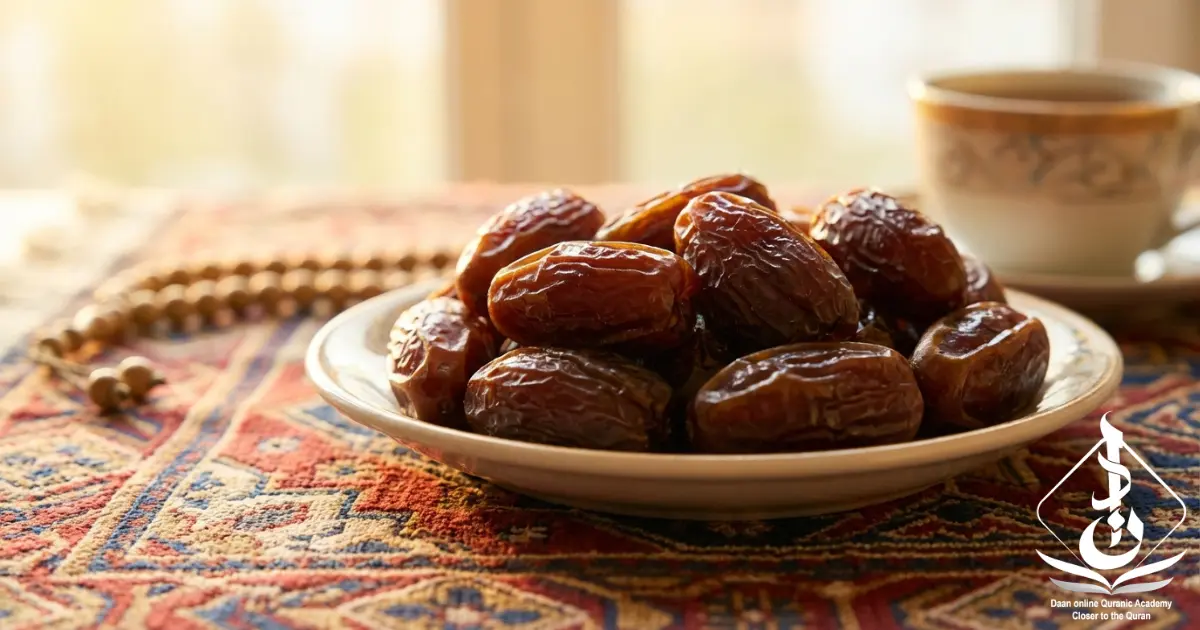
On the morning of Eid Al-Fitr, the Sunnah is to eat an odd number of dates before leaving for the prayer — ideally three, five, or seven. This single practice carries profound symbolic weight: after a month of fasting, the very first act before the prayer that marks Ramadan’s completion is to break the habit of abstaining from food. It is a tangible, physical declaration that the fast is over and Allah’s permission to eat has been joyfully received.
“The Prophet ﷺ would not go out on the morning of Eid Al-Fitr until he had eaten some dates, and he would eat an odd number.”
Abstaining from Food — Eid Al-Adha Only
The opposite Sunnah of Eid applies on Eid Al-Adha: the Prophet ﷺ would not eat anything before the prayer. Instead, his first food on the day of Eid Al-Adha would come from the Udhiyah — the sacrificial animal he offered after the prayer. This practice connects the act of eating directly to the sacrifice, making the meal itself a participation in the central ibadah of the day. It is one of the clearest distinctions between the Sunnahs of Eid Al-Fitr and Eid Al-Adha, and it is frequently confused or reversed by Muslims who are unaware of the Prophetic specifics.
“The Prophet ﷺ would not eat on the day of Eid Al-Adha until he returned from the prayer, and then he would eat from his sacrifice.”
The Etiquette of the Eid Prayer Ground (Musalla)
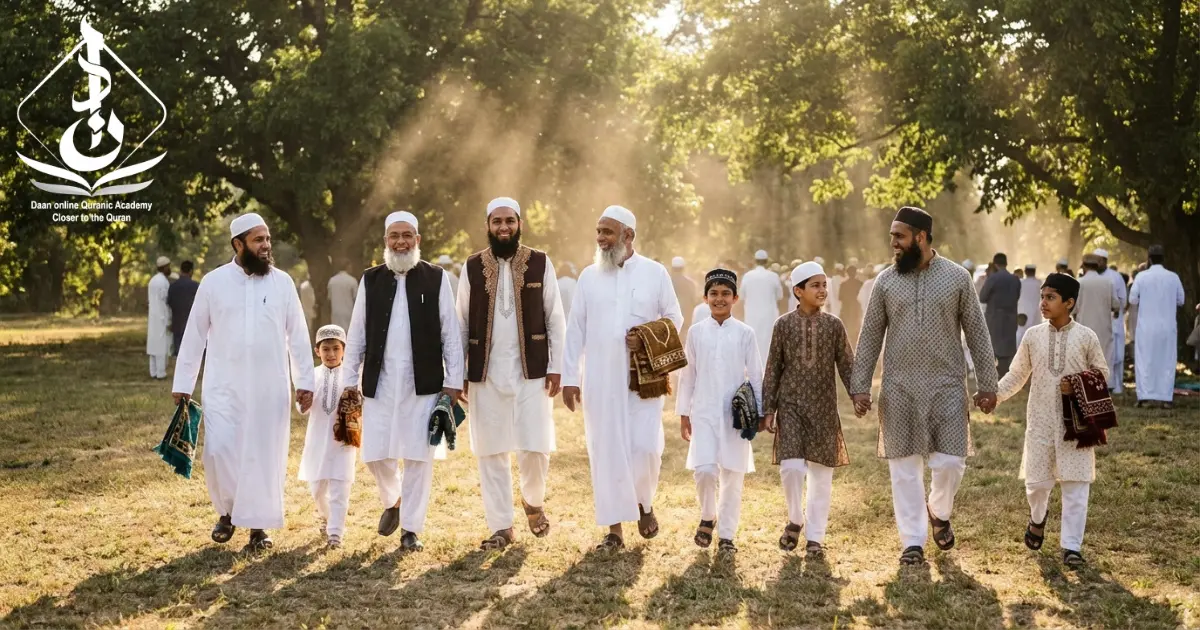
The Eid prayer ground — المُصَلَّى (al-Musalla) — is the largest communal gathering of the Muslim community and carries its own specific Sunnahs of Eid governing how a Muslim travels to it, stands within it, and returns from it. These practices transform the journey to prayer into an act of worship in itself — each step witnessed by the earth and the angels.
Walking to the Prayer Ground
It is an established Sunnah of Eid to walk to the Musalla rather than drive, when this is reasonably possible. Ali ibn Abi Talib (RA) said: “It is from the Sunnah to go to the Eid prayer walking.” The scholars mention several wisdoms: walking allows the Takbeer to be heard along the route, it demonstrates humility before the gathering of worship, and it increases the number of steps counted as acts of worship toward the prayer. Those for whom walking is genuinely difficult due to distance or health are naturally exempt from this specific Sunnah.
Taking Different Routes Going and Returning
Among the most beautifully distinctive of all Sunnahs of Eid is the practice of deliberately taking a different route home from the prayer than the one taken on the way. This practice is authentically established from the Prophet ﷺ himself:
“On the day of Eid, the Prophet ﷺ used to return by a different route from the one he had taken.”
The scholars have mentioned several wisdoms for this Sunnah of Eid: both paths bear witness for the believer on the Day of Judgement; greetings and blessings are spread to more people along both routes; and the symbols of Islam are displayed throughout a wider area of the community. For English-speaking Muslims in Western cities, this Sunnah is entirely accessible — simply plan your walk or drive home from the Eid prayer via a different road than the one you came by.
Bringing Everyone — Men, Women, and Children
One of the most emphatic of all the Sunnahs of Eid in the Prophetic tradition is the command for the entire community — men, women, children, and even menstruating women who do not pray — to attend the Eid gathering. The Prophet ﷺ was explicit about this inclusivity in an authenticated narration:
“The Prophet ﷺ commanded us to bring out on Eid the unmarried women, the menstruating women, and the secluded women, so that they might witness the goodness and the supplication of the Muslims. The menstruating women were to stay away from the prayer area.”
This hadith demonstrates that Eid is not merely a prayer event — it is a community event, a spiritual gathering whose blessings extend to all who participate, even those not actively praying. Bringing your children to Eid prayer is itself a fulfilment of this Sunnah of Eid, building in them a lived connection to the greatest communal act of worship in the Islamic year.
The Method of Eid Prayer: Takbeerat, Recitation, and Khutbah
The Eid prayer has a specific structure that distinguishes it from every other prayer in the Islamic calendar — and understanding this structure is essential for any Muslim wanting to observe the Sunnahs of Eid prayer correctly. It consists of two Rak’ahs, offered without Adhan or Iqamah, with additional Takbeerat that are unique to this prayer.
The Additional Takbeerat: Seven and Five
The most structurally distinctive of the Sunnahs of Eid prayer is the additional Takbeerat. The majority of scholars hold: seven Takbeerat in the first Rak’ah (after the opening Takbeer, before the recitation) and five Takbeerat in the second Rak’ah (before the recitation after standing). Between each Takbeer, it is recommended to say سُبْحَانَ اللَّهِ وَالْحَمْدُ لِلَّهِ وَلَا إِلَٰهَ إِلَّا اللَّهُ وَاللَّهُ أَكْبَرُ. This structure is established from Abdullah ibn Amr ibn al-As (RA) in an authenticated narration in Sunan Abi Dawud (No. 1151).
Recommended Recitation in the Eid Prayer
An often unknown Sunnah of Eid is the specific surahs the Prophet ﷺ would recite in the prayer. It is established that he would recite Surah Al-A’la (87) in the first Rak’ah and Surah Al-Ghashiyah (88) in the second — or alternatively Surah Qaf (50) in the first and Surah Al-Qamar (54) in the second. Both combinations are established in Sahih Muslim (No. 878). Knowing these recitations before Eid allows the worshipper to follow this Prophetic Sunnah consciously rather than by chance.
The Khutbah: After the Prayer, Not Before
A key structural difference between the Eid Khutbah and the Jumu’ah Khutbah is when it is delivered. In Jumu’ah, the Khutbah precedes the prayer. In the Sunnahs of Eid, the Khutbah comes after the prayer — established by the Prophet ﷺ’s consistent practice. Attending the Khutbah after the Eid prayer is Sunnah (not obligatory), but it is strongly recommended. The Eid Khutbah traditionally addresses the rulings and spiritual significance of the day — the Udhiyah on Eid Al-Adha, the Zakat Al-Fitr on Eid Al-Fitr, and the deeper meaning of the occasion. Staying for the full Khutbah completes the Prophetic model of Eid worship in its entirety.
If this is your first Eid prayer, do not feel overwhelmed by the additional Takbeerat or the unfamiliar structure. Follow the Imam — stand when they stand, bow when they bow, and do not worry about counting the Takbeerat precisely until you have attended a few times. The Prophet ﷺ was known to shorten the prayer if he heard a young child crying — the Sunnahs of Eid prayer is designed to be accessible, welcoming, and joyful for the entire community. Explore our Quran and Islamic Studies courses if you want to build the Arabic foundation that makes every prayer more deeply meaningful.
Social Sunnahs of Eid: Greetings, Family Ties, and Community Joy
The Sunnahs of Eid extend far beyond the prayer ground — they encompass the entire social fabric of the day, governing how Muslims greet one another, how they celebrate with their families, and how they ensure the joy of Eid reaches every member of the community. These social Sunnahs are what give Eid its distinctive warmth and communal character that Muslims in every country and culture recognise as uniquely Islamic.
The Eid Greeting: Taqabbal Allahu Minna wa Minkum
The authentic Eid greeting transmitted from the Companions (RA) is تَقَبَّلَ اللَّهُ مِنَّا وَمِنكُم (Taqabbal Allahu minna wa minkum — May Allah accept from us and from you). Ibn Hajar al-Asqalani mentions in Fath al-Bari that the Companions used to exchange this greeting on the days of Eid. It is a profoundly appropriate Eid greeting precisely because it frames the celebration not as a declaration of accomplishment but as a humble supplication for acceptance — acknowledging that the ultimate judge of whether our worship was received is Allah alone.
This Sunnah of Eid transforms every exchange of greetings on the day into a mutual dua. When you say Taqabbal Allahu minna wa minkum to your Muslim brothers and sisters, you are making a supplication for their worship to be accepted — and earning reward for every person you greet this way.
Silat Al-Rahim: Maintaining and Restoring Family Ties
صِلَةُ الرَّحِم (Silat al-Rahim — maintaining ties of kinship) is one of the most strongly emphasised obligations in Islam, and Eid is its annual high point. The Sunnahs of Eid include visiting relatives, calling those far away, and — most importantly — using the occasion to heal rifts and restore broken family ties. The day of Eid, with its atmosphere of joy, mercy, and divine acceptance, is one of the most powerful contexts available to a Muslim for reconciliation. Scholars have noted that refusing to visit or reconcile with a relative on Eid, when the occasion and atmosphere are so conducive to it, carries special gravity.
Bringing Joy to Children: Gifts and Celebration
Providing gifts, joy, and celebration to children on Eid is among the most beautiful of the Sunnahs of Eid in its social dimension. The Prophet ﷺ was known for his warmth toward children on Eid — playing with them, speaking to them, and expressing joy in their presence. The Eidiya (gift) tradition that exists across virtually every Muslim culture is a living expression of this Prophetic spirit. For Muslim parents in the West raising children in non-Muslim majority societies, making Eid a day of genuine, memorable celebration for your children — better and more joyful than any secular holiday — is itself a form of reviving this Sunnah of Eid and building your children’s Islamic identity through lived experience.
Common Mistakes to Avoid on Eid
Just as understanding the Sunnahs of Eid enriches the celebration, awareness of common mistakes helps protect its validity and spirit. The following are the most frequently encountered errors — among English-speaking Muslims particularly — that either contradict a specific Sunnah or diminish the spiritual character of the day.
Confusing the Food Sunnahs Between the Two Eids
Perhaps the most common practical error: eating before the Eid Al-Adha prayer (when the Sunnah is to abstain until after the prayer and the sacrifice), or not eating before the Eid Al-Fitr prayer (when the Sunnah is to eat an odd number of dates beforehand). This is easily corrected once the authentic distinction between the Sunnahs of Eid Al-Fitr and Eid Al-Adha is known — and it is why authentic Islamic knowledge is the foundation of correct practice.
Neglecting the Takbeer
In many Western Muslim communities, the Takbeer of Eid is either not known or not practised publicly. This represents the loss of one of the most distinctive of all Sunnahs of Eid — the one that fills the air of Muslim communities with the remembrance of Allah. Reviving the Takbeer in your home, saying it on your way to the prayer, and teaching it to your children is one of the most impactful ways to restore the complete Prophetic Eid experience.
Extravagance and Israf in Celebration
Islam encourages genuine celebration on Eid — dressing well, giving gifts, sharing food, and expressing joy are all Prophetically endorsed. The line that the Sunnahs of Eid draw is at إِسْرَاف (Israf — waste and extravagance). Spending beyond one’s means, discarding large quantities of food, or turning Eid into a competition of display contradicts both the spirit of gratitude that underlies the celebration and the Islamic principle of moderation (الاِعْتِدَال) that governs all of life’s occasions.
Neglecting Zakat Al-Fitr Before Eid Al-Fitr Prayer
One of the most critical obligations associated with Eid Al-Fitr is Zakat Al-Fitr — the obligatory charity that must be paid before the Eid prayer. The Prophet ﷺ established it to purify the fasting person from any deficiencies in their Ramadan and to ensure that every poor Muslim can participate fully in the Eid celebration. Delaying it until after the prayer reduces it from an obligatory Zakat to a voluntary charity. Ensuring every household member’s Zakat Al-Fitr is paid before the prayer is itself a Sunnah of Eid Al-Fitr — and one whose observance makes you a means of another Muslim’s joy on this blessed day.
Turning Eid Into a Day of Screen Time or Passive Entertainment
The Sunnahs of Eid are inherently active and relational — Takbeer, prayer, visiting family, giving gifts, sharing meals, and maintaining community. Replacing these with passive screen consumption or avoiding social connection altogether contradicts the entire Prophetic model of Eid as a day of communal worship and shared joy. The hours after the prayer are among the most blessed of the entire year — the spirit of the Sunnahs of Eid calls them to be filled with dhikr, family, generosity, and celebration.
Frequently Asked Questions About the Sunnahs of Eid
What are the main Sunnahs of Eid every Muslim should follow?
The main Sunnahs of Eid are: (1) Saying the Takbeer from the night before Eid; (2) Performing Ghusl and wearing best clothes; (3) Eating an odd number of dates before Eid Al-Fitr prayer (or abstaining from food until after the Eid Al-Adha prayer and sacrifice); (4) Walking to the Musalla and returning by a different route; (5) Bringing the whole family — men, women, and children — to the Eid gathering; (6) Attending the full prayer including the Khutbah; (7) Greeting fellow Muslims with Taqabbal Allahu minna wa minkum; (8) Visiting and strengthening family ties; (9) Bringing joy to children through gifts and celebration; and (10) Ensuring Zakat Al-Fitr is paid before the Eid Al-Fitr prayer.
What is the correct Eid greeting in Arabic?
The authentic Eid greeting transmitted from the Companions (RA) is تَقَبَّلَ اللَّهُ مِنَّا وَمِنكُم — Taqabbal Allahu minna wa minkum (May Allah accept from us and from you). This is the greeting that Ibn Hajar al-Asqalani attributes to the Companions’ practice in Fath al-Bari. The popular phrase “Eid Mubarak” is also widely used and is permissible as a general expression of congratulation, though Taqabbal Allahu minna wa minkum is more directly rooted in the Prophetic tradition as a Sunnah of Eid. Both can be combined: “Eid Mubarak — Taqabbal Allahu minna wa minkum.”
Is Eid prayer obligatory (Fard) or Sunnah?
There is a well-known scholarly difference on this question. The Hanafi school considers Eid prayer Wajib (obligatory) for every capable Muslim. The Hanbali school holds it is Fard Kifayah (a communal obligation). The Maliki and Shafi’i schools hold it is Sunnah Mu’akkadah (a highly emphasised Sunnah). In all four schools, it is an act that no capable Muslim should miss without a genuine excuse — the Prophet ﷺ never abandoned it, commanded the entire community to attend, and its abandonment without reason is considered blameworthy by all scholars. Whatever your madhab, the spirit of the Sunnahs of Eid is that this prayer represents the single most important communal gathering of the year outside of Jumu’ah.
Can women attend the Eid prayer?
Yes — and in fact the Prophet ﷺ explicitly commanded women to attend, as established in Sahih al-Bukhari (No. 971) narrated by Umm Atiyya (RA): even menstruating women were instructed to come and witness the gathering, though they stood away from the prayer area. Attending the Eid prayer is among the most established of the Sunnahs of Eid for women — it is a Prophetic instruction that connects every Muslim woman to the community gathering and the spiritual blessing of the day. Women should attend with complete Islamic modesty, as with any mosque or prayer gathering.
What is the difference between the Sunnahs of Eid Al-Fitr and Eid Al-Adha?
The main differences in the Sunnahs of Eid Al-Fitr versus Eid Al-Adha are: (1) Food before prayer — Sunnah to eat (dates) before Eid Al-Fitr prayer; Sunnah to abstain from food until after the Eid Al-Adha prayer; (2) Takbeer duration — Eid Al-Adha Takbeer extends much longer, from the 1st of Dhul Hijjah through the 13th, including restricted Takbeer after prayers; (3) The Udhiyah — sacrifice is central to Eid Al-Adha and has no equivalent in Eid Al-Fitr; (4) Zakat Al-Fitr — obligatory before Eid Al-Fitr prayer only. Both Eids share the core Sunnahs of Ghusl, best clothes, walking to the Musalla, changing routes, and the Eid greeting.
How can I teach my children the Sunnahs of Eid?
The most effective method for teaching children the Sunnahs of Eid is living them together and explaining each practice in the moment. Teach them the Takbeer in the days before Eid and say it together in the car. Let them choose their best Eid clothes. Take them to the prayer and sit with them through the Khutbah. Involve them in distributing Zakat Al-Fitr. Teach them to say Taqabbal Allahu minna wa minkum to relatives. For structured Arabic and Islamic education that gives children the language and knowledge foundation to understand their worship more deeply, explore our Quran and Islamic Studies courses for children taught by certified native Egyptian tutors in private 1-on-1 live sessions. See our flexible plans starting from $9/hr.
Understand Every Sunnah of Eid — and Every Ayah of the Quran — in Its Original Language
Knowing the Sunnahs of Eid is the beginning of a richer, deeper Islamic practice. The next step is developing the Arabic and Quranic foundation that allows you to understand every prayer, every Takbeer, and every supplication on Eid in the language in which they were revealed. At Daan Quranic Academy, our certified native Egyptian tutors teach all levels — children and adults — across the UK, USA, Europe, and Australia.
No commitment required. One free session to experience the Daan Academy difference.
Final Thoughts: Eid as a Complete Act of Worship
The Sunnahs of Eid reveal something profound about the Islamic understanding of celebration: in Islam, joy itself is legislated. The Prophet ﷺ did not leave Eid as a blank canvas to be filled with any cultural practice — he shaped it, detailed it, and modelled it across both Eids with the same precision he applied to Salah and fasting. Following these Sunnahs is not a restriction on celebration; it is the enrichment of celebration with meaning, intention, and divine reward at every step.
From the Takbeer that fills the night before Eid, to the dates eaten before Fajr on Eid Al-Fitr, to the route taken home from the prayer, to the Taqabbal Allahu minna wa minkum exchanged between Muslims — every Sunnah of Eid is a thread in a complete Prophetic tapestry of celebration that honours Allah, connects the community, and brings genuine, lasting joy to every heart that participates in it consciously and with knowledge.
May Allah accept our worship, grant us the joy of observing every Sunnah of Eid with knowledge and sincerity, and unite our families in faith and celebration. Find more Islamic practice guides on our Islamic education blog, and explore our tutor credentials and approach before you begin your learning journey.
تَقَبَّلَ اللَّهُ مِنَّا وَمِنكُم
(Taqabbal Allahu minna wa minkum — May Allah accept from us and from you.)