A Comprehensive Guide to Modern and Traditional Learning Methods
Learning Arabic is widely regarded as one of the most challenging linguistic endeavors for non-native speakers. This difficulty stems not only from its complex grammar and unique phonetics but also from its diverse linguistic layers—ranging from Classical Arabic (the language of the Quran) to Modern Standard Arabic (MSA) and various regional dialects. As global demand for Arabic grows for religious, economic, and academic purposes, a pivotal question arises: What is the most effective way to learn? Should we stick to traditional textbooks, immerse ourselves in an Arabic-speaking environment, or leverage the digital revolution?
In this article, we provide an in-depth analytical comparison between three prominent approaches: The Immersion Method, Online Learning, and The Traditional Method.
The Traditional Method (Grammar-Translation)
This approach relies heavily on structured textbooks and intensive explanations of syntax (Nahw) and morphology (Sarf), focusing primarily on reading, writing, and translation.
Characteristics and Fundamentals:
- Textbook-Centric: Dependence on established series like “Al-Arabiya Bayna Yadayk” or “Al-Kitaab.”
- Linguistic Analysis: A focus on the “why” behind grammatical cases (I’rab), building a solid theoretical foundation.
- Teacher’s Role: The instructor is the primary source of information, acting as a lecturer and error corrector.
Advantages:
- Academic Precision: Students develop a deep understanding of the language’s structure, which is vital for studying Islamic sciences or classical literature.
- Logical Progression: This method provides a clear roadmap (levels), giving students a sense of structured achievement.
Disadvantages:
- Neglect of Communication: A student might be able to parse a complex sentence yet struggle to order a meal in an Arabic-speaking country.
- Potential Boredom: The heavy focus on dry grammar can lead to a loss of motivation, especially for learners seeking quick practical results.

The Immersion Method
This method is based on the principle: “Live the language, don’t just study it.” This is achieved either by traveling to an Arabic-speaking country or by creating a “strictly Arabic” environment where no intermediary language (like English) is allowed.
Characteristics and Fundamentals:
- Mimicry: Learners acquire the language much like a child does—through listening, trial, and error.
- Cultural Context: Words are not learned in isolation but through facial expressions, customs, and real-life social cues.
Advantages:
- Conversational Speed: Students achieve remarkable fluency in a short period compared to other methods.
- Breaking the Fear Barrier: Immersion forces communication, eliminating the anxiety of speaking a new language.
- Natural Pronunciation: Learners acquire accents and intonations that are much closer to those of native speakers.
Disadvantages:
- Lack of Grammatical Structure: A student may speak fluently but make significant grammatical errors because they rely solely on what they hear.
- High Cost: Traveling and living abroad requires a substantial budget and a full-time commitment.

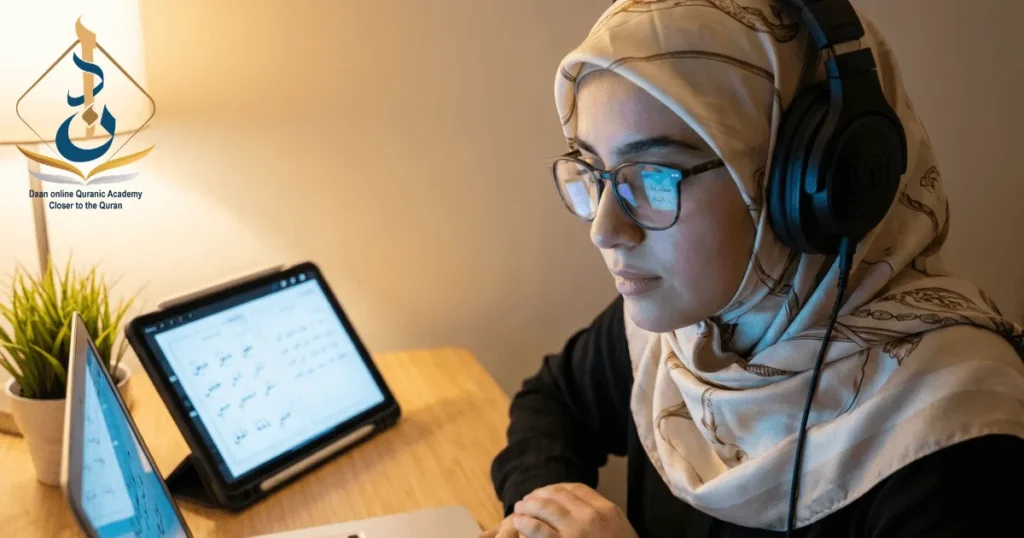
Online Learning and Digital Platforms (E-Learning)
This is the modern alternative that has established itself as a powerhouse, especially post-COVID-19, by merging technology with educational curricula.
Characteristics and Fundamentals:
- Flexibility: Learning anytime and anywhere in the world.
- Multimedia Integration: Using videos, interactive games, and podcasts to make learning engaging.
- Virtual Classrooms: Live sessions via Zoom or Teams with native Arabic tutors.
Advantages:
- Personalization: Students can choose specific niches (Business Arabic, Quranic Arabic, or Dialects).
- Interactivity: Using AI tools for instant pronunciation correction and feedback.
- Abundance: Access to vast resources, often free or affordable, catering to all budgets.
Disadvantages:
- Distraction: The sheer volume of resources can lead to “app-hopping” without completing a single curriculum.
- Self-Discipline Issues: The absence of direct physical supervision can lead to procrastination or inconsistency.
Analytical Comparison (Summary Table)
| Feature | Traditional Method | Immersion Method | Online Learning |
| Primary Goal | Grammatical Accuracy | Oral Fluency | Flexibility & Accessibility |
| Speed of Results | Slow (Requires patience) | Very Fast (Speaking) | Moderate (Student-dependent) |
| Cost | Moderate | Very High | Low to Moderate |
| Acquired Skill | Writing & Analysis | Listening & Speaking | Balanced (Platform-dependent) |
The Ideal Solution: An Integrative Vision
Modern research in Applied Linguistics suggests that the “Eclectic Approach” is the most effective. Learners should not rely on a single path but rather adopt “Blended Learning.”
Practical Application:
- Build the Foundation (Traditional): Start with phonetics and basic grammar to understand the logic of the language.
- Digital Practice (Online): Use apps for daily vocabulary reinforcement and listening.
- Artificial Immersion: You don’t need to travel; watch Arabic films, listen to the Quran regularly, or join online “Language Exchange” groups to practice speaking.
Conclusion
Learning Arabic for non-native speakers is more than just acquiring a new tongue; it is a bridge to a rich culture, history, and civilization. While traditional methods provide the skeleton, and technology provides the tools, direct connection provides the soul. Ultimately, passion and consistency remain the true benchmarks of success. Arabic is not mastered through quick leaps, but through steady, deliberate steps.
Experience our unique approach first-hand. Book your free free trial sessions now with no strings attached.