On the 20th of the blessed month of Ramadan, in the eighth year of the Hijra, the Arabian Peninsula witnessed an event that was far more than a mere military victory; it was a moral and social revolution that redefined the concepts of conquest and power. This was the “Opening of Makkah,” or what historians call “The Greatest Conquest” (Al-Fath al-A’zam). It closed the chapter of paganism in its final stronghold and heralded the birth of a new era dominated by monotheism and tolerance.
1. The Roots of the Event: A Broken Covenant
The opening of Makkah was not born out of a desire for expansion or revenge, but was the natural result of Quraysh violating its treaties. In the sixth year of the Hijra, the “Treaty of Hudaybiyyah” was signed between the Muslims and Quraysh. One of its terms allowed tribes to choose their alliance; the tribe of Khuza’ah joined the Prophet’s (PBUH) alliance, while Banu Bakr joined Quraysh.
Peace lasted for two years until the unexpected happened: Quraysh aided Banu Bakr with weapons and men to attack Khuza’ah at night at a well called “Al-Wateer,” killing some of them while they were in prayer. This was a flagrant violation of the treaty. A cry for help reached Madinah through the poet Amr ibn Salim al-Khuza’i, who stood before the Prophet (PBUH) reciting: “O Lord, I appeal to Muhammad… by the long-standing alliance of our fathers and his.” The Prophet responded with his famous promise: “You have been supported, O Amr ibn Salim.”
2. Desperate Attempts to Repair the Covenant
Realizing the gravity of their mistake, Quraysh sent their leader, Abu Sufyan ibn Harb, to Madinah to try and renew the treaty. However, he found all doors closed. He approached the Prophet, who did not answer him, and then Abu Bakr, Umar, and Ali, all of whom refused to mediate. Abu Sufyan returned to Makkah realizing that a “storm” was coming and that the balance of power had shifted entirely toward Madinah.
3. Secret Preparation: “O Allah, Blind Their Eyes and Ears”
The Prophet (PBUH) began preparing an army of ten thousand warriors—the likes of which had never been seen in Islamic history. Displaying military genius, he imposed a total media blackout on the operation. He closed the roads leading to Makkah and prayed: “O Allah, take away the eyes and news from Quraysh so that we may surprise them in their land.” His goal was to overwhelm Quraysh and crush their will to fight, thereby preventing bloodshed in the Sacred City.
4. The March Towards Makkah and the Psychological Strategy
On the 10th of Ramadan, the great army moved. When they reached “Marr al-Zahran” near Makkah, the Prophet ordered ten thousand fires to be lit—one for each soldier—to make it appear to Makkah that they were surrounded by an unstoppable force. This was a brilliant psychological tactic to paralyze any resistance.
During this time, Abu Sufyan went out to scout and met Al-Abbas ibn Abd al-Muttalib (the Prophet’s uncle), who took him to the Muslim camp. There, in a historic dialogue, Abu Sufyan realized that the power of Islam was invincible and embraced the faith. Recognizing Abu Sufyan’s status among his people, the Prophet issued a wise decree that saved many lives: “Whoever enters the house of Abu Sufyan is safe, whoever locks his door is safe, and whoever enters the Sacred Mosque is safe.”
5. The Entry of the Victors: Humility Over Arrogance
The Islamic army entered Makkah from four directions to ensure full control:
- Khalid ibn al-Walid from the left flank.
- Az-Zubayr ibn al-Awwam from the high ground.
- Abu Ubaydah ibn al-Jarrah through the valley.
- Sa’d ibn Ubadah with the Ansar.
The Prophet (PBUH) entered Makkah riding his camel, “Al-Qaswa,” bowing his head in such humility before Allah that his beard almost touched his saddle. He was grateful for this long-awaited victory. He did not enter as a tyrant seeking revenge against those who had tortured and exiled him; he entered as a Messenger of Mercy.
6. Purifying the Kaaba: “Truth Has Come”
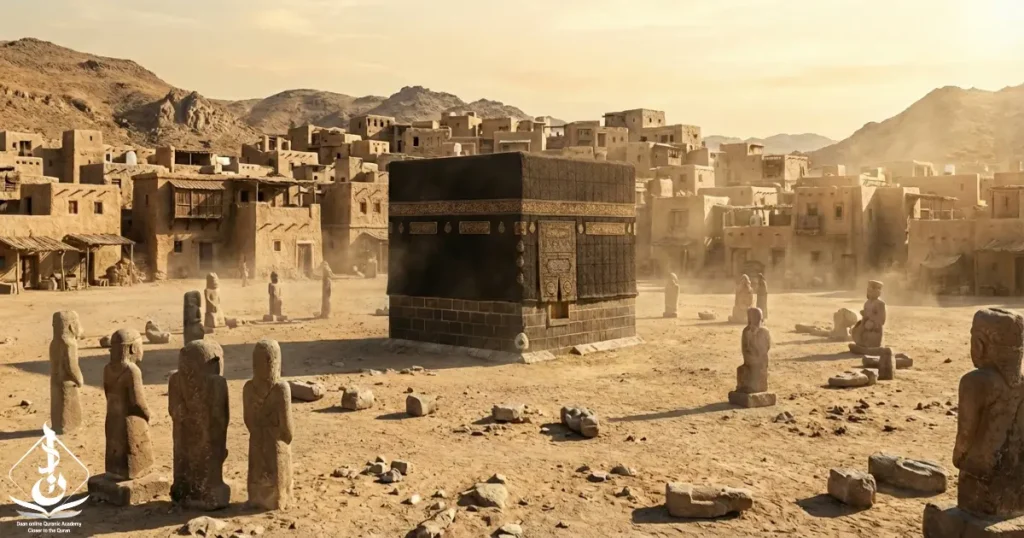
The Prophet headed directly to the Kaaba, which was surrounded by 360 idols. He began striking them with his bow while reciting the verse: {And say, "Truth has come, and falsehood has departed. Indeed is falsehood, [by nature], ever bound to depart."} The idols collapsed under the weight of monotheism, and the House of Allah was purified for the first time in centuries. He then ordered Bilal ibn Rabah—the former slave who had been tortured in Makkah’s heat—to climb the Kaaba and call the Adhan, announcing the dominance of Islam and the voice of truth above all else.
7. General Amnesty: The Greatest Lesson in Tolerance
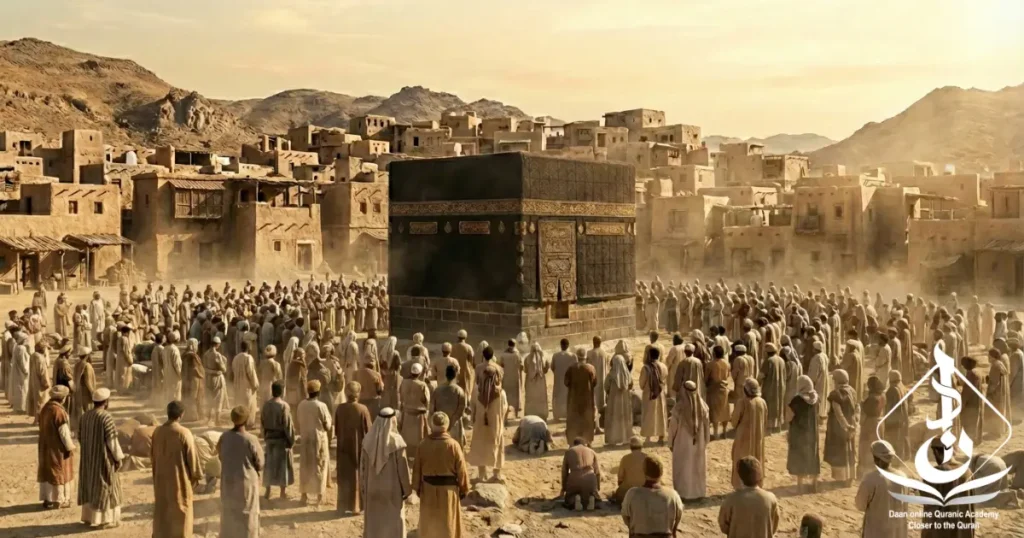
After purifying the House, the people of Makkah gathered at the Kaaba, waiting for the “Victorious Conqueror” to pass judgment on them. The Prophet (PBUH) looked at them—those who had harmed him, besieged him, killed his companions, and plotted against his life—and asked: “O people of Quraysh, what do you think I will do with you?” They replied: “Good. You are a noble brother and the son of a noble brother.” The Prophet then spoke words that continue to echo through history as the greatest charter of forgiveness: “Go, for you are the free ones.” With these words, the Prophet won hearts before he won land, and people entered the religion of Allah in crowds, out of love and conviction rather than force or fear.
8. Historical Impact of the Opening of MakkahThe victory had consequences that shook the foundations of the Arabian Peninsula:
- The End of Paganism: The spiritual prestige of idols was destroyed in the hearts of Arabs.
- Unification of Arabia: Makkah, Madinah, and the surrounding tribes were united under one banner, paving the way for the global spread of Islam.
- Shifting the Political Landscape: Quraysh ceased to be an opposition force and instead channeled its expertise toward serving Islam.
- Consolidating Human Values: The victory proved that true strength lies in forgiveness and that building human character is more important than tearing down walls.
9. Lessons for the Modern World
The Opening of Makkah is not just a memory; it is a blueprint for action:
- Fulfillment of Covenants: Demonstrating how Islam sanctifies contracts and agreements.
- Planning and Mastery: The importance of preparation, secrecy, and strategic intelligence.
- Mercy in Power: Showing how the powerful can be merciful and how tolerance ends the cycle of violence.
- Equality: Bilal standing atop the Kaaba was a message to the world that the only measure of superiority is piety and action.
Conclusion:
The Opening of Makkah remains a testament that Islam did not spread by the sword as an end, but through values supported by strength to repel injustice. It was a day of mercy, a day of loyalty, and a day that proved Ramadan fasting provides a spiritual strength that transcends material limits, creating a victory that remains a beacon for humanity through the ages.
Experience our unique approach first-hand. Book your free free trial sessions now with no strings attached.