The 5 Pillars of Islam: A Complete Guide to the Foundations of Muslim Faith and Life
The 5 pillars of Islam are the five core acts of worship that form the complete foundation of every Muslim’s faith, practice, and daily life — and understanding them is the essential starting point for every Muslim, every revert, and every parent raising children in the faith. They are not merely religious rituals to be performed mechanically. They are a living, interconnected system of worship, character development, social responsibility, and spiritual purification that Allah designed to structure the believer’s entire relationship with their Creator and with humanity. This complete guide explains each of the 5 pillars of Islam — what they are, what they mean spiritually, how they are practised, and why each one is indispensable to the Islamic way of life.
“Islam is built upon five [pillars]: testifying that there is no god worthy of worship except Allah and that Muhammad is the Messenger of Allah, establishing the prayer, paying the Zakat, making the Hajj to the House, and fasting in Ramadan.”
This single hadith — among the most authenticated statements in all of Islamic literature — contains the complete architecture of Muslim practice. The Prophet ﷺ described Islam not as a set of abstract beliefs but as a structure: something built, something with foundations, something that stands or falls based on the integrity of what supports it. When someone asks “what are the 5 pillars of Islam?”, this hadith is the direct, authoritative, and comprehensive answer. Everything that follows in this guide is an exploration of what each of these five foundations actually means, demands, and produces in the life of a believer.
📑 Table of Contents
- What Are the 5 Pillars of Islam? An Overview
- The First Pillar — Shahada: The Declaration of Faith
- The Second Pillar — Salah: The Five Daily Prayers
- The Third Pillar — Zakat: The Purification of Wealth
- The Fourth Pillar — Sawm: Fasting in Ramadan
- The Fifth Pillar — Hajj: The Pilgrimage to Makkah
- How the 5 Pillars of Islam Shape Daily Muslim Life
- Frequently Asked Questions
What Are the 5 Pillars of Islam? An Overview
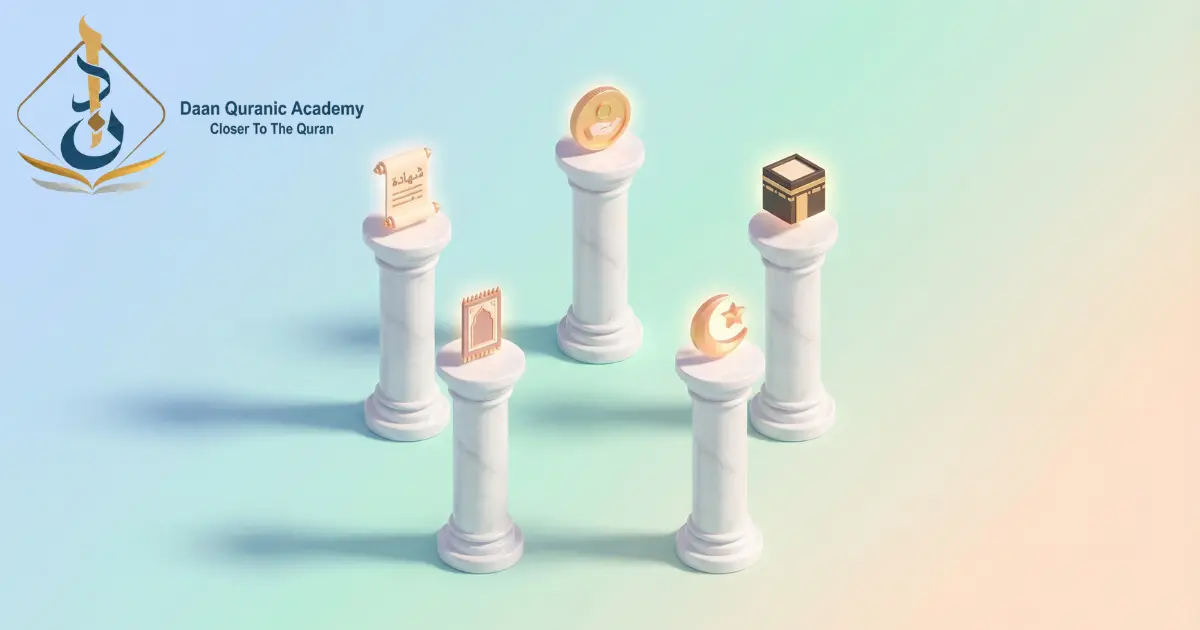
The term أَرْكَانُ الإِسْلَام (Arkan al-Islam — the Pillars of Islam) describes the five obligatory acts of worship that every Muslim who is adult, sane, and physically and financially capable is required to observe. They are called “pillars” because they are the structural supports of the religion — remove any one of them and the building of Islamic practice loses its integrity. Together, they form an interlocking system: the Shahada establishes belief, Salah enacts it five times daily, Zakat expresses it through wealth, Sawm purifies it through self-discipline, and Hajj completes and renews it in the most powerful communal act of worship on earth.
| # | Pillar | Arabic | Meaning | Frequency |
|---|---|---|---|---|
| 1 | Shahada | الشَّهَادَة | Declaration of Faith | Lifelong conviction |
| 2 | Salah | الصَّلَاة | Ritual Prayer | 5 times daily |
| 3 | Zakat | الزَّكَاة | Obligatory Charity | Annually (if eligible) |
| 4 | Sawm | الصَّوْم | Fasting | Month of Ramadan |
| 5 | Hajj | الحَجّ | Pilgrimage | Once in a lifetime |
In Islam, faith (إِيمَان — Iman) and action (عَمَل — ‘Amal) are inseparable. The 5 pillars of Islam are the primary meeting point between the two: they take the inner conviction of the heart and require that it manifest in specific, regular, embodied acts of worship. A Muslim who sincerely believes but never prays is considered to be in a spiritually deficient state. A Muslim who prays but neglects Zakat when obligated has left a right of the poor unfulfilled. The pillars work together, and together they are precisely what the Prophet ﷺ meant when he described Islam as a building: all five are necessary for the structure to stand.
The First Pillar — Shahada: The Declaration of Faith
The Shahada — أَشْهَدُ أَنْ لَا إِلَهَ إِلَّا اللَّهُ وَأَشْهَدُ أَنَّ مُحَمَّداً رَسُولُ اللَّهِ — is simultaneously the simplest and the most profound of the 5 pillars of Islam. Its translation: “I bear witness that there is no god worthy of worship except Allah, and I bear witness that Muhammad is the Messenger of Allah.” Two clauses. Fifteen Arabic words. The complete doctrinal foundation of an entire civilisation.
Shahada — الشَّهَادَة — The Declaration of Faith
The first clause — لَا إِلَهَ إِلَّا اللَّهُ (La ilaha illallah — there is no deity except Allah) — establishes Tawhid: the absolute, uncompromising oneness of Allah. “Ilah” means object of worship or ultimate allegiance; the statement declares that nothing in creation — no person, no power, no pursuit — is worthy of the devotion and submission that belongs exclusively to Allah. The second clause — مُحَمَّدٌ رَسُولُ اللَّهِ (Muhammadun Rasulullah — Muhammad is the Messenger of Allah) — affirms that Allah communicated His guidance to humanity through a specific, historical human messenger whose life and teachings are the living example of how to act on the first clause. Together, the two clauses establish both the source of authority (Allah alone) and the means of guidance (the Prophet ﷺ). Everything else in Islamic belief and practice unfolds from these two affirmations.
What makes the Shahada the first of the 5 pillars of Islam — and the most fundamental — is that it is the only pillar that is not a physical action. All four remaining pillars are practices: you pray, you give, you fast, you journey. The Shahada is a conviction — the inner reality from which all outer practice flows. Every Muslim hears the Shahada in the Adhan five times a day, recites it in every Salah, and hopes to speak it as their last words before death. It is not a single moment of entry into Islam; it is a lifelong witness to the most important truth in existence.
For reverts to Islam, the Shahada is the gateway — spoken sincerely before witnesses, it is the moment of entry into the faith and the beginning of a new relationship with Allah. For born Muslims, it is the foundation returned to every day, reminding them of what they ultimately believe, what they ultimately worship, and to Whom they ultimately answer. Understanding the precise meaning of each Arabic word in the Shahada deepens this relationship profoundly. Our Arabic and Islamic Studies courses are designed to give every Muslim — born or revert — exactly this depth of understanding in the language of the Quran itself.
The Second Pillar — Salah: The Five Daily Prayers
Salah — the five daily obligatory prayers — is the most regular, most visible, and most practically demanding of the 5 pillars of Islam. While the Shahada is a conviction held continuously and the remaining three pillars are seasonal or once-in-a-lifetime obligations, Salah structures every single day of a Muslim’s life — five fixed times from before dawn to after nightfall. It is the daily living of the Shahada: the regular, embodied, repeated act of turning toward Allah and reaffirming in body and speech the declaration made in the first pillar. The five prayers were made obligatory during the Night Journey (Al-Isra wal-Miraj), when Allah spoke directly to the Prophet ﷺ — a distinction no other pillar shares, and a signal of Salah’s unique spiritual weight.
Salah — الصَّلَاة — The Five Daily Prayers
Each of the five prayers consists of a specific number of units (رَكَعَات — Rak’aat), performed facing the Qibla (the direction of the Kaaba in Makkah), in a state of ritual purification (طَهَارَة — Taharah). The prayers include standing, bowing, and prostration — physical expressions of complete submission to Allah — combined with recitations of Quranic verses and supplications that connect the worshipper directly to the words of Allah. The prostration (سُجُود — Sujood) — in which the forehead touches the ground before Allah — is described by the Prophet ﷺ as the position of maximum closeness to Allah available to a human being.
- Fajr — before sunrise (2 rak’aat). The day begins in the remembrance of Allah before the world awakens. The Prophet ﷺ described the two rak’aat of Fajr as “better than this world and everything in it” (Muslim 725). The Quran describes this prayer as “witnessed” — by the angels of the night departing and the angels of the day arriving (17:78).
- Dhuhr — midday (4 rak’aat). The midpoint of the working day pauses for prayer, returning the mind from the affairs of the world to its ultimate purpose. This prayer anchors the second quarter of the day in the same orientation as the morning — a reminder that the believer’s direction does not change regardless of what occupies their time.
- Asr — late afternoon (4 rak’aat). The prayer the Quran (2:238) singles out as one to be “guarded” — perhaps because the late afternoon is when fatigue and distraction are highest and the temptation to defer is strongest. Consistently establishing Asr is one of the most reliable signs of a firmly structured prayer life.
- Maghrib — immediately after sunset (3 rak’aat). The transition from day to night is marked by prayer. Maghrib is one of the most emotionally resonant prayer times — the brief window of the changing sky, the call to break the fast during Ramadan, the gathering of family at the end of the working day.
- Isha — night (4 rak’aat). The day concludes in remembrance. The Prophet ﷺ said that the Isha and Fajr prayers are the heaviest for hypocrites — confirming that a Muslim who consistently establishes these two is establishing their faith at its most demanding times.
The Quran’s statement that Salah “prohibits immorality and wrongdoing” is not metaphorical. A person who stands before Allah five times daily, in full consciousness of being seen and held accountable, develops a habitual awareness of Allah’s presence — مُرَاقَبَة (Muraqabah) — that reshapes their relationship to every other act of their day. Salah is not five interruptions to daily life; it is five anchors from which the rest of daily life is structured.
Many Muslims in the West learn the physical motions of Salah without fully understanding the Arabic they recite. Understanding what Surah Al-Fatiha says word by word, what the phrases of Ruku and Sujood declare, and what the Tashahud affirms transforms prayer from a practised routine into a living conversation with Allah. This understanding — available through proper Arabic and Tajweed study — is one of the single most impactful developments possible in a Muslim’s spiritual life. Our certified native Egyptian tutors specialise in helping students across the UK, USA, Europe, and Australia develop exactly this depth of understanding in their recitation and prayer.
The Third Pillar — Zakat: The Purification of Wealth
The word زَكَاة comes from an Arabic root meaning both “to purify” and “to grow.” This dual meaning describes precisely what Zakat accomplishes: by giving a portion of accumulated wealth to those who need it, the giver purifies the remainder from the spiritual contamination of hoarding, and simultaneously grows their reward with Allah. Zakat appears alongside Salah in over 80 Quranic verses — a pairing that signals their equal theological weight among the 5 pillars of Islam. You cannot fully establish one while neglecting the other.
Zakat — الزَّكَاة — The Purification of Wealth
Zakat is obligatory on any Muslim who has held wealth above the نِصَاب (Nisab — minimum Zakat threshold) for a complete lunar year. The standard rate is 2.5% of total qualifying net savings and assets. The Nisab is equivalent to 87.48 grams of gold or 612.36 grams of silver. The Quran (9:60) specifies eight categories of recipients: the poor (الفُقَرَاء), the destitute (المَسَاكِين), those employed to collect it, those whose hearts are to be reconciled, those in bondage, those in debt, those in the cause of Allah, and the stranded traveller. This comprehensive distribution framework makes Zakat the world’s oldest and most systematically designed poverty-relief mechanism — predating every modern welfare system by over fourteen centuries.
What distinguishes Zakat from ordinary charitable giving is its mandatory nature and its specific rate and recipient categories. Sadaqah (voluntary charity) is unlimited, spontaneous, and open to any worthy purpose. Zakat is an obligation — a right that the poor hold over the wealth of those who have reached the Nisab, not a favour the wealthy choose to bestow. This framing is theologically deliberate: wealth in Islam is a trust from Allah (أَمَانَة), not an absolute personal possession. The 2.5% of qualifying wealth that a Muslim gives in Zakat annually is not “their” money being donated — it is the portion of their trust that was never truly theirs in the first place. Giving it is not generosity; withholding it is theft.
Muslim families in the UK, USA, Europe, and Australia often face practical questions about Zakat calculation — which assets are Zakatable, how to calculate the Nisab in local currency, whether pension contributions count, and how to identify legitimate recipients. Reputable Islamic organisations in most Western countries provide free Zakat calculators and scholarly guidance. The critical starting point is sincerity of intention: take the calculation seriously, consult a reliable source, give the full amount, and trust in the Quranic promise (2:276) that Allah decreases wealth by usury and increases it by genuine charity.
The Fourth Pillar — Sawm: Fasting in Ramadan
Sawm — the obligatory fast observed throughout the month of Ramadan — is the fourth of the 5 pillars of Islam and the one most visibly tied to a specific time. From the first light of Fajr until the sun sets at Maghrib, a fasting Muslim abstains completely from food, drink, and marital relations, as well as from all immoral speech and actions. Ramadan is simultaneously the most demanding and the most beloved month in the Islamic calendar — the month the Quran was revealed, the month of Tarawih prayers, the month of heightened generosity, and the month whose final ten nights contain Laylat al-Qadr, described in the Quran (97:3) as better than a thousand months of worship.
Sawm — الصَّوْم — Fasting in Ramadan
The Quranic verse announcing the obligation of fasting identifies its ultimate purpose with precision: لَعَلَّكُمْ تَتَّقُونَ (la’allakum tattaqoon — that you may develop Taqwa). Taqwa — God-consciousness and the protective awareness of Allah’s presence — is the product of Ramadan fasting, not the hunger itself. The hunger and thirst are the training ground. A month of voluntary physical restraint, when approached with this understanding, systematically strengthens the will’s authority over the body’s impulses — a discipline that extends, when cultivated, far beyond Ramadan into the rest of the year. Sawm is obligatory on every adult Muslim who is physically capable; those who are ill, travelling, pregnant, nursing, or elderly have specific concessions. For a complete guide to every ruling governing the fast, see our complete guide to the Fiqh of Fasting in Islam.
For Muslim families in the West, Ramadan carries a communal dimension beyond the individual spiritual. Iftar gatherings, Tarawih prayers, late-night Suhoor, charity drives, and the collective experience of fasting alongside the entire global Muslim Ummah create a shared identity and belonging that no other month in the Islamic calendar fully replicates. For new Muslims approaching their first Ramadan, our Complete Beginner’s Guide to Ramadan Fiqh covers every essential ruling in accessible detail. And for those wanting to make this Ramadan genuinely transformative rather than merely observed, our guide on Ramadan for Positive Change provides a practical framework for real spiritual growth.
The Fifth Pillar — Hajj: The Pilgrimage to Makkah
Hajj is the fifth and final of the 5 pillars of Islam — obligatory once in a lifetime for every Muslim who is physically and financially capable. It takes place during the first ten days of Dhul Hijjah, the twelfth month of the Islamic lunar calendar, in and around Makkah in Saudi Arabia. Each year, approximately two to three million Muslims from every country, culture, language, and background converge on a single point — the Masjid al-Haram — to perform the same rites of pilgrimage that trace back to Prophet Ibrahim (AS) and were completed and confirmed by the Prophet ﷺ on his Farewell Pilgrimage in the tenth year of the Hijra, the final year of his blessed life.
Hajj — الحَجّ — The Pilgrimage to Makkah
The rites of Hajj include: wearing the simple white إِحْرَام (Ihram — the pilgrim’s garment) that erases all distinctions of wealth, class, and nationality; performing طَوَاف (Tawaf — seven circuits around the Kaaba); walking between the hills of Safa and Marwa in remembrance of Hajar’s search for water; standing at the plain of عَرَفَة (Arafat) — the spiritual centrepiece of Hajj, which the Prophet ﷺ described as “Hajj itself”; spending the night at Muzdalifah; casting pebbles at the Jamarat in commemoration of Ibrahim’s (AS) rejection of Shaytan; the sacrifice of Eid al-Adha and the sharing of its meat; and the final Tawaf of departure. Each rite relives the trials and surrenders of Ibrahim, Hajar, and Ismail (peace be upon them all) — making Hajj not merely a journey to a place but a participation in the defining narrative of monotheism.
The theological significance of Hajj is completion and renewal. When the Prophet ﷺ performed his Farewell Hajj, Allah revealed the ayah: الْيَوْمَ أَكْمَلْتُ لَكُمْ دِينَكُمْ — “This day I have perfected for you your religion” (5:3). The personal completion of Hajj by the individual Muslim carries a parallel meaning: the Prophet ﷺ said that a person who performs Hajj without committing sin returns as they were on the day their mother bore them — completely forgiven, spiritually renewed, returned to the pure state of Fitrah. Of all the 5 pillars of Islam, Hajj is the one that most fully demands the whole person: the body that travels, the wealth that funds it, the time that is given, and the heart that makes the intention solely for Allah.
How the 5 Pillars of Islam Shape Daily Muslim Life
The 5 pillars of Islam are not five separate compartments of religious practice. They are a unified, interconnected system that together structure the temporal, spatial, financial, physical, and communal dimensions of a Muslim’s life into a coherent whole. Understanding how they interact with and reinforce each other reveals why Islam describes itself not merely as a religion but as a complete دِين (Deen — way of life) — not a Sunday-morning practice but a continuous orientation of the entire self toward Allah.
“The head of the matter is Islam, its pillar is prayer, and the highest part of its hump is jihad in the cause of Allah.”
The Shahada orients the Muslim’s entire life toward a single ultimate purpose: worship of Allah alone. Salah then enacts that orientation five times every day — preventing it from remaining a theoretical conviction by forcing it into the practical structure of every waking day. Zakat takes that conviction and expresses it through wealth — demonstrating that the Muslim’s resources, like their time and body in prayer, belong ultimately to Allah and are held in trust. Sawm purifies what the other pillars have built: the annual month of fasting strips away worldly accumulation and rebuilds Taqwa as the primary motivator of action. And Hajj, for those who undertake it, completes the journey: a literal physical journey to the House of Allah, in which the believer stands before the Kaaba and experiences with every sense what it means to belong entirely to the One they have been testifying to, praying toward, giving for, and fasting for across their entire Muslim life.
For Muslim families in the West — navigating careers, school systems, social pressures, and cultural environments that do not accommodate Islamic practice — the 5 pillars of Islam are also the most practical identity anchors available. A Muslim child who prays five daily prayers knows, five times every day, who they are and to Whom they belong. A Muslim professional who pays Zakat annually knows that their wealth is not the ultimate measure of their worth. A Muslim family that fasts Ramadan together builds a shared experience of discipline, community, and spiritual renewal that no secular holiday can replicate. The pillars are not just religious obligations; they are the infrastructure of a meaningful Muslim life in any context. Build this foundation with structured Quranic and Islamic education through our flexible online plans starting from $9/hr.
Frequently Asked Questions About the 5 Pillars of Islam
What are the 5 pillars of Islam in order?
The 5 pillars of Islam in the order established by the Prophet ﷺ (Sahih Bukhari 8) are: (1) Shahada — the declaration that there is no god except Allah and that Muhammad ﷺ is His messenger; (2) Salah — the five daily obligatory prayers; (3) Zakat — the annual obligatory giving of 2.5% of qualifying savings to those entitled to receive it; (4) Sawm — the fast of the month of Ramadan; and (5) Hajj — the pilgrimage to Makkah, obligatory once in a lifetime for those who are able. This order reflects a natural progression: from inner conviction (Shahada), to daily embodied practice (Salah), to financial worship (Zakat), to annual purification (Sawm), to the ultimate lifetime completion (Hajj).
Why are they called “pillars” and not “rules” or “commandments”?
The Prophet ﷺ himself used the metaphor of a building — saying directly that “Islam is built upon five” (Sahih Bukhari 8). The Arabic word أَرْكَان (Arkan) means structural pillars or load-bearing columns — the supports without which a building cannot stand. The metaphor communicates that these five practices are not optional devotions or recommended extras; they are the structural supports without which Islamic practice has no integrity. Rules and commandments can be broken individually without immediate structural collapse; pillars cannot be removed without threatening the whole. This is why Islamic scholars consistently treat neglect of any pillar — particularly Salah and Zakat — as serious spiritual deficiencies requiring urgent correction, not minor sins to be deferred.
Are the 5 pillars of Islam the same for Sunni and Shia Muslims?
The five acts of worship — Shahada, Salah, Zakat, Sawm, and Hajj — are acknowledged as obligatory by both Sunni and Shia traditions, with the distinction that in Shia Islam the foundational principles are sometimes structured differently (the Usul al-Din and Furu al-Din frameworks), and some scholars add additional pillars such as Khums (a different form of religious taxation) or Jihad. For the Sunni majority (approximately 85-90% of the world’s 1.8 billion Muslims), the five as described in the Bukhari and Muslim hadith of Ibn Umar are the definitively established pillars of the religion, and this is the understanding reflected in this guide and in mainstream Islamic education worldwide.
What happens if a Muslim cannot perform one of the 5 pillars?
Islamic law provides specific accommodations for each pillar based on the Quranic principle: “Allah does not burden a soul beyond what it can bear” (2:286). For Salah: a person who cannot stand may pray sitting; one who cannot sit may pray lying down; one who cannot perform physical wudu may use dry purification (Tayammum). For Zakat: one who does not meet the Nisab threshold has no obligation. For Sawm: the sick, elderly, pregnant, nursing, and travelling have specific concessions — either making up missed days later or paying a daily expiation (Fidya). For Hajj: the obligation only applies to those who are physically and financially capable. The Shahada has no exceptions — it is a declaration of the heart and tongue accessible to all human beings in any condition.
How do the 5 pillars of Islam apply to children?
The formal legal obligation applies at puberty (البُلُوغ — Bulugh). However, Islamic scholars unanimously emphasise introducing children to the pillars before puberty as essential preparation. The Prophet ﷺ said: “Order your children to pray when they are seven years old, and discipline them for it when they are ten” (Sunan Abu Dawud 495). Parents should teach the Shahada’s meaning from the earliest years, involve children in Salah as observers before they are obligated, let them experience Ramadan in age-appropriate ways, and build generosity through Sadaqah as a precursor to Zakat. Building this foundation early is one of the most powerful investments in a child’s Islamic identity and lifelong practice — transforming the pillars from obligations they encounter at puberty into beloved practices they have grown up with.
What is the difference between Zakat and Sadaqah?
Zakat is the obligatory annual payment of 2.5% of qualifying savings above the Nisab — a duty, not a choice, with specific rates, thresholds, and categories of recipients defined in the Quran. Failing to pay Zakat when obligated is a serious sin. Sadaqah is voluntary charity — it can be given at any time, in any amount, to almost any worthy cause. The Prophet ﷺ described even a smile as Sadaqah. The two are complementary, not competing: Zakat fulfils the mandatory minimum of financial worship; Sadaqah extends generosity beyond obligation into the continuous daily practice of giving. Both purify the giver’s relationship with wealth, but Zakat carries specific legal parameters that Sadaqah does not. A Muslim who gives generously in Sadaqah but neglects Zakat has not fulfilled their obligation; the two are not interchangeable.
How can I learn to perform the 5 pillars of Islam correctly?
The most effective path to correctly and meaningfully performing the 5 pillars of Islam is structured Islamic education — learning the Quran with proper Tajweed so your recitation in Salah is accurate, understanding the Arabic of the prayers you recite, and studying the authentic Sunnah of the Prophet ﷺ as the practical model for every pillar. At Daan Quranic Academy, our certified native Egyptian tutors provide private 1-on-1 online sessions for children and adults across the UK, USA, Europe, and Australia — covering Quran recitation, Tajweed, and Islamic studies in a structured, progressive curriculum designed for English-speaking Muslims. Book a free trial class with no commitment to experience the difference that expert, personalised teaching makes.
Learn to Practise the 5 Pillars of Islam With Knowledge, Understanding, and Confidence
Understanding the 5 pillars of Islam is where it begins — but the real depth comes from the Quran and the Arabic language that carry them. At Daan Quranic Academy, our certified native Egyptian tutors help Muslims across the UK, USA, Europe, and Australia build the Quranic and Arabic foundation that transforms the pillars from obligations into acts of genuine, conscious, joyful worship.
No commitment required. One free session to experience the Daan Academy difference.
Final Thoughts: Five Pillars, One Direction
The 5 pillars of Islam are, at their deepest level, one single act expressed five ways: the act of turning toward Allah. The Shahada turns the tongue and the heart. Salah turns the body — five times a day — toward the Qibla. Zakat turns the hand, releasing what was never truly ours to hold. Sawm turns the will inward, freeing it from the body’s constant demands. And Hajj turns the feet — literally, physically — toward the House of Allah, completing the journey that the Shahada began. Each pillar is a different dimension of the same submission, and together they form the complete shape of a Muslim life: oriented, disciplined, generous, purified, and ultimately destined to return to its Creator. Explore more Islamic guides and educational resources on our Islamic education blog.
May Allah grant us and our families the sincerity to fulfil each of the five pillars with full knowledge, complete conviction, and the love that makes every act of worship a joy rather than a burden. Ameen.