5 Pillars of Islam vs Pillars of Faith: The Complete Guide to the Difference
The 5 Pillars of Islam and the 6 Pillars of Faith (Iman) are two of the most fundamental concepts in Islamic theology — yet many Muslims, reverts, and students of the deen struggle to articulate the precise difference between the 5 Pillars of Islam vs Pillars of Faith. Understanding this distinction is not merely an academic exercise; it is the foundation upon which a meaningful, conscious Muslim life is built. In this guide, we explore both sets of pillars in depth, drawing exclusively from the Quran and authentic Sunnah, so that your knowledge of the 5 Pillars of Islam vs Pillars of Faith is grounded in revelation — not assumption.
This ayah captures the essence of Iman — inward faith held deep in the heart, directed at the unseen realities Allah has disclosed through revelation. Yet this Iman does not exist in isolation. It must find expression in action: the outward, observable practices that form the 5 Pillars of Islam. Together, these two frameworks constitute a complete and balanced religious life — one simultaneously rooted in sincere conviction and expressed through disciplined worship. Understanding the 5 Pillars of Islam vs Pillars of Faith gives every Muslim a clearer, more grounded picture of their entire deen.
📑 Table of Contents
What Are the 5 Pillars of Islam?
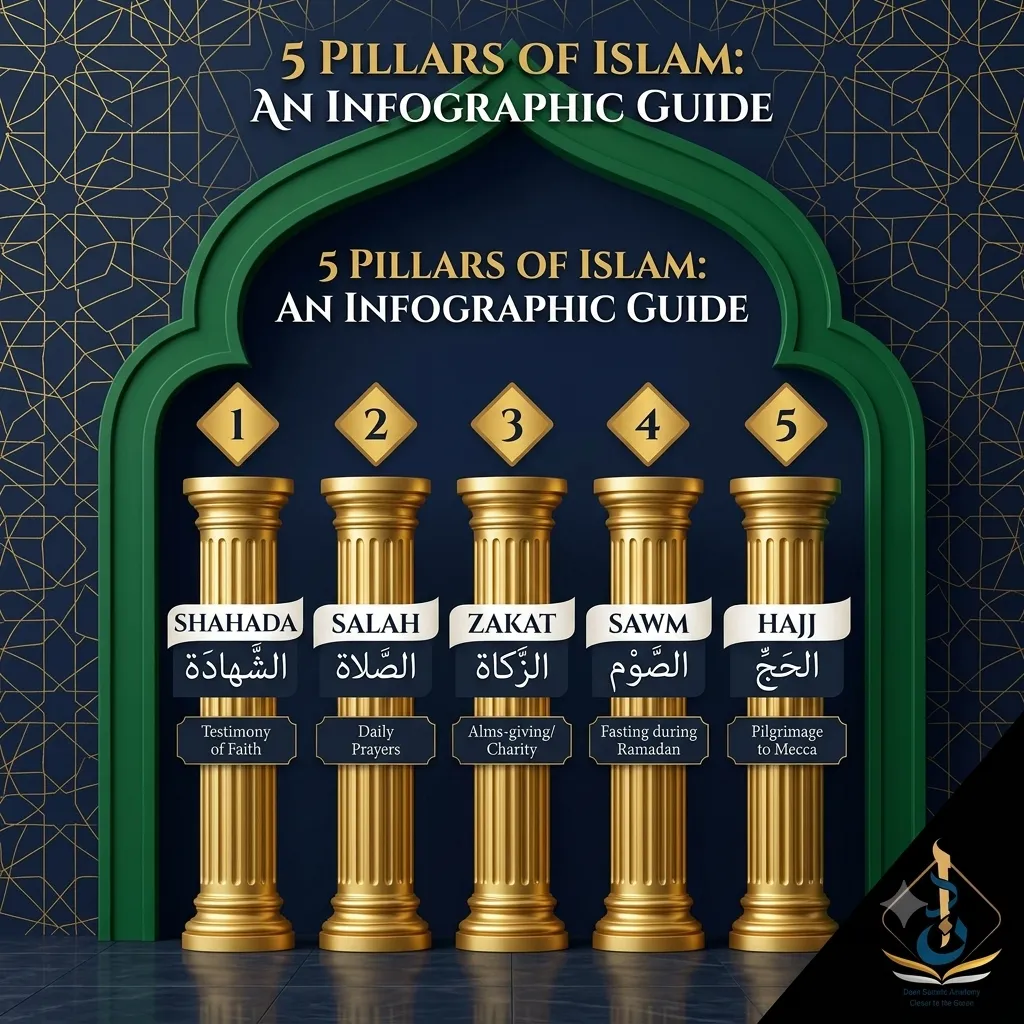
The 5 Pillars of Islam — known in Arabic as أَرْكَانُ الْإِسْلَامِ (Arkān al-Islām) — are the five core acts of worship and practice that every adult Muslim is obligated to fulfil. They are the practical, observable framework of Muslim life: the answer to the question, what does a Muslim do?
Their definitive scriptural basis comes from an iconic hadith narrated by Abdullah ibn Umar (RA):
“Islam is built upon five [pillars]: the testimony that there is no deity worthy of worship except Allah and that Muhammad is the Messenger of Allah, establishing the prayer, giving zakat, making the pilgrimage to the House, and fasting in Ramadan.”
The metaphor of pillars is deliberate and profound. Just as structural pillars hold up a building, these five practices uphold the entire structure of a Muslim’s religious life. This is why scholars across the centuries have unanimously taught that knowing and performing the 5 Pillars of Islam is obligatory individual knowledge — فَرْضُ عَيْن (farḍ ʿayn) — upon every Muslim who has reached maturity. Our detailed article on The 5 Pillars of Islam covers each in full — this guide focuses specifically on the 5 Pillars of Islam vs Pillars of Faith distinction.
The Arabic word إِسْلَام (Islām) derives from the root س-ل-م (s-l-m), which carries the meanings of peace, safety, and wholeness through surrender. The 5 Pillars of Islam are therefore the practices through which a Muslim actively and tangibly submits to Allah — with body, wealth, time, and tongue. They are Islam made visible.
A Closer Look at Each of the 5 Pillars of Islam
Each of the 5 Pillars of Islam carries its own theological depth, spiritual purpose, and practical requirements. Here is a focused overview of all five, arranged as the Prophet Muhammad ﷺ himself presented them:
Shahada — The Declaration of Faith
The الشَّهَادَة (Shahādah — testimony, bearing witness) is the verbal declaration: لَا إِلَٰهَ إِلَّا اللَّهُ مُحَمَّدٌ رَسُولُ اللَّهِ (Lā ilāha illallāh, Muḥammadun rasūlullāh). It is simultaneously the entry point into Islam and its permanent centre of gravity. Far from being a one-time recitation, the Shahada is the lens through which every subsequent act of worship acquires its meaning and legitimacy — the first of the 5 Pillars of Islam and the most foundational.
Salah — The Ritual Prayer
الصَّلَاة (Ṣalāh — prayer, connection) is performed five times daily: Fajr (dawn), Dhuhr (midday), Asr (afternoon), Maghrib (sunset), and Isha (night). The Quran commands the establishment of prayer in more than ninety places. Salah requires ritual purification (wudu), facing the Qiblah, and the recitation of Quranic verses within every unit of prayer — making proper Quran recitation and Tajweed a prerequisite for the validity of this central pillar of the 5 Pillars of Islam.
Zakat — Obligatory Charity
الزَّكَاة (Zakāh — purification, growth) is the annual obligation to give 2.5% of qualifying savings to the eight categories of recipients defined in Surah At-Tawbah (9:60). In the Quran, Zakat is paired with Salah in over twenty verses — a deliberate coupling that insists upon the unity of private worship and public social responsibility across the 5 Pillars of Islam.
Sawm — Fasting in Ramadan
الصِّيَام (Ṣiyām — fasting, abstention) during the holy month of Ramadan requires abstaining from food, drink, smoking, and marital relations from Fajr until Maghrib. Allah addresses the believers about this fourth of the 5 Pillars of Islam directly:
Hajj — The Pilgrimage to Makkah
الحَجّ (Ḥajj — pilgrimage, setting out with intention) is the annual pilgrimage to Makkah in Dhul Hijjah, obligatory once in a lifetime for every Muslim who is physically and financially able: وَلِلَّهِ عَلَى النَّاسِ حِجُّ الْبَيْتِ مَنِ اسْتَطَاعَ إِلَيْهِ سَبِيلًا (“And [due] to Allah from the people is a pilgrimage to the House — for whoever is able.” — Surah Al-Imran 3:97). Hajj is submission made collective and universal — the fifth and final of the 5 Pillars of Islam.
What Are the 6 Pillars of Iman (Faith)?
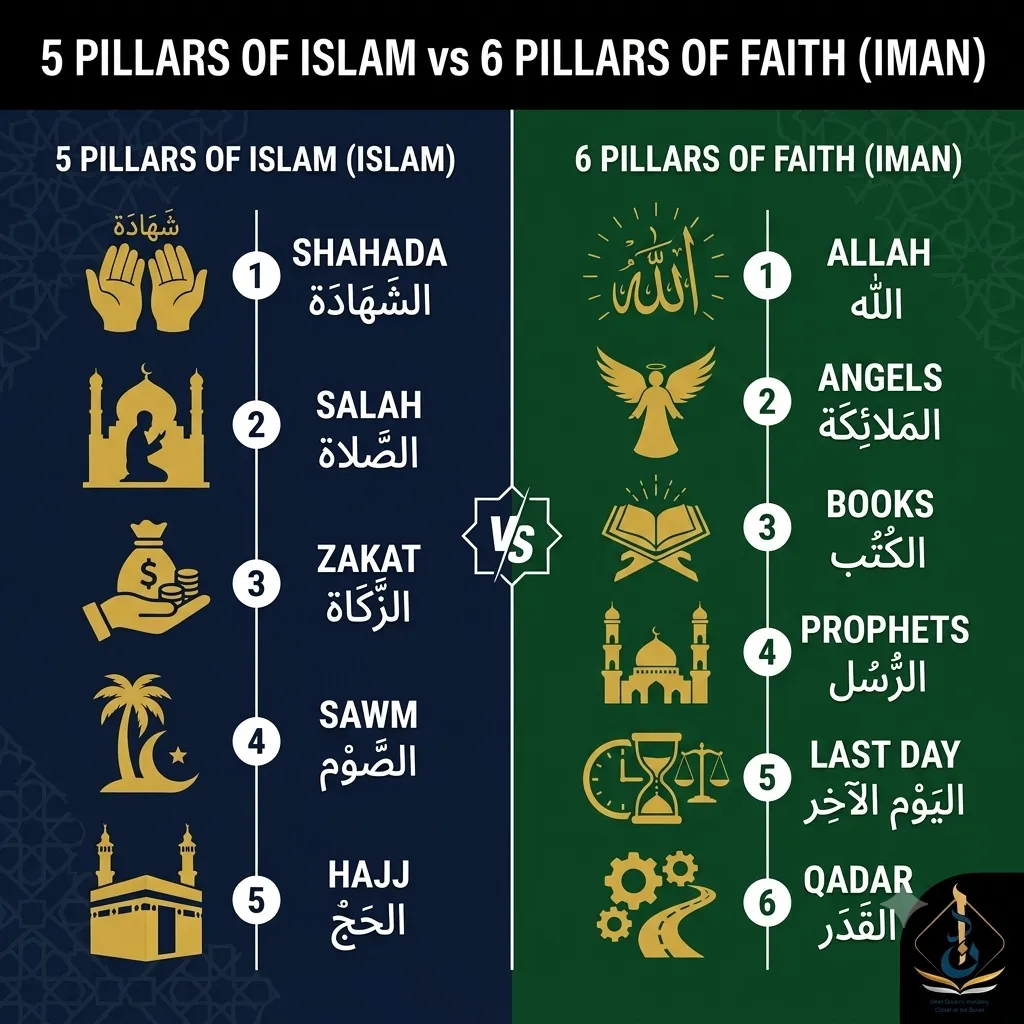
If the 5 Pillars of Islam describe what a Muslim does, the 6 Pillars of Iman — أَرْكَانُ الْإِيمَان (Arkān al-Īmān) — describe what a Muslim believes. These six articles of belief are the theological convictions held in the heart that animate and give eternal meaning to every outward act of worship. This is the essential distinction when understanding the 5 Pillars of Islam vs Pillars of Faith: one governs action, the other governs conviction.
Their source is the celebrated Hadith of Jibreel, in which the Angel Jibreel (AS) came to the Prophet Muhammad ﷺ in human form and asked him to define Islam, Iman, and Ihsan. When he asked about Iman, the Prophet ﷺ responded:
“[Iman] is to believe in Allah, His angels, His books, His messengers, the Last Day, and to believe in divine decree (al-qadar) — both its good and its evil.”
Notice that the Prophet ﷺ described Iman as pointing to an inward orientation of the heart toward Allah and the realities He has made known — not a checklist of ritual actions, but a set of deep, life-shaping convictions. Iman is the rootedness from which all Islamic practice springs. Without it, the 5 Pillars of Islam risk becoming empty form. This is the heart of the 5 Pillars of Islam vs Pillars of Faith discussion.
Classical scholars of Ahl al-Sunnah, including Imam al-Bukhari and Imam Ahmad ibn Hanbal, defined Iman as that which يَزِيدُ بِالطَّاعَةِ وَيَنْقُصُ بِالْمَعْصِيَة (increases with obedience and diminishes with sin). This is why deepening knowledge of the 6 Pillars of Faith is itself an act of worship — it actively strengthens the very faith that motivates all outward practice.
A Closer Look at Each of the 6 Pillars of Iman
Each of the six pillars of Iman addresses a fundamental dimension of reality that the believer affirms, internalises, and is transformed by. Together, they form a comprehensive Islamic worldview rooted entirely in divine revelation — the inward counterpart to the outward 5 Pillars of Islam.
Belief in Allah
The first and most foundational pillar of Iman is belief in Allah — not merely His existence, but in His absolute Oneness (التَّوْحِيد (Tawḥīd)), His perfect attributes, and His exclusive right to be worshipped. Scholars structure Tawhid into three interconnected dimensions: the Oneness of His Lordship (رُبُوبِيَّة), the Oneness of His Divinity (أُلُوهِيَّة), and the Oneness of His Names and Attributes (أَسْمَاءٌ وَصِفَات). Every other pillar of belief, and every outward pillar of practice, flows from this foundational conviction.
Belief in the Angels
Muslims affirm the real existence of the angels — الْمَلَائِكَة (al-Malā’ikah) — noble beings created by Allah from light, who never disobey Him. Among the most significant are Jibreel (the Angel of Revelation, who transmitted the Quran to the Prophet ﷺ), Mikail, Israfil, and the angels of death, recording, and protection. Belief in the angels is a firm conviction that alongside the visible world exists an invisible realm whose work intersects with human life at every moment, from birth to death.
Belief in the Revealed Books
Allah sent Books of divine guidance to humanity through His chosen Prophets — the Tawrah (Torah), the Zabur (Psalms), and the Injeel (Gospel). The final and most comprehensive revelation is the Quran, sent to Muhammad ﷺ. The Quran alone has been preserved — letter for letter, vowel mark for vowel mark — through an unbroken chain of memorisation and written transmission across fourteen centuries. This miraculous preservation is precisely why learning Quran with correct Tajweed is a sacred act of honouring the only perfectly intact revelation from Allah. Explore our Quran, Tajweed, and Arabic courses taught by native Egyptian tutors certified in Quranic sciences.
Belief in the Prophets and Messengers
Muslims believe in all the Prophets and Messengers Allah sent throughout history — from Adam (AS), through Ibrahim, Musa, Dawud, Sulayman, and Isa (Jesus AS), culminating in Muhammad ﷺ, the خَاتَمُ النَّبِيِّين (Seal of the Prophets). The Quran mentions twenty-five Prophets by name. A defining feature of Islamic belief is that Muslims love and honour all Prophets — including Isa (AS) and Musa (AS). To show disrespect to any of them is fundamentally contrary to Islamic doctrine.
Belief in the Day of Judgment
The يَوْمُ الْقِيَامَة (Yawm al-Qiyāmah — Day of Rising) is the day on which all creation will be resurrected and every soul held accountable. This pillar encompasses the resurrection of bodies, the gathering, the individual Reckoning, the weighing of deeds on the Scale (الْمِيزَان), the crossing of the Bridge (الصِّرَاط), and the ultimate destination in either Paradise (الجَنَّة) or Hellfire (النَّار). Belief in the Day of Judgment is perhaps the greatest motivator for righteous action — and is what gives the 5 Pillars of Islam their eternal weight.
Belief in Divine Decree
الْقَدَر (al-Qadar — divine decree, measure) is the belief that Allah has complete and prior knowledge of all things; that He has written and decreed all that will come to pass; and that human beings simultaneously possess genuine free will and carry full moral responsibility for their choices. The Quran affirms: إِنَّا كُلَّ شَيْءٍ خَلَقْنَاهُ بِقَدَرٍ (“Indeed, We created all things according to a measure.” — Surah Al-Qamar, 54:49). Belief in Qadar produces unshakeable inner peace — knowing that what has been decreed for you will never miss you.
5 Pillars of Islam vs Pillars of Faith: Key Differences at a Glance
When comparing the 5 Pillars of Islam vs Pillars of Faith, the essential distinction is this: the pillars of Islam are outward actions; the pillars of Faith are inward convictions. Though deeply intertwined and mutually reinforcing, their nature, source, and function are distinct. The comparison below clarifies the 5 Pillars of Islam vs Pillars of Faith — not to separate them, but to show how they work together:
| Aspect | 5 Pillars of Islam | 6 Pillars of Iman (Faith) |
|---|---|---|
| Nature | Outward actions and practices | Inward beliefs and convictions |
| Arabic Term | أَرْكَانُ الْإِسْلَامِ | أَرْكَانُ الْإِيمَان |
| Primary Source | Hadith of Ibn Umar (Bukhari & Muslim) | Hadith of Jibreel (Sahih Muslim) |
| Observable By | Others (outwardly visible deeds) | Allah alone (held in the heart) |
| Number | Five | Six |
| Core Question | What does a Muslim do? | What does a Muslim believe? |
| Core Purpose | Structure and discipline of worship | Conviction and meaning behind worship |
| Without the Other | Action without belief becomes empty ritual | Belief without action is incomplete faith |
The relationship between the 5 Pillars of Islam vs Pillars of Faith is symbiotic — neither is complete without the other. The Hadith of Jibreel presents them as two sides of the same coin, both required for the complete state of إِحْسَان (Iḥsān — excellence in worship): “to worship Allah as though you see Him; for even if you do not see Him, He assuredly sees you.” This triad of Islam (action), Iman (belief), and Ihsan (excellence) represents the full and integrated spectrum of the Muslim’s relationship with Allah.
Why the 5 Pillars of Islam vs Pillars of Faith Distinction Matters in Daily Life
Understanding the difference between the 5 Pillars of Islam vs Pillars of Faith has direct, practical implications for every Muslim — regardless of age, background, or level of practice.
For New Muslims and Reverts
When someone takes their Shahada, they typically begin learning the 5 Pillars of Islam first — and rightly so, as these provide the immediate practical framework for worship. However, building knowledge of the 6 Pillars of Iman alongside them transforms routine religious acts into deeply meaningful experiences. Knowing why you pray — because you believe in Allah, in His Messenger, and in the accountability of the Last Day — elevates Salah from physical posture to intimate conversation with the Creator. For reverts building this foundation, our article on Preserving Islamic Identity in the West offers complementary guidance.
For Parents Teaching Children
Children can be taught the mechanics of Salah from the age of seven, as the Prophet ﷺ advised. But alongside the how of worship, planting the seeds of Iman builds a faith that is genuinely resilient, not merely habitual. A child who understands both the 5 Pillars of Islam and the Pillars of Faith will carry Islam into adulthood with conviction and ownership. For practical guidance, read our guide on A Plan for Teaching Salah to Non-Arabic Speaking Children.
For Every Practising Muslim
There are moments in every Muslim’s life when the outward pillars feel heavy — when rising for Fajr is a battle, when Ramadan tests the limits of endurance, when giving Zakat requires a genuine struggle against the nafs. In those moments, it is the inward pillars of Iman that sustain the outward practice. Belief in Qadar brings patience in hardship. Belief in the Day of Judgment rekindles motivation. The 6 Pillars of Iman are the spiritual fuel for the 5 Pillars of Islam — without them, the engine eventually runs dry. This is why understanding the 5 Pillars of Islam vs Pillars of Faith together is essential for every Muslim, at every stage.
One of the most effective approaches to Islamic education — for yourself or your children — is to study the 5 Pillars of Islam and the 6 Pillars of Iman not as two separate topics but as an integrated whole. A qualified teacher who makes these connections explicit is invaluable. Daan Academy’s Islamic Studies course covers both, alongside Quran and Arabic, with certified native Egyptian tutors in private 1-on-1 sessions.
Many of the foundational texts for both the 5 Pillars of Islam vs Pillars of Faith are found directly in the Quran. Learning to recite the Quran correctly through Tajweed is the essential first step. Compare our flexible pricing plans starting from $9/hr — structured Quran, Tajweed, and Arabic education led by qualified, certified teachers is one of the most significant investments a Muslim can make for the next generation.
Frequently Asked Questions
What is the difference between the 5 Pillars of Islam and the Pillars of Faith?
The 5 Pillars of Islam are the five outward acts of worship every Muslim must perform: Shahada, Salah, Zakat, Sawm, and Hajj. The 6 Pillars of Faith (Iman) are the six inward beliefs every Muslim must hold: belief in Allah, angels, books, prophets, the Last Day, and divine decree. In the 5 Pillars of Islam vs Pillars of Faith comparison — Islam governs what you do; Iman governs what you believe.
What are the 5 Pillars of Islam in order?
The 5 Pillars of Islam in the order the Prophet ﷺ presented them (Sahih al-Bukhari, Hadith 8) are: 1. Shahada (Declaration of Faith), 2. Salah (Prayer — five times daily), 3. Zakat (Obligatory Charity — 2.5% of qualifying savings), 4. Sawm (Fasting in Ramadan), 5. Hajj (Pilgrimage to Makkah — once in a lifetime for those able).
What are the 6 Pillars of Iman (Faith) in Islam?
The 6 Pillars of Iman, established by the Prophet ﷺ in the Hadith of Jibreel (Sahih Muslim, Hadith 8), are: 1. Belief in Allah, 2. Belief in the Angels, 3. Belief in the Revealed Books, 4. Belief in the Prophets and Messengers, 5. Belief in the Day of Judgment, 6. Belief in Divine Decree (al-Qadar) — both its good and its evil.
Can a person have Iman without performing the 5 Pillars of Islam?
According to the mainstream Sunni position (Ahl al-Sunnah wal Jama’ah), Iman and Islam are inseparable in a complete sense. A person who sincerely holds the 6 Pillars of Faith but deliberately and permanently abandons the 5 Pillars of Islam has a deficiency that weakens their faith severely. The two frameworks are designed to work together — belief without practice is spiritually incomplete, and practice without belief risks becoming empty ritual.
Is Salah part of the Pillars of Islam or the Pillars of Faith?
Salah (prayer) is the second of the 5 Pillars of Islam — it is an outward act of worship. However, the motivation to pray flows from the Pillars of Faith: specifically from belief in Allah, belief in the Prophets (who demonstrated how to pray), and belief in the Day of Judgment (the accountability before which every Salah is a preparation). This is exactly how the 5 Pillars of Islam vs Pillars of Faith connect in practice — belief drives action.
How should I teach my children the 5 Pillars of Islam and Pillars of Faith?
Teach the 5 Pillars of Islam practically alongside the Pillars of Faith conceptually — connect each practice to the belief that motivates it. For example, when teaching Salah, explain that we pray because we believe in Allah (Pillar of Faith 1) and will be accountable on the Last Day (Pillar 5). For structured Islamic studies alongside Quran and Arabic, Daan Academy offers a free trial session with certified native Egyptian tutors for children of all ages.
Where can I learn more about the 5 Pillars of Islam and Islamic studies online?
At Daan Quranic Academy, our Islamic Studies course covers the pillars of Islam and Faith as part of a comprehensive curriculum that includes Quran recitation, Tajweed, and Arabic — all in private 1-on-1 sessions with certified native Egyptian tutors. Visit our Why Choose Us page to see tutor credentials and methodology, or explore all programs on our courses page.
Deepen Your Understanding of Islam with Expert Guidance
The Quran and authentic Sunnah are the living sources of everything you have read here about the 5 Pillars of Islam vs Pillars of Faith. If you want to connect this knowledge to authentic Quranic recitation, Tajweed, and Arabic — our certified native Egyptian tutors are ready to guide you, your family, or your children through a personalised, structured learning journey from wherever you are in the world.
No commitment required. One free session to experience the Daan Academy difference.
Final Thoughts
The 5 Pillars of Islam vs Pillars of Faith is not a comparison between two competing frameworks — it is a study of two complementary dimensions of a single, complete, divinely designed way of life. The 5 Pillars of Islam give the believer a structured, disciplined, and observable practice that shapes daily existence from before sunrise to after nightfall. The Pillars of Faith give that practice its soul, its direction, and its eternal weight.
A Muslim who prays, fasts, pays Zakat, and aspires to Hajj while understanding why — grounded in firm belief in Allah, His angels, His books, His messengers, the Last Day, and divine decree — stands on a foundation that no trial, doubt, or passing difficulty can ultimately shake. This integrated vision is what the Prophet ﷺ conveyed through the Hadith of Jibreel: a complete human being who acts with the body, believes with the heart, and worships with excellence. Explore more Islamic guides on our blog.
May Allah make us among those who understand His deen with clarity, act upon it with sincerity, and transmit it to those who come after us with both knowledge and love.
اللَّهُمَّ أَرِنَا الْحَقَّ حَقًّا وَارْزُقْنَا اتِّبَاعَهُ، وَأَرِنَا الْبَاطِلَ بَاطِلًا وَارْزُقْنَا اجْتِنَابَهُ
“O Allah, show us the truth as truth and bless us with the ability to follow it; and show us falsehood as falsehood and bless us with the ability to avoid it.”